Amos Meaning: What This Hebrew Name Really Stands For
Amos meaning, in short, is “carried” or “burden,” from the Hebrew verb amas, “to carry a load.” Most sources soften that into “borne by God,” which is why the name has such a steady, dependable feel. If you’ve ever wondered why this short, old-fashioned name keeps showing up in nurseries and family Bibles alike, you’re in the right place, and you’ll have a clear, sourced answer by the end. For more insights, read here:- alchemist meaning and accolades meaning
- Amos Meaning: What This Hebrew Name Really Stands For
- Quick Answer: Amos at a Glance
- Where the Name Amos Comes From
- Amos Meaning: The Short Version
- The Biblical Amos: A Farmer Turned Prophet
- How to Pronounce Amos
- Amos as a Boy's Name Today
- Amos Meaning Compared to Similar Prophet Names
- Formal vs. Informal Use
- Common Mistakes to Avoid
- Related Words and Names
- Amos in Everyday Sentences
- Quick Cheat-Sheet
- Frequently Asked Questions
- What is the literal meaning of Amos?
- Is Amos a name from the Bible?
- How do you pronounce Amos correctly?
- Is Amos a popular name right now?
- Can Amos be used as a girl's name?
- Does Amos have a nickname?
- What does the name Amos mean in Hebrew specifically?
- Is there a difference between Amos the name and Amos the place?
- Wrapping Up
Quick Answer: Amos at a Glance
| Detail | Info |
|---|---|
| Meaning | “Carried,” “burden,” or “borne by God” |
| Origin | Hebrew (עָמוֹס, transliterated Amos) |
| Gender | Traditionally male, occasionally unisex |
| Pronunciation | US: AY-muhs · UK: AY-moss |
| Bible connection | One of the twelve minor prophets, author of the Book of Amos |
| Popularity | Rising steadily in the US and UK since the 2010s |
Where the Name Amos Comes From
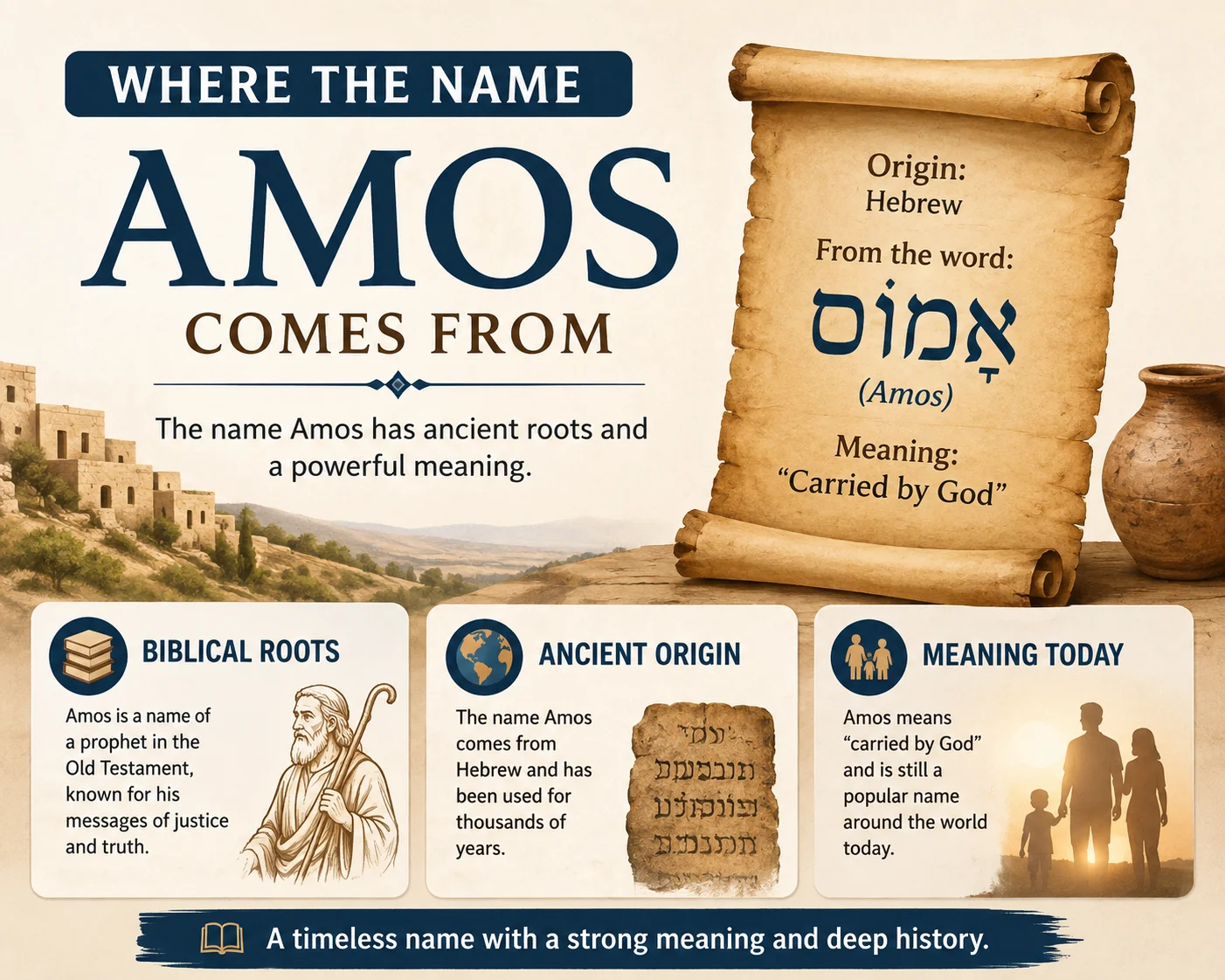
The story behind Amos meaning starts in ancient Hebrew. It traces back to the root amas (עמס), which simply means “to load” or “to carry a heavy weight.” Lexicographers who study Old Testament proper names, including entries built on Strong’s Concordance, list “burden” as the most literal reading.
Over time, translators softened that literal sense into something warmer: “borne by God” or “carried by the Lord.” That shift makes sense once you consider the man who first carried this name, and it’s the softened version most people picture when they think of Amos meaning.
Amos Meaning: The Short Version
If you only remember one line, remember this: Amos meaning boils down to “one who carries” or “one carried by God.” It’s not flashy, but it’s honest, and it lines up across Hebrew dictionaries, Bible commentaries, and baby-name references alike. Everything else here fills in the context.
The Biblical Amos: A Farmer Turned Prophet
Amos wasn’t born into a priestly family. According to the Old Testament, he was a shepherd and a grower of sycamore figs in the town of Tekoa, working the land long before he ever preached a word. He lived and worked around the 8th century BC, an older contemporary of Hosea and Isaiah, during the reigns of Jeroboam II of Israel and Uzziah of Judah. That timeframe matters for Amos meaning too.
His book, the Book of Amos, is short but sharp. It speaks against greed, corruption, and the mistreatment of the poor, using plain, farmer’s language rather than polished courtly speech. Scholars consider it one of the oldest prophetic books preserved in the Hebrew Bible. That background is essential for grasping Amos meaning in full, since the name still carries an air of moral seriousness rather than royal grandeur.
How to Pronounce Amos
Getting the sound right matters a lot, especially if you’re naming a child or reading a passage aloud. In American English, this name is pronounced AY-muhs (rhymes loosely with “famous” minus the F). In British English, you’ll more often hear AY-moss, with a slightly firmer ending vowel. Both are correct; the difference is regional, not a mistake. Either way, Amos meaning stays identical.
A simple memory trick: think of “A” like the letter, then “moss” like the plant, and you’ll land close enough to either accepted pronunciation.
Amos as a Boy’s Name Today
Modern parents rarely reach for Amos meaning as their main reason for choosing it, but the backstory does add weight to the decision. The name sits comfortably alongside other short biblical picks like Silas, Asa, and Judah. It has climbed steadily in US birth records since 2010, moving into the top few hundred boy names.
Famous bearers help too. Tori Amos, the singer-songwriter, carries it as a surname, while Amos Diggory from the Harry Potter series introduced this name to a whole new generation of readers. Even the old radio and TV show Amos ‘n’ Andy left a small cultural fingerprint, though that legacy is now viewed through a more critical historical lens.
Amos Meaning Compared to Similar Prophet Names
Understanding Amos meaning is easier once you set it beside its neighbors in the Hebrew Bible. Hosea’s name means “salvation,” Isaiah’s means “the Lord is salvation,” and Joel’s means “the Lord is God.” Against that backdrop, Amos meaning stands out as unusually humble and physical: it’s about carrying weight, not about salvation or divine titles. That grounded, working-class feel is part of what makes the name feel approachable rather than lofty.
Formal vs. Informal Use
- Formal contexts: Amos stands well on its own in official documents, professional bios, and religious settings. It doesn’t need a nickname to feel complete.
- Informal contexts: Friends and family sometimes shorten it affectionately, though genuine nicknames are rare since it’s short and punchy.
- Written vs. spoken: In writing, always capitalize it as a proper noun. In speech, watch the vowel sound so you’re not accidentally saying “Ah-moss” with a flattened first syllable, which sounds slightly off in both US and UK usage.
Common Mistakes to Avoid
- Confusing it with “Amoss” or “Amosh.” Neither spelling variant is standard; the accepted English spelling is simply Amos.
- Assuming it’s only a first name. Amos also functions as a surname and, less often, as a place name (there’s a town called Amos in Quebec, Canada).
- Mixing up the definition with unrelated words. Some casual sources link Amos to “love” through a supposed Latin root, but that’s not supported by standard etymological dictionaries; the sourced meaning stays rooted in the Hebrew “to carry.”
- Overstating the definition. “Burden” sounds heavy on its own, but in context it’s closer to “one who carries” or “one supported by God,” not a negative label.
Related Words and Names
Names built from the same idea of carrying or being supported by the divine share a family resemblance with Amos meaning. Elijah (“my God is Yahweh”) and Nathaniel (“gift of God”) come from the same theophoric naming pattern common in the Hebrew Bible, even though their literal roots differ. If you enjoy Hebrew name origins, the wider list of Old Testament prophet names is a natural next step.
Amos in Everyday Sentences
- “They named their son Amos after his great-grandfather, who loved the Old Testament.”
- “The professor spent the lecture unpacking the Book of Amos and its warnings about social justice.”
- “Amos carried the heavy box up three flights of stairs without complaint,” a small, almost poetic echo of the name’s own root.
Quick Cheat-Sheet
- Literal root: “to carry, to load”
- Common gloss: “burden” or “borne by God”
- Word class: proper noun (personal name)
- Pronunciation: AY-muhs (US) / AY-moss (UK)
- Bible role: minor prophet, 8th century BC
- Modern use: boy’s given name, occasional surname
Frequently Asked Questions
What is the literal meaning of Amos?
The core of Amos meaning traces to the Hebrew verb “to carry” or “to load,” which most dictionaries render as “burden.” Many baby-name sources round this out to the gentler “borne by God,” reflecting how the name was used for a prophet seen as carrying a divine message.
Is Amos a name from the Bible?
Yes. Amos was one of the twelve minor prophets in the Hebrew Bible and Old Testament, and he’s the author of the short prophetic Book of Amos. He lived roughly in the 8th century BC and worked as a shepherd before he began prophesying.
How do you pronounce Amos correctly?
Both AY-muhs (more common in American English) and AY-moss (more common in British English) are considered correct. The variation comes down to regional accent rather than one version being right or wrong.
Is Amos a popular name right now?
It’s been rising steadily rather than topping the charts. It sits in a growing cluster of short, old-fashioned Hebrew names that parents have rediscovered over the past decade, alongside names like Asa and Silas.
Can Amos be used as a girl’s name?
It’s traditionally and overwhelmingly a male name, though a small number of records show occasional use for girls. If you want a unisex option with a similar Hebrew root, look into names from the same “carry” family.
Does Amos have a nickname?
Not really. Since it’s already short and single-syllable, most people use it in full, which keeps Amos meaning easy to reference in conversation.
What does the name Amos mean in Hebrew specifically?
In Hebrew, the root connects to amas, meaning “to load” or “to carry a burden.” Scholars studying Old Testament proper names, drawing on classic lexicons, generally agree on this root even though “borne by God” is more commonly quoted in baby-name guides.
Is there a difference between Amos the name and Amos the place?
Yes. Beyond the personal name, Amos is also a town in northwestern Quebec, Canada, and historically an ancient settlement near the Mediterranean coast. Context makes clear which one is meant, though Amos meaning specifically refers only to the personal name’s origin.
Wrapping Up
Amos meaning carries real weight, in both senses of the word. It’s a name grounded in an unusually direct etymology, tied to a prophet who spoke plainly about fairness and burden-bearing, and it still reads as warm and grounded today. If you’re weighing it for a child, a character, or simply satisfying your own curiosity, you now have the full, sourced picture. For more Hebrew name breakdowns like this one, browse the related name guides on SmartWording, and see the Book of Amos on Wikipedia for the full biblical text this name comes from.