Lima syndrome is a psychological response in which a captor develops sympathy, care, or even affection for the person they are holding hostage. It’s essentially the reverse of the better-known Stockholm syndrome, where a hostage bonds with their captor. The term traces back to a real hostage crisis in Peru, and it still shows up today in psychology discussions, true-crime writing, and everyday conversation about kidnappings and hostage negotiations. For more insights, read here:- jeoseung saja and sparked
- Quick Answer: What Does Lima Syndrome Mean?
- Pronunciation and Word Origin
- Lima Syndrome vs Stockholm Syndrome
- The Psychology Behind It
- How Common Is This Really?
- Real-World Examples
- Examples in Sentences
- Formal vs Informal: When to Use the Term
- Common Mistakes to Avoid
- Related Words and Concepts
- Quick Tips / Cheat Sheet
- Frequently Asked Questions
- What is the simplest definition of Lima syndrome?
- Where does the name come from?
- Is Lima syndrome the opposite of Stockholm syndrome?
- Is it a recognized psychological diagnosis?
- How common is it in real hostage situations?
- Can the term apply outside of hostage situations?
- Why do some captors develop this kind of sympathy?
- Is there a well-known real case besides the Lima crisis?
- Wrapping Up
Quick Answer: What Does Lima Syndrome Mean?
| Term | Meaning | Example |
|---|---|---|
| Lima syndrome | A captor feels sympathy or attachment toward a hostage | A kidnapper lets a hostage call home out of guilt |
| Stockholm syndrome | A hostage feels sympathy or attachment toward a captor | A hostage defends their captor’s actions to police |
| Capture-bonding | The broader idea of emotional bonds forming during captivity | Either party grows attached during a prolonged standoff |
In short: with Lima syndrome, the softening runs from the person with power toward the person being held, not the other way round.
Pronunciation and Word Origin
Lima syndrome is pronounced LEE-mah SIN-drohm, named after Lima, the capital of Peru. Psychologists coined the phrase after the 1996–1997 Japanese embassy hostage crisis in Lima, where members of the Túpac Amaru Revolutionary Movement took hundreds of diplomats and guests captive. Over the following weeks, several captors reportedly grew sympathetic toward their hostages, releasing dozens of them before the standoff ended. That pattern gave researchers a memorable name for a phenomenon they’d only glimpsed before.
Lima Syndrome vs Stockholm Syndrome
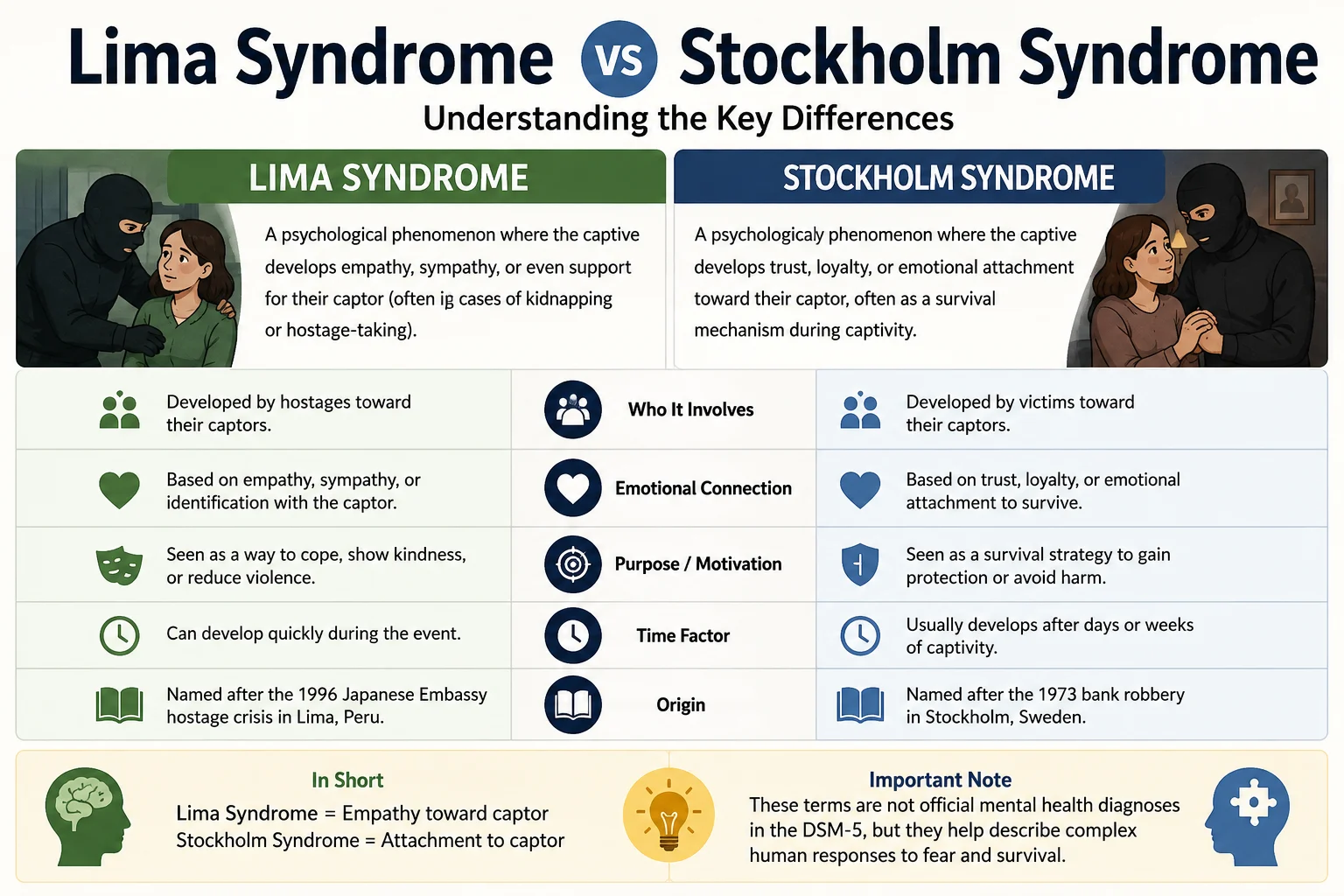
People often mix these two up, and it’s an easy mistake to make since both describe emotional bonds forming under extreme stress. The direction of the bond is what separates them.
- Lima syndrome: the person holding power starts to identify with, pity, or protect the person they’re controlling.
- Stockholm syndrome: the person with less power starts to defend, trust, or feel loyal toward the one controlling them.
Neither is a formal clinical diagnosis. Both are informal terms used by psychologists, journalists, and true-crime writers to describe patterns seen in hostage situations, abusive relationships, and even some workplace dynamics.
The Psychology Behind It
Why would a captor start sympathizing with someone they’re holding against their will? It comes down to basic human psychology under pressure, and a few factors tend to come up again and again in the research on this topic.
- Prolonged close contact. Spending days or weeks in the same room with someone tends to humanize them. Isolation from the outside world can also push captor and hostage toward an unusual kind of shared reality.
- Shared conversation. Hostages who talk about their families, fears, or daily lives become harder to see as mere targets. Small talk, it turns out, is a surprisingly powerful equalizer.
- Guilt or moral conflict. Some captors were never fully committed to the plan and start to second-guess it under pressure, especially once the initial adrenaline fades.
- Youth or inexperience. Reports from the Lima crisis suggested some of the younger captors were especially prone to this shift, possibly because they had less ideological hardening than their older counterparts.
- Practical necessity. Feeding, watching, and managing captives for days on end forces a level of interaction that’s hard to keep purely transactional.
None of this excuses the crime itself. It simply explains a documented emotional pattern that shows up in real hostage cases, and one that negotiators are trained to watch for and gently encourage once it appears.
How Common Is This Really?
Despite the attention Lima syndrome gets in true-crime shows and psychology blogs, genuine cases are considered unusual. Most hostage situations end through negotiation, force, or the captors’ original demands being met or refused — not through a sudden change of heart. What makes the Lima case so widely cited is precisely how rare that kind of shift is; researchers don’t have a large pool of confirmed cases to draw firm conclusions from, so much of the discussion around the phenomenon still leans on that one well-documented crisis plus scattered, less rigorously studied reports from other standoffs around the world.
Real-World Examples
The clearest case tied to the name is the Japanese embassy hostage crisis in Lima, where captors reportedly formed friendly rapport with some hostages and let a number of them go early. Beyond that specific event, the pattern has been referenced in:
- True-crime documentaries discussing kidnappers who bring food, blankets, or news to captives.
- Negotiation training materials that coach officers to build on any sign of a captor’s softening stance.
- Fictional thrillers and crime novels that borrow the concept for plot tension between a captor and a hostage.
- Academic papers on hostage negotiation, which sometimes cite the Lima case as a rare but instructive counterexample to Stockholm syndrome.
- News commentary during modern kidnapping or siege events, where journalists reach for the term whenever a captor’s behavior seems to soften.
Examples in Sentences
Seeing the phrase in context makes it easier to use correctly:
- “The negotiator noticed early signs of Lima syndrome when the gunman began sharing his lunch with the hostages.”
- “Some critics argue that Lima syndrome is overused in fiction as an easy plot device.”
- “Researchers studying hostage psychology still debate how common genuine Lima syndrome actually is.”
Formal vs Informal: When to Use the Term
In academic or clinical writing, it’s best to note that this is a descriptive, informal label rather than a diagnosis recognized in manuals like the DSM-5. Phrases such as “a pattern consistent with Lima syndrome” or “researchers have described Lima syndrome in hostage negotiations” read more carefully than a flat clinical claim.
In casual writing, journalism, or conversation, using the term on its own is perfectly natural: “It sounds like Lima syndrome” is clear and widely understood.
Common Mistakes to Avoid
- Mixing it up with Stockholm syndrome. Remember: Lima flows from captor to hostage; Stockholm flows the other way.
- Treating it as an official diagnosis. It’s a descriptive term, not a listing in a diagnostic manual.
- Assuming it always happens. Most hostage situations do not show this pattern; it’s notable specifically because it’s uncommon.
- Using it outside its context. The phrase describes captor-hostage dynamics, not general kindness or empathy in unrelated situations.
- Ignoring the power imbalance. Even when a captor shows warmth, the hostage remains in danger; sympathy from one side doesn’t erase the threat of the overall situation.
Related Words and Concepts
A few related terms are worth knowing if this topic interests you:
- Stockholm syndrome — a hostage’s sympathy toward their captor.
- Capture-bonding — a broader term for emotional attachment formed during captivity, in either direction.
- Traumatic bonding — attachment that forms through cycles of tension and relief in abusive relationships.
- Hostage negotiation — the practical field that studies and uses these emotional patterns to resolve crises safely.
- Reverse Stockholm syndrome — an informal alternative name some writers use for the same captor-to-hostage sympathy pattern.
Quick Tips / Cheat Sheet
- Think “L for Lima, L for the person who Lets go” as a quick memory trick.
- If the sympathy flows toward the hostage, it’s this term; if it flows toward the captor, it’s Stockholm syndrome.
- Use it descriptively, not diagnostically, in serious or academic contexts.
- It’s rare in real cases, so avoid treating it as an expected outcome of every kidnapping.
Frequently Asked Questions
What is the simplest definition of Lima syndrome?
It’s when a captor develops sympathy, warmth, or protective feelings toward the hostage they are holding, sometimes leading them to treat the hostage better or release them early.
Where does the name come from?
It comes from Lima, Peru, the site of the 1996–1997 Japanese embassy hostage crisis, where some captors reportedly grew sympathetic toward the people they were holding.
Is Lima syndrome the opposite of Stockholm syndrome?
Yes. Stockholm syndrome describes a hostage bonding with their captor, while this term describes the captor bonding with the hostage instead.
Is it a recognized psychological diagnosis?
No. It’s a descriptive, informal term used in psychology writing and journalism rather than a condition listed in diagnostic manuals such as the DSM-5.
How common is it in real hostage situations?
It’s considered rare. Most documented hostage cases don’t show this pattern, which is part of why the Lima crisis stood out to researchers and journalists at the time.
Can the term apply outside of hostage situations?
It’s occasionally stretched to describe a person in power showing unexpected sympathy toward someone they control, such as in fiction, though its original and most accurate use is hostage-related.
Why do some captors develop this kind of sympathy?
Close contact, shared conversation, personal guilt, and inexperience are commonly cited reasons. Spending extended time with a hostage tends to make that person harder to dehumanize, and the ordinary rhythms of daily survival, meals, sleep, and small conversations, quietly chip away at the emotional distance a captor first tries to maintain.
Is there a well-known real case besides the Lima crisis?
The Lima embassy crisis remains the clearest, most cited example, since it’s the event the term is named after. Other cases are sometimes described using the label, though less definitively, often because reporters or witnesses only had partial insight into what the captors were actually thinking during the standoff.
Wrapping Up
Lima syndrome offers a useful way to describe a genuine, if uncommon, shift in hostage dynamics: sympathy flowing from the person in control toward the person being held. Knowing the term — and how it differs from its more famous cousin, Stockholm syndrome — helps you read true-crime stories, negotiation training, and psychology discussions with a sharper eye. For a deeper dive into the original case that inspired the name, the Wikipedia entry on the Japanese embassy hostage crisis is a solid starting point. If terms like this one interest you, SmartWording has more guides on psychology-related vocabulary and easily confused word pairs worth exploring next.