For more insights, read here:- main character energy meaning and lpc meaning.
- What Does Main Character Syndrome Meaning Psychology Mean?
- Main Character Syndrome Meaning Psychology Explained Simply
- Is Main Character Syndrome a Real Psychological Disorder?
- The Psychology Behind Main Character Syndrome
- Self-Focused Attention
- The Spotlight Effect
- Egocentric Thinking
- Personal Narrative
- Positive Main Character Energy vs. Negative Main Character Syndrome
- Why Main Character Syndrome Can Sometimes Be Healthy
- When Main Character Syndrome Becomes Unhealthy
- Main Character Syndrome and Narcissism
- Main Character Syndrome and Confidence
- Main Character Syndrome on Social Media
- Main Character Syndrome in Dating
- Main Character Syndrome in Friendships
- Main Character Syndrome at Work
- Main Character Syndrome Examples
- Main Character Syndrome Example Sentences
- Main Character Syndrome Meaning in Everyday Language
- Is Main Character Syndrome an Insult?
- Common Misunderstandings About Main Character Syndrome
- It Does Not Mean Everyone Is Selfish
- It Is Not a Clinical Diagnosis
- It Is Not Automatically Narcissism
- Confidence Is Not a Problem
- Main Character Energy Can Be Positive
- Main Character Syndrome vs. Main Character Energy
- Main Character Syndrome vs. Self-Centeredness
- Main Character Syndrome vs. Egocentrism
- How to Avoid the Negative Side of Main Character Syndrome
- Listen Before Responding
- Ask Other People Questions
- Check Your Assumptions
- Celebrate Other People's Success
- Keep Your Confidence
- Remember That Everyone Has a Story
- Why the Phrase Became Popular
- Is Main Character Syndrome Always Negative?
- Frequently Asked Questions
- What is the main character syndrome meaning psychology?
- Is main character syndrome a mental illness?
- What causes main character syndrome?
- Is main character syndrome the same as narcissism?
- Can main character syndrome be positive?
- How do you know if someone has main character syndrome?
- Final Conclusion
Main character syndrome meaning psychology describes an informal way of talking about a mindset in which someone views themselves as the central character in their own life story. The phrase can describe healthy confidence and personal agency, but it can also describe excessive self-focus, attention-seeking behavior, or a tendency to treat other people as less important.
The important point is that main character syndrome is not a recognized psychological disorder or medical diagnosis. It is an informal internet and popular-culture expression. Mental health professionals may discuss related ideas such as self-focused attention, narcissistic traits, empathy, self-importance, and how people construct stories about their lives, but these concepts are not automatically the same thing as main character syndrome.
In everyday language, the phrase can be positive, negative, or humorous. Someone may use it positively when they become more confident and take control of their choices. Someone else may use it critically when a person acts as though everyone around them exists only to support their personal story.
What Does Main Character Syndrome Meaning Psychology Mean?
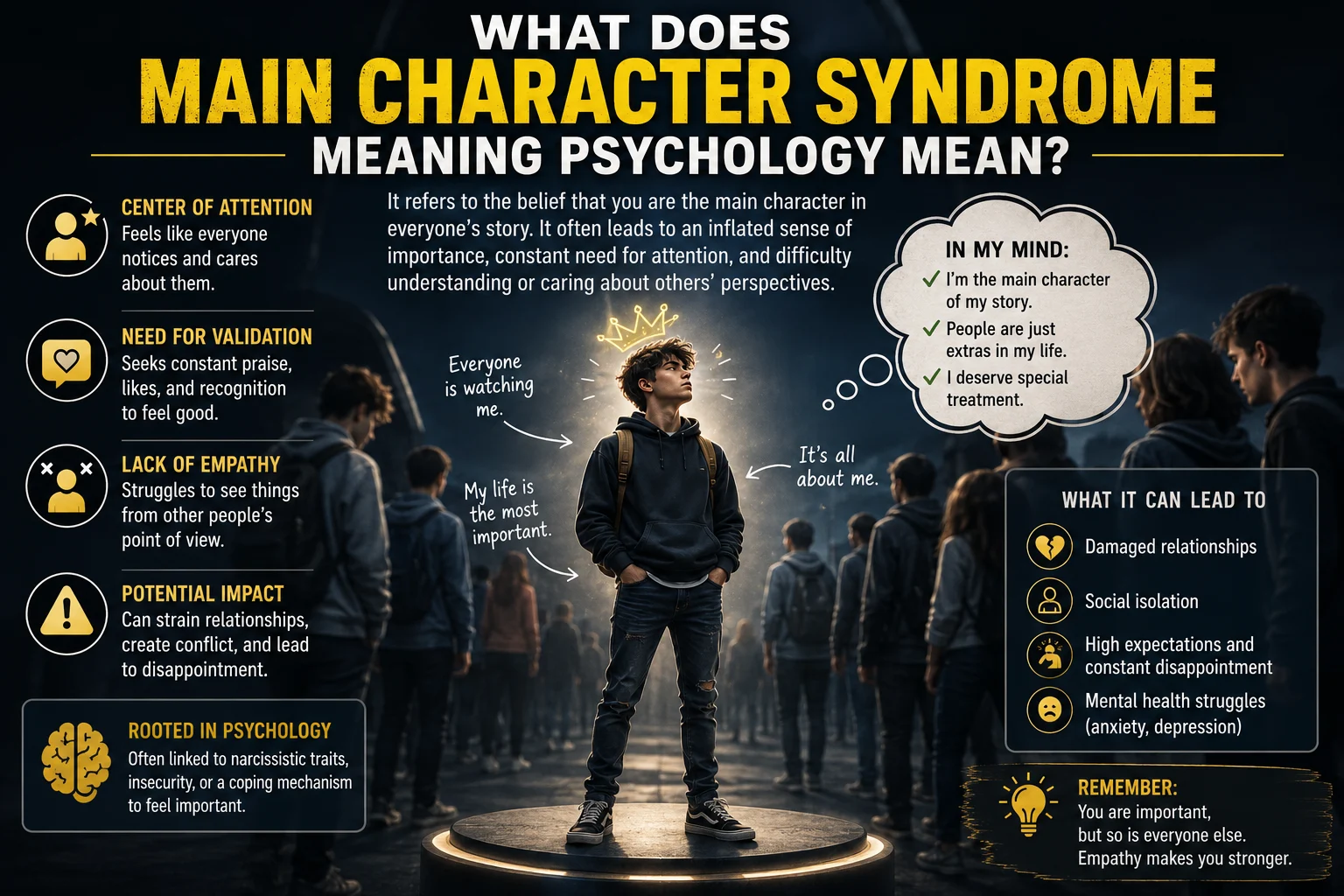
Main character syndrome meaning psychology refers to the idea of seeing yourself as the protagonist of your own life story and sometimes behaving as though you are the most important person in the situation.
In its simplest form, the expression means:
“Viewing your life as a story in which you are the main character.”
That basic idea is not automatically unhealthy. Everyone experiences life from their own point of view. The problem appears when the mindset becomes extreme and a person repeatedly ignores the feelings, needs, achievements, or perspectives of other people.
For example, imagine someone attending a friend’s graduation. Instead of celebrating the graduate, they become upset because nobody is paying attention to them. A person might jokingly describe this behavior as main character syndrome.
On the other hand, someone who decides to pursue a personal goal, become more confident, and stop worrying excessively about other people’s opinions might be described as having “main character energy.” That use is generally positive.
The difference is important. Main character syndrome can be used as criticism, while main character energy can be used as encouragement.
Main Character Syndrome Meaning Psychology Explained Simply
A simple explanation of main character syndrome meaning psychology is:
It is an informal expression for seeing yourself as the central figure in your life story, sometimes so strongly that you overlook other people’s perspectives.
The word “syndrome” can make the expression sound medical. However, it does not mean that the person has a recognized syndrome.
Medical and psychological sources consistently explain that the expression is not a formal diagnosis. Instead, it is a popular term used to describe a pattern of behavior or attitude.
This distinction prevents an important misunderstanding.
Someone can display behavior that people call main character syndrome without having a mental health condition. Similarly, someone can be confident, dramatic, creative, or highly expressive without being self-centered.
Is Main Character Syndrome a Real Psychological Disorder?
No. Main character syndrome is not a recognized mental disorder or clinical diagnosis.
The term became popular as an informal cultural expression, particularly through online communities and social media. Mental health professionals may use established psychological concepts to discuss behaviors that resemble the negative version of the phrase, but they do not diagnose someone simply because they appear to have main character syndrome.
This is especially important when comparing the expression with narcissism.
Narcissistic Personality Disorder is a specific mental health diagnosis. Main character syndrome is not.
A person who enjoys attention, posts cinematic videos, talks about their achievements, or imagines their life as a movie does not automatically have a personality disorder.
Psychological diagnosis requires professional assessment and consideration of a person’s broader patterns, functioning, relationships, and symptoms.
The Psychology Behind Main Character Syndrome
Although the expression itself is informal, it can point toward several psychological ideas.
Self-Focused Attention
People naturally focus on themselves. We think about our appearance, goals, relationships, mistakes, worries, and future plans.
This is normal.
However, excessive self-focused attention can cause a person to interpret many situations primarily through their own experiences.
For example, if someone enters a room and immediately thinks, “Everyone is looking at me,” they may be overestimating how much attention other people are actually giving them.
That type of thinking can sometimes resemble the behavior described by main character syndrome.
The Spotlight Effect
The spotlight effect is a psychological concept involving the tendency to overestimate how much other people notice our appearance, actions, or mistakes.
Imagine spilling coffee on your shirt in a crowded café. You might feel as if everyone has noticed the stain.
In reality, most people are probably focused on their own conversations, phones, meals, or thoughts.
This does not mean that the spotlight effect equals main character syndrome. Rather, it can help explain one aspect of the broader idea: people sometimes experience themselves as being more visible or important to others than they actually are.
Egocentric Thinking
Egocentric thinking involves viewing situations primarily from one’s own perspective.
This is a normal part of human experience. Nobody can completely escape their own point of view.
The concern comes when a person consistently refuses to consider how situations affect other people.
For example, someone might assume that a friend canceled plans because they do not care about them. They may never consider that the friend could be exhausted, busy, or dealing with another problem.
That pattern of interpretation can contribute to the negative behavior people sometimes label as main character syndrome.
Personal Narrative
People naturally create stories about their lives.
We remember important events, connect experiences, identify turning points, and imagine where our lives may go next.
This personal storytelling can be healthy. It can help people understand their experiences and make decisions.
The “main character” metaphor takes that ordinary process and turns it into a dramatic story framework.
The healthy version says:
“I am responsible for the choices I make in my life.”
The unhealthy version can become:
“Everything that happens is about me.”
That difference is at the heart of many discussions surrounding main character syndrome.
Positive Main Character Energy vs. Negative Main Character Syndrome
The expression can have two very different meanings.
Positive main character energy can involve:
- Confidence
- Independence
- Personal growth
- Self-expression
- Creativity
- Taking responsibility
- Pursuing meaningful goals
- Becoming comfortable with individuality
- Caring less about unnecessary judgment
Negative main character syndrome can involve:
- Excessive self-importance
- Constant attention-seeking
- Entitlement
- Self-centered behavior
- Ignoring other people’s feelings
- Treating others like supporting characters
- Expecting special treatment
- Turning ordinary events into personal drama
The same person can even experience both sides.
Someone might confidently pursue their dreams while occasionally becoming too focused on themselves.
That is why the context and tone of the phrase matter.
Why Main Character Syndrome Can Sometimes Be Healthy
Seeing yourself as the main character is not automatically a problem.
In fact, there can be a useful psychological message behind the metaphor.
You are responsible for your choices.
You can decide what goals matter to you.
You can leave situations that are harmful.
You can develop new skills.
You can change your direction.
You can create meaningful experiences.
This is why people sometimes use “main character energy” as a positive expression.
For example:
“I stopped waiting for everyone else’s approval and started pursuing my own goals. I’m finally embracing my main character energy.”
Here, the speaker is not necessarily claiming to be more important than everyone else. They are describing confidence and personal agency.
A healthy version of the main character idea allows other people to be important too.
You can be the main character in your own story while understanding that everyone else is the main character in theirs.
When Main Character Syndrome Becomes Unhealthy
The expression becomes more negative when self-focus starts affecting relationships or everyday behavior.
A person may constantly redirect conversations toward themselves.
They may become irritated when someone else receives attention.
They may assume that other people’s decisions are secretly about them.
They may expect friends or partners to organize their lives around their needs.
They may create unnecessary drama because ordinary situations do not feel important enough.
They may also interpret disagreements as personal attacks rather than opportunities to understand another perspective.
These behaviors do not automatically indicate a psychological disorder. They are simply examples of behaviors that people may casually describe with the phrase.
Main Character Syndrome and Narcissism
Main character syndrome is sometimes compared with narcissism because the negative version can involve self-importance, attention-seeking, entitlement, or reduced consideration for others.
However, the terms are not interchangeable.
Narcissistic traits exist on a broad spectrum, while Narcissistic Personality Disorder is a clinical diagnosis.
Main character syndrome is an informal expression.
For example, someone could joke:
“I have main character syndrome because I put on headphones and pretend my walk is a movie scene.”
That statement has nothing to do with diagnosing a personality disorder.
A more serious situation would require professional evaluation rather than an internet label.
Healthline and other mental health resources similarly emphasize that main character syndrome and main character energy are informal expressions rather than clinical diagnoses.
Main Character Syndrome and Confidence
Confidence and self-centeredness are different.
A confident person may believe:
“I know what I want, and I believe I can work toward it.”
A self-centered person may think:
“My wants should matter more than everyone else’s.”
Confidence does not require putting other people down.
Healthy confidence can coexist with empathy, humility, and respect.
This is one reason the positive interpretation of main character energy can be useful. It encourages people to take their own lives seriously without necessarily treating everyone else as unimportant.
Main Character Syndrome on Social Media
The expression became closely associated with internet culture and social media.
Online platforms encourage people to present selected parts of their lives through photos, videos, captions, stories, and personal narratives.
This makes the metaphor of being the “main character” particularly easy to understand.
A person might film themselves walking through a city with cinematic music, describe a solo trip as a personal transformation, or joke about feeling as though a camera is following them.
These examples do not necessarily represent unhealthy behavior.
The phrase can simply be playful.
However, social media can also encourage people to think about how their lives look to an imagined audience.
That is one reason main character language can sometimes be connected to attention, self-presentation, and the desire for validation.
Psychological sources describe the term as a social-media-era expression rather than a formal disorder.
Main Character Syndrome in Dating
Dating provides many examples of how the phrase can be used.
Suppose someone expects their partner to always prioritize them, constantly reassure them, and make every decision around their preferences.
A friend might describe this as main character syndrome.
The problem is not wanting affection or attention.
Healthy relationships naturally involve attention, care, and reassurance.
The problem occurs when one person believes their needs should always matter more than their partner’s needs.
A balanced relationship recognizes two protagonists, not one person and a supporting cast.
For example:
“She expected the entire relationship to revolve around her schedule. Her friends joked that she had main character syndrome.”
The phrase here is informal criticism, not a diagnosis.
Main Character Syndrome in Friendships
Friendships can also reveal excessive self-focus.
Imagine a group of friends discussing an important achievement.
One person repeatedly interrupts and turns the discussion toward themselves.
If someone else shares exciting news, they immediately try to compete.
If another friend receives praise, they become jealous.
People may casually describe this pattern as main character syndrome.
But context matters.
Someone having a bad day or talking about their own problems for a few minutes does not mean they have a persistent self-centered personality.
The phrase should describe a recognizable pattern rather than become a label for every moment of self-focus.
Main Character Syndrome at Work
The phrase can also be used informally in workplace conversations.
For example, a coworker may behave as though every project depends entirely on them, dismiss other people’s contributions, or become upset when another colleague receives recognition.
Someone might jokingly say:
“He has serious main character syndrome at work.”
However, this is not professional psychological terminology.
In a workplace setting, it is usually more useful to describe the actual behavior.
For example:
“She frequently takes credit for group achievements.”
That statement is clearer and more objective than simply saying:
“She has main character syndrome.”
Main Character Syndrome Examples
Here are some simple examples:
- A person assumes everyone in a café is watching them because they are wearing a new outfit.
- Someone becomes upset when their friend receives more attention at a party.
- A person turns every group conversation into a discussion about their own experiences.
- Someone believes a small disagreement is part of a dramatic personal storyline.
- A person treats other people’s problems as less important than their own.
- Someone records a cinematic solo walk and jokingly calls it their main character moment.
- A person decides to travel alone because they want to become more independent.
- Someone stops worrying about unnecessary judgment and becomes more confident.
The first five examples show the more critical use of the phrase.
The final three show how the same “main character” idea can be playful or positive.
Main Character Syndrome Example Sentences
- “She joked about having main character syndrome after turning her morning walk into a movie scene.”
- “His main character syndrome sometimes makes him forget to listen to other people.”
- “Taking control of your goals can give you positive main character energy.”
- “Main character syndrome is an informal expression, not a clinical diagnosis.”
- “She felt like the main character during her solo trip.”
- “His friends teased him about his main character syndrome because he made every story about himself.”
- “Confidence does not automatically mean someone has main character syndrome.”
- “The phrase can be positive when it means self-confidence and negative when it means excessive self-importance.”
Main Character Syndrome Meaning in Everyday Language
In everyday language, the meaning depends heavily on tone.
If someone says:
“She is giving main character energy.”
they may be complimenting her confidence, appearance, independence, or presence.
If someone says:
“She has main character syndrome.”
they may be criticizing her for acting as though the world revolves around her.
If someone says:
“I had a main character moment today.”
they may simply be describing a memorable or cinematic experience.
Therefore, readers should look at the surrounding conversation before deciding whether the phrase is positive or negative.
Is Main Character Syndrome an Insult?
It can be.
When used negatively, main character syndrome can suggest that someone is:
- Self-centered
- Dramatic
- Attention-seeking
- Self-important
- Entitled
- Unaware of other people’s perspectives
However, the phrase can also be used affectionately or jokingly.
For example:
“My sister has main character syndrome because she turns every grocery-store trip into an adventure.”
This might be playful rather than genuinely insulting.
Tone, relationship, and context determine the meaning.
Common Misunderstandings About Main Character Syndrome
It Does Not Mean Everyone Is Selfish
Everyone naturally sees life through their own perspective.
Being the protagonist of your own story does not automatically mean being selfish.
It Is Not a Clinical Diagnosis
The word “syndrome” is part of the slang expression. It does not turn the phrase into a medical diagnosis.
It Is Not Automatically Narcissism
Some behaviors associated with the negative version may overlap with narcissistic traits, but the terms are not interchangeable.
Confidence Is Not a Problem
Being proud of yourself, pursuing goals, enjoying your appearance, or celebrating achievements is not automatically unhealthy.
Main Character Energy Can Be Positive
The phrase can encourage people to take ownership of their lives, especially when it is used to promote confidence and personal growth.
Main Character Syndrome vs. Main Character Energy
The two phrases are closely related but often carry different tones.
Main character energy is usually more positive.
It can mean:
“I feel confident, independent, attractive, creative, or excited about my life.”
Main character syndrome is more likely to be critical.
It can mean:
“This person behaves as though everything should revolve around them.”
For example:
“I’m going to take myself on a solo trip. Main character energy.”
This sounds empowering.
But:
“He expects everyone to stop talking whenever he enters the room. That’s main character syndrome.”
This sounds critical.
The same basic metaphor produces different meanings depending on how it is used.
Main Character Syndrome vs. Self-Centeredness
Self-centeredness means being excessively focused on oneself and one’s own needs, feelings, or interests.
Main character syndrome can describe similar behavior, but it adds the metaphor of being the protagonist in a movie or story.
Therefore, “self-centered” is a more general descriptive term, while “main character syndrome” is more informal and culturally specific.
Main Character Syndrome vs. Egocentrism
Egocentrism involves difficulty considering perspectives other than one’s own.
Main character syndrome can overlap with this idea when a person treats their own viewpoint as the only important one.
However, the terms should not be treated as exact synonyms.
Egocentrism is a psychological concept.
Main character syndrome is internet and popular-culture language.
How to Avoid the Negative Side of Main Character Syndrome
If you recognize some of these behaviors in yourself, the goal does not have to be becoming less confident.
Instead, try balancing confidence with awareness of other people.
Listen Before Responding
When someone shares something, allow them to finish before bringing the conversation back to yourself.
Ask Other People Questions
Show genuine interest in their experiences.
Check Your Assumptions
If you think everyone is judging you or talking about you, consider whether there is another explanation.
Celebrate Other People’s Success
Someone else’s success does not reduce your value.
Keep Your Confidence
You do not need to become invisible or stop caring about your goals.
Healthy self-confidence and empathy can exist together.
Remember That Everyone Has a Story
You may be the protagonist of your own life, but the people around you are also experiencing their own fears, dreams, problems, and goals.
That simple perspective can create a healthier version of the main character idea.
Why the Phrase Became Popular
The appeal of main character language comes partly from its simplicity.
Movies and novels make the idea of a protagonist easy to understand.
The protagonist has goals.
They experience challenges.
They change.
They make choices.
They have important relationships.
Applying that storytelling framework to real life gives people a memorable way to describe confidence, self-expression, or self-importance.
The expression has also been documented in online language for years, while its more recent social-media use helped broaden its meaning. Merriam-Webster notes that related “main character energy” usage spread online following a 2020 TikTok trend.
Because internet slang changes quickly, the exact history of the expression should be treated cautiously. Different communities may have used the phrase before it became widely popular.
Is Main Character Syndrome Always Negative?
No.
This is one of the most important points about the expression.
There is nothing inherently wrong with thinking your life matters.
There is nothing wrong with wanting to improve yourself.
There is nothing wrong with taking yourself on a solo date, dressing confidently, pursuing a dream, or enjoying a cinematic moment.
The negative meaning appears when personal importance becomes more important than basic respect for other people.
A healthy mindset might be:
“My life matters, and I am responsible for how I live it.”
An unhealthy mindset might be:
“My life matters more than everyone else’s.”
That small difference changes the entire meaning.
Frequently Asked Questions
What is the main character syndrome meaning psychology?
The main character syndrome meaning psychology is an informal description of viewing yourself as the central character in your own life story, sometimes with excessive self-focus or reduced consideration for others. It is not a clinical diagnosis.
Is main character syndrome a mental illness?
No. Main character syndrome is not a recognized mental illness or formal psychological diagnosis. It is an informal cultural expression used to describe certain behaviors and attitudes.
What causes main character syndrome?
There is no single established cause because main character syndrome is not a clinical condition. The behaviors associated with the phrase may relate to ordinary self-focus, personal storytelling, social-media self-presentation, a desire for attention, or other individual factors.
Is main character syndrome the same as narcissism?
No. Main character syndrome is an informal expression. Narcissistic Personality Disorder is a clinical condition that requires professional diagnosis. Some negative behaviors described by the phrase may overlap with narcissistic traits, but the terms are not equivalent.
Can main character syndrome be positive?
Yes. The related phrase “main character energy” is often used positively to describe confidence, independence, self-expression, and taking ownership of one’s life.
How do you know if someone has main character syndrome?
There is no clinical test for it. In casual language, people may use the phrase when someone consistently makes situations about themselves, seeks excessive attention, ignores other perspectives, or behaves as though other people are supporting characters.
Final Conclusion
The main character syndrome meaning psychology is best understood as an informal concept rather than a medical diagnosis. It describes a way of viewing life in which a person sees themselves as the central figure in their personal story.
The idea has both a healthy and an unhealthy side. The healthy version can encourage confidence, independence, self-expression, and personal responsibility. The unhealthy version can involve excessive self-focus, entitlement, attention-seeking, or a failure to recognize that other people have equally meaningful lives.
In other words, being the main character of your own life does not require treating everyone else like background characters.
A useful way to think about it is simple: you can take ownership of your story while still respecting everyone else’s story. A protagonist can be confident without being self-centered, ambitious without being entitled, and proud without making other people feel invisible.
The most empowering interpretation is therefore not “I am more important than everyone else.”
It is:
“My life matters, my choices matter, and other people’s lives matter too.”
That balanced perspective captures the positive side of main character energy without falling into the negative behavior that people often criticize as main character syndrome.