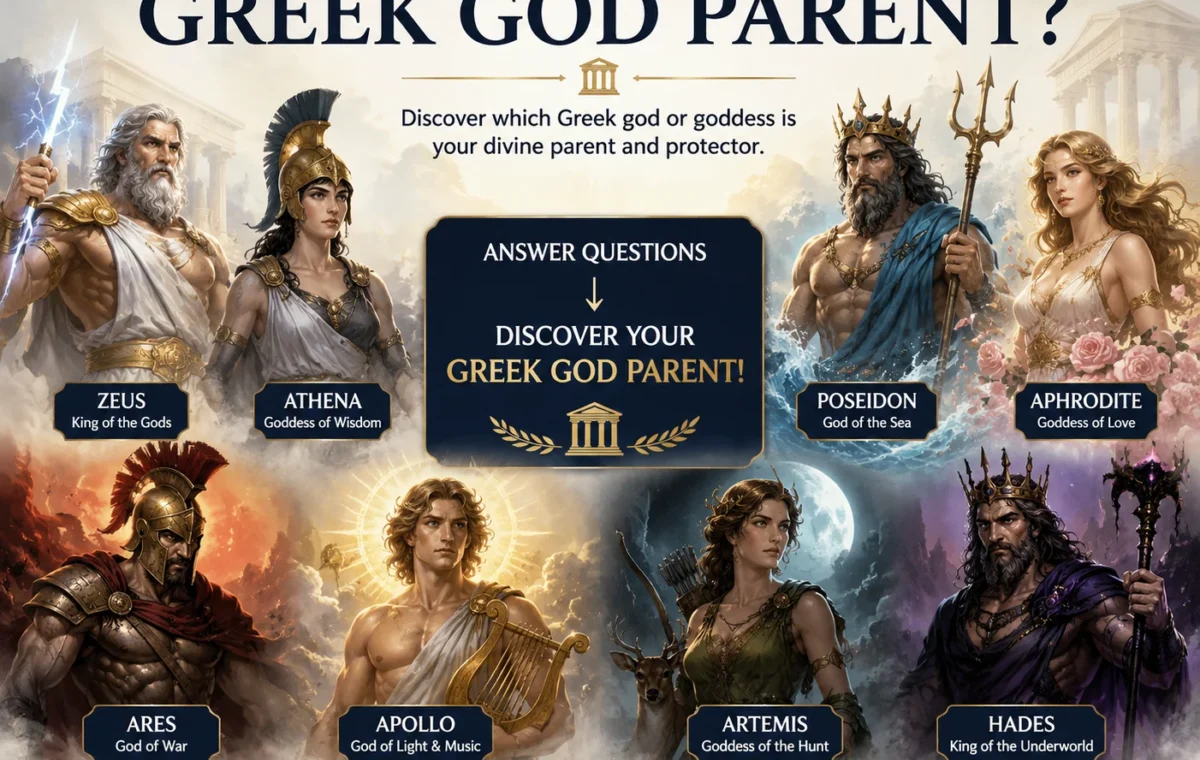
If you’re asking “who is my Greek god parent,” the short answer is: it depends on your personality, not your family tree. There’s no real bloodline here — it’s a fun mythology-based exercise (popularized by Percy Jackson) that matches your traits to an Olympian. Once you know your dominant qualities, picking your likely godly parent gets a lot easier.
- Quick Answer: Match Your Traits to a God
- What "Who Is My Greek God Parent" Actually Means
- Where the Idea Comes From
- How to Answer Who Is My Greek God Parent
- The 12 Olympians and Their Signature Traits
- Other Gods Who Might Be the Answer
- Formal vs. Casual — How People Ask This Question
- Common Mistakes to Avoid
- Related Words and Phrases
- Quick Tips / Cheat-Sheet for Who Is My Greek God Parent
- Frequently Asked Questions
- Is there an official test for who is my Greek god parent?
- Can I have more than one possible godly parent?
- What's the difference between a godly parent and a patron god?
- Why is Percy Jackson connected to this question?
- Are Roman gods used in these quizzes too?
- How accurate are online quizzes at guessing who is my Greek god parent?
- Does birth order or zodiac sign affect the result?
- What if I don't relate to any of the twelve Olympians?
Who is my Greek godparent shows up everywhere from personality quizzes to creative writing prompts, and honestly, it’s a great excuse to learn some real mythology while you’re at it. For more insights, read here:- brung and dulces
Quick Answer: Match Your Traits to a God
Before the details, here’s the fastest way to answer who is my Greek god parent — just scan the table below for the traits that sound most like you.
| If you’re mostly… | Your likely Greek god parent | Why it fits |
|---|---|---|
| Bold, competitive, protective | Ares or Athena | War and strategy both reward courage |
| Creative, dramatic, expressive | Apollo or Dionysus | Both rule art, music, and performance |
| Curious, clever, sneaky | Hermes | God of wit, travel, and quick thinking |
| Calm, nurturing, loyal | Demeter or Hestia | Both value home, growth, and steadiness |
| Ambitious, commanding | Zeus | The natural leader of the pantheon |
| Deep, intuitive, private | Hades or Poseidon | Rulers of the unseen and the untamed |
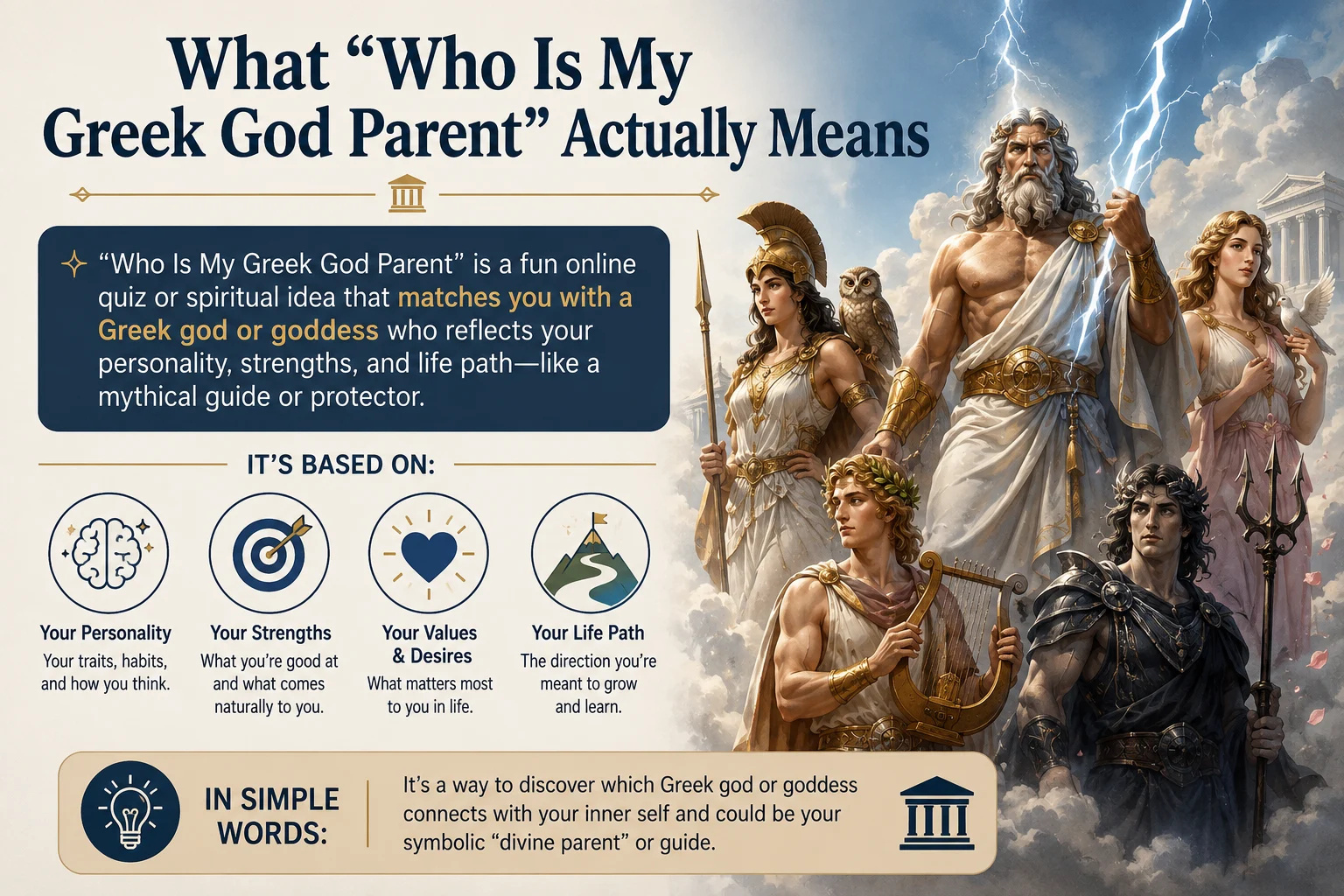
What “Who Is My Greek God Parent” Actually Means
This phrase almost never refers to literal ancestry. Instead, it’s a playful way of asking, “Which Olympian’s personality do I share?” The idea took off thanks to Rick Riordan’s Percy Jackson books, where half-human, half-divine “demigods” discover their godly parent based on hidden abilities and instincts. Fans borrowed that concept and turned it into quizzes, forums, and roleplay games.
So when someone searches who is my Greek god parent on Google, they’re usually looking for one of three things: a personality-based quiz, a breakdown of the gods’ traits so they can self-identify, or simple curiosity about Greek mythology.
Where the Idea Comes From
Long before internet quizzes, Greek mythology itself was full of demigods — mortals fathered or mothered by a god. Heracles, Perseus, and Achilles are the classic examples. Each one showed traits that echoed their divine parent: Heracles had Zeus’s raw strength, and Achilles carried the sea-nymph Thetis’s near-invincibility.
Modern culture picked up that pattern. Today, working out who is my Greek god parent is less about mythology homework and more about self-reflection dressed up in ancient robes.
How to Answer Who Is My Greek God Parent
There’s no single official test, but most quizzes and fan guides use the same core method to work out who is my Greek god parent:
- List your top three personality traits. Be honest, not aspirational.
- Think about how you handle conflict. Do you fight, plan, charm, or retreat?
- Notice what you’re drawn to. Art, nature, logic, adventure, or comfort?
- Match those answers to a god’s known domain using the table above or the list below.
It’s less scientific than it sounds, and that’s the point — this is meant to be fun, not clinical.
The 12 Olympians and Their Signature Traits
Here’s a closer look at the major Olympians, since they’re the most common answer to who is my Greek god parent.
- Zeus — leadership, authority, a strong sense of justice (and a temper to match).
- Hera — loyalty, high standards, protectiveness over family and commitments.
- Poseidon — intensity, moodiness, a pull toward freedom and the unknown.
- Demeter — patience, generosity, deep care for others’ wellbeing.
- Athena — logic, strategy, fairness, and a love of learning.
- Apollo — charisma, artistic talent, confidence, and a love of the spotlight.
- Artemis — independence, discipline, a strong moral code, and love of the outdoors.
- Ares — directness, competitiveness, and a willingness to confront problems head-on.
- Aphrodite — warmth, charm, and a gift for reading people’s emotions.
- Hephaestus — craftsmanship, patience, and quiet resilience under pressure.
- Hermes — quick thinking, humor, adaptability, and a restless streak.
- Dionysus — spontaneity, love of celebration, and an emotional, expressive nature.
Other Gods Who Might Be the Answer
Not everyone who asks who is my Greek god parent fits neatly into the twelve Olympians. If you’re drawn to mystery and transformation, Hades, god of the underworld, might be the better match — he’s often misunderstood but fair and disciplined. If home and quiet stability sound like you, Hestia could fit, even though she’s rarely the flashy pick in these quizzes.
Formal vs. Casual — How People Ask This Question
The question who is my Greek god parent gets phrased differently depending on the setting. In casual settings — quizzes, social media, fandom chats — the phrasing stays loose and playful: “Who’s my godly parent?” or “Which god am I?” In a classroom or essay context, it’s more useful to rephrase it formally, such as “Which Olympian best represents my personal traits, and why?” That version reads better in academic writing and shows you understand the mythology, not just the meme.
Common Mistakes to Avoid
These slip-ups are the easiest way to get who is my Greek god parent wrong:
- Picking a god because you like their story, not your traits. That’s fandom, not a match.
- Ignoring flaws. Real gods have real weaknesses — Zeus’s pride, Ares’s recklessness — and those matter too.
- Mixing up Greek and Roman names. Zeus is Greek; Jupiter is his Roman counterpart, and they’re not interchangeable in a strict mythology context.
- Assuming there’s one “correct” answer. Multiple gods can fit; go with whichever resonates most honestly.
Related Words and Phrases
A few terms come up often alongside who is my Greek god parent:
- Demigod — a person with one mortal and one divine parent.
- Pantheon — the full collection of gods in a mythology.
- Godly parent — informal shorthand for which god you’d be “claimed” by.
- Olympian — one of the twelve major gods who ruled from Mount Olympus.
Quick Tips / Cheat-Sheet for Who Is My Greek God Parent
- Think traits first, favorite myths second.
- If two gods feel equally right, look at how you handle stress — that usually breaks the tie.
- Read a short myth about your top pick; it often confirms or challenges your guess.
- For deeper reading on the gods’ roles and stories, the Encyclopaedia Britannica entry on Greek mythology is a solid, reliable source.
Frequently Asked Questions
Is there an official test for who is my Greek god parent?
No official test exists — this is a fan-created concept, not a documented mythological practice. Most quizzes rely on personality questions rather than any fixed formula, so results can vary between quizzes.
Can I have more than one possible godly parent?
Yes. Many people identify with traits from two or three gods at once. In that case, pick whichever god’s values or behavior patterns feel closest to how you actually act, not just what you admire.
What’s the difference between a godly parent and a patron god?
This distinction matters for anyone comparing who is my Greek god parent with the idea of a patron deity. A godly parent implies direct descent, as in the demigod tradition. A patron god is simply a deity whose values you admire or feel connected to, without any implied bloodline.
Why is Percy Jackson connected to this question?
Rick Riordan’s novels popularized the idea of modern demigods discovering their divine parent through personality and hidden skills, which is why so many quizzes today borrow that same structure and language.
Are Roman gods used in these quizzes too?
Occasionally, but most quizzes stick to Greek names since the original demigod concept and most mythology references use Greek terminology rather than the Roman equivalents.
How accurate are online quizzes at guessing who is my Greek god parent?
They’re accurate as entertainment, not as science. A well-written quiz can reflect your self-reported traits fairly well, but it can’t measure anything beyond the answers you choose to give it.
Does birth order or zodiac sign affect the result?
No — those systems are unrelated to Greek mythology. Some fan communities combine them for fun, but there’s no traditional or mythological link between zodiac signs and godly parentage.
What if I don’t relate to any of the twelve Olympians?
Look beyond the main twelve. Minor gods like Hecate, Nike, or Iris cover traits — magic, victory, communication — that the Olympians don’t fully represent, and one of them might fit better.
Answering who is my Greek god parent isn’t really about mythology trivia — it’s a fun way to reflect on your own personality through an ancient lens. Whether you land on Athena’s logic, Apollo’s flair, or Hades’s quiet depth, the “right” answer is whichever one feels honest. If this got you curious about mythology-inspired vocabulary, SmartWording has more guides on idioms, word origins, and figurative language worth exploring next.