Cursing means using swear words, blasphemy, or foul language, often out of anger or frustration. If you want a softer, sharper, or simply more precise word for it, this guide sorts 30+ alternatives by tone — formal, casual, polite, and everything between — with real example sentences. For more insights read here:- topor and odinism
- Quick Answer: Top Alternatives at a Glance
- What Does "Cursing" Actually Mean?
- Formal Alternatives
- Professional / Workplace-Friendly Words
- Casual, Everyday Synonyms
- Friendly, Light-Hearted Words
- Polite Euphemisms
- Strong, Emphatic Words
- Formal vs Informal — When to Use Which
- Common Mistakes to Avoid
- Related Words
- Quick Cheat Sheet
- Frequently Asked Questions
- What is a polite way to say cursing?
- What's the difference between cursing and swearing?
- Is "cussing" the same as Cursing?
- What is a formal word for Cursing?
- What do you call someone who swears a lot?
- Is blasphemy the same as Cursing?
- What's a workplace-appropriate way to report Cursing?
- What is another word for cursing someone out?
- What does cursing someone mean?
- What is cuss mean in slang?
Quick Answer: Top Alternatives at a Glance
| Word | Tone | One-Line Meaning |
|---|---|---|
| Swearing | Neutral/Common | Using rude or offensive words |
| Profanity | Formal | Offensive or blasphemous language |
| Bad language | Everyday | General term for rude speech |
| Cussing | Casual (US) | Informal word for swearing |
| Foul language | Neutral-formal | Language seen as dirty or vulgar |
| Blaspheming | Formal/Religious | Disrespectful language about sacred things |
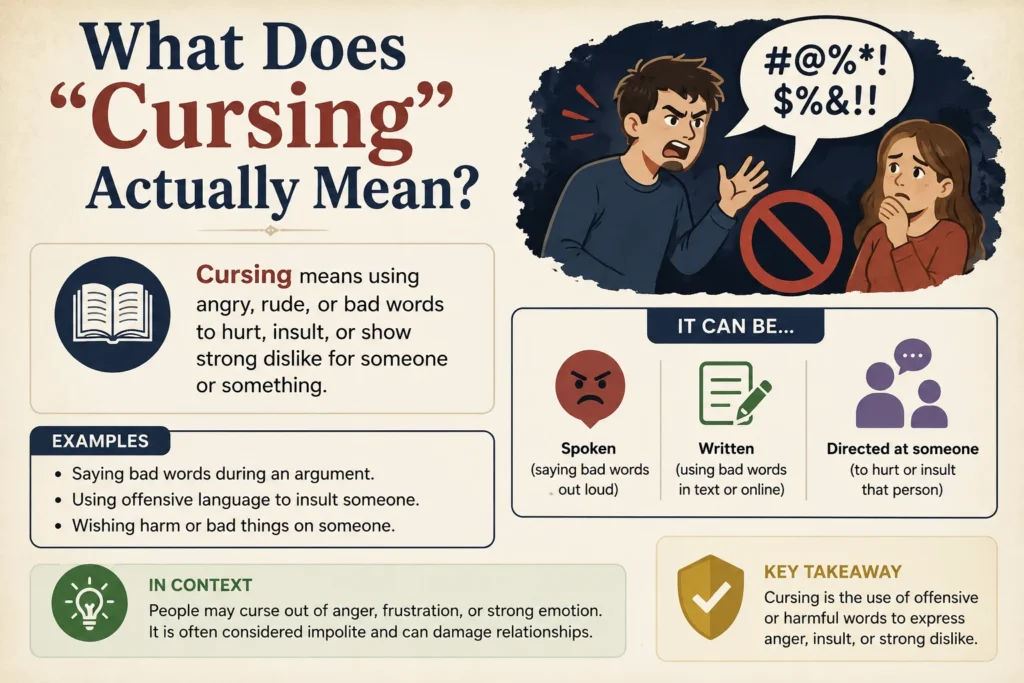
What Does “Cursing” Actually Mean?
At its core, the word describes the act of using swear words or invoking harm on someone, often in the heat of the moment. It can be mild (“darn it”) or genuinely offensive, depending on the words chosen and the setting. Dictionaries like Merriam-Webster define a curse as “a prayer or invocation for harm or injury to come upon one” or the act of using profane or obscene language. Because the word covers such a wide range — from muttering under your breath to shouting expletives — having a fuller vocabulary helps you describe the behavior more precisely.
Formal Alternatives
These fit reports, articles, workplace policies, or academic writing where a clinical tone matters.
- Profanity — offensive or vulgar language, often used in official contexts. “The venue has a strict no-profanity policy during family events.”
- Blasphemy — disrespectful speech about religious matters. “The play was banned for what critics called blasphemy.”
- Obscenity — language deemed indecent by social or legal standards. “The broadcast was fined for obscenity.”
- Vulgarity — coarse or crude language or behavior. “His vulgarity shocked the interview panel.”
- Imprecation — a spoken curse or wish of harm; quite literary. “She muttered an imprecation under her breath.”
Professional / Workplace-Friendly Words
Useful in HR emails, meeting notes, or performance reviews without sounding harsh.
- Inappropriate language — a soft, neutral catch-all. “Please avoid inappropriate language during client calls.”
- Unprofessional remarks — implies a workplace standard was broken. “His unprofessional remarks were noted in the review.”
- Offensive language — broad, HR-safe phrasing. “The policy prohibits offensive language of any kind.”
- Coarse language — describes rough, unpolished speech. “The report cited coarse language on the call recordings.”
Casual, Everyday Synonyms
These are what most people actually say out loud.
- Swearing — the most common everyday term. “Stop swearing in front of the kids!”
- Cussing — informal, especially in American English. “He was cussing at the printer again.”
- Cursing someone out — directing insults or swear words at a person specifically. “She cursed the driver out after he cut her off.”
- Swearing a blue streak — an idiom for a long, intense outburst of swear words. “He swore a blue streak when he stubbed his toe.”
- Letting rip — informal, means releasing a burst of angry words. “He let rip after the missed deadline.”
Friendly, Light-Hearted Words
For talking about mild slip-ups without judgment.
- Muttering — quietly expressing frustration, not necessarily rude. “She was muttering to herself over the paperwork.”
- Grumbling — complaining under one’s breath. “Dad was grumbling about the traffic.”
- Griping — casual word for irritated complaining. “They griped about the delay but got over it.”
- Venting — releasing frustration verbally, doesn’t always involve rude words. “He just needed to vent after the meeting.”
Polite Euphemisms
Handy when you want to describe the behavior without repeating the actual swear words.
- Using colorful language — a gentle, humorous way to reference someone’s word choice. “Grandpa used some colorful language when the car wouldn’t start.”
- Choice words — implies strong, pointed language, often sarcastic. “She had a few choice words for the referee.”
- Salty language — informal, means sharp or crude speech. “His replies got a little salty after the third question.”
- Off-color remarks — implies mildly inappropriate or crude comments. “The comedian’s set had a few off-color remarks.”
- Not fit for polite company — a classic, indirect phrase. “What he said next wasn’t fit for polite company.”
Strong, Emphatic Words
For serious or vivid descriptions of the behavior.
- Vile language — implies genuinely offensive or disgusting speech. “The email contained vile language directed at staff.”
- Foul-mouthed — an adjective describing someone who swears often. “He’s known for being foul-mouthed in traffic.”
- Ranting and raving — an intense, angry outburst, often loud. “She was ranting and raving about the delayed flight.”
- Filthy language — very strong, implies deeply offensive content. “The comments section was full of filthy language.”
- Tirade — a long, angry speech, often laced with strong words. “His tirade lasted a full five minutes.”
Formal vs Informal — When to Use Which
In writing, tone matters as much as meaning. A report or workplace memo calls for profanity, offensive language, or inappropriate language — words that describe the act without repeating it. In speech with friends, swearing, cussing, or letting rip feel far more natural. Save words like blasphemy or imprecation for religious, legal, or literary contexts — using them in casual chat can sound stiff or overly dramatic.
Common Mistakes to Avoid
- Mixing register. Don’t write “the employee engaged in blaspheming” in a casual team chat — it reads oddly formal.
- Confusing swearing with insulting. Not all rude speech involves actual swear words; sometimes “insulting” or “berating” is more accurate.
- Overusing euphemisms in serious writing. In an HR document, vague phrases like “colorful language” can undercut how serious the incident actually was.
- Assuming all synonyms are interchangeable. “Blasphemy” specifically involves religious disrespect — it isn’t just any rude outburst.
Related Words
If this topic interests you, it’s worth exploring nearby vocabulary too: expletives (the individual swear words themselves), invective (harsh, insulting language aimed at someone), and oaths (an older term that can mean either a promise or a sworn curse, depending on context).
Quick Cheat Sheet
| Situation | Best Word |
|---|---|
| Writing an HR policy | Inappropriate/offensive language |
| Describing a friend’s outburst | Swearing, cussing |
| Academic or legal writing | Profanity, obscenity |
| Religious context | Blasphemy |
| Softening the description | Colorful/salty language |
| Describing a long angry outburst | Tirade, ranting |
Frequently Asked Questions
What is a polite way to say cursing?
“Using colorful language” or “choice words” are gentle, indirect ways to reference the behavior without sounding harsh or repeating the actual swear words.
What’s the difference between cursing and swearing?
They’re largely interchangeable in everyday English, though “swearing” is more common in British English, while both terms appear regularly in American English. Some dictionaries note that a curse can also specifically mean wishing harm on someone, not just using rude words.
Is “cussing” the same as Cursing?
Yes — “cussing” is simply the informal, American-English version of the same idea: using swear words, usually out of frustration or anger.
What is a formal word for Cursing?
“Profanity” is the standard formal term, often used in legal, academic, or media contexts to describe offensive or vulgar language.
What do you call someone who swears a lot?
“Foul-mouthed” is the most common adjective for someone who uses offensive language frequently.
Is blasphemy the same as Cursing?
Not quite. Blasphemy specifically refers to disrespectful language about religion or sacred things, while general Cursing can be about anything.
What’s a workplace-appropriate way to report Cursing?
Use neutral, HR-friendly terms like “inappropriate language,” “unprofessional remarks,” or “offensive language” in written reports.
What is another word for cursing someone out?
“Berating,” “chewing out,” or “tearing into someone” all describe directing angry, often rude language at a specific person.
What does cursing someone mean?
To curse someone means wishing bad luck, harm, or pain to come upon them. It can mean asking a supernatural power or magic to hurt them, yelling angry and rude words at them, or speaking with deep hatred.
What is cuss mean in slang?
A cuss is slang for a swear word, an act of Cursing, or an old-fashioned term for a stubborn or peculiar person. It comes as a casual short form of the word “curse”