Other Ways to Say Sparked: 30+ Synonyms and When to Use Them.
Need a fresh way to say sparked? Try ignited, triggered, kindled, prompted, or set off, depending on how formal or dramatic you want to sound. Each one carries a slightly different shade of meaning, and picking the right one makes your writing sharper and less repetitive.
- Other Ways to Say Sparked: 30+ Synonyms and When to Use Them.
- Quick Answer: Top Alternatives at a Glance
- Formal Alternatives to "Sparked"
- Professional / Neutral Alternatives
- Casual and Everyday Alternatives
- Warm and Friendly Alternatives
- Strong and Emphatic Alternatives
- Formal vs. Informal — When to Use Which
- Common Mistakes to Avoid
- Related Words Worth Knowing
- Quick Cheat-Sheet
- Frequently Asked Questions
- What is another word for "sparked"?
- What does "sparked" mean exactly?
- Is "triggered" the same as "sparked"?
- What's a formal synonym for "sparked"?
- What's a casual way to say "sparked"?
- Can "kindled" replace "sparked" in every sentence?
- What word means the opposite of "sparked"?
- Why does word choice like this matter for writing?
- What is a spark in slang?
- What does a sparked discussion mean?
- What does a sparked out mean?
“Sparked” is a handy verb — it means something caused a reaction, idea, or event to begin, often suddenly. But if you’re writing an essay, a news piece, or even a text to a friend, using the same word over and over gets tired fast. Below, you’ll find a full lineup of alternatives, sorted by tone, so you can grab exactly the right one. For more insights, read here:- cursing and venin
Quick Answer: Top Alternatives at a Glance
| Word | Tone | Meaning in a nutshell |
|---|---|---|
| Ignited | Formal | Set something dramatically into motion |
| Triggered | Professional | Caused an immediate reaction or response |
| Kindled | Warm/Literary | Gently started a feeling or idea |
| Prompted | Professional | Led someone to act or decide |
| Set off | Casual | Started a chain reaction |
| Stirred | Warm | Awakened emotion or interest |
| Incited | Strong/Formal | Deliberately provoked, often unrest |
| Fired up | Casual | Got someone excited or energized |
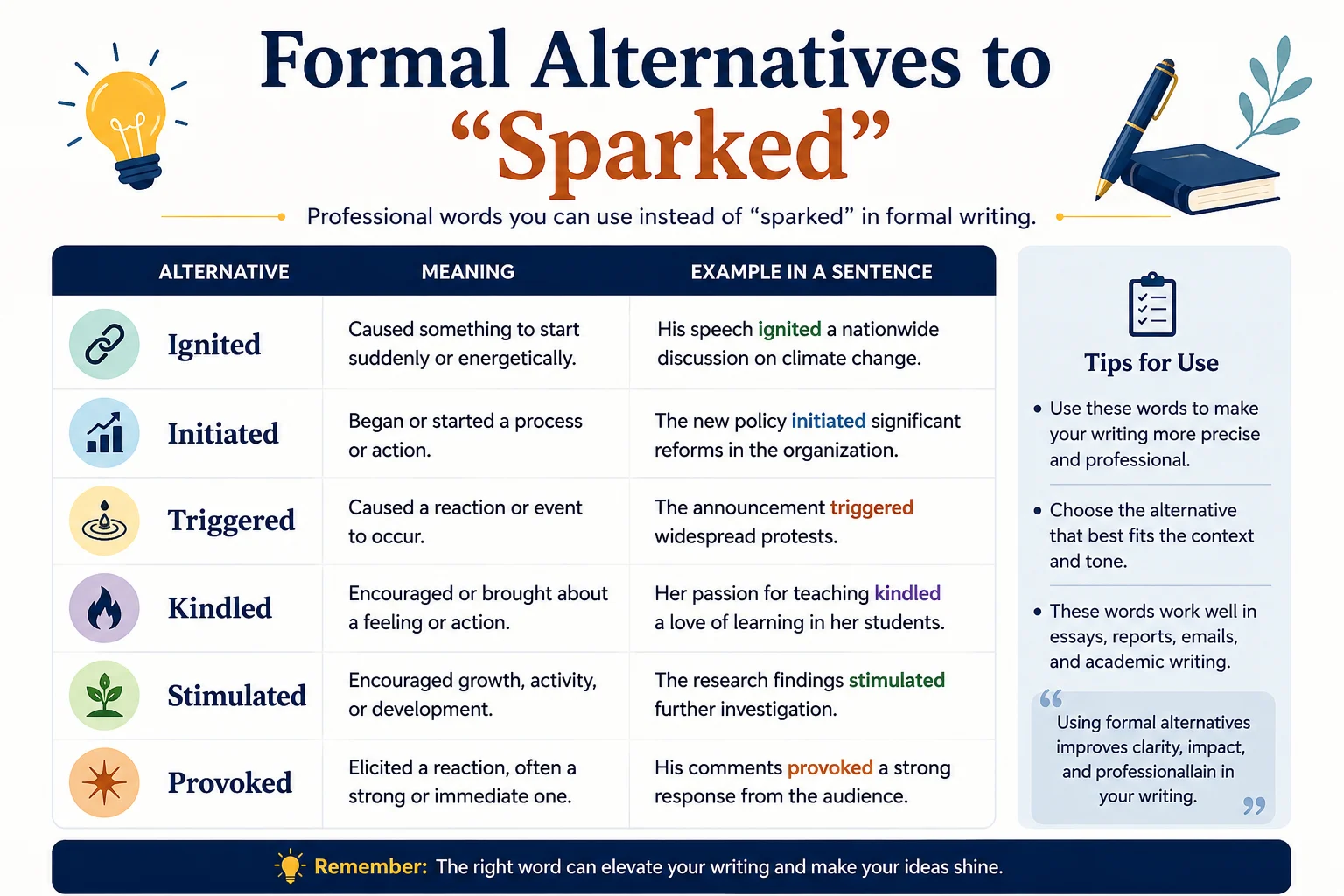
Formal Alternatives to “Sparked”
These fit essays, reports, journalism, and anything where you want a polished tone.
- Ignited — Suggests something burst into action almost violently or dramatically. Her speech ignited a wave of public debate.
- Incited — Often used when someone deliberately stirs up trouble, protest, or unrest. The rumor incited panic among residents.
- Instigated — Similar to incited, but leans toward planning or deliberate cause. Investigators believe he instigated the walkout.
- Precipitated — A more academic choice, useful for cause-and-effect writing. The policy change precipitated a wave of resignations.
- Engendered — A literary option meaning “gave rise to.” The film engendered fierce discussion among critics.
- Catalyzed — Borrowed from chemistry; implies one event speeds up a bigger process. The scandal catalyzed reforms across the industry.
Professional / Neutral Alternatives
Good for workplace emails, business writing, and everyday formal contexts without sounding overdone.
- Triggered — A common, versatile choice for cause and effect. The error message was triggered by a corrupted file.
- Prompted — Focuses on what led someone to act. Customer complaints prompted a review of the return policy.
- Initiated — Suggests a formal or intentional start. The report initiated a company-wide safety audit.
- Generated — Neutral and factual, common in reports. The announcement generated significant media interest.
- Produced — Simple and clear, works for outcomes and results. The experiment produced unexpected findings.
- Set in motion — A phrase that works well for processes or plans. The merger set in motion months of restructuring.
Casual and Everyday Alternatives
Perfect for conversation, blog posts, or relaxed writing.
- Set off — Great for chain reactions, arguments, or alarms. His comment set off a heated argument at dinner.
- Touched off — Similar to “set off,” slightly more vivid. The joke touched off a round of laughter.
- Kicked off — Works for events, projects, or trends. The video kicked off a whole new trend online.
- Got the ball rolling — Informal, friendly phrasing. Her idea got the ball rolling on the fundraiser.
- Fired up — Implies enthusiasm or motivation. The coach’s speech fired up the whole team.
- Started off — Simple and conversational. That small joke started off the whole prank war.
Warm and Friendly Alternatives
Useful when you’re describing emotions, memories, curiosity, or inspiration.
- Kindled — Gentle and often used for feelings or interest. Her grandmother’s stories kindled a love of history in her.
- Stirred — Implies a quiet emotional response. The old song stirred memories of childhood summers.
- Awakened — Poetic, often paired with curiosity or passion. Traveling awakened a hunger for adventure in him.
- Inspired — Focuses on creative or motivational influence. The mural inspired her to take up painting.
- Fueled — Suggests something added energy to an existing feeling. The victory fueled the team’s confidence.
- Rekindled — Perfect for reviving something that had faded. The reunion rekindled their old friendship.
Strong and Emphatic Alternatives
Use these when you want extra intensity or drama.
- Unleashed — Implies a sudden, powerful release. The decision unleashed a storm of criticism.
- Provoked — Suggests deliberate or forceful causation, often negative. The insult provoked an immediate response.
- Detonated — Figurative and dramatic, useful for shocking news. The leaked memo detonated a scandal overnight.
- Galvanized — Implies sudden motivation to act, often collectively. The disaster galvanized volunteers across the country.
- Roused — Suggests waking something dormant into action. The underdog’s win roused the crowd to its feet.
Formal vs. Informal — When to Use Which
Written formal work (reports, essays, journalism) tends to favor ignited, incited, precipitated, and catalyzed. Everyday conversation and casual writing lean on set off, kicked off, and fired up. If you’re writing for work but want to sound approachable, triggered, prompted, and generated sit comfortably in the middle — professional without feeling stiff.
Common Mistakes to Avoid
- Confusing “incited” with “invited.” They look similar but mean very different things — incited implies provoking, often trouble.
- Overusing “triggered” for emotional topics. In mental health contexts, this word has a specific clinical meaning, so use it carefully.
- Treating all these words as fully interchangeable. “Kindled” fits a slow-building feeling; it would sound odd describing a loud explosion of controversy.
- Forgetting tone consistency. Mixing a casual phrase like “fired up” into a formal report can undercut your credibility.
Related Words Worth Knowing
If this list helped, you might also want to look at synonyms for “caused”, words for “began”, or alternatives to “led to” — all cousins of this idea, useful when you’re describing cause and effect. According to Merriam-Webster, the verb form of “spark” specifically means to stir into activity, which is exactly the sense most of these alternatives capture.
Quick Cheat-Sheet
| Situation | Best Pick |
|---|---|
| Academic essay | Precipitated, catalyzed |
| News writing | Ignited, triggered |
| Casual chat | Set off, fired up |
| Describing emotion | Kindled, stirred |
| Describing controversy | Incited, provoked |
Frequently Asked Questions
What is another word for “sparked”?
Common alternatives include ignited, triggered, prompted, kindled, and set off, depending on how formal or emotional the sentence needs to sound.
What does “sparked” mean exactly?
It means something suddenly caused a reaction, event, or feeling to begin, often unexpectedly or quickly.
Is “triggered” the same as “sparked”?
They’re close, but “triggered” often implies a more direct, almost automatic cause-effect link, while this word can suggest something slower or more emotional too.
What’s a formal synonym for “sparked”?
Ignited, precipitated, and catalyzed all work well in formal or academic writing.
What’s a casual way to say “sparked”?
Try set off, kicked off, or got the ball rolling for a more relaxed tone.
Can “kindled” replace “sparked” in every sentence?
Not quite — kindled works best for slow-building feelings like curiosity or affection, not sudden, dramatic events.
What word means the opposite of “sparked”?
Words like extinguished, quelled, or suppressed describe stopping or preventing something from starting.
Why does word choice like this matter for writing?
Varying your vocabulary keeps readers engaged and shows precision — using the same verb repeatedly can make writing feel flat or repetitive.
What is a spark in slang?
In slang, spark most commonly means to light a cigarette or cannabis, to start a romantic connection, or historically, to woo a romantic partner
What does a sparked discussion mean?
To “spark a conversation” means to start a new discussion, trigger talking, or get people to share ideas. It is like a small spark that grows into a bigger flame of words.
What does a sparked out mean?
Sparked out is a British slang term meaning completely asleep, passed out, or knocked unconscious.