A jeoseung saja is the Korean spirit who guides the souls of the dead into the afterlife — Korea’s answer to the grim reaper. The term comes from Korean shamanism and folk belief, and it’s the reason you keep seeing men in black suits and wide-brimmed hats in Korean dramas and films. Once you know the story behind it, you’ll never watch one of those scenes the same way again. (Updated for 2026.) For more insights, read here:- finding jesus and what is the longest book in the bible
- Quick Answer
- What Does Jeoseung Saja Mean?
- Where the Idea Comes From
- Traditional vs. Modern Depictions
- Examples in Sentences
- Formal vs. Informal Use
- Related Words and Cultural Comparisons
- Common Mistakes to Avoid
- Quick Tips / Cheat-Sheet
- Why This Character Resonates With Modern Audiences
- Frequently Asked Questions
- What language does jeoseung saja come from?
- Is jeoseung saja the same as the grim reaper?
- Why do these afterlife messengers wear black suits in K-dramas?
- Who is Yeomra in relation to this figure?
- Can a jeoseung saja be persuaded or bargained with?
- Is there more than one jeoseung saja?
- How do you pronounce jeoseung saja?
- Where can I read more about Korean death folklore?
- Wrapping Up
Quick Answer
| Term | Meaning | Example |
|---|---|---|
| Jeoseung (저승) | “The other world,” the afterlife or land of the dead | He believed jeoseung was just beyond the mountain ridge. |
| Saja (사자) | “Messenger” or “envoy” | A royal saja carried the king’s orders. |
| Jeoseung saja (저승사자) | The messenger who escorts souls to the afterlife | In the drama, it waited quietly by the hospital bed. |
What Does Jeoseung Saja Mean?
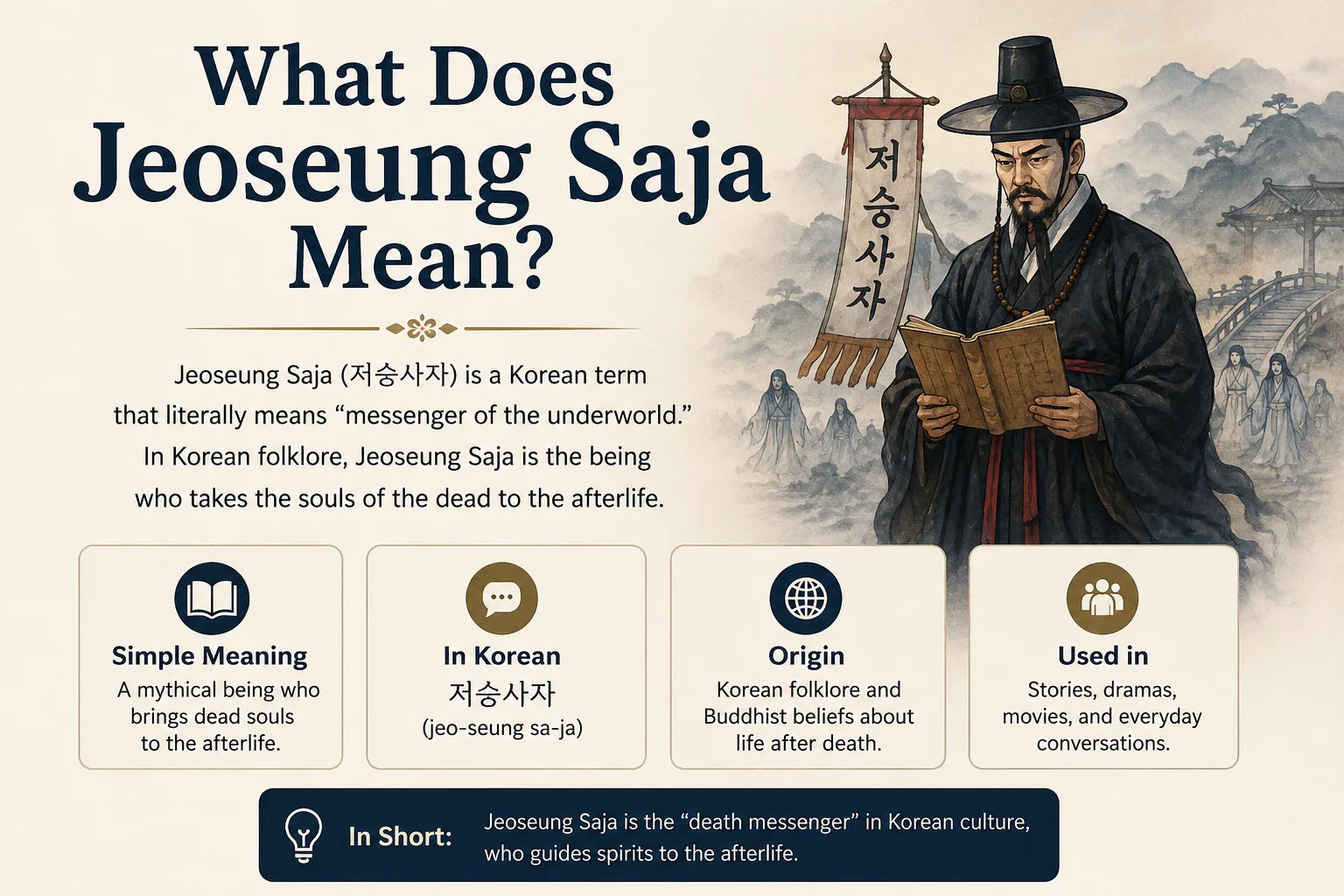
Broken down, the phrase is straightforward: jeoseung means “the afterlife” or “the other world,” and saja means “messenger” or “envoy.” Put together, a jeoseung saja is literally an afterlife messenger — a being sent from the underworld to collect a person’s soul when their time is up and lead it to where it belongs next.
The core concept isn’t unique to Korea — most cultures have some version of a death guide — but the specific name, look, and rules here are distinctly Korean, shaped by centuries of local belief.
Unlike the Western grim reaper, this figure isn’t usually seen as evil or something to fear outright. It’s closer to a civil servant of the underworld, carrying out an assigned task rather than hunting people down out of malice. That distinction matters a lot in how the character shows up in Korean storytelling.
Where the Idea Comes From
The roots of this belief sit in Korean shamanism (muism) and folk religion, later layered with Buddhist ideas about judgment after death. In traditional belief, when someone dies, a jeoseung saja is dispatched to bring the soul before Yeomra, the king of the underworld, who judges how the person lived and decides what comes next. This lines up loosely with concepts found across East Asian mythology, including Yama in Buddhist tradition and the underworld guardians of Chinese folk religion.
Older folk art and shaman paintings show this figure dressed in a black or dark blue hanbok (traditional Korean clothing) with a tall black gat (a horsehair hat once worn by scholars and officials). That look — formal, a little severe, unmistakably otherworldly — has carried straight through into how the character is drawn today.
Traditional vs. Modern Depictions
Folk belief and modern pop culture don’t always agree on the details, and it helps to see them side by side.
- Traditional folklore: dressed in a dark hanbok and gat, often shown as stern, unhurried, simply doing a job.
- Shamanic ritual (gut): invoked during death rites so families can appease the messenger and ease a loved one’s passage.
- Modern K-dramas and film: frequently reimagined in a black suit, long coat, and fedora — a striking blend of old folklore and noir style.
- Shows and movies that popularized it: Goblin: The Lonely and Great God, the Along with the Gods film series, and Hotel Del Luna all feature versions of this character, each adding its own twist.
If you’ve watched any of those, you’ve already met one, even if you didn’t know the term for it at the time.
Examples in Sentences
Seeing the phrase used naturally helps it stick.
- “In the finale, the jeoseung saja finally reveals his real name.”
- “According to my grandmother, one of these messengers visits exactly three days before someone passes.”
- “The drama’s lead actor plays a jeoseung saja who’s grown tired of his job after centuries of work.”
- “Some shamans claim they can sense when this kind of visitor is nearby.”
Formal vs. Informal Use
In formal or academic writing — folklore studies, religious history, cultural essays — the full phrase is used and often explained on first mention, since most English-speaking readers won’t know it yet. In casual conversation among K-drama fans, it’s frequently shortened or paired with “the reaper guy” or simply “the reaper” once the audience already understands the reference. Both are fine; context decides which fits.
Related Words and Cultural Comparisons
A few related terms and figures come up often in the same conversations:
- Grim Reaper – the Western personification of death, usually shown with a scythe and black robe.
- Shinigami (死神) – a Japanese “death god” concept with some overlap but a different mythological background.
- Yeomra (염라대왕) – the king of the underworld who judges souls after the messenger delivers them.
- Cha-sa (차사) – an older, more formal term sometimes used interchangeably with this phrase in classical texts.
- Hyeongwansa (형관사) – another traditional name occasionally used for underworld officials in older folklore.
Knowing these near-relatives helps you avoid mixing up figures from different cultures when you’re writing about Korean mythology specifically. Even within Korea, regional shamanic traditions describe the messenger’s appearance and temperament a little differently, so don’t be surprised if two sources disagree on small details like clothing color or number of companions.
Common Mistakes to Avoid
- Don’t confuse it with a ghost. A jeoseung saja is a guide or official, not a wandering spirit stuck on earth.
- Don’t assume it’s always villainous. Many stories portray this character as world-weary, even sympathetic, rather than menacing.
- Don’t romanize it inconsistently. You’ll see “jeosung saja” or “jusung saja” online — the standard romanization is jeoseung saja.
- Don’t treat it as identical to the Grim Reaper. The imagery overlaps in modern media, but the cultural roots and rules around the role differ.
Quick Tips / Cheat-Sheet
- Remember the split: jeoseung = afterlife, saja = messenger.
- Picture the classic outfit — black hanbok and gat in folklore, black suit and fedora in modern shows.
- If a K-drama character escorts souls or checks a “death list,” you’re very likely looking at a jeoseung saja.
- The role reports to Yeomra, the underworld’s judge, not the other way around.
Why This Character Resonates With Modern Audiences
Part of the reason the jeoseung saja has traveled so well into contemporary storytelling is that it’s rarely written as purely evil. Writers use it to explore grief, regret, and the idea of dying with unfinished business — themes that land with viewers far beyond Korea. A character whose job is literally to end someone’s story turns out to be a rich way to talk about mortality without leaning on horror-movie shock value.
This also explains why the imagery keeps shifting. Streaming platforms have steadily introduced international audiences to Korean death folklore, sitting it alongside older, better-known traditions like the Western Grim Reaper and ancient Egyptian funerary belief. Viewers who’d never encountered Korean shamanism before are now comparing notes across mythologies, which is partly why searches for the term have climbed in recent years. Subtitled dialogue rarely translates the phrase outright, so fans go looking for the meaning themselves — which is exactly the gap a guide like this one is meant to fill.
Frequently Asked Questions
What language does jeoseung saja come from?
It comes from Korean, combining jeoseung (the afterlife) and saja (messenger). Both words have roots in Sino-Korean vocabulary shaped by earlier Chinese characters.
Is jeoseung saja the same as the grim reaper?
They serve a similar role — both collect souls after death — but they come from different mythologies with different rules, appearances, and cultural meanings. Treating them as identical oversimplifies both traditions.
Why do these afterlife messengers wear black suits in K-dramas?
Modern productions blend the traditional black hanbok look with a noir aesthetic, giving the character a sleek, mysterious appearance that still nods to the original dark clothing.
Who is Yeomra in relation to this figure?
Yeomra is the king of the underworld who formally judges a soul once it arrives. Its own job ends at delivering the soul; judgment is Yeomra’s task alone, not theirs.
Can a jeoseung saja be persuaded or bargained with?
In folklore and shamanic ritual, families sometimes performed small rites to appease or plead with the messenger, though tradition holds firmly that the assignment itself can’t ever be undone.
Is there more than one jeoseung saja?
Yes. Folk belief and fiction alike usually describe multiple messengers working under Yeomra’s authority, each assigned different souls or regions.
How do you pronounce jeoseung saja?
Roughly “jaw-suhng sah-jah,” with even, unhurried stress on each syllable. It’s easier than it looks once you break the whole phrase down into its two separate parts.
Where can I read more about Korean death folklore?
Cultural encyclopedias, folklore studies, and sites like Wikipedia’s overview of Korean shamanism are good starting points for going deeper.
Wrapping Up
A jeoseung saja isn’t a monster to fear so much as a figure doing an old, solemn job: guiding souls from this world into the next. Once you know the meaning, the black hanbok, and Yeomra’s role in the story, the character stops feeling like just another spooky drama trope and starts feeling like part of a much older, quietly moving tradition worth remembering the next time it shows up on screen. If you’re curious about other Korean words and cultural terms, browse SmartWording’s guides on Korean vocabulary and idioms, or check the Encyclopedia of Korean Folk Culture for a deeper dive into the sources behind this figure.