
Introduction
Yacub is a name with multiple meanings depending on context. In Islamic and biblical traditions, it refers to Jacob, one of the most important prophets in Abrahamic faiths. However, this name also appears in Nation of Islam teachings as a controversial historical narrative. This guide explores both meanings, their origins, and cultural significance across different religious and cultural communities. For more insights, read here:- the reason for god and sin of pride
- Introduction
- Quick Answer
- The Biblical Patriarch: Yacub in Islamic Context
- Arabic and Islamic Context
- Etymology and Pronunciation Guide
- The Nation of Islam Interpretation
- Historical and Religious Importance
- Spiritual Meaning and Core Teachings
- Comparison With Related Biblical Figures
- Common Misconceptions and Clarifications
- Misconception 1: "Different names refer to different people"
- Misconception 2: "All interpretations are equally valid"
- Misconception 3: "The story is purely mythological"
- Contemporary Usage and Significance
- Related Figures and Connected Stories
- Frequently Asked Questions
- Is Yacub mentioned in the Qur'an?
- What's the difference between the Arabic and English versions?
- Why do different spellings exist?
- Are Nation of Islam teachings about Yacub accepted by Muslims?
- What spiritual lessons emerge from this patriarch's life?
- Why is this figure important to three religions?
- Conclusion
Quick Answer
| Context | Meaning |
|---|---|
| Islamic/Arabic | Arabic form of Jacob, the biblical patriarch and prophet |
| Biblical | One of the three patriarchs of Israel, son of Isaac, father of twelve tribes |
| Nation of Islam | A figure in controversial Nation of Islam mythology and teachings |
| General Usage | A respectful name used across Islamic, Christian, and Jewish traditions |
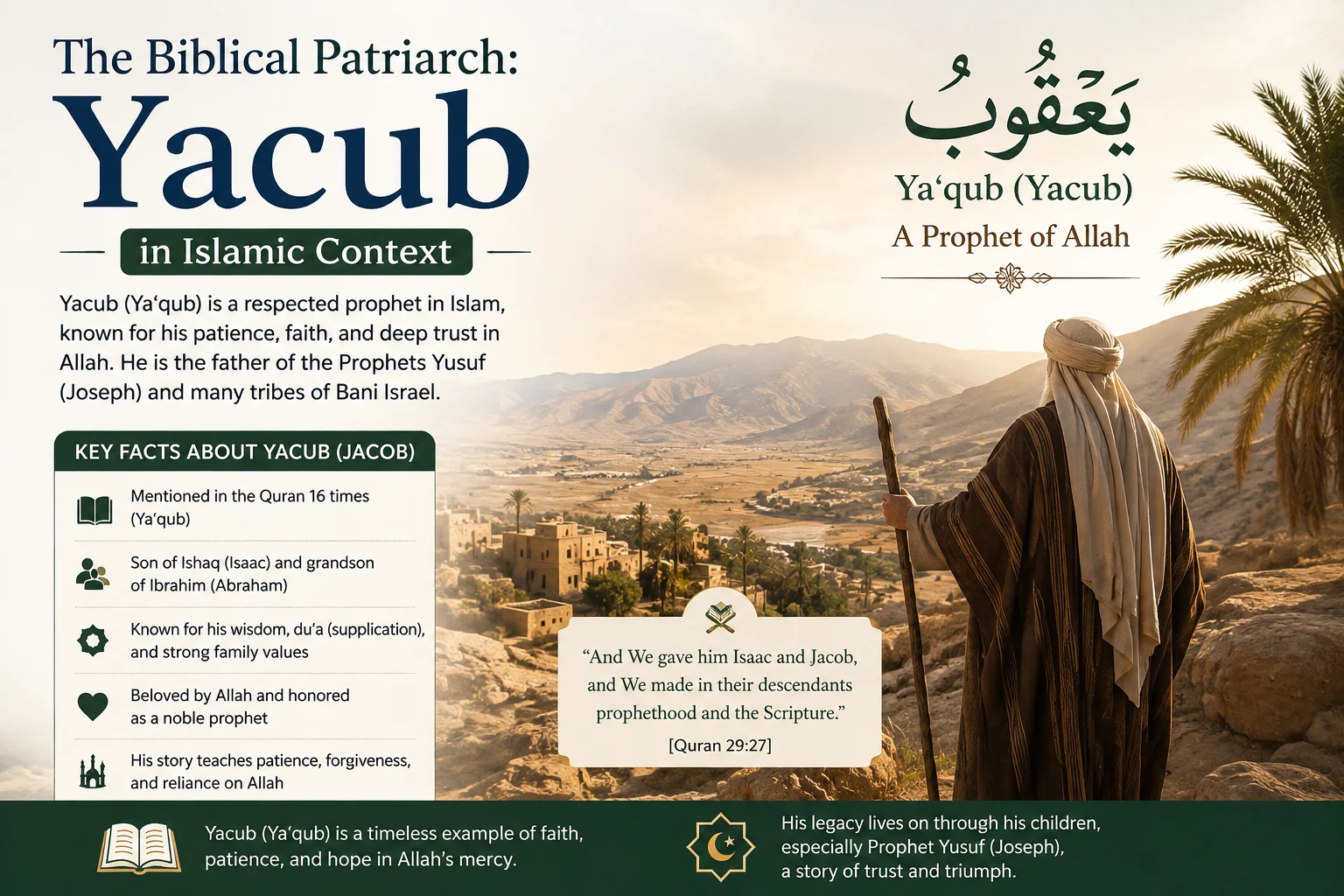
The Biblical Patriarch: Yacub in Islamic Context
In Islamic tradition, Yacub refers to the prophet Jacob, known as “Israel” in English texts. He holds a central place in the Hebrew Bible, the Christian Old Testament, and the Islamic Qur’an. The name comes from the Arabic transliteration of the Hebrew name Yaakov.
This patriarch was the son of Isaac and grandson of Abraham, making him one of the three patriarchs of Israel. His life story spans significant spiritual and historical narratives, including his famous wrestling match with an angel and his vision of a ladder reaching heaven.
The name itself carries meaning in Hebrew. According to biblical scholars, Yacub comes from a Hebrew word meaning “heel-grabber” or “supplanter,” referring to his birth when he grasped his twin brother Esau’s heel.
Arabic and Islamic Context
In Islamic scholarship and Arabic-speaking communities, this name represents the prophet Jacob mentioned throughout the Qur’an. He appears in several Qur’anic chapters as a righteous messenger and guardian of the faith. Islamic tradition holds this figure in high spiritual esteem as one of the great prophets whose descendants became the twelve tribes of Israel.
The Qur’an refers to him multiple times, emphasizing his role in transmitting divine guidance. Muslim scholars note that he lived in the land of Canaan and exemplified devotion to God across his long life. His twelve sons became the patriarchs of the twelve tribes, each representing a distinct lineage within ancient Israel.
Islamic teaching emphasizes his patience through trials, his love for his son Joseph, and his eventual reunion with Joseph after years of separation. This narrative appears in the Qur’an’s Chapter of Joseph, one of the most detailed stories in Islamic scripture.
Etymology and Pronunciation Guide
The name Yacub derives from Hebrew origins but is pronounced differently across languages and traditions.
Pronunciation Guide:
- Arabic: YAH-koob or YAH-kub
- English: JAY-kub (Jacob)
- Hebrew: Yah-ah-KOHV
The shift from Hebrew to Arabic to English reflects how this name transforms across linguistic and cultural boundaries. The Arabic form appears in Islamic texts; “Jacob” represents the anglicized version most familiar to English speakers. Understanding this linguistic journey helps clarify why the name appears under different spellings and pronunciations across faith communities.
The Nation of Islam Interpretation
Yacub appears prominently in Nation of Islam teachings, particularly in narratives developed by Nation of Islam founder W.D. Fard Muhammad and his successor Elijah Muhammad. This context differs significantly from traditional Islamic and biblical interpretations.
In Nation of Islam mythology, this figure is described as a black scientist who created the white race through genetic experimentation approximately 6,600 years ago. This narrative forms part of the Nation of Islam’s teachings about racial history and cosmology.
Mainstream Islamic scholars, both Sunni and Shia, explicitly reject these teachings as contradicting authentic Islamic sources and scientific understanding. Traditional Islamic scholarship views such narratives as departing from established Islamic doctrine entirely.
The Nation of Islam’s interpretation remains controversial and is not accepted by the broader Islamic community worldwide. It represents a distinct theological framework separate from orthodox Islamic teaching.
Historical and Religious Importance
As a biblical and Qur’anic figure, Yacub holds immense historical importance for understanding the development of monotheistic religions. His role as a patriarch connects directly to the founding narratives of Judaism, Christianity, and Islam.
His descendants—the twelve tribes—form the historical and theological foundation of the people of Israel. This connection makes him a central personality in the religious identity of these faith communities.
Archaeologically and historically, scholars continue debating the precise dating and circumstances of this patriarch’s life. Some scholars place him in the Middle Bronze Age, while others situate him within different historical periods. Despite scholarly questions about specific dates, his role in religious tradition remains undisputed across faith communities.
Spiritual Meaning and Core Teachings
Across traditional Islamic and Christian interpretations, this figure embodies several spiritual principles:
Perseverance Through Trial: He experienced significant hardships—family conflict, deception, separation from beloved son Joseph—yet maintained faith. His life teaches resilience and spiritual steadfastness.
Divine Protection: Islamic and Christian texts emphasize God’s protection throughout his life, even when circumstances seemed dire. This illustrates the principle of divine care for believers.
Covenant Inheritance: He received God’s covenant through his grandfather Abraham and father Isaac, passing it to his descendants. This represents spiritual transmission across generations.
Transformation: When this patriarch wrestled the angel and was renamed “Israel,” his spiritual transformation became symbolic. The name change represented his new identity and purpose within God’s plan.
Comparison With Related Biblical Figures
Understanding this figure’s place among biblical ancestors clarifies his significance:
| Figure | Role | Key Characteristic |
|---|---|---|
| Abraham | First patriarch | Father of the faithful, covenant founder |
| Isaac | Second patriarch | Sacrifice narrative, continuity |
| Yacub | Third patriarch | Twelve sons, Israel namesake |
| Joseph | Son | Reconciliation, divine providence |
Each figure represents distinct spiritual lessons, with this patriarch exemplifying faithfulness through personal transformation and family restoration.
Common Misconceptions and Clarifications
Misconception 1: “Different names refer to different people”
Truth: The Arabic and English versions refer to the same person. This is simply how Islamic texts and communities pronounce the Hebrew name. All traditions recognize one biblical patriarch.
Misconception 2: “All interpretations are equally valid”
Truth: Traditional Islamic scholarship sharply distinguishes Qur’anic teachings from Nation of Islam narratives. The latter represents a distinct and minority interpretation rejected by mainstream Islamic authorities worldwide.
Misconception 3: “The story is purely mythological”
Truth: While questions exist about specific historical details, this figure appears as a significant patriarch in three major world religions’ foundational texts. This doesn’t settle historical debates but indicates his importance to billions of people.
Contemporary Usage and Significance
Today, Yacub appears in several important contexts:
Religious Study: Scholars examine this patriarch’s narrative across comparative religion, biblical studies, and Islamic theology courses. Universities worldwide include his story in religious history curricula.
Personal Names: Many Muslims name their sons using this form, honoring the ancient prophet. This remains a common practice in Arabic-speaking communities and among Muslims globally.
Cultural References: The name appears in literature, music, and cultural discussions about religious identity and history. Contemporary authors reference this figure when exploring themes of faith, identity, and spiritual transformation.
Interfaith Dialogue: Understanding this patriarch helps Jews, Christians, and Muslims recognize shared foundational figures and narratives, facilitating meaningful interfaith conversation and mutual respect.
Related Figures and Connected Stories
Several biblical and Qur’anic figures connect directly to this patriarch’s narrative:
- Abraham — His grandfather, founder of the Abrahamic covenant
- Isaac — His father, link in patriarchal succession
- Joseph — His beloved son, featured in the Qur’an’s longest narrative chapter
- Esau — His twin brother, represents the path not taken in covenant tradition
These connections illustrate how this figure’s narrative interlocks with broader religious history and family lineages.
Frequently Asked Questions
Is Yacub mentioned in the Qur’an?
Yes, this figure appears multiple times throughout the Qur’an, particularly in chapters discussing the prophets and the twelve tribes. Islamic tradition holds him as one of the great prophets whose guidance and faith exemplified righteousness.
What’s the difference between the Arabic and English versions?
They’re identical—just different language versions. The Arabic form is used in Islamic texts; the English version appears in most Western contexts. Both refer to the same biblical patriarch and prophet.
Why do different spellings exist?
Different transliteration systems from Arabic to English produce various spellings. Multiple versions represent the same name transliterated differently. Choose the spelling most common in your specific context.
Are Nation of Islam teachings about Yacub accepted by Muslims?
No. Mainstream Islamic scholars worldwide—both Sunni and Shia—explicitly reject Nation of Islam narratives as inconsistent with Islamic doctrine and scientific understanding. Traditional Islam recognizes this figure only as the biblical patriarch and Qur’anic prophet.
What spiritual lessons emerge from this patriarch’s life?
Religious traditions emphasize his perseverance through trials, his faith despite hardship, his eventual family reconciliation, and his role in establishing covenant lineages. These themes remain spiritually relevant across generations and cultures.
Why is this figure important to three religions?
Abraham, Isaac, and this patriarch form the patriarchal foundation for Judaism, Christianity, and Islam. All three faiths trace spiritual heritage through these ancestors, making him central to understanding their interconnected origins and shared values.
Conclusion
Yacub represents far more than a name—it embodies centuries of religious tradition, spiritual teaching, and historical significance across Jewish, Christian, and Islamic communities. Whether understood as the Arabic transliteration of the Hebrew patriarch or through Nation of Islam frameworks, this figure’s narrative continues shaping how billions understand faith, family, and divine purpose. For deeper exploration of biblical figures and their meanings, visit Merriam-Webster’s biblical names reference, and explore SmartWording’s additional guides on religious terminology, spiritual vocabulary, and comparative religious studies.