The apricity meaning is simple: it’s the warmth of the sun on a cold day — that specific, cozy heat on your skin in winter when the sky is clear. It’s a noun, it’s rare, and it’s beautifully specific in a way most English words aren’t. Once you learn the apricity meaning, you’ll start noticing the feeling everywhere.
- Quick Answer: What Does Apricity Mean?
- Pronunciation and Word Breakdown
- Where Does Apricity Come From?
- The Full Apricity Meaning, Explained Simply
- Apricity in a Sentence: Real Examples
- Formal vs Informal — When to Use Apricity
- Apricity vs Similar Words: A Cheat-Sheet
- Synonyms and Near-Synonyms for Apricity
- Antonyms of Apricity
- Common Mistakes to Avoid
- How to Remember Apricity
- Related Words Worth Knowing
- Frequently Asked Questions
- What is the simplest apricity meaning?
- Is apricity a real word?
- How do you pronounce apricity?
- Is apricity the same as sunbathing?
- What part of speech is apricity?
- Why is apricity considered a rare word?
- Can apricity be used in everyday conversation?
- Does apricity have a plural form?
- Final Thoughts
This word has quietly built a fan base among word lovers and poets — anyone who’s ever stood in a frosty garden soaking up a sunbeam and thought, “there should be a word for this.” There is. Let’s get into it. For more insights, read here:- apres meaning and angel number meaning
Quick Answer: What Does Apricity Mean?
| Term | Details |
|---|---|
| Word | Apricity |
| Part of speech | Noun |
| Pronunciation | uh-PRISS-ih-tee (/əˈprɪsɪti/) |
| Core sense | The warmth of the sun in winter |
| Origin | Latin apricus, “exposed to the sun” |
| Status | Archaic / rare, revived in modern usage |
| Closest synonym | Winter sunshine, solar warmth |
If you only remember one thing, remember this: the apricity meaning boils down to “the pleasant warmth of sunshine in cold weather.” It’s not heat in general — it’s specifically that low winter sun that somehow still warms your face.
Pronunciation and Word Breakdown
Apricity is pronounced uh-PRISS-ih-tee, with the stress falling on the second syllable. In the International Phonetic Alphabet, that’s /əˈprɪsɪti/. Break it into four small chunks — a-PRIS-i-ty — and it becomes much easier to say out loud.
The word has four syllables and no tricky silent letters, so it’s friendlier to pronounce than it looks on the page.
Where Does Apricity Come From?
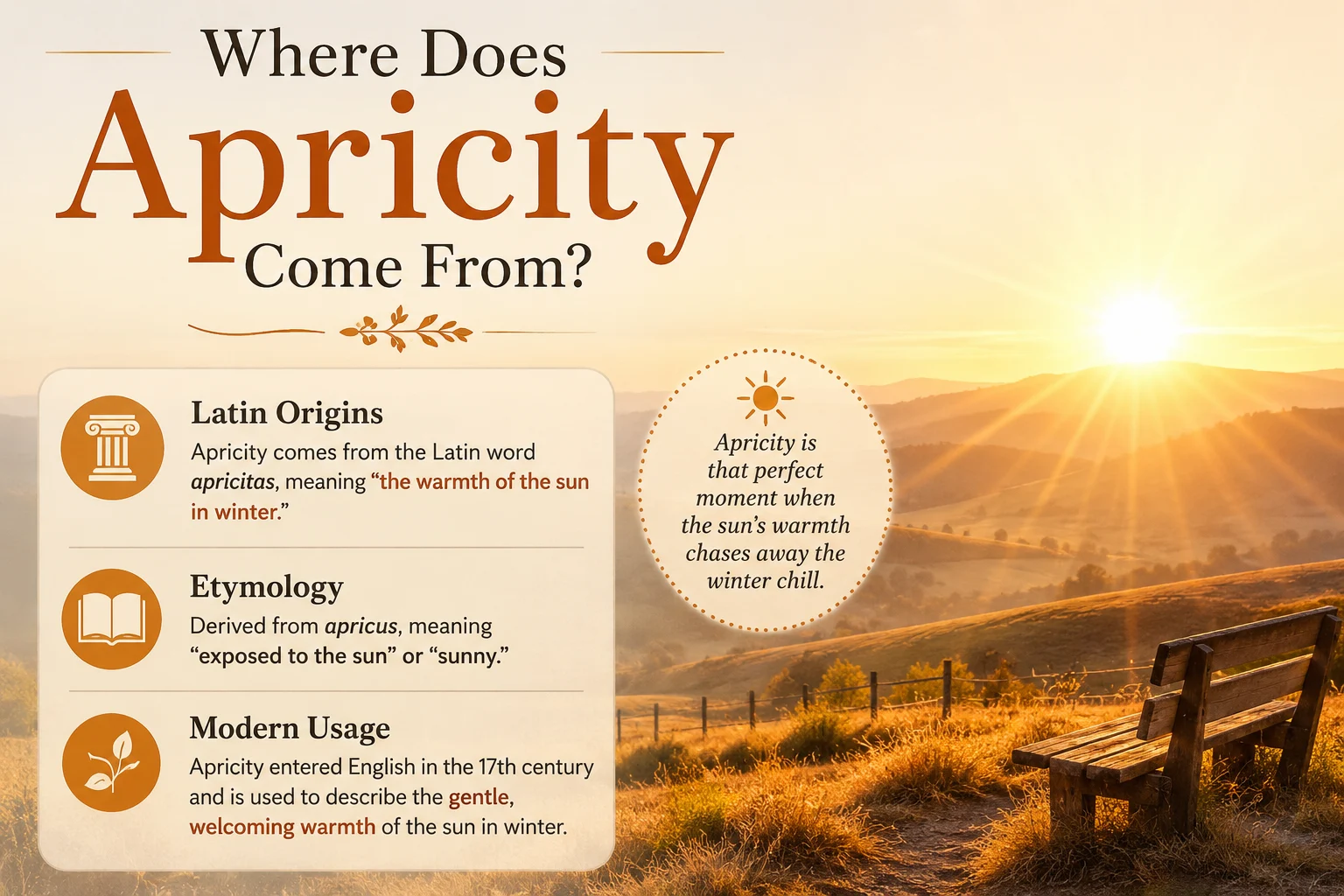
The word traces back to the Latin adjective apricus, meaning “exposed to the sun.” From there it picked up the noun form apricitas, referring to the warmth of sunshine itself, which English absorbed by the 1600s.
It first appeared in English dictionaries as early as the 17th century, including Henry Cockeram’s The English Dictionarie in 1623 — one of the earliest dictionaries of the English language. From there, the word mostly vanished from everyday use, sitting quietly in dictionaries for centuries until word collectors began dusting it off again in recent decades.
That revival is part of a broader fascination with rare and forgotten words. Apricity has become something of a poster child for that movement, since the feeling it names is so universal yet oddly underserved by the rest of the language — part of the wider story of the Latin language shaping English vocabulary.
The Full Apricity Meaning, Explained Simply
Here’s the apricity meaning stripped to its essentials: a noun describing the warmth of the sun, specifically in winter or cold weather. It’s not just “warmth” — it’s warmth that feels like a small gift, because you weren’t expecting it in the middle of the cold.
Picture two scenes: sweating in direct summer heat and looking for shade, versus standing outside on a freezing January morning and finding one patch of sunlight that actually warms your face. Only the second one counts. The contrast is built right into the word — you need the cold as a backdrop for the warmth to register.
Apricity in a Sentence: Real Examples
Seeing the word in context helps it stick far better than any definition alone:
- “We sat on the porch, wrapped in blankets, enjoying the apricity of a clear December afternoon.”
- “There’s a small courtyard at work where I like to catch a bit of apricity on my lunch break.”
- “The dog stretched out on the frost-covered lawn, tilting his face toward the apricity like it was the best thing in the world.”
- “After weeks of grey skies, that single hour of apricity felt like a reward.”
- “Photographers chase apricity in winter because it gives portraits a warm, golden glow without the harsh light of summer.”
Notice that this word almost always pairs with winter, cold, frost, or grey skies — that contrast is part of what makes it work.
Formal vs Informal — When to Use Apricity
Apricity sits comfortably in both formal and casual writing, but its rarity means readers may need context clues either way.
In formal or literary writing, it works beautifully in nature writing, poetry, and descriptive prose where precision matters, signaling a writer reaching for exact language rather than settling for “warm sunshine.”
In casual conversation, the apricity meaning is more of a delightful surprise than an everyday choice — most people will need a quick gloss the first time they hear it. It suits captions on a sunny winter photo or a journal entry, but it’s not the kind of word you’d toss into small talk without a raised eyebrow in return.
Apricity vs Similar Words: A Cheat-Sheet
| Word | Meaning | How it Differs from Apricity |
|---|---|---|
| Apricity | Warmth of the sun in winter | Season-specific; only cold-weather sun |
| Sunshine | Light and warmth from the sun generally | Broad, everyday, no seasonal restriction |
| Warmth | General heat or comfort | Not tied to sunlight or any season |
| Balmy | Mild, pleasantly warm weather | Describes overall weather, not a sunbeam |
| Solstice | Point in the year with shortest/longest day | A date, not a sensation |
| Petrichor | The smell of rain on dry earth | Different sense entirely (smell, not warmth) |
Apricity is the only word here naming one specific sensory experience: sun-warmth against winter cold. That precision is why the apricity meaning is so hard to swap for anything else.
Synonyms and Near-Synonyms for Apricity
No single-word synonym captures the full apricity meaning, but these come close:
- Winter sunshine — the plain, descriptive alternative
- Solar warmth — more technical and clinical in tone
- A sun patch — informal, describes the spot rather than the feeling
- Sunbath (verb: to sunbathe) — related, but usually a summer activity
- Glow — captures the pleasant feeling, though it loses the winter-specific nuance
None of these fully replace the original word, which is really the point — English otherwise lacks a tidy way to say this.
Antonyms of Apricity
Since the apricity meaning is narrow and specific, true antonyms are limited, but these words capture the opposite feeling:
- Chill — the cold itself, with none of the warmth
- Bleakness — the general grey, sunless feeling of deep winter
- Frigidity — extreme cold, without relief
- Gloom — the dim, sunless quality of an overcast day
Common Mistakes to Avoid
A few small mix-ups come up often:
- Confusing it with “apricot.” They look alike on the page but share no connection in meaning.
- Using it for summer heat. Save it for cold-weather sun; a hot July afternoon strips away the apricity meaning.
- Mispronouncing the stress. It lands on the second syllable, not the first.
- Treating it as an adjective. It’s a noun only — “the apricity of the afternoon,” not “an apricity afternoon.”
How to Remember Apricity
Picture “apricot” in a sunny orchard, then swap the fruit for the feeling of sun on your skin. Or link it to the Latin root apricus, meaning “sunny.” Either association gives your brain a hook for the apricity meaning.
Related Words Worth Knowing
A few neighboring words might interest you too:
- Petrichor — the earthy smell after rain, a term you can read more about on Wikipedia
- Komorebi — sunlight filtering through leaves (borrowed from Japanese, not standard English)
- Sonder — the realization that every stranger has a life as vivid as your own
- Gloaming — the soft light of dusk
These belong to a small club of words that name feelings English speakers experience often but rarely had a precise term for — much like the apricity meaning itself.
Frequently Asked Questions
What is the simplest apricity meaning?
The simplest way to explain it: apricity is the warmth of the sun on a cold day. It’s a noun describing that pleasant winter-sun feeling rather than warmth in general.
Is apricity a real word?
Yes, it’s a genuine English word first recorded in the 1600s, though rare in everyday speech, surviving mainly in larger historical and unabridged dictionaries.
How do you pronounce apricity?
It’s pronounced uh-PRISS-ih-tee, or /əˈprɪsɪti/ in IPA, with the stress on the second syllable. Saying it in four short chunks makes it easier to get right.
Is apricity the same as sunbathing?
Not quite. Sunbathing is a deliberate act of lying in the sun, usually a summer activity, while the apricity meaning describes the sensation of winter warmth itself, whether sought out or stumbled into.
What part of speech is apricity?
Apricity is a noun, and the apricity meaning applies only in that form — there’s no standard adjective or verb, so you’d describe “the apricity of the morning” rather than calling something “apricitous.”
Why is apricity considered a rare word?
It fell out of everyday use for centuries after first appearing in early dictionaries. Its recent revival comes largely from word-lovers and language blogs highlighting forgotten vocabulary with vivid, specific meanings.
Can apricity be used in everyday conversation?
It can, though most listeners won’t recognize it right away. It works nicely in writing or conversations with people who enjoy language, where the apricity meaning becomes part of the fun to explain.
Does apricity have a plural form?
In practice, no — it’s an uncountable noun, similar to “warmth” or “sunlight,” so you wouldn’t say “apricities.”
Final Thoughts
Apricity is one of those small, specific words that makes you wonder why it isn’t more common — English has plenty of gaps like this, and this one names a genuinely pleasant feeling. Once you know the apricity meaning, that patch of winter sun on a park bench or a kitchen windowsill has a word attached to it, and the moment feels a little more memorable.
Next time you catch that warmth on a cold day, you’ll have the exact word for it. If you enjoyed learning the apricity meaning, check the full entry on Merriam-Webster to keep exploring rare vocabulary like this one.