Apres is a French word meaning “after” that’s used in English, particularly in the phrase apres-ski (the social activities and socializing that happen after a day of skiing). While the literal translation is simply “after,” the English usage of apres meaning carries connotations of relaxation, celebration, and leisure time following an event or work. Understanding apres meaning opens the door to grasping an entire cultural concept tied to fun and socializing. For more insights, read here:- angel number meaning and amos meaning
- What Does Apres Mean?
- Pronunciation & Spelling
- The Definition Explained
- Examples of Apres in Sentences
- Formal vs. Informal Usage
- Synonyms & Related Words
- Etymology & Origin
- Common Mistakes & Misconceptions
- Related Vocabulary & Phrases
- Quick Memory Tips
- Frequently Asked Questions
- What is the apres meaning in modern English?
- Is "apres" used outside of skiing contexts?
- Should I use an accent on the 'e'?
- Is apres considered a French word or an English word?
- Can I use "apres" on its own, without "ski"?
- Why is apres associated with luxury or sophistication?
- What's the difference between "apres" and "after-party"?
- How common is "apres" in everyday English?
- Conclusion
| Term | Meaning | Common Use |
|---|---|---|
| Apres | After (French); socializing after an event | Apres-ski parties, apres events |
| Apres-ski | Activities/socializing after skiing | “Let’s hit the bars for some apres-ski” |
| Apres-work | Socializing after work | Happy hour, apres-work drinks |
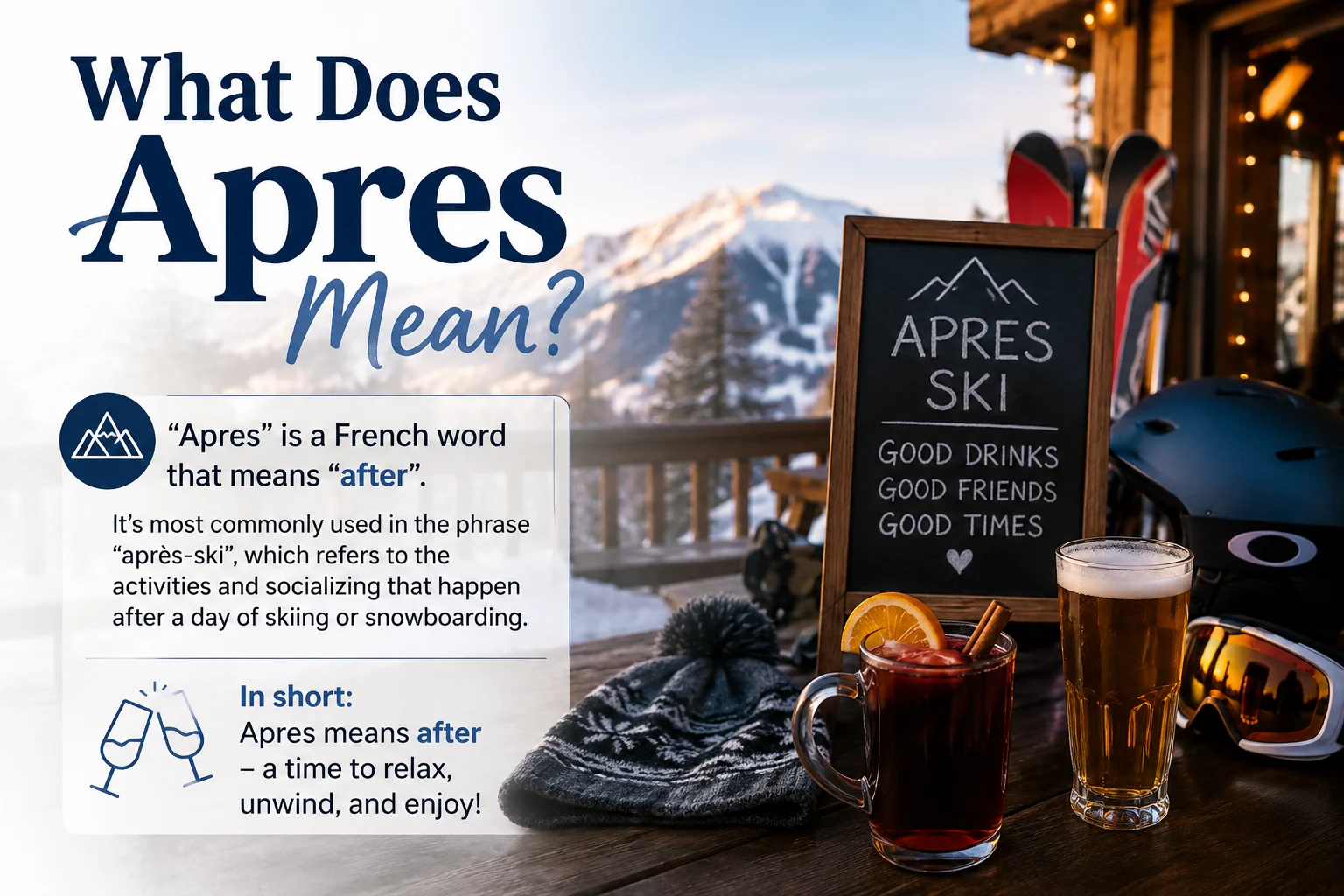
What Does Apres Mean?
The word apres comes directly from French and translates to “after.” In its native language, it’s a preposition—simple and straightforward. However, when adopted into English, it’s evolved into something more layered. Many people ask about apres meaning specifically because the word carries cultural weight beyond its literal translation.
In English, apres meaning extends beyond the literal translation. It now describes the vibe, activities, and social atmosphere that unfold after a primary event concludes—especially skiing. Think of it as the fun, relaxed part that comes next.
The most famous use is apres-ski. Picture this: you’ve spent the day carving down mountain slopes, your legs are tired, your cheeks are windburned. Then you head to the lodge, peel off your gear, and step into a world of cozy fireplaces, mulled wine, live music, and friends. That’s the apres experience. It’s the reward, the celebration, the social payoff.
Pronunciation & Spelling
Pronunciation: The apres pronunciation is roughly “ah-PRAY” or “ap-RAY,” with a soft, silent ‘s’ at the end—very French. In IPA: /ə ˈpreɪ/.
In English, you’ll see it written as:
- Apres (standalone, less common)
- Apres-ski (hyphenated, most common)
- Après (occasionally, with the French accent, though this is less necessary in English)
Getting the pronunciation right helps you sound confident when discussing apres meaning in conversation.
The Definition Explained
At its core, apres meaning is about timing and atmosphere. Let’s break it down:
Literal level: After, following, subsequent to.
Cultural level: The social, leisure-focused activities and ambiance that emerge after a primary event—particularly skiing, but also work, sports competitions, or parties.
Emotional level: Relaxation, celebration, camaraderie, letting loose after effort or exertion.
Understanding apres meaning requires grasping these layers. This is why you don’t hear people say “the apres meeting” or “the apres commute.” The word carries positive, social baggage. It implies fun is coming next.
Examples of Apres in Sentences
Apres-ski context:
- “After a long day on the slopes, we looked forward to the apres scene at our favorite mountain bar.”
- “The resort’s apres-ski program includes live DJs, fondue dinners, and hot tubs.”
- “She’s an apres-ski enthusiast—she might not be the best skier, but she never misses the apres-ski parties.”
Broader usage:
- “The apres-work drinks spot has become our team’s Thursday ritual.”
- “They hosted an apres-concert gathering at their apartment for friends.”
- “The apres-game tailgate was just as memorable as the match itself.”
These examples show how apres meaning adapts across different social situations.
Formal vs. Informal Usage
Formal contexts: Rarely used in formal writing. You might see it in hospitality marketing (“Enjoy our apres amenities”), event planning, or travel brochures. Generally reserved for lifestyle or leisure contexts. Academic or business writing wouldn’t naturally incorporate apres meaning into formal prose.
Informal/Spoken: This is where apres meaning shines. It’s conversational, playful, and increasingly recognized in casual English. “Fancy some apres?” feels natural among friends planning a night out.
Written vs. Spoken: In writing, it tends to appear in apres-ski compounds (marketing copy, travel blogs, resort websites). Spoken English is looser—people might use it more freely and creatively.
Geographic note: More prevalent in skiing countries and mountain communities—Austria, Switzerland, France, Colorado, Canada—but understood globally thanks to tourism and social media.
Synonyms & Related Words
| Synonym | How It Differs |
|---|---|
| Afterwards | More formal, less leisure-focused |
| After-party | Less elegant, more party-centric |
| Hangout | Casual, American; no sense of “after an event” |
| Social hour | Broader, less tied to a preceding activity |
| Celebration | About marking success, not the time period itself |
| Unwinding | Describes the mood, not the timing/venue |
Etymology & Origin
Apres meaning comes from French, where “après” (with the accent) simply means “after.” The French have used it for centuries as an everyday preposition—après demain (day after tomorrow), après vous (after you).
When skiing culture exploded in European Alps resorts during the mid-20th century, the social tradition of gathering after skiing became known as apres-ski in French. As skiing tourism spread globally—especially to North America—the term traveled with it, becoming absorbed into English. The concept of apres meaning evolved as resorts marketed these social experiences.
The word was popularized by resort marketing, ski magazines, and holiday travel culture. By the 1960s-70s, apres-ski was a recognized English term, even if it retained its French spelling and pronunciation.
Today, the broader concept of “apres” has loosened from skiing alone and entered lifestyle vernacular more broadly—apres-work, apres-sport, even apres-wedding gatherings.
Common Mistakes & Misconceptions
Mistake 1: Thinking apres is English. It’s French, though it’s now embedded in English usage. Don’t apologize for pronouncing it with a soft French accent—that’s correct.
Mistake 2: Assuming it always follows a hyphen. You can say “apres-ski” or describe something as having “that apres vibe,” but standalone “apres” usage is less common in English. When referencing apres meaning, you can write it as one or two words.
Mistake 3: Using it generically for “later.” Apres isn’t just any “after”—it’s specifically the social, leisure-focused after. You wouldn’t say “apres breakfast” to mean “after breakfast at 9 AM.” It’s about the experience, not just the time.
Mistake 4: Misspelling. It’s “apres” in English (without the French accent on the ‘e’), though “après” isn’t wrong—just more formally French.
Related Vocabulary & Phrases
- Apres-ski (noun): The social scene after skiing
- Apres-ski (adjective): “Apres-ski attire,” “apres-ski crowd”
- Apres-work: Social gathering after the workday (gaining popularity)
- Apres-sport: Post-game or post-match social activities
- Apres-party: Similar to after-party, but with an elegant edge
When & How to Use Apres Correctly
Use apres when:
- You’re describing social activities after skiing or a sport.
- You want to sound cosmopolitan or leisure-focused.
- You’re marketing a resort, event, or gathering.
- You’re among people familiar with the term (travelers, skiers, urbanites).
Avoid apres when:
- The context is purely temporal—just say “after.”
- Your audience won’t recognize the term (non-English speakers, unfamiliar readers).
- You’re writing formal academic or business prose.
Tone: Apres carries a playful, sophisticated, aspirational tone. It suggests indulgence, relaxation, and good times. Use it when you want that vibe. The apres meaning in any context should feel celebratory.
Quick Memory Tips
The “A” trick: Apres = After + Posh (it’s the fancier way to say the social scene after an event).
Visual link: Picture the apres-ski—slopes in the background, a fireplace glow in the foreground. The apres is the cozy, warm part that comes next.
Rhyme help: Apres rhymes with “spray” or “day”—”ah-PRAY.”
Frequently Asked Questions
What is the apres meaning in modern English?
The apres meaning in today’s English refers to the social, leisure-filled atmosphere following a primary event, especially skiing. It’s evolved from a French word into a lifestyle concept that conveys relaxation, celebration, and camaraderie.
Is “apres” used outside of skiing contexts?
Yes, increasingly. While apres-ski remains the primary use, modern English speakers now use “apres” for work drinks (apres-work), post-game gatherings (apres-sport), even after-wedding parties. The concept has broadened beyond skiing.
Should I use an accent on the ‘e’?
In English, it’s optional. “Apres” (no accent) is standard English spelling. “Après” (with accent) is more formally French. Either works, though “apres” is cleaner for English text.
Is apres considered a French word or an English word?
It’s borrowed from French, so it’s technically a French loanword in English—similar to “café” or “résumé.” Dictionaries now list it in English, so it counts as English vocabulary, even if it maintains French heritage.
Can I use “apres” on its own, without “ski”?
Rarely, and only informally. “What’s the apres like here?” or “Let’s check out the apres” might work among friends, but it’s less common than “apres-ski.” The apres meaning feels strongest when paired with a specific activity.
Why is apres associated with luxury or sophistication?
Because it emerged from Alpine ski resort culture—historically an upscale leisure activity. The term carries those connotations of privilege, relaxation, and the “good life.” It’s evolved into a lifestyle word understood by aspirational audiences.
What’s the difference between “apres” and “after-party”?
After-party is purely functional and neutral—it’s a party that happens after something. Apres implies a certain elegance, leisure, and cultural sophistication. Apres-ski is more refined than “skiing after-party.”
How common is “apres” in everyday English?
Among travelers, skiers, and lifestyle enthusiasts, fairly common. In everyday speech for most English speakers, rare. It’s a niche but recognized term—understood by most educated speakers, actively used by some, never used by others.
Conclusion
Apres meaning boils down to this: it’s the French word for “after,” now embraced in English to describe the social, leisure-filled atmosphere and activities that follow a primary event—most famously skiing, but increasingly any social occasion worth celebrating. It’s a word that carries connotations of relaxation, camaraderie, and letting loose after effort. Understanding apres meaning means grasping not just a translation, but a lifestyle concept.
The apres meaning is the vibe, the reward, the social payoff. Whether you’re planning a mountain getaway, a team outing, or simply want to sound a bit more cosmopolitan in conversation, knowing when and how to use “apres” will serve you well.
For more vocabulary insights and lifestyle language exploration, browse our guides to French loanwords and other fascinating words that shaped modern English on SmartWording.