

EXTRA Meaning .The word “extra” usually means additional, more than necessary, or beyond what is expected. In informal English and modern slang, calling someone “extra” can also mean they are being overly dramatic, exaggerated, or attention-seeking.
- What Does EXTRA Mean?
- EXTRA Meaning in Slang
- EXTRA Meaning in Texting and Social Media
- What Does “Being Extra” Mean?
- EXTRA Meaning in Everyday English
- EXTRA as a Noun
- EXTRA as an Adverb
- Is EXTRA a Positive or Negative Word?
- EXTRA Meaning in Different Contexts
- In Conversation
- In Slang
- At Work
- In Dating
- In Fashion and Lifestyle
- Synonyms for EXTRA
- Antonyms of EXTRA
- Examples of EXTRA in Sentences
- Common Misunderstanding About EXTRA
- Is EXTRA Rude?
- EXTRA Meaning in Simple English
- EXTRA Meaning as Slang
- What Does “Being Extra” Mean?
- EXTRA Meaning in Text Messages
- EXTRA Meaning on Social Media
- EXTRA Meaning in Dating
- EXTRA Meaning in the Workplace
- EXTRA Meaning in Fashion and Style
- EXTRA Meaning in Everyday Speech
- EXTRA Meaning as a Noun
- EXTRA Meaning as an Adverb
- Is EXTRA a Positive or Negative Word?
- Synonyms for EXTRA
- EXTRA Meaning With Real-Life Examples
- Common Phrases With EXTRA
- Extra Time
- Extra Money
- Extra Effort
- Extra Special
- Being Extra
- EXTRA vs. Excessive
- EXTRA vs. Dramatic
- EXTRA vs. Over-the-Top
- Is Calling Someone EXTRA an Insult?
- Can EXTRA Be a Compliment?
- Why Does EXTRA Have Different Meanings?
- Quick Guide to EXTRA Meaning
- Frequently Asked Questions About EXTRA Meaning
- What is the basic EXTRA meaning?
- What does “you are so extra” mean?
- Is “extra” slang?
- Is being extra good or bad?
- What is another word for extra in slang?
- Can I use extra in professional English?
- Final Thoughts
The exact meaning of “extra” depends on the context. It can describe an additional item, an amount beyond what is needed, a person’s behavior, or something unusually elaborate.more clicks:-steadfast or librarian .
What Does EXTRA Mean?
EXTRA is commonly used as an adjective, noun, and adverb in different contexts.
As an adjective, “extra” means additional or more than the usual amount.
Example:
- “I ordered an extra coffee for my friend.”
It can also describe something that goes beyond what is necessary.
Example:
- “We brought extra blankets in case it gets cold.”
In informal speech, “extra” can describe someone who behaves in an exaggerated or dramatic way.
Example:
- “She brought a full cake to a casual study session. She is so extra.”
Here, “extra” does not mean “additional.” It means the person’s behavior is more elaborate or dramatic than the situation requires.
EXTRA Meaning in Slang
In slang, “extra” usually describes someone who is overly dramatic, excessive, flashy, or doing more than necessary.
For example:
- “Why are you being so extra?”
- “He is extra for no reason.”
- “That outfit is extra, but I love it.”
- “She made the whole situation extra.”
When used this way, “extra” can be playful rather than genuinely insulting. Friends may call each other “extra” when someone reacts dramatically, dresses very boldly, or puts an unusual amount of effort into something.
The tone matters. “You’re so extra” could be affectionate teasing, mild criticism, or a compliment depending on the situation.
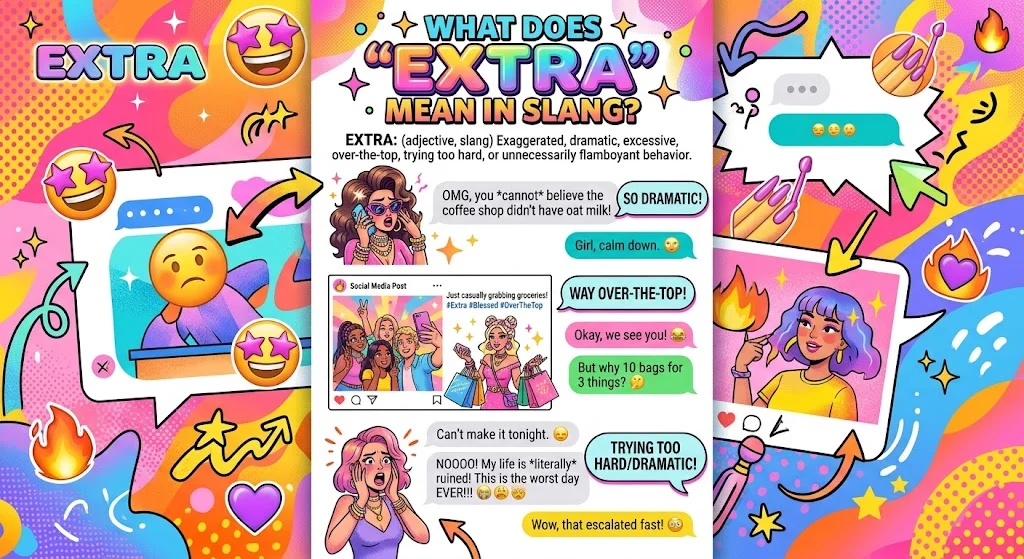
EXTRA Meaning in Texting and Social Media
In texting and online conversations, “extra” is often used casually to comment on someone’s behavior.
Someone might write:
“Bro, you’re extra 😂”
This generally means, “You’re being overly dramatic or doing too much.”
Another example is:
“Why did you decorate your entire room for one birthday? So extra.”
Online, the word can also describe an exaggerated aesthetic, reaction, outfit, or lifestyle.
However, “extra” is not limited to social media. It is also common in everyday spoken English.
What Does “Being Extra” Mean?
“Being extra” means acting in an exaggerated, dramatic, elaborate, or excessive way.
For example:
- “Stop being extra and just tell me what happened.”
- “He was being extra about a tiny mistake.”
- “I know I’m being extra, but I want everything to be perfect.”
The phrase “doing too much” is often close in meaning to “being extra.”
EXTRA Meaning in Everyday English
Outside slang, “extra” most commonly means something added to the normal amount.
Examples include:
- “Do you need extra time?”
- “Please bring an extra chair.”
- “We have extra food.”
- “There is an extra charge for delivery.”
- “I packed an extra shirt.”
In these examples, “extra” has no slang meaning. It simply refers to something additional.
EXTRA as a Noun
“Extra” can also function as a noun.
It may refer to something additional or an added amount:
- “The hotel charges extra for breakfast.”
- “I paid extra for faster shipping.”
In film and television, an “extra” is a person who appears in the background without having a major speaking role.
Example:
- “She worked as an extra in a movie.”
This is a well-established meaning and is different from the slang use.
EXTRA as an Adverb
“Extra” can also be used informally to mean particularly or very.
For example:
- “I’m extra tired today.”
- “This coffee is extra strong.”
- “Be extra careful on the stairs.”
This use is especially common in casual speech.
Is EXTRA a Positive or Negative Word?
“Extra” can be either positive or negative depending on context.
When describing unnecessary behavior, it may sound critical:
- “You’re being extra.”
When describing style or effort, it can be positive:
- “Her outfit is extra, and that’s exactly why it works.”
It can also be neutral:
- “I brought an extra notebook.”
Therefore, you should consider the surrounding words and the speaker’s tone before deciding what “extra” means.
EXTRA Meaning in Different Contexts
In Conversation
In ordinary conversation, “extra” often means additional.
Example:
- “Would you like extra sauce?”
In Slang
In slang, “extra” can mean dramatic, excessive, or over-the-top.
Example:
- “He is being extra about the smallest problem.”
At Work
At work, “extra” generally retains its standard meaning.
Example:
- “The manager gave us extra time to finish the project.”
Calling a coworker “extra” may sound informal or judgmental, so it is usually better suited to casual conversation.
In Dating
In dating conversations, “extra” can describe someone who is making a situation unnecessarily complicated or dramatic.
Example:
- “He was being extra because I didn’t reply immediately.”
It can also be playful:
- “She went extra with the date decorations.”
In Fashion and Lifestyle
“Extra” may describe something bold, elaborate, luxurious, or intentionally attention-grabbing.
Example:
- “Her party dress is extra, but it suits her personality.”
Synonyms for EXTRA
Depending on the meaning, useful synonyms include:
- Additional
- Added
- More
- Spare
- Excess
- Surplus
- Excessive
- Over-the-top
- Dramatic
- Exaggerated
- Elaborate
- Unnecessary
Not all of these synonyms work in every context. For example, “additional” works well for the standard meaning, while “dramatic” or “over-the-top” is closer to the slang meaning.
Antonyms of EXTRA
Depending on the context, possible opposites include:
- Necessary
- Essential
- Basic
- Minimal
- Ordinary
- Limited
- Standard
- Simple
Examples of EXTRA in Sentences
Here are examples showing the different meanings of “extra”:
- “Can I have an extra slice of pizza?”
- “We need extra chairs for the guests.”
- “She is being extra about a simple misunderstanding.”
- “He went extra with his birthday decorations.”
- “I paid extra for the premium service.”
- “Please be extra careful while driving.”
- “The director hired several extras for the crowd scene.”
- “I always carry an extra phone charger.”
- “That reaction was a little extra.”
- “Her outfit is extra, but she looks amazing.”
Common Misunderstanding About EXTRA
A common misunderstanding is assuming that “extra” always means dramatic or excessive.
It does not.
The traditional meaning is simply additional or more than the usual amount. The slang meaning developed from the broader idea of going beyond what is necessary.
For example, “extra money” normally means additional money, while “you’re extra” is likely to describe someone’s behavior.
The context determines the intended meaning.
Is EXTRA Rude?
“Extra” is not inherently rude or offensive.
When used as slang to describe a person, however, it can sound critical because it suggests that someone is being excessive or dramatic. Among friends, it is often harmless teasing.
For formal or sensitive situations, clearer language such as “overly dramatic,” “excessive,” or “more elaborate than necessary” may be more appropriate.
EXTRA Meaning: Slang, Usage, Examples, and Contexts
Understanding the EXTRA meaning depends heavily on context. In standard English, “extra” usually refers to something additional or more than what is normally needed. In informal language, however, the EXTRA meaning can describe a person who is dramatic, excessive, flashy, or doing more than necessary.
Because the word appears in everyday speech, texting, workplace conversations, entertainment, and slang, its meaning can shift slightly depending on how it is used.
EXTRA Meaning in Simple English
The simplest EXTRA meaning is “additional” or “more than usual.”
For example:
- “Can I get an extra chair?”
- “We brought extra food.”
- “I need extra time to finish the assignment.”
- “She bought an extra notebook.”
In these sentences, “extra” simply identifies something additional.
However, the EXTRA meaning changes when the word is used to describe someone’s personality or behavior.
For example:
“Why are you being so extra?”
Here, “extra” means that the person is acting overly dramatic, exaggerated, or excessive.
EXTRA Meaning as Slang
The slang EXTRA meaning is closely connected with the idea of doing more than a situation requires.
Someone may be called “extra” when they:
- Overreact to a small situation
- Make something unnecessarily complicated
- Dress in an unusually dramatic way
- Put excessive effort into something
- Seek attention through exaggerated behavior
- Turn a simple event into something elaborate
For example:
“She brought a professional camera to take pictures at a casual dinner. She is so extra.”
The speaker is probably teasing the person for going beyond what was necessary.
The slang EXTRA meaning is not always negative. Depending on tone, it can be humorous, affectionate, complimentary, or mildly critical.
What Does “Being Extra” Mean?
“Being extra” means behaving in a way that seems exaggerated, dramatic, elaborate, or excessive.
For example:
“Stop being extra and just tell me what happened.”
Here, the speaker thinks the other person is making the situation more dramatic than necessary.
Another example is:
“I know I’m being extra, but I want every detail to be perfect.”
In this sentence, the speaker recognizes that they are putting unusually high effort into something.
The phrase “being extra” therefore has a more informal meaning than the standard use of “extra.”
EXTRA Meaning in Text Messages
The EXTRA meaning is especially easy to notice in casual text conversations.
A friend might send:
“You’re so extra 😂”
This usually means:
“You are being dramatic.”
The laughing emoji can make the comment sound playful rather than insulting.
Another example:
“Why did you send me five paragraphs? You’re extra.”
Here, the speaker is joking about someone giving an unusually long response.
The meaning depends on the relationship between the people involved. A close friend may use “extra” as harmless teasing, while the same comment from a stranger could sound judgmental.
EXTRA Meaning on Social Media
On social media, “extra” can describe exaggerated reactions, elaborate outfits, dramatic posts, or an unusually elaborate lifestyle.
For example:
“That birthday setup is extra!”
This could mean that the setup is very elaborate or impressive.
Similarly:
“Her reaction was extra.”
This suggests that her reaction appeared much stronger or more dramatic than the situation required.
The EXTRA meaning in online conversations is therefore often connected with exaggeration and excess rather than simply “additional.”
EXTRA Meaning in Dating
In dating conversations, “extra” can describe someone who appears overly dramatic, demanding, or elaborate.
For example:
“He got extra after I didn’t reply for an hour.”
This suggests that his reaction became unnecessarily dramatic.
However, “extra” can also be positive in dating and relationships.
For example:
“She went extra for their anniversary and planned an entire weekend.”
Here, “extra” suggests considerable effort and attention rather than bad behavior.
The tone determines whether the EXTRA meaning is positive or negative.
EXTRA Meaning in the Workplace
In professional English, “extra” most often has its ordinary meaning of additional.
Examples include:
- “We need extra staff today.”
- “The client requested extra information.”
- “Please allow extra time for testing.”
- “There is an extra charge for urgent delivery.”
Using “extra” as slang at work can be less appropriate, especially in formal communication.
For example, saying “The manager is being extra” is casual and potentially judgmental. A professional alternative would be:
“The manager is being unusually demanding.”
Therefore, the EXTRA meaning should be interpreted carefully in professional settings.
EXTRA Meaning in Fashion and Style
In fashion, “extra” can describe an outfit that is bold, elaborate, glamorous, or attention-grabbing.
For example:
“Her red-carpet look is extra, but it works perfectly.”
Here, “extra” can be a compliment.
Someone might also say:
“That jacket is a little extra for a casual lunch.”
In this case, the word suggests that the clothing is more dramatic or elaborate than the occasion requires.
The EXTRA meaning in fashion can therefore range from playful criticism to genuine praise.
EXTRA Meaning in Everyday Speech
Outside slang, “extra” is one of the most common words for describing something additional.
Consider these examples:
“I need an extra day.”
“Would you like extra sauce?”
“Take an extra blanket.”
“We have an extra ticket.”
In each example, the EXTRA meaning is simply “additional.”
This is different from:
“You’re being extra.”
The first group uses the standard dictionary sense, while the second uses the informal sense.
EXTRA Meaning as a Noun
“Extra” can also work as a noun.
For example:
“The restaurant charges extra for delivery.”
Here, “extra” refers to an additional amount or cost.
Another established use appears in movies and television. An “extra” is a person who appears in the background of a production, usually without a major speaking role.
For example:
“She worked as an extra in a television drama.”
This EXTRA meaning is different from the slang use and should not be confused with “being extra.”
EXTRA Meaning as an Adverb
In informal English, “extra” can also be used to emphasize an adjective or describe an increased degree.
Examples include:
- “Be extra careful.”
- “I’m extra tired today.”
- “This coffee is extra strong.”
- “Please be extra quiet.”
In these examples, “extra” means something like “particularly” or “especially.”
This use is common in casual speech and does not carry the dramatic slang meaning.
Is EXTRA a Positive or Negative Word?
The EXTRA meaning can be positive, negative, or neutral.
When it means additional, the word is usually neutral:
“I brought an extra charger.”
When it describes exaggerated behavior, it can be negative:
“Why are you being so extra?”
When it describes impressive effort or style, it can be positive:
“She went extra with the decorations, and everyone loved them.”
This flexibility is one reason context is so important when interpreting the word.
Synonyms for EXTRA
The best synonym depends on which EXTRA meaning is intended.
For the standard meaning, useful alternatives include:
- Additional
- Added
- Spare
- More
- Supplementary
- Surplus
For the informal meaning, alternatives include:
- Dramatic
- Excessive
- Over-the-top
- Exaggerated
- Elaborate
- Flashy
- Overdone
For example, “additional” works well in “extra time,” while “dramatic” is closer to the meaning in “You’re being extra.”
EXTRA Meaning: More Examples, Common Uses, and FAQs
The EXTRA meaning becomes clearer when you compare the word across different situations. Although “extra” commonly means something additional, informal English often uses it to describe exaggerated behavior, strong reactions, or an unusually elaborate style.
EXTRA Meaning With Real-Life Examples
Here are some natural examples that show how the EXTRA meaning changes with context:
- “Can I have an extra blanket?”
- Here, “extra” means additional.
- “I ordered an extra meal for my brother.”
- It means one more meal than originally needed.
- “You are being extra about a small mistake.”
- Here, “extra” means overly dramatic.
- “She went extra with her birthday decorations.”
- This suggests that she made the decorations unusually elaborate.
- “Please give me an extra five minutes.”
- The word means additional time.
- “That reaction was so extra.”
- It suggests that the reaction was exaggerated.
- “He always carries an extra charger.”
- Here, “extra” means a spare or additional item.
- “Her outfit is extra, but I love it.”
- The EXTRA meaning here suggests something bold, dramatic, or attention-grabbing.
- “The hotel charges extra for room service.”
- It means an additional cost.
- “Be extra careful when crossing the road.”
- Here, “extra” means especially or particularly.
Common Phrases With EXTRA
The word “extra” appears in many everyday expressions.
Extra Time
“Extra time” means additional time beyond the original amount.
Example:
- “The teacher gave us extra time to complete the test.”
Extra Money
“Extra money” refers to money available in addition to what is normally expected or required.
Example:
- “I saved some extra money for emergencies.”
Extra Effort
“Extra effort” means doing more than the basic amount required.
Example:
- “Her extra effort helped the team finish the project.”
Extra Special
“Extra special” means particularly special or important.
Example:
- “Today feels extra special because my family is here.”
Being Extra
“Being extra” is the informal expression most closely associated with slang.
Example:
- “You’re being extra. It was only a small problem.”
The phrase usually suggests exaggerated behavior.
EXTRA vs. Excessive
“Extra” and “excessive” can sometimes be similar, but they are not always interchangeable.
“Extra” can simply mean additional:
- “I need an extra chair.”
“Excessive” means more than is reasonable or necessary:
- “His spending was excessive.”
When someone says “You’re extra,” the intended EXTRA meaning may be close to “excessive,” but the slang word sounds more casual and conversational.
EXTRA vs. Dramatic
“Dramatic” can describe exaggerated emotional behavior, while “extra” has a broader informal meaning.
For example:
“She was dramatic about the situation.”
This directly describes an exaggerated emotional response.
“She was being extra.”
This can mean she was dramatic, but it could also suggest she was making something elaborate, complicated, or attention-grabbing.
Therefore, “dramatic” is not a perfect replacement for every EXTRA meaning.
EXTRA vs. Over-the-Top
“Over-the-top” is another close expression when “extra” describes something unusually elaborate or exaggerated.
For example:
- “His birthday party was over-the-top.”
- “His birthday party was extra.”
Both sentences can suggest that the celebration was unusually elaborate.
However, “extra” is shorter, more casual, and often more playful.
Is Calling Someone EXTRA an Insult?
Not necessarily.
The meaning depends on tone, relationship, and situation.
Among friends, someone might say:
“You’re so extra 😂”
as a playful joke.
In another situation, saying:
“You’re always extra.”
could sound like criticism.
If you are unsure how someone will interpret the word, more specific language is safer. Instead of saying someone is “extra,” you could say they are being dramatic, enthusiastic, elaborate, or overly cautious, depending on what you actually mean.
Can EXTRA Be a Compliment?
Yes. The EXTRA meaning can be positive when it refers to impressive effort, style, or enthusiasm.
For example:
“She went extra for the wedding, and everything looked beautiful.”
Here, “extra” suggests that she made an unusually strong effort.
Similarly:
“That outfit is extra in the best possible way.”
This clearly makes the word positive.
Why Does EXTRA Have Different Meanings?
The different uses of “extra” are connected by the basic idea of going beyond the normal amount.
If you have an “extra” chair, you have one more chair than needed.
If someone is “extra,” they may be doing more than the situation seems to require.
The slang sense therefore builds naturally on the ordinary meaning of the word.
Quick Guide to EXTRA Meaning
| Context | Meaning |
|---|---|
| Extra food | Additional food |
| Extra time | Additional time |
| Extra money | Additional money |
| Extra careful | Especially careful |
| Being extra | Acting dramatically or excessively |
| Extra outfit | Bold or elaborate style |
| Movie extra | Background performer |
| Pay extra | Pay an additional amount |
This quick comparison shows why context matters when interpreting EXTRA meaning.
Frequently Asked Questions About EXTRA Meaning
What is the basic EXTRA meaning?
The basic EXTRA meaning is something additional, added, or beyond the normal amount.
What does “you are so extra” mean?
“You are so extra” usually means that someone is being dramatic, exaggerated, elaborate, or doing more than necessary.
Is “extra” slang?
“Extra” is a standard English word, but it also has an established informal slang use. In slang, it commonly describes exaggerated or excessive behavior.
Is being extra good or bad?
It can be either. The EXTRA meaning may be negative when someone is overreacting, but it can be positive when someone is showing impressive effort or style.
What is another word for extra in slang?
Depending on the situation, alternatives include “dramatic,” “over-the-top,” “excessive,” “exaggerated,” “flashy,” or “overdone.”
Can I use extra in professional English?
Yes. “Extra” is completely normal in professional English when it means additional, such as “extra time,” “extra information,” or “extra costs.” The slang use is more casual.
Final Thoughts
The EXTRA meaning is simple at its core: something that goes beyond the ordinary amount. In everyday English, it usually means additional or added. In informal slang, however, “extra” can describe someone or something that is dramatic, exaggerated, elaborate, or doing more than necessary.
The best way to understand the word is to look at the context. “Extra time” means additional time, while “being extra” usually describes behavior. In fashion, parties, or creative settings, “extra” may even be a compliment for something bold and impressive.
Learning these distinctions makes it easier to understand EXTRA meaning in conversations, text messages, social media posts, and everyday English.
Language changes meaning through context, and “extra” is a useful example of how one familiar word can carry both a straightforward dictionary meaning and a modern informal sense.
