DTR meaning stands for “define the relationship,” a conversation two people have to clarify exactly what their relationship is — whether they’re exclusive, casually dating, or something else entirely. It’s a common dating term used when the status of a relationship feels unclear and someone wants honest clarity. This guide covers when to have the conversation, how to start it, and how it compares to other common dating terminology. For more insights, read here:- ate and left no crumbs meaning and bffr meaning.
- DTR Meaning: The Direct Definition
- Why DTR Conversations Matter So Much
- Origin of DTR as Slang
- How DTR Became Common Dating Vocabulary
- The Psychology Behind Wanting to DTR
- DTR and Attachment Styles
- How People Use DTR in Texting and Dating Apps
- When to Have the DTR Talk
- How to Initiate a DTR Conversation
- DTR in Different Relationship Stages
- Is DTR Only for Romantic Relationships?
- Why DTR Conversations Can Feel Stressful
- DTR vs. Similar Dating Terms
- Common Misunderstandings About the DTR Meaning
- DTR in Modern Dating Culture
- DTR and Long-Distance or Online-First Relationships
- What Happens After a DTR Conversation
- DTR and Friendship Circles
- DTR as a Sign of Emotional Maturity
- Common Phrases Used to Bring Up DTR
- DTR Across Different Dating App Cultures
- How to Use DTR Correctly in a Sentence
- Frequently Asked Questions
- What does DTR mean in dating?
- When is the right time to DTR?
- Is DTR only used for exclusivity conversations?
- Can DTR conversations end badly?
- Who should initiate the DTR talk?
- Is DTR used outside romantic relationships?
- Does DTR guarantee a relationship will work out?
- Is it normal to feel relieved after a DTR conversation?
- Conclusion
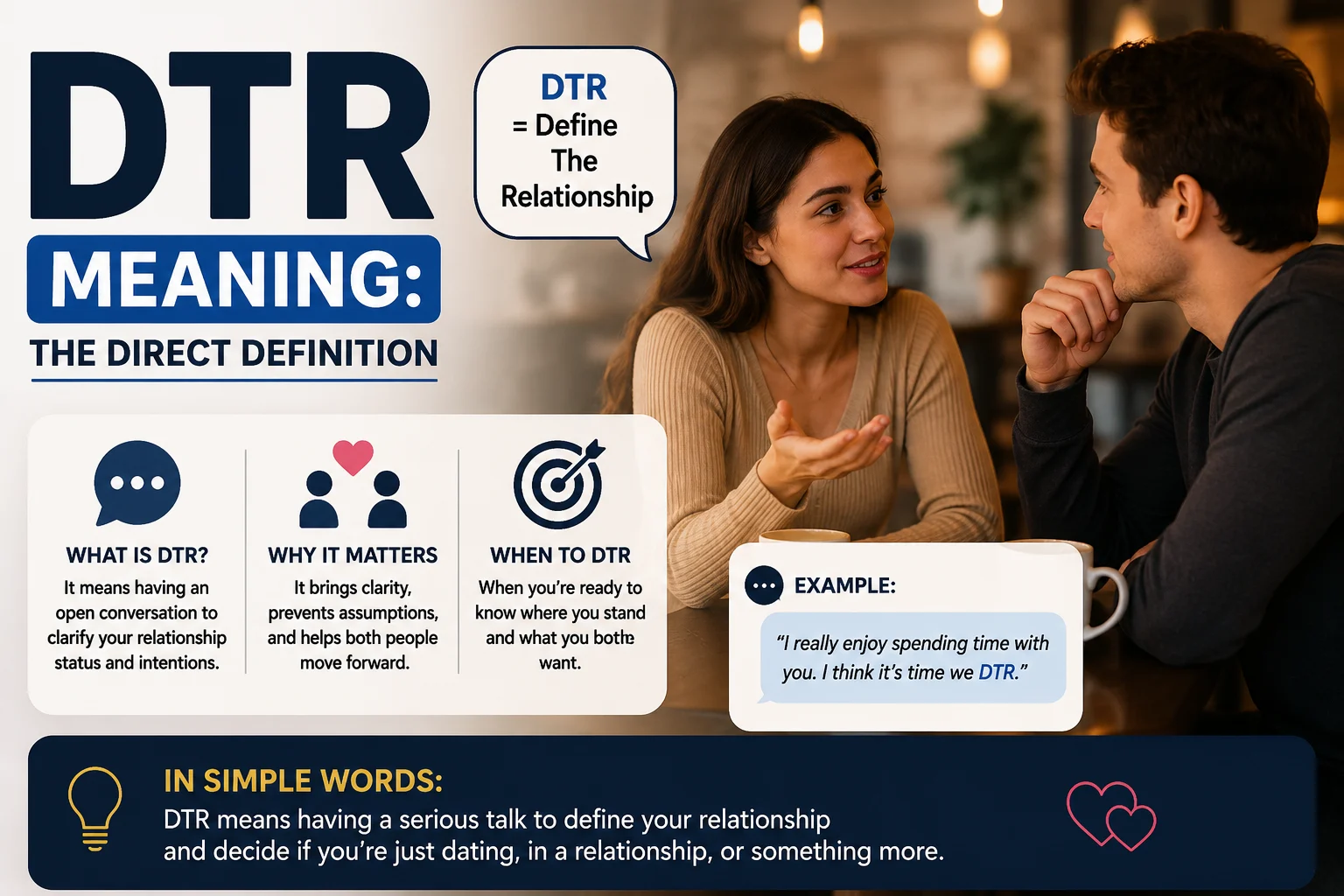
DTR Meaning: The Direct Definition
At its core, dtr meaning centers on clarity and honest communication. A “DTR talk” happens when one or both people in a dating situation want to move past ambiguity and openly discuss where things stand — are you exclusive, casually seeing each other, or looking for something more serious? The conversation itself is often referred to simply as “having the DTR.”
This isn’t a formal, scripted conversation with fixed rules. It’s simply shorthand for any direct discussion aimed at replacing assumptions and uncertainty with actual clarity about a relationship’s status.
Why DTR Conversations Matter So Much
Part of why dtr meaning carries so much weight is what’s at stake emotionally when two people are dating without a clear label attached to what they’re doing. Ambiguity can feel exciting early on, but over time, unclear expectations can quietly cause frustration, hurt feelings, or mismatched investment between two people who may be picturing very different futures for the same relationship.
A direct DTR conversation short-circuits this slow buildup of unspoken assumptions, replacing guesswork with an actual, shared understanding — even when that understanding isn’t the one someone was secretly hoping for, which is ultimately the real value behind dtr meaning as a concept.
Origin of DTR as Slang
Dtr meaning developed as an abbreviation within dating and relationship culture, particularly gaining traction alongside the rise of dating apps and more casual, undefined dating situations becoming increasingly common. As dating norms shifted away from clearly defined stages toward more ambiguous arrangements, having language to specifically request clarity became genuinely useful, and “DTR” filled that need efficiently.
Because exact origins of casual dating slang are rarely documented in real time, and because abbreviations like this spread informally through conversation and social media before appearing in any dictionary, the specific point at which “DTR” became widely recognized shorthand should be treated as a general pattern rather than a firmly dated history.
How DTR Became Common Dating Vocabulary
Like many contemporary dating terms, dtr meaning spread gradually through everyday conversation, social media, dating advice content, and online discussion about relationships, becoming a widely recognized shorthand well before it appeared in more formal dictionaries or style guides. Once a term becomes useful enough to fill a genuine communication gap, it tends to spread quickly among people navigating similar situations.
Because tracking the exact spread of dating slang in real time is difficult, any detailed claim about precisely when or how “DTR” crossed into widespread mainstream use should be treated as an approximate pattern rather than a precisely documented timeline.
The Psychology Behind Wanting to DTR
Understanding dtr meaning also means understanding the psychological need behind it. Humans generally prefer clarity over ambiguity, especially in situations involving genuine emotional investment. Uncertainty about where a relationship stands can create ongoing low-level anxiety, even in otherwise happy, positive dating situations, simply because the brain naturally seeks resolution when something important remains unresolved.
This psychological pull toward clarity helps explain why DTR conversations, despite feeling nerve-wracking beforehand, often bring genuine relief afterward — regardless of whether the specific answer was the one someone was hoping to hear, simply having clarity tends to reduce the background anxiety that ambiguity creates.
DTR and Attachment Styles
Different people may feel differently about when and how urgently they want to have a DTR conversation, and this can sometimes connect to broader patterns in how individuals generally approach closeness and uncertainty in relationships. Someone who values clarity and reassurance might want to have the conversation earlier, while someone more comfortable with ambiguity might feel less urgency around defining things quickly.
Because individual differences in relationship style are complex and shouldn’t be reduced to simple labels, any specific claims connecting DTR timing preferences to broader psychological patterns should be treated as general observation rather than a clinical or definitive framework.
How People Use DTR in Texting and Dating Apps
The abbreviation shows up constantly in texting between people navigating dating situations, as well as in broader conversations among friends discussing their own relationships. Someone might text a friend “I think it’s time for the DTR talk,” or ask directly “can we DTR this weekend?” using the term as shorthand for a serious, clarifying conversation.
This usage tends to carry a slightly nervous but hopeful tone, since the conversation itself often feels emotionally significant. Understanding dtr meaning in this context mostly comes down to recognizing that it represents a genuine, sometimes vulnerable request for honesty rather than a casual, low-stakes chat.
Scrolling through dating advice content or relationship discussion threads is often the easiest way to see this pattern of dtr meaning discussed openly and thoughtfully.
When to Have the DTR Talk
Timing matters significantly when it comes to dtr meaning in practice. Having the conversation too early, before either person has built much emotional investment, can feel premature or overly formal. Waiting too long, once assumptions have already hardened into unspoken expectations, can create confusion or hurt feelings if those assumptions turn out to be mismatched.
There’s no universal, correct timeline for when a DTR conversation should happen, since every relationship develops at its own pace. Many people look for signs like consistent time spent together, emotional closeness, or simply their own growing need for clarity as reasonable indicators that dtr meaning conversation is worth having sooner rather than later.
How to Initiate a DTR Conversation
Approaching dtr meaning in practice often feels more manageable with a clear, direct opening rather than a vague or indirect hint. Simple, honest phrasing — “I really like where this is going, and I wanted to talk about what we’re looking for” — tends to work better than dropping subtle hints and hoping the other person picks up on them.
Choosing a calm, private moment, rather than bringing it up during an argument or a rushed, distracted moment, generally helps the conversation go more smoothly. Because every relationship and personality is different, there’s no single perfect script for approaching dtr meaning in real life, but honesty and directness consistently make these conversations easier for both people involved.
DTR in Different Relationship Stages
Dtr meaning can apply at different points depending on the specific relationship. Early on, it might simply clarify whether two people are exclusively dating or still seeing other people. Later, in longer, more established relationships, a similar conversation might address bigger milestones, like moving in together or long-term commitment, even though the word “DTR” is used somewhat less often at that more advanced stage.
Regardless of timing, the underlying purpose of dtr meaning stays consistent: replacing assumption and ambiguity with clear, mutual understanding about where the relationship actually stands.
Is DTR Only for Romantic Relationships?
Overwhelmingly, yes. Dtr meaning is almost always used specifically within dating and romantic contexts, rather than platonic friendships or professional relationships. While people occasionally use the abbreviation loosely or jokingly outside dating — like humorously “DTR-ing” a close friendship — this remains a playful exception rather than the term’s standard, established use.
Because casual, joking usage can vary widely and isn’t consistently documented, any claim about how commonly the term gets applied outside dating specifically should be treated as anecdotal rather than a firmly established secondary meaning.
Why DTR Conversations Can Feel Stressful
Understanding dtr meaning also means understanding why these conversations often carry real emotional weight. Bringing up the topic risks vulnerability — there’s a real possibility the other person isn’t on the same page, which can feel scary regardless of how the relationship has been going so far.
This emotional weight is completely normal, and feeling nervous before a DTR conversation doesn’t mean something is wrong with the relationship itself. Many people find that even a difficult or disappointing DTR conversation ultimately provides valuable clarity, even when the answer isn’t what they hoped to hear.
DTR vs. Similar Dating Terms
Several other terms overlap with dtr meaning, though each carries a slightly different emphasis. “Exclusive” describes the specific outcome some DTR conversations aim for — agreeing not to date other people. “Situationship” describes an undefined, often prolonged romantic connection that hasn’t gone through a DTR conversation at all, which is often exactly the kind of ambiguity that eventually prompts one. “Official” casually describes a relationship status once it’s been clearly defined, often as a direct result of a DTR talk.
Understanding these related terms helps clarify exactly where dtr meaning fits within the broader vocabulary people use to describe modern dating stages and relationship ambiguity.
Common Misunderstandings About the DTR Meaning
One common misunderstanding assumes a DTR conversation always ends in exclusivity or a clearly positive outcome. In reality, these conversations can lead to several different results — mutual exclusivity, an agreement to keep things casual, or even the realization that both people want different things entirely.
Another misunderstanding treats dtr meaning as inherently dramatic or confrontational. While the conversation can feel emotionally significant, it doesn’t have to be tense or accusatory; many DTR talks happen calmly and even naturally as part of an already open, communicative relationship.
A third misunderstanding assumes only one person can initiate a DTR conversation, typically imagined as whoever is more emotionally invested. In practice, either person in a relationship can reasonably bring up the topic, and doing so isn’t a sign of weakness or excessive attachment.
DTR in Modern Dating Culture
The rise of dating apps and increasingly casual, undefined dating norms has made dtr meaning more relevant than ever, since ambiguous situations — talking to multiple people, unclear exclusivity, or undefined “hanging out” versus “dating” — have become genuinely common. The abbreviation reflects a broader cultural need for language specifically addressing this kind of romantic uncertainty.
Because dating norms and terminology shift over time and vary across different communities and generations, general claims about exactly how common DTR conversations are within any specific dating culture should be treated as a broad impression rather than precisely measured data.
DTR and Long-Distance or Online-First Relationships
Dtr meaning takes on particular importance in long-distance relationships or connections that began primarily online, where physical distance and limited in-person time can make assumptions about status even easier to misread than usual. Two people texting regularly for months without meeting in person, for example, might genuinely disagree about whether they’re “together” without ever having explicitly discussed it.
In these situations, a DTR conversation often becomes especially valuable precisely because so much of the relationship happens through text or video calls, where tone and intent can be harder to read accurately than in face-to-face interaction — another reminder that dtr meaning matters just as much in digital-first relationships as in traditional ones.
What Happens After a DTR Conversation
Once a dtr meaning conversation happens, the outcome can look different depending on what both people decide. Some couples move into an explicitly exclusive relationship, others agree to continue casually dating with clearer expectations, and some realize their goals don’t align and decide to part ways. None of these outcomes represents a “failed” DTR conversation — the success of the conversation lies in the honesty and clarity it produces, not in any single expected result.
Following up with continued open communication after the initial conversation also tends to matter, since a single DTR talk doesn’t necessarily resolve every future question that might come up as the relationship continues to develop.
DTR and Friendship Circles
Beyond the couple involved, dtr meaning conversations often become a topic of discussion within friend groups, especially before they happen. Friends frequently give advice, share their own DTR experiences, or help someone rehearse what they want to say, reflecting just how common and relatable this particular dating milestone has become in everyday conversation.
This social dimension highlights how dtr meaning extends beyond just the two people directly involved — it’s become a recognizable, shared cultural reference point that many people discuss openly with friends, rather than something kept entirely private in most modern dating circles.
DTR as a Sign of Emotional Maturity
Choosing to have a direct dtr meaning conversation, rather than avoiding the topic indefinitely, is often viewed as a sign of emotional maturity and genuine respect for the other person’s time and feelings. Avoiding the conversation out of fear of the answer can feel easier in the short term, but it often prolongs uncertainty for both people involved.
This doesn’t mean every DTR conversation needs to happen immediately or without any hesitation — nervousness is completely normal — but choosing honesty over indefinite ambiguity is generally seen as a healthier, more respectful approach to modern dating.
Common Phrases Used to Bring Up DTR
Because starting a dtr meaning conversation can feel intimidating, many people rely on a few tried-and-true conversational openers rather than improvising entirely from scratch. Phrases like “I want to make sure we’re on the same page,” “can we talk about where this is going,” or “I’ve really enjoyed getting to know you and want to check in” all serve as gentle, non-confrontational ways to open the topic.
These kinds of openers work well because they signal genuine interest and care rather than pressure or ultimatum, setting a collaborative tone right from the start of what can otherwise feel like an intimidating dtr meaning conversation to initiate.
DTR Across Different Dating App Cultures
Because dtr meaning is so closely tied to modern, app-based dating, the specific expectations around timing can vary somewhat depending on which platform or dating culture two people are navigating. Apps oriented toward casual dating may see DTR conversations happen later or less frequently, while apps or communities more focused on serious relationships might see them happen earlier and more explicitly as a normal part of the process.
Because dating app cultures and norms shift frequently and vary by platform, region, and user base, specific claims about how DTR timing differs across particular apps should be treated as a general impression rather than firmly documented data about dtr meaning conversations specifically.
How to Use DTR Correctly in a Sentence
Because the term shows up across a few related contexts, it helps to see a few natural examples. As a request: “Can we DTR sometime this week? I want to know where we stand.” As a description: “We finally had the DTR talk, and we’re officially exclusive now.” As advice between friends: “You’ve been seeing him for two months — maybe it’s time to DTR.”
In each case, “DTR” signals a direct, clarifying conversation about relationship status, fitting naturally into both casual conversation and more serious, reflective discussions about dating.
Frequently Asked Questions
What does DTR mean in dating?
Dtr meaning stands for “define the relationship,” a conversation clarifying whether two people are exclusive, casually dating, or something else.
When is the right time to DTR?
There’s no fixed timeline. Many people look for signs like consistent time together and growing emotional closeness as reasonable indicators the conversation is worth having.
Is DTR only used for exclusivity conversations?
Mostly, though it can apply to other relationship clarity conversations too, including bigger milestones in more established relationships.
Can DTR conversations end badly?
Yes, sometimes. They can reveal mismatched expectations, which is uncomfortable in the moment but often provides valuable long-term clarity.
Who should initiate the DTR talk?
Either person in the relationship can reasonably bring it up; it isn’t a sign of weakness or excessive attachment to want clarity.
Is DTR used outside romantic relationships?
Rarely, and usually only jokingly. The term is almost exclusively associated with dating and romantic relationship contexts.
Does DTR guarantee a relationship will work out?
No. It only guarantees clarity, not a specific outcome; the relationship’s long-term success depends on far more than a single conversation.
Is it normal to feel relieved after a DTR conversation?
Yes, very commonly. Even when the answer isn’t exactly what someone hoped for, most people report feeling relieved simply to have clarity instead of ongoing uncertainty.
Conclusion
DTR meaning ultimately comes down to one empowering idea: clarity in relationships, replacing assumption and uncertainty with honest, direct conversation. Whether the outcome is exclusivity, clarity around staying casual, or the realization that two people want different things, having the DTR talk consistently offers something valuable — real understanding instead of guesswork.