Extra meaning slang overdramatic examples are useful for understanding how the word “extra” can describe behavior that feels excessive, dramatic, elaborate, or far beyond what a situation requires. In everyday slang, saying someone is “extra” often means they are doing too much or reacting in a way that seems bigger than necessary.
- What Does Extra Mean in Slang?
- Extra Meaning Slang Overdramatic Examples Explained Simply
- The Simple Definition of Extra
- Extra Has More Than One Meaning
- Why Does Extra Mean Overdramatic?
- Overdramatic Examples of “Extra” in Everyday Life
- Example 1: The Tiny Problem
- Example 2: The Missed Reply
- Example 3: The Restaurant Choice
- Example 4: The Birthday Party
- Example 5: The Homework
- Example 6: The Small Argument
- Extra Meaning in Texting
- Extra Meaning on Social Media
- Extra Meaning in Dating
- Extra Meaning in Friendships
- Extra Meaning at Work
- Is Extra a Positive or Negative Word?
- Extra vs. Dramatic
- Extra vs. Over-the-Top
- Extra vs. Doing Too Much
- Extra vs. Excessive
- Extra and Personality
- Extra and Fashion
- Extra and Celebrations
- Extra and Storytelling
- Can Extra Mean Attention-Seeking?
- Common Misunderstandings About Extra
- How to Know Which Meaning Is Intended
- Examples of “Extra” in Short Conversations
- Conversation 1
- Conversation 2
- Conversation 3
- Conversation 4
- Example Sentences for Natural Usage
- When Should You Use Extra?
- Is Saying “You’re Extra” Offensive?
- The Tone Can Change the Meaning
- Does Extra Have a Positive Slang Meaning?
- Origin of Extra
- Related Words and Expressions
- Over-the-top
- Dramatic
- Excessive
- Doing too much
- Overboard
- Theatrical
- Extravagant
- Extra Meaning Slang Overdramatic Examples in One Quick Guide
- Quick Comparison Table
- Final Conclusion
- Frequently Asked Questions
- What does extra mean in slang?
- What does “you’re being extra” mean?
- Is extra a bad word?
- Can extra be a compliment?
- What is another word for extra slang?
- Does extra only mean overdramatic?
For example, if someone gets a small scratch and acts as though they have survived a major disaster, a friend might laugh and say, “You’re being extra.” The expression can be playful, teasing, critical, or even positive depending on the situation.
The standard meaning of “extra” is still “additional” or “more than usual.” However, dictionaries now recognize a slang sense involving excessively elaborate behavior and dramatic or eccentric actions.
This guide explains the extra meaning slang overdramatic examples readers commonly encounter in texting, conversations, social media, dating, friendships, and informal situations.For more insights, read here:- flex meaning slang showing off examples and ft meaning.
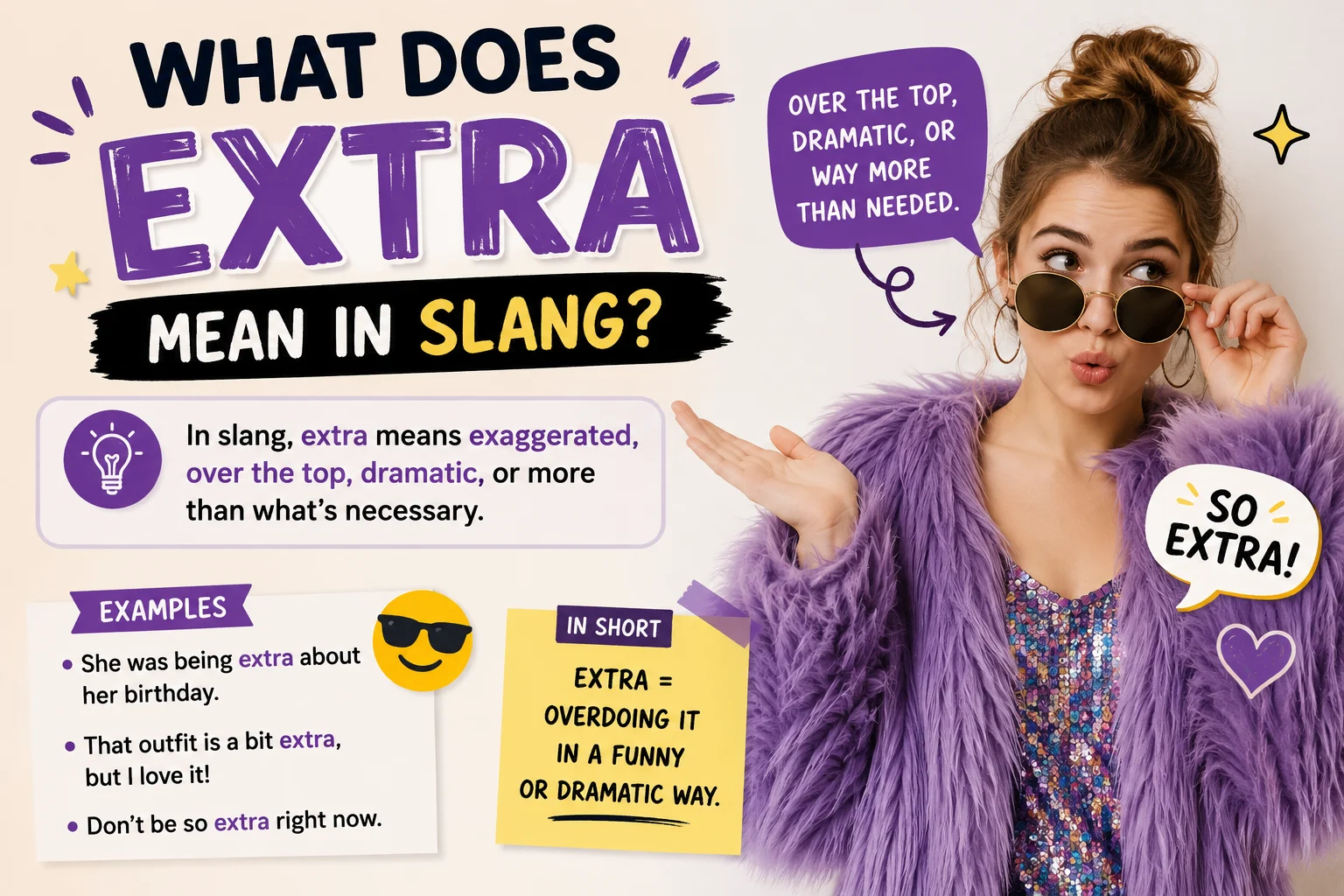
What Does Extra Mean in Slang?
The extra meaning slang overdramatic examples usually point to one central idea: doing more than necessary, especially in a dramatic, excessive, elaborate, or attention-grabbing way.
When someone says, “You’re so extra,” they may mean:
- You are being overly dramatic.
- You are making a small situation seem huge.
- You are putting in more effort than necessary.
- You are behaving in an exaggerated way.
- You are making something unusually elaborate.
- You are going beyond what people expected.
Merriam-Webster records the slang adjective “extra” as going beyond what is usual or standard, including behavior that is dramatic, eccentric, extremely elaborate, or extravagant.
Cambridge similarly defines the slang use as being too extreme, making too much effort, or demanding too much effort and attention.
So, when you hear “She is being extra,” the speaker is usually saying that her behavior has crossed from normal into excessive.
Extra Meaning Slang Overdramatic Examples Explained Simply
The easiest way to understand extra meaning slang overdramatic examples is to imagine a situation where the reaction is much bigger than the actual problem.
Suppose a friend arrives five minutes late.
Instead of calmly saying, “Sorry I’m late,” they dramatically announce:
“My life is officially ruined. Nobody understands what I have been through!”
A friend might respond:
“Okay, you’re being extra.”
The word does not mean that the person is literally “additional.” It means the person’s response is exaggerated.
Another example would be someone losing a video game and immediately throwing themselves onto the couch while announcing:
“I have failed everyone!”
That could also be described as extra.
The important idea is excess. The behavior goes beyond what most people would consider necessary or expected.
The Simple Definition of Extra
In slang, “extra” can mean:
Over-the-top, overly dramatic, excessive, elaborate, or unusually intense.
The expression is informal and often used in conversations between friends.
For example:
“Why are you being so extra?”
This can mean:
“Why are you making such a big deal out of this?”
Likewise:
“That outfit is extra.”
This can mean:
“That outfit is unusually flashy or elaborate.”
Therefore, extra does not always describe emotions. It can describe a person’s appearance, behavior, plans, storytelling, decorations, celebrations, or general style.
Extra Has More Than One Meaning
It is important not to confuse the slang meaning with the ordinary dictionary meaning.
In standard English, “extra” means something additional or more than what is normally included.
For example:
“Can I have an extra chair?”
Here, extra simply means another chair.
“I ordered extra cheese.”
Again, extra means additional.
But:
“You are being extra.”
Here, the word has a slang meaning.
It refers to excessive or dramatic behavior.
The same spelling therefore has different meanings depending on context. This is why extra meaning slang overdramatic examples are particularly useful when learning informal English.
Why Does Extra Mean Overdramatic?
The slang meaning developed from the broader idea of going beyond what is normal, expected, or necessary.
Merriam-Webster explains that the modern slang use is associated with going beyond ordinary limits, including being extremely elaborate or behaving dramatically and eccentrically.
Merriam-Webster’s discussion of the slang usage also explains that this newer sense is associated with going “over the top” rather than merely being additional.
Oxford also recognizes an informal slang sense involving behavior that is too dramatic or involves too much effort.
This makes the development of the meaning fairly logical.
If something is “extra,” it goes beyond the normal amount. If a person is “extra,” their behavior may similarly go beyond what seems normal for the situation.
Overdramatic Examples of “Extra” in Everyday Life
Here are several original examples that make the slang meaning easier to understand.
Example 1: The Tiny Problem
A friend spills a little water on their shirt.
They look at the shirt and say:
“This is the worst day of my entire life.”
Someone nearby laughs:
“You’re so extra.”
The reaction is much larger than the problem.
Example 2: The Missed Reply
Someone sends a text and does not receive a response for ten minutes.
They immediately send:
“Okay, I guess you hate me now.”
Their friend replies:
“Relax. You’re being extra.”
The person is exaggerating the meaning of the delayed reply.
Example 3: The Restaurant Choice
A group cannot decide between two restaurants.
One person dramatically announces:
“If nobody cares about my opinion, I’m leaving.”
Another person says:
“Why are you being so extra?”
The disagreement is small, but the reaction is unusually dramatic.
Example 4: The Birthday Party
Someone turns a simple birthday dinner into a huge event with balloons, lights, flowers, custom signs, a giant cake, and a professional photographer.
A friend says:
“You really went extra for this birthday.”
In this case, extra means elaborate rather than necessarily negative.
Example 5: The Homework
A teacher asks students to make a simple poster.
One student creates a three-dimensional model with lights, sound effects, moving parts, and decorations.
Another student says:
“Okay, you went extra.”
The student did far more than the assignment required.
Example 6: The Small Argument
Two friends disagree about a movie.
One says:
“I can’t believe you would betray me like this.”
The other responds:
“It’s a movie. Stop being extra.”
The phrase points to unnecessary emotional exaggeration.
Extra Meaning in Texting
In texting, “extra” is particularly convenient because it communicates a lot with one short word.
A person might text:
“You’re extra 😂”
This often sounds playful.
Someone might also write:
“Why are you so extra?”
This can be teasing or mildly critical.
Another common use is:
“That was extra.”
This means an action or reaction seemed excessive.
The tone often comes from the surrounding conversation, punctuation, and emojis.
For example:
“You’re so extra 😂😂”
usually feels lighter than:
“You’re being extra.”
The first may be friendly teasing, while the second can sound more critical.
Extra Meaning on Social Media
The slang meaning of extra can also describe social media content that is highly dramatic, elaborate, flashy, or exaggerated.
For example, imagine someone receives a small gift and creates a ten-minute video with dramatic music, cinematic editing, multiple camera angles, and an emotional speech.
A viewer might comment:
“This is so extra.”
The comment does not necessarily mean the video is bad.
It may mean that the creator made the moment much bigger than expected.
However, it is better not to assume that every platform uses the word in exactly the same way. Slang can vary among communities, age groups, regions, and online spaces.
Extra Meaning in Dating
The word “extra” is common in casual conversations about dating because people often use it to describe exaggerated reactions.
For example:
“She didn’t text him back for twenty minutes, and he sent six messages. That’s extra.”
The speaker thinks the reaction is excessive.
Another example:
“He planned a surprise dinner, brought flowers, arranged music, and decorated the entire room.”
Someone might say:
“He went extra for the date.”
Here, the meaning can be positive. The person put in an unusually large amount of effort.
This shows why context matters.
Extra can mean too much, but it can also mean impressively elaborate.
Extra Meaning in Friendships
Friends frequently use “extra” as a playful way to point out exaggerated behavior.
Imagine a friend refusing to eat at a restaurant because the table is missing one particular type of napkin.
You might laugh and say:
“You’re being extra.”
Or imagine a friend becoming dramatically excited about a small piece of good news.
You might say:
“I love how extra you are.”
The same word can therefore become affectionate.
It does not automatically mean criticism.
Extra Meaning at Work
Because “extra” is informal slang, it should be used carefully in professional settings.
Among coworkers who know each other well, someone might say:
“You went extra with that presentation.”
This could mean the presentation has many animations, graphics, transitions, or decorative elements.
However, in a formal report, it would be clearer to say:
“The presentation is more elaborate than necessary.”
Or:
“The presentation contains more detail than required.”
Professional communication usually benefits from precise language rather than casual slang.
Is Extra a Positive or Negative Word?
The answer depends on context.
Extra can be negative when it means:
- Unnecessarily dramatic
- Excessive
- Attention-seeking
- Overcomplicated
- Too demanding
- Over-the-top
For example:
“Stop being extra. It’s not that serious.”
But extra can be positive when it means:
- Creative
- Bold
- Elaborate
- Energetic
- Generous
- Fun
For example:
“She went extra with the decorations, and the party looked amazing.”
Someone may even describe themselves proudly as extra.
In that situation, the person may enjoy being dramatic, stylish, expressive, or extravagant.
Extra vs. Dramatic
“Extra” and “dramatic” overlap, but they are not perfect synonyms.
Dramatic usually focuses on strong emotions, exaggerated reactions, or theatrical behavior.
For example:
“He was dramatic after losing the game.”
Extra is broader.
For example:
“He was extra after losing the game.”
Both sentences can mean that his reaction was excessive.
But you can also say:
“That wedding cake is extra.”
A cake cannot literally have an emotional reaction, so here extra means unusually elaborate or extravagant.
This distinction is important when studying extra meaning slang overdramatic examples.
Extra vs. Over-the-Top
“Over-the-top” is one of the closest expressions to the slang meaning of extra.
Merriam-Webster defines “over-the-top” as going beyond what is expected, usual, normal, or appropriate. It can also describe something extremely or excessively flamboyant or outrageous.
For example:
“That party was extra.”
“That party was over-the-top.”
Both can communicate that the party was unusually elaborate.
The difference is mainly style.
“Extra” sounds shorter, more casual, and more slang-oriented.
“Over-the-top” is also informal but is a more established expression.
Extra vs. Doing Too Much
“Doing too much” is another close expression.
Consider:
“She made a five-minute apology video because she forgot to bring my book.”
Someone might say:
“She is doing too much.”
Another person might say:
“She is being extra.”
Both suggest that the response is excessive.
However, “doing too much” focuses strongly on an action, while extra can describe a person’s general style.
For example:
“He is extra.”
This can describe a personality that is consistently dramatic, expressive, flashy, or elaborate.
Extra vs. Excessive
“Excessive” is more formal than “extra.”
Compare:
“His reaction was excessive.”
with:
“His reaction was extra.”
The first sounds appropriate in formal writing.
The second sounds casual and conversational.
This is one reason the slang sense is more common in speech, texting, entertainment discussions, and informal online communication.
Extra and Personality
Sometimes people use extra to describe a person’s personality rather than one particular action.
For example:
“My sister is so extra.”
This could mean that she is naturally expressive, dramatic, energetic, fashionable, or theatrical.
The statement does not necessarily criticize her.
Someone might even say:
“She is extra, but that’s what makes her fun.”
In this example, extra is almost a compliment.
The speaker appreciates the person’s larger-than-life personality.
Extra and Fashion
The word can also describe clothing or personal style.
For example:
“She wore a sparkling silver jacket, giant boots, and a crown to a casual dinner.”
Someone might say:
“That outfit is extra.”
The speaker may mean the outfit is unusually bold or elaborate.
Again, the meaning does not automatically imply disapproval.
In fashion conversations, being extra can sometimes be intentional and desirable.
Extra and Celebrations
Celebrations are another common area where the slang meaning appears.
Someone might decorate a small apartment with hundreds of balloons for a birthday.
Another person may say:
“You went extra this year.”
The word means that the celebration is more elaborate than ordinary.
The same idea can apply to weddings, proposals, parties, holidays, graduation celebrations, and surprise events.
Extra and Storytelling
A person may also be called extra when telling stories.
Imagine someone describing a normal trip to the grocery store as if it were an action movie.
They might use dramatic pauses, exaggerated gestures, loud reactions, and an extremely detailed description.
A friend may say:
“You’re so extra when you tell stories.”
The speaker is not necessarily accusing the storyteller of lying.
They may simply be pointing out the theatrical style.
Can Extra Mean Attention-Seeking?
Sometimes, yes.
If someone constantly exaggerates their behavior specifically to attract attention, another person may describe them as extra.
For example:
“She made a huge announcement about something that could have been said privately.”
Someone might call that behavior extra.
However, it is important not to treat “extra” as a precise psychological label.
The slang word is usually a casual judgment about behavior, not a formal description of someone’s personality or mental state.
Common Misunderstandings About Extra
One major misunderstanding is thinking that extra always means “dramatic.”
That is not true.
The slang sense can refer to excessive effort or elaborate style even when no emotion is involved.
Another misunderstanding is assuming that extra is always negative.
It can be affectionate or complimentary.
A third misunderstanding is confusing slang extra with ordinary extra.
For example:
“I need extra money.”
This is standard English.
“You are extra.”
This is slang.
The surrounding words tell you which meaning is intended.
How to Know Which Meaning Is Intended
Look at what comes after or around the word.
If someone says:
“Can I get extra sauce?”
The standard meaning is additional.
If someone says:
“She is extra.”
The slang meaning is likely intended.
If someone says:
“That party was extra.”
The meaning may be elaborate or excessive.
If someone says:
“He was extra about the argument.”
The meaning is likely dramatic or exaggerated.
Context provides the answer.
Examples of “Extra” in Short Conversations
Conversation 1
A: “Why did you send me twelve messages?”
B: “Because you didn’t answer!”
A: “I was in the shower.”
B: “Oh.”
A: “You are so extra.”
Conversation 2
A: “I decorated the entire house for movie night.”
B: “For one movie?”
A: “Yes.”
B: “That’s extra, but I respect it.”
Conversation 3
A: “He said he was five minutes away.”
B: “And?”
A: “He arrived six minutes later.”
B: “You were about to write a breakup speech, weren’t you?”
A: “Maybe.”
B: “You’re extra.”
Conversation 4
A: “Why are there 200 balloons?”
B: “It’s her birthday.”
A: “You went extra.”
B: “Obviously.”
Example Sentences for Natural Usage
Here are additional original examples:
- “Don’t be extra; nobody is mad at you.”
- “She got extra excited about the concert.”
- “That response was way too extra.”
- “He went extra with the decorations.”
- “My brother becomes extra whenever guests arrive.”
- “You don’t have to be so extra about a small mistake.”
- “Her outfit was extra, but it looked great.”
- “He gave the story an extra dramatic ending.”
- “That was probably the most extra birthday cake I’ve ever seen.”
- “She loves being extra during celebrations.”
- “Why did you make the announcement so extra?”
- “He was being extra for attention.”
- “The proposal was extra in the best possible way.”
- “You are doing too much and being extra.”
- “That reaction was a little extra.”
- “She can be extra, but she’s usually hilarious.”
- “They went extra for the wedding.”
- “His explanation was unnecessarily extra.”
- “I knew the presentation was going to be extra.”
- “Stop acting extra and tell me what happened.”
When Should You Use Extra?
Use extra in informal situations when you want to describe something as excessive, dramatic, elaborate, flashy, or unusually intense.
It works well with:
- Friends
- Family
- Casual texting
- Informal conversations
- Social media comments
- Entertainment discussions
- Dating conversations
- Friendly teasing
It is less suitable for formal academic or professional writing.
Instead of:
“Your report is extra.”
Use:
“Your report contains unnecessary detail.”
Instead of:
“Your response is extra.”
Use:
“Your response seems unnecessarily strong.”
The formal alternatives communicate the idea more precisely.
Is Saying “You’re Extra” Offensive?
Usually, it is not a serious insult.
However, tone matters.
A close friend may use it affectionately.
A stranger may use it critically.
A manager might use it in a way that sounds dismissive.
Because the word can suggest that someone’s behavior is unnecessary or excessive, it is possible for the listener to take offense.
If you are trying to be polite, consider softer alternatives such as:
“You’re being a little dramatic.”
or:
“That might be a bit much.”
The Tone Can Change the Meaning
Consider the sentence:
“You’re extra.”
It could mean:
“You are hilarious and dramatic.”
Or:
“You are annoying and doing too much.”
The words are identical.
The difference comes from tone, relationship, facial expression, and context.
This is common with slang because slang often communicates attitude as well as literal meaning.
Does Extra Have a Positive Slang Meaning?
Yes. Some dictionary sources recognize positive or broader slang uses of extra, including senses associated with being extremely good, while the more familiar contemporary sense often concerns being over-the-top or excessive.
That means context is especially important.
For example:
“That dessert is extra!”
could mean the dessert is extremely good or impressively elaborate.
But:
“Why are you being extra?”
usually suggests excessive behavior.
The positive interpretation is not always obvious, so readers should avoid assuming that every use is complimentary.
Origin of Extra
The ordinary word “extra” has a long history in English.
Merriam-Webster gives its adjective origin as probably a shortening of “extraordinary.”
Oxford similarly identifies “extra” as a mid-17th-century adjective probably shortened from “extraordinary.”
The modern slang sense developed around the broader idea of going beyond ordinary limits.
Merriam-Webster notes that the slang meaning was added to its dictionary in October 2021, while its usage discussion describes examples of the newer sense in which “extra” means going over the top.
The exact cultural pathway of every modern slang use is more difficult to establish, so specific claims about who first created or popularized the slang meaning should be treated carefully.
Related Words and Expressions
Several words and expressions can communicate similar ideas.
Over-the-top
Means excessively elaborate, extreme, flamboyant, or beyond normal expectations.
Dramatic
Describes behavior or reactions involving unusually strong emotion or theatrical presentation.
Excessive
Means more than is necessary, reasonable, or appropriate.
Doing too much
A casual phrase for behavior that seems unnecessarily intense or elaborate.
Overboard
Means going beyond a reasonable limit.
Theatrical
Can describe behavior that is highly expressive or dramatic.
Extravagant
Describes something unusually elaborate, expensive, or excessive.
These words overlap with extra, but none is a perfect replacement in every situation.
Extra Meaning Slang Overdramatic Examples in One Quick Guide
For readers who want the shortest explanation, remember these patterns:
“You’re extra.”
You are behaving in an overly dramatic or excessive way.
“That outfit is extra.”
The outfit is unusually flashy or elaborate.
“She went extra for the party.”
She put in a lot more effort than expected.
“That reaction was extra.”
The reaction was exaggerated.
“He is always extra.”
He often behaves in a dramatic, expressive, or excessive way.
“That was extra, but I loved it.”
The action was excessive but enjoyable.
These examples cover the most useful everyday meanings.
Quick Comparison Table
Term | Basic Meaning | Example
Extra | Excessive, dramatic, or elaborate | “You’re being extra.”
Dramatic | Showing unusually strong emotion | “He was dramatic about losing.”
Over-the-top | Beyond normal expectations | “The party was over-the-top.”
Doing too much | Acting excessively | “You’re doing too much.”
Excessive | More than necessary | “The reaction was excessive.”
Elaborate | Detailed or carefully developed | “The decorations were elaborate.”
Final Conclusion
The extra meaning slang overdramatic examples show how a familiar English word can develop a more informal meaning. In slang, “extra” often describes someone or something that is over-the-top, dramatic, excessive, elaborate, or doing more than necessary.
When someone says, “You’re being extra,” they usually mean that the person’s reaction or behavior is bigger than the situation requires. The phrase can be teasing, funny, critical, or affectionate depending on context.
The word can also describe fashion, parties, decorations, storytelling, dating behavior, social media content, and other forms of elaborate expression. It does not always have a negative meaning. Sometimes being extra is exactly what makes something memorable, creative, exciting, or fun.
Remember that “extra” also has its ordinary meaning of “additional.” The sentence “I need extra time” has nothing to do with slang. The sentence “You are extra” usually does.
For a broader understanding of the grammatical category involved, see the Wikipedia entry for noun. In everyday conversation, however, the slang meaning is best understood through context and tone.
In short, extra is a flexible informal word for something that goes beyond the expected level. If the behavior feels like “a bit much,” calling it “extra” may be a natural way to describe it.
Frequently Asked Questions
What does extra mean in slang?
Extra means overly dramatic, excessive, elaborate, eccentric, or over-the-top. It often describes someone who is doing more than the situation requires.
What does “you’re being extra” mean?
“You’re being extra” usually means “You are behaving too dramatically or making a bigger deal out of something than necessary.”
Is extra a bad word?
No. Extra is not inherently offensive or negative. It can be playful, critical, affectionate, or complimentary depending on context.
Can extra be a compliment?
Yes. Someone may call an outfit, party, performance, or celebration extra because it is bold, elaborate, impressive, or fun.
What is another word for extra slang?
Possible alternatives include “over-the-top,” “dramatic,” “doing too much,” “excessive,” “overboard,” and “theatrical,” depending on context.
Does extra only mean overdramatic?
No. In slang, it can also describe something unusually elaborate, flashy, eccentric, or excessive. In standard English, it can simply mean additional.