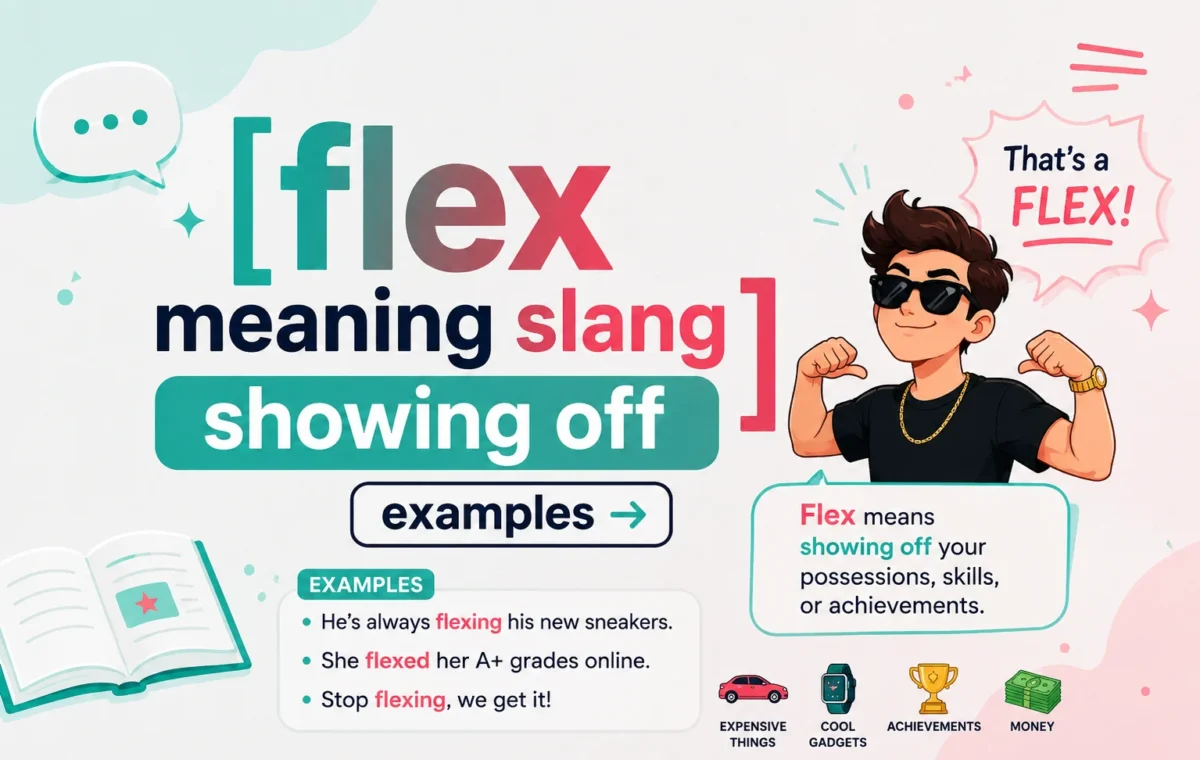
Flex meaning slang showing off examples is a common search phrase for people trying to understand how “flex” is used in modern informal English. In slang, “flex” generally means to show off, boast, or deliberately display something impressive. A person might flex their money, clothes, car, skills, achievements, fitness, gaming abilities, or lifestyle.
- What Does Flex Mean in Slang?
- Flex Meaning Slang Showing Off Examples Explained
- Simple Meaning of Flex
- Flex as a Verb
- Flex as a Noun
- What Does Flexing Mean?
- Is Flex Always About Money?
- Money Flex
- Skill Flex
- Achievement Flex
- Fashion Flex
- Fitness Flex
- Gaming Flex
- Flex Meaning in Texting
- Flex Meaning on Social Media
- What Does “Weird Flex but OK” Mean?
- Flex Meaning in Dating
- Flex Meaning in Gaming
- Flex Meaning at Work
- Is Flex Positive or Negative?
- Positive Flex
- Playful Flex
- Negative Flex
- Is Flex Rude or Offensive?
- Flex vs. Show Off
- Flex vs. Brag
- Flex vs. Flaunt
- Common Flex Examples in Everyday Life
- Flex Meaning Slang Showing Off Examples in Conversations
- Example 1: New Car
- Example 2: Expensive Watch
- Example 3: Academic Achievement
- Example 4: Gaming
- Example 5: Travel
- When Should You Use Flex?
- When Should You Avoid Flex?
- Common Misunderstandings About Flex
- Does Flex Mean Showing Off?
- Related Slang Words
- Show Off
- Brag
- Stunt
- Ball Out
- Humblebrag
- Drip
- Does Flex Have Other Meanings?
- Pronunciation of Flex
- Part of Speech
- Verb
- Noun
- Origin of the Slang Meaning
- Why Do People Say Flex?
- How to Understand Flex From Context
- Frequently Asked Questions About Flex
- What is the flex meaning slang showing off examples?
- What does “I’m flexing” mean?
- What does “that’s a flex” mean?
- What does “nice flex” mean?
- Is flexing the same as bragging?
- Can you flex a skill?
- Is flex slang?
- Is flex offensive?
- Final Takeaway
For example, if someone posts a picture of an expensive new watch mainly to make others notice it, a friend might comment, “Nice flex.” The comment could be sincere, playful, or sarcastic depending on the situation.
The word can also appear as a noun. Someone may say, “That car is a flex,” meaning that the car is an impressive thing being displayed. Dictionary sources recognize the slang senses of “flex” as boasting, bragging, or showing off.
This guide explains the flex meaning slang showing off examples, including texting, social media, dating, gaming, workplace usage, similar slang, tone, and common examples. For more insights, read here:- lowkey obsessed meaning and fym meaning.
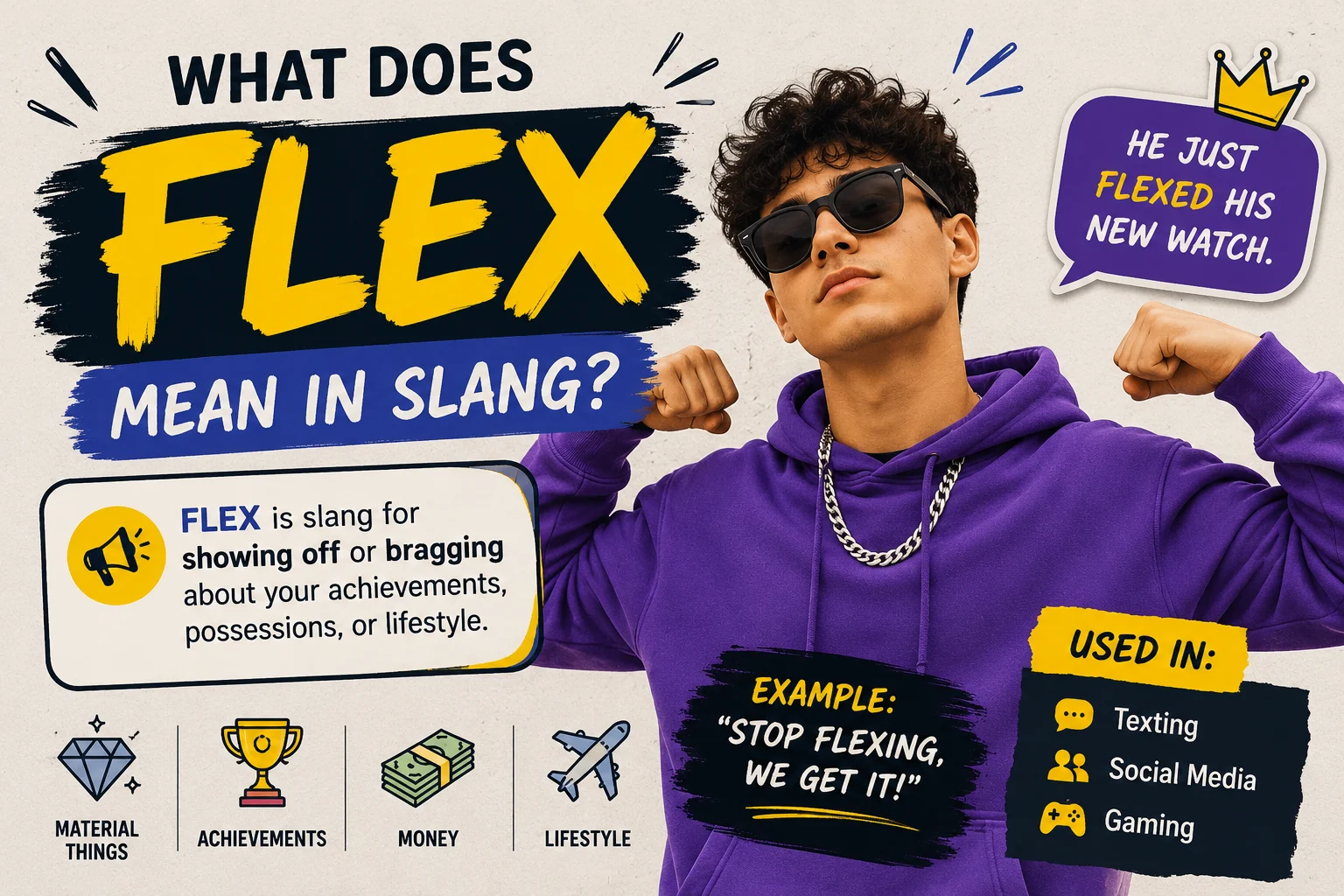
What Does Flex Mean in Slang?
The flex meaning slang showing off examples is simple: “flex” means to show off, boast, or proudly display something that you believe is impressive.
The thing being shown off can be almost anything.
Someone might flex:
- Money
- A new car
- Designer clothing
- Jewelry
- A phone
- Academic achievements
- Athletic ability
- Physical appearance
- Gaming skills
- A rare collection
- Travel experiences
- Professional success
- Social connections
For example:
“Buying that luxury car just to impress people is a flex.”
Here, “flex” refers to the act or display of showing off.
Dictionary.com lists the slang verb “flex” as meaning to boast, brag, or show off, and also recognizes “flex” as a slang noun meaning a boast or brag.
Flex Meaning Slang Showing Off Examples Explained
When people use “flex” in casual conversation, they normally suggest that someone is making an effort to make an impressive quality visible.
For example:
“She keeps flexing her expensive shoes.”
This means she keeps showing her expensive shoes to other people, possibly because she wants attention or admiration.
Another example is:
“That new gaming setup is a huge flex.”
Here, “flex” means the gaming setup is impressive enough to be something worth showing off.
The important point is that flexing does not necessarily mean someone is being dishonest or arrogant. Sometimes it is simply playful language used to describe an impressive achievement or possession.
Simple Meaning of Flex
The simplest definition is:
Flex = show off.
“Flexing” means showing off.
“A flex” means something presented as impressive or boastful.
These forms are related but can function differently in a sentence.
Examples:
- “He likes to flex.” — He likes to show off.
- “She is flexing her new car.” — She is showing off her new car.
- “That car is a flex.” — That car is an impressive display.
- “Nice flex!” — That is an impressive thing to show off.
Flex as a Verb
The most common slang use of “flex” is as a verb.
When used this way, “flex” means to show off or boast about something.
Examples:
“He likes to flex his wealth.”
“She flexed her new shoes.”
“They are flexing their achievements.”
“I’m not trying to flex.”
The ordinary physical meaning of “flex” is connected with bending or contracting something, especially a muscle. The slang sense developed a figurative connection with demonstrating strength, ability, or superiority. Dictionary.com also records the expression “flex one’s muscles” in the sense of showing off strength or power.
Flex as a Noun
“Flex” can also be used as a slang noun.
In this form, a flex is something that someone displays to impress other people.
For example:
“That watch is a serious flex.”
“Getting that scholarship is a major flex.”
“Your new computer is such a flex.”
In each sentence, “flex” describes the impressive display rather than the action of showing it.
This distinction is useful:
Verb: “He flexes his car.”
Noun: “His car is a flex.”
Both sentences communicate the idea of showing something impressive.
What Does Flexing Mean?
“Flexing” is the present participle of “flex.”
In slang, it means actively showing off.
For example:
“Why are you flexing?”
This can mean:
“Why are you showing off?”
The tone can be friendly or critical.
A friend might say:
“Bro, stop flexing!”
while laughing at someone who is showing a new pair of shoes.
In another situation, the same sentence could genuinely criticize someone for constantly bragging.
Context matters.
Is Flex Always About Money?
No.
Money is one common subject of flexing, but it is far from the only one.
A person can flex a skill, achievement, possession, appearance, experience, or connection.
Money Flex
Someone displays wealth or expensive purchases.
Example:
“Posting all those luxury purchases was definitely a money flex.”
Skill Flex
Someone demonstrates an ability that others find impressive.
Example:
“Playing that difficult song perfectly was a serious flex.”
Achievement Flex
Someone highlights a major accomplishment.
Example:
“Graduating at the top of the class was an impressive flex.”
Fashion Flex
Someone displays expensive or fashionable clothing.
Example:
“Those limited-edition sneakers are a huge flex.”
Fitness Flex
Someone shows physical strength, athletic results, or a transformed physique.
Example:
“Posting that workout result was a fitness flex.”
Gaming Flex
Someone displays a rare item, high ranking, difficult achievement, or exceptional gaming ability.
Example:
“That rare game skin is a serious flex.”
Flex Meaning in Texting
In texting, “flex” is usually casual slang for showing off.
A person might text:
“Nice flex 😂”
This could mean:
“Nice thing to show off.”
The laughing emoji can make the message more playful.
Another example:
“Bro is flexing again.”
This usually means:
“He is showing off again.”
Friends may use the word teasingly without actually criticizing the person.
For example:
Person A: “Look at my new phone!”
Person B: “Okay, flex!”
Person B probably understands that Person A is proud of the phone and is joking about the display.
Flex Meaning on Social Media
Social media provides many situations in which people use the word “flex.”
A person might upload a photograph of:
- A luxury vehicle
- An expensive outfit
- A vacation
- A new home
- A fitness achievement
- A professional award
- A rare collectible
- A gaming setup
Someone viewing the post may respond:
“That’s a flex.”
The phrase does not automatically accuse the poster of arrogance. It can simply acknowledge that the post highlights something impressive.
The phrase “weird flex but OK” is a related internet expression used sarcastically when someone boasts about something unusual or questionable. Dictionary.com describes it as a mocking response to an unusual boast and documents its development as an internet catchphrase.
What Does “Weird Flex but OK” Mean?
“Weird flex but OK” means roughly:
“That is a strange thing to brag about, but I’ll accept it.”
It is usually humorous or sarcastic.
For example:
Person A: “I stayed awake for 48 hours just to finish a TV series.”
Person B: “Weird flex but OK.”
The second person is jokingly treating the unusual achievement as something the first person is proudly displaying.
The phrase became associated with internet culture and social media, but its exact usage can vary by community.
Flex Meaning in Dating
The word can also appear in dating conversations.
A person might say:
“He was flexing his career during the date.”
This means he was emphasizing his professional success to impress the other person.
Another example:
“She posted all her travel photos as a little flex.”
Here, “flex” suggests that the photos communicate an attractive or impressive lifestyle.
However, someone showing their accomplishments is not automatically flexing. The word usually implies some degree of deliberate display or emphasis.
Flex Meaning in Gaming
Gaming communities can use “flex” to describe impressive achievements, rare items, rankings, equipment, or skills.
Examples:
“That rare skin is a flex.”
“Her ranking is a serious flex.”
“He’s flexing his tournament trophy.”
“Winning that match was the ultimate flex.”
In gaming, “flex” may also have other specialized meanings depending on the particular game. For example, some communities use “flex” to describe versatility or the ability to perform different roles.
Therefore, the exact meaning should always be interpreted from the surrounding conversation.
Flex Meaning at Work
“Flex” can appear in informal workplace conversations, particularly when people are talking casually about achievements.
For example:
“Getting promoted that quickly is a flex.”
This means the promotion is an impressive accomplishment.
Another example:
“Her ability to speak five languages is a serious flex.”
This uses “flex” humorously to recognize an impressive skill.
However, “flex” is informal slang. In formal reports, business documents, academic writing, or professional correspondence, words such as “demonstrate,” “highlight,” or “showcase” may be more appropriate.
Is Flex Positive or Negative?
The tone of “flex” depends heavily on context.
Positive Flex
Someone can use “flex” as a compliment.
“That car is a flex.”
This may mean:
“That car is extremely impressive.”
Playful Flex
Friends may use the word jokingly.
“Okay, Mr. Millionaire, stop flexing!”
The speaker may not genuinely believe the person is arrogant.
Negative Flex
The word can also criticize someone.
“He never stops flexing his money.”
This suggests the speaker thinks the person shows off too much.
Therefore, the flex meaning slang showing off examples can range from admiration to teasing to criticism.
Is Flex Rude or Offensive?
“Flex” is generally informal rather than offensive.
It is not normally considered a swear word or an inherently insulting expression.
However, the expression can become negative when it is used to accuse someone of arrogance.
For example:
“Stop flexing.”
This could sound dismissive.
Similarly:
“He is always flexing his wealth.”
This may suggest that the speaker dislikes the person’s behavior.
The surrounding tone, relationship, and situation determine how harsh the expression sounds.
Flex vs. Show Off
“Flex” and “show off” are closely related.
Show off is a standard informal English expression meaning to display something in order to attract admiration or attention.
Flex is more slang-oriented and often sounds more modern and casual.
Compare:
“He likes to show off his new car.”
“He likes to flex his new car.”
The basic meaning is similar, but the second sentence has a stronger slang and conversational feel.
Flex vs. Brag
“Brag” usually focuses more on talking proudly about something.
“Flex” can involve both talking and displaying.
For example:
“He bragged about his salary.”
This emphasizes what he said.
“He flexed his expensive watch.”
This emphasizes what he displayed.
A person can do both at the same time.
Flex vs. Flaunt
“Flaunt” means to display something proudly or openly, often in a way that attracts attention.
“Flex” is more casual slang.
For example:
“She flaunted her wealth.”
“She flexed her wealth.”
The first sounds more formal or literary, while the second sounds more conversational and slang-heavy.
Common Flex Examples in Everyday Life
Here are some natural examples of the word in use:
- “That new car is a serious flex.”
- “He keeps flexing his expensive sneakers.”
- “She wasn’t trying to flex; she was just excited.”
- “Nice flex with the new watch.”
- “Getting first place was a huge flex.”
- “His cooking skills are an underrated flex.”
- “That gaming setup is definitely a flex.”
- “Stop flexing your vacation pictures.”
- “Her ability to speak several languages is a powerful flex.”
- “He bought the phone mainly to flex.”
- “That collection is an impressive flex.”
- “Winning against the champion was a major flex.”
- “She posted the award as a small flex.”
- “Your new shoes are quite a flex.”
- “He wasn’t bragging, but everyone called it a flex.”
Flex Meaning Slang Showing Off Examples in Conversations
Example 1: New Car
Person A: “I finally bought my dream car.”
Person B: “Okay, that’s a flex!”
Here, “flex” is playful and positive.
Example 2: Expensive Watch
Person A: “This watch cost more than my first car.”
Person B: “Bro, stop flexing.”
Here, “flexing” is used to tease someone for showing off.
Example 3: Academic Achievement
Person A: “I got the highest grade in the class.”
Person B: “That’s a pretty good flex.”
This is mostly complimentary.
Example 4: Gaming
Person A: “I unlocked the rarest item in the game.”
Person B: “Huge flex.”
This means the achievement is impressive.
Example 5: Travel
Person A posts photographs from an expensive vacation.
Person B comments:
“Nice flex.”
The comment may be sincere or sarcastic depending on their relationship.
When Should You Use Flex?
Use “flex” when the conversation is casual.
Good situations include:
- Text messages
- Casual conversations
- Social media comments
- Memes
- Informal posts
- Friendly jokes
- Online communities
Examples:
“That’s a flex.”
“Stop flexing.”
“Nice flex!”
“Bro is flexing again.”
These expressions sound natural in informal communication.
When Should You Avoid Flex?
Avoid “flex” in highly formal writing unless you are specifically discussing slang.
For example, instead of writing:
“The manager flexed his achievements.”
A formal version could be:
“The manager highlighted his achievements.”
Instead of:
“She was flexing her professional experience.”
You could write:
“She emphasized her professional experience.”
This is because “flex” has a strongly informal tone in this sense.
Common Misunderstandings About Flex
One common misunderstanding is that flex always means someone is arrogant.
That is not true.
“Flex” can be playful, complimentary, or critical.
Another misunderstanding is that flexing always involves expensive possessions.
It does not.
A person can flex a talent, achievement, skill, appearance, or experience.
A third misunderstanding is that every social-media post showing something impressive is automatically a flex.
Not necessarily.
The word often suggests that the person is intentionally emphasizing the impressive quality. Simply sharing good news does not always mean someone is showing off.
Does Flex Mean Showing Off?
Yes, in modern slang, one of the established meanings of “flex” is to show off, boast, or brag. Dictionary.com explicitly lists the slang verb as meaning to boast or brag and the noun as a boast or brag.
The word can describe:
- The action of showing off
- The thing being shown off
- A boast
- An impressive display
For example:
“He flexed his new car.”
“The car was a flex.”
Both sentences are connected to the same basic idea.
Related Slang Words
Several slang expressions can overlap with “flex.”
Show Off
To deliberately display something in order to attract attention or admiration.
Brag
To talk proudly about yourself, your achievements, or possessions.
Stunt
To make an attention-grabbing display, often involving style, money, or status.
Ball Out
To spend or live extravagantly.
Humblebrag
To boast while pretending to be modest.
Drip
Slang associated with impressive or fashionable clothing and style. It can overlap with flexing when someone shows off an outfit.
These words are related but should not be treated as exact replacements in every sentence.
Does Flex Have Other Meanings?
Yes.
Outside slang, “flex” has several established meanings.
As a verb, it can mean to bend or contract something, especially a muscle. For example:
“He flexed his arm.”
It can also mean demonstrating ability or expertise in a broader sense. Dictionary.com lists “flex” as a verb meaning to demonstrate ability or expertise, alongside the slang sense of boasting or showing off.
In British English, “flex” can also refer to a flexible electrical cord.
There are also technical, scientific, computing, and organizational uses of the word, so context is essential.
Pronunciation of Flex
“Flex” is pronounced:
/fleks/
It rhymes with words such as:
- Checks
- Text
- Next
- Specs
The pronunciation is generally straightforward in standard English.
Part of Speech
In the slang sense, “flex” can function as both a verb and a noun.
Verb
“He likes to flex.”
Meaning: He likes to show off.
Noun
“That was a flex.”
Meaning: That was a boast or impressive display.
“Flexing” is the present participle or gerund form of the verb.
Origin of the Slang Meaning
The physical verb “flex” has a much older history connected with bending or contracting. Dictionary.com traces the older word to Latin roots associated with bending or turning.
The modern slang idea is related figuratively to the concept of displaying strength. The expression “flex one’s muscles” has long been associated with showing strength or power.
From there, “flex” came to be used more broadly for displaying wealth, ability, status, possessions, or other advantages.
The exact history of every modern slang use is difficult to establish, so it is better not to claim that one particular person, platform, song, or website invented the slang sense without strong evidence.
Why Do People Say Flex?
People use “flex” because it is short, expressive, and casual.
Instead of saying:
“You are deliberately displaying your expensive possessions in an attempt to impress other people.”
Someone can simply say:
“You’re flexing.”
That makes the word useful in texting, casual conversation, memes, and online communication.
It can also make criticism sound lighter.
For example:
“Okay, flex!”
sounds more playful than:
“You are behaving arrogantly by showing off your possessions.”
How to Understand Flex From Context
When you see “flex,” ask three questions:
- What is being displayed?
- Is the person emphasizing it?
- Does the speaker sound impressed, amused, or critical?
For example:
“That’s a flex.”
If someone says this after seeing a luxury car, it probably means the car is being presented as a status symbol.
If someone says:
“Weird flex but okay.”
the speaker is probably making a sarcastic comment about an unusual boast.
Context makes the difference.
Frequently Asked Questions About Flex
What is the flex meaning slang showing off examples?
The phrase refers to the slang use of “flex” meaning to show off, boast, or display something impressive. Examples include showing an expensive car, highlighting an achievement, or displaying a rare possession.
What does “I’m flexing” mean?
“I’m flexing” usually means “I’m showing off.” It can be serious, playful, or humorous depending on the context.
What does “that’s a flex” mean?
“That’s a flex” means that something is an impressive display or boast.
What does “nice flex” mean?
“Nice flex” can mean “That is impressive,” “Nice thing to show off,” or, sarcastically, “You are really showing off.”
Is flexing the same as bragging?
They are closely related, but not identical. Bragging often involves talking proudly about something, while flexing can involve displaying something without necessarily talking about it.
Can you flex a skill?
Yes. Someone can flex a skill by demonstrating an ability that they want other people to notice.
Is flex slang?
Yes. “Flex” has several standard meanings, but the sense meaning “to show off” is an informal slang usage.
Is flex offensive?
Generally, no. However, calling someone out for flexing can imply that the person is arrogant, boastful, or trying too hard to impress others.
Final Takeaway
The flex meaning slang showing off examples can be summarized in one simple idea: flex means to show off, boast, or deliberately display something impressive.
The word can describe money, clothing, cars, skills, achievements, gaming abilities, fitness, travel, or other things a person wants people to notice.
As a verb, you might say:
“He is flexing his new car.”
As a noun, you might say:
“That car is a flex.”
The tone can be positive, playful, sarcastic, or critical. That is why context matters when interpreting the word.
For a broader understanding of the word as a noun, it is also useful to remember that “flex” has meanings beyond slang, including physical, technical, and other specialized uses.
In everyday slang, however, the easiest way to remember it is:
Flex = show off.
Flexing = showing off.
A flex = an impressive display or boast.