Lowkey meaning in a sentence is usually “somewhat,” “quietly,” “subtly,” or “without making something obvious.” In modern informal English, people use “lowkey” to soften an opinion, feeling, desire, or statement. For example, “I lowkey love this song” can mean “I really like this song, but I am saying it in a casual or understated way.”
- What Does Lowkey Mean in a Sentence?
- Lowkey Meaning in a Sentence: The Simple Definition
- Why Do People Say “Lowkey”?
- Lowkey Meaning as “Somewhat”
- Lowkey Meaning as “Secretly”
- Lowkey Meaning as “Without Making a Big Deal”
- Is Lowkey Slang?
- Lowkey vs. Low-Key
- Lowkey Meaning in Texting
- Lowkey Meaning on Social Media
- Lowkey Meaning in Dating
- Lowkey Meaning in Gaming
- Lowkey Meaning in the Workplace
- Lowkey in Different Parts of a Sentence
- Before a verb
- Before an adjective
- At the beginning
- As an adjective
- 25 Lowkey Meaning in a Sentence Examples
- Lowkey Meaning in Positive Sentences
- Lowkey Meaning in Negative Sentences
- Lowkey vs. Highkey
- Lowkey vs. Secretly
- Lowkey vs. Kinda
- Lowkey vs. Subtly
- Is Lowkey Rude?
- Is Lowkey Appropriate for Formal Writing?
- Common Mistakes When Using Lowkey
- Mistake 1: Assuming it always means secretly
- Mistake 2: Using it in every sentence
- Mistake 3: Treating it as formal vocabulary
- Mistake 4: Assuming one fixed translation
- Origin and History of Lowkey
- Pronunciation of Lowkey
- Part of Speech
- Synonyms for Lowkey
- Antonyms for Lowkey
- When Should You Use Lowkey?
- When Should You Avoid Lowkey?
- Quick Guide to Lowkey
- Frequently Asked Questions
- What is the lowkey meaning in a sentence?
- What does lowkey mean in texting?
- Does lowkey mean secretly?
- Is lowkey slang?
- Is lowkey positive or negative?
- What is the opposite of lowkey?
- Conclusion
The word can have slightly different meanings depending on the context. In one sentence, it can mean “a little” or “somewhat.” In another, it can suggest that someone is keeping a feeling private or is not openly showing it. Merriam-Webster lists the informal adverbial use as meaning something moderate or limited and also as something done without seeking much attention.
Because lowkey is informal slang, it appears naturally in texting, casual conversations, online comments, social media posts, and everyday speech. It is less suitable for formal academic or professional writing. For more insights, read here:- extra meaning slang overdramatic examples and flex meaning slang showing off examples.
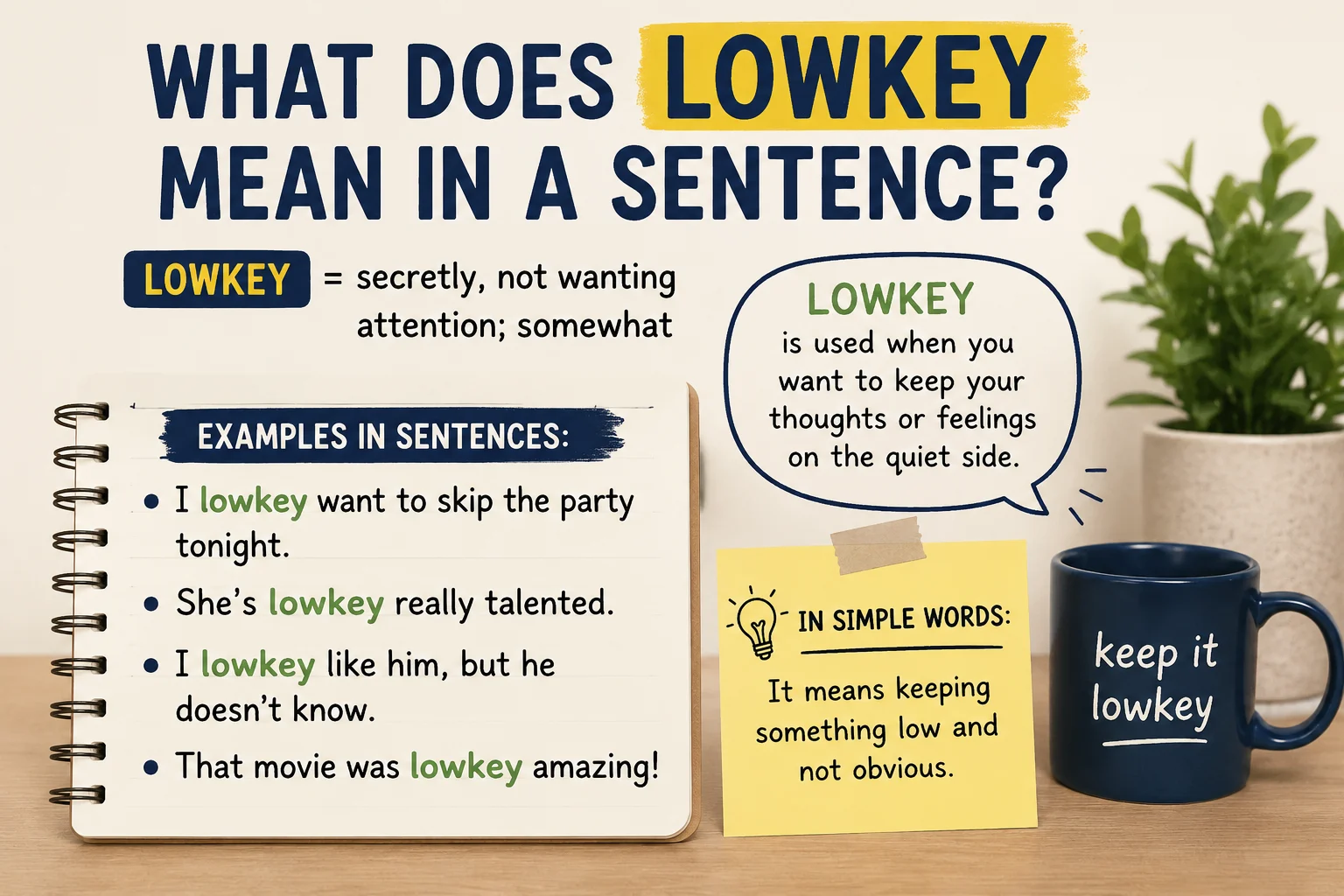
What Does Lowkey Mean in a Sentence?
Lowkey usually tells the reader or listener that something is subtle, moderate, understated, or not being strongly emphasized.
Consider these examples:
- “I’m lowkey tired.”
- “I lowkey want some pizza.”
- “That movie was lowkey amazing.”
- “She lowkey likes him.”
- “This game is lowkey difficult.”
The exact meaning changes slightly in each sentence.
“I’m lowkey tired” may mean “I’m somewhat tired.”
“She lowkey likes him” may suggest “She likes him but is not openly admitting it.”
“That movie was lowkey amazing” can mean “That movie was surprisingly or actually amazing, although I am expressing the opinion casually.”
This flexibility is one reason the expression is useful in informal English.
Lowkey Meaning in a Sentence: The Simple Definition
The simplest definition is:
Lowkey means in a subtle, quiet, understated, or somewhat limited way.
It can sometimes be replaced by words such as:
- somewhat
- slightly
- quietly
- subtly
- secretly
- casually
- privately
- kind of
- a little
However, these alternatives are not identical in every situation.
For example, “I’m somewhat nervous” and “I’m lowkey nervous” communicate a similar idea, but the second sentence has a much more casual tone.
Likewise, “I secretly like him” strongly suggests that the feeling is hidden. “I lowkey like him” may suggest secrecy, but it can also simply make the confession sound softer and less intense.
Why Do People Say “Lowkey”?
People often use the word to reduce the intensity of a statement.
Compare:
“I love this restaurant.”
with:
“I lowkey love this restaurant.”
The first statement is direct and confident. The second sounds more relaxed and understated.
Similarly:
“I’m nervous.”
sounds direct.
“I’m lowkey nervous.”
sounds softer and more casual.
This makes the expression useful when someone wants to say something honestly without sounding overly serious, dramatic, or enthusiastic.
Merriam-Webster describes the modern adverbial use as a way of expressing something moderate or limited and notes another use involving little attention or recognition.
Lowkey Meaning as “Somewhat”
One of the most common uses of lowkey is to mean “somewhat,” “a little,” or “to a moderate degree.”
For example:
“I’m lowkey hungry.”
This can mean:
“I’m somewhat hungry.”
Another example:
“That test was lowkey hard.”
This means:
“That test was somewhat difficult.”
Here are more examples:
- “I’m lowkey bored.”
- “This place is lowkey expensive.”
- “That answer is lowkey funny.”
- “I’m lowkey worried.”
- “The weather is lowkey annoying.”
- “This book is lowkey interesting.”
- “That restaurant is lowkey good.”
In these sentences, the word does not necessarily mean that the speaker is hiding anything. Instead, it reduces the strength of the statement.
Lowkey Meaning as “Secretly”
Another established use is “secretly” or “without openly showing it.”
For example:
“She lowkey likes him.”
This can suggest:
“She likes him but does not openly admit it.”
Similarly:
“I lowkey want to go.”
may suggest:
“I secretly or quietly want to go.”
Other examples include:
- “He lowkey misses his old friends.”
- “She lowkey has a crush on him.”
- “I lowkey want to buy that jacket.”
- “They lowkey planned the whole surprise.”
- “He lowkey hopes she calls.”
- “I lowkey miss those days.”
The idea of secrecy is possible in these examples, but it should not automatically be assumed. Context determines whether the speaker means “secretly,” “somewhat,” or simply “in an understated way.”
Lowkey Meaning as “Without Making a Big Deal”
Lowkey can also communicate the idea that something is being done without attracting attention.
For example:
“Let’s keep the party lowkey.”
Here, lowkey describes the event itself. It can mean that the party should be relaxed, simple, quiet, or not overly elaborate.
Another example:
“We had a lowkey weekend.”
This means the weekend was calm, relaxed, or not very eventful.
This use is slightly different from the slang construction “I lowkey love it.”
In “a lowkey weekend,” the word functions more like a traditional adjective meaning restrained, quiet, or understated.
In “I lowkey love it,” it functions as an informal adverb modifying the statement.
Is Lowkey Slang?
Yes, lowkey is widely used as informal slang, especially when it works as an adverb before a verb, adjective, or feeling.
Examples include:
- “I lowkey agree.”
- “I lowkey love it.”
- “She’s lowkey hilarious.”
- “I’m lowkey stressed.”
- “That was lowkey impressive.”
The expression is common in informal digital communication and casual speech.
However, the older expression “low-key” has been part of English for much longer. Merriam-Webster records the adjective from the late 19th century and the informal adverbial sense from much more recently.
Lowkey vs. Low-Key
You may see the expression written in several ways:
- lowkey
- low-key
- low key
Modern slang frequently uses lowkey as one word, especially online.
The hyphenated form low-key is also established in standard English. Dictionary sources recognize both the traditional adjective and the newer informal adverbial usage.
For a casual text, someone might write:
“I lowkey love this.”
For a more traditional adjective use, someone might write:
“We had a low-key evening.”
Both are understandable, but the grammatical role and tone can differ.
Lowkey Meaning in Texting
Texting is one of the easiest places to see lowkey in action.
People often use it to make statements feel more relaxed.
For example:
“Lowkey, I miss everyone.”
This can mean:
“I kind of miss everyone, but I’m saying it casually.”
Another example:
“I lowkey forgot about the meeting.”
This means the speaker forgot about the meeting and is admitting it in an informal, sometimes humorous way.
Common texting examples include:
- “Lowkey same.”
- “Lowkey true.”
- “I lowkey agree.”
- “Lowkey obsessed.”
- “I’m lowkey tired.”
- “That’s lowkey crazy.”
- “Lowkey not gonna lie.”
- “I lowkey want one.”
The expression is particularly useful because text messages do not always communicate tone as clearly as face-to-face conversations. Adding a word such as lowkey can make an emotional statement feel less intense.
Lowkey Meaning on Social Media
Lowkey is also common in informal online communication.
People may use it in:
- captions
- comments
- memes
- group chats
- posts
- online discussions
- casual replies
For example:
“Lowkey one of the best movies ever.”
The speaker is strongly praising the movie but presenting the statement in an understated, conversational way.
Another example:
“Lowkey forgot I had homework.”
This can sound humorous because the speaker is casually admitting something that may actually be important.
It is better to describe lowkey as general informal internet and conversational language rather than claiming that one specific platform created or exclusively popularized it.
Lowkey Meaning in Dating
Lowkey is particularly useful when someone is talking about romantic feelings.
For example:
“I lowkey like her.”
This can mean:
“I like her, but I’m not openly admitting how strongly I feel.”
Another example:
“He lowkey has a crush on you.”
This suggests that he may have romantic feelings but is not making them obvious.
Other examples:
- “I lowkey miss him.”
- “She lowkey wants him to text first.”
- “I’m lowkey nervous about our date.”
- “I lowkey want to ask her out.”
- “He’s lowkey jealous.”
- “I lowkey think she likes me.”
The word can make a romantic statement sound less vulnerable or less direct.
For instance:
“I have a crush on her.”
is a straightforward admission.
“I lowkey have a crush on her.”
sounds more cautious and casual.
Lowkey Meaning in Gaming
Gamers can use lowkey in the same general way as other speakers.
Examples include:
“This boss is lowkey impossible.”
The speaker means the boss is very difficult, while using casual understatement.
“This character is lowkey overpowered.”
This suggests that the character may be stronger than expected.
Other examples:
- “This map is lowkey fun.”
- “I lowkey carried the team.”
- “That player is lowkey good.”
- “Ranked mode is lowkey stressful.”
- “I’m lowkey scared to try this level.”
The meaning depends on the surrounding words, just as it does in everyday conversation.
Lowkey Meaning in the Workplace
Lowkey can appear in casual workplace conversations, but it is still informal.
For example, a coworker might say:
“I’m lowkey stressed about the deadline.”
Everyone may understand the intended meaning immediately.
However, a formal email would be better written as:
“I’m somewhat concerned about the deadline.”
Likewise, instead of:
“The results were lowkey surprising.”
a formal report could say:
“The results were somewhat surprising.”
This distinction is important for writers who want to use slang correctly. A word can be natural in conversation but inappropriate in formal writing.
Lowkey in Different Parts of a Sentence
Lowkey is flexible in informal English.
Before a verb
“I lowkey love this song.”
Here, lowkey modifies the action or feeling expressed by “love.”
Before an adjective
“That movie was lowkey amazing.”
Here, it softens or qualifies the adjective “amazing.”
At the beginning
“Lowkey, I want to leave.”
Here, the word frames the entire statement.
As an adjective
“We had a lowkey evening.”
Here, it describes the evening as calm, relaxed, or understated.
Understanding these patterns makes it easier to recognize the expression when reading texts, comments, or conversations.
25 Lowkey Meaning in a Sentence Examples
Here are original examples showing different uses:
- “I’m lowkey hungry right now.”
- “I lowkey love this song.”
- “That movie was lowkey incredible.”
- “She lowkey wants to leave.”
- “He lowkey misses his hometown.”
- “This restaurant is lowkey expensive.”
- “I’m lowkey nervous about tomorrow.”
- “That joke was lowkey funny.”
- “I lowkey agree with you.”
- “She lowkey has a crush on him.”
- “This game is lowkey difficult.”
- “I’m lowkey proud of myself.”
- “He was lowkey disappointed.”
- “I lowkey forgot the appointment.”
- “That outfit is lowkey perfect.”
- “We lowkey need more time.”
- “I’m lowkey excited for the weekend.”
- “This book is lowkey interesting.”
- “He lowkey knows the answer.”
- “I lowkey want another slice.”
- “That player is lowkey talented.”
- “I lowkey miss our old conversations.”
- “The assignment was lowkey stressful.”
- “She’s lowkey one of the funniest people here.”
- “I lowkey want to watch another episode.”
These examples show that lowkey can describe feelings, opinions, actions, people, places, and situations.
Lowkey Meaning in Positive Sentences
Lowkey can introduce a positive opinion without making it sound exaggerated.
Examples:
- “That restaurant is lowkey amazing.”
- “You’re lowkey talented.”
- “This song is lowkey beautiful.”
- “The new game is lowkey fun.”
- “That was lowkey impressive.”
- “I lowkey love this design.”
In these sentences, the speaker is positive but uses an understated tone.
Sometimes this understatement makes the compliment sound more natural.
For example:
“You’re amazing!”
is highly enthusiastic.
“You’re lowkey amazing.”
sounds more casual and conversational.
Lowkey Meaning in Negative Sentences
The word can also appear before negative descriptions.
Examples:
- “I’m lowkey annoyed.”
- “That was lowkey disappointing.”
- “This is lowkey frustrating.”
- “He’s lowkey rude.”
- “The assignment is lowkey terrible.”
The slang itself is not negative. The surrounding word determines whether the overall statement is positive, negative, or neutral.
Lowkey vs. Highkey
A useful comparison is highkey.
Lowkey generally suggests something understated, moderate, subtle, or not openly emphasized.
Highkey is informal slang that generally adds emphasis and can mean something like strongly, openly, obviously, or very much.
Compare:
“I lowkey love this song.”
with:
“I highkey love this song.”
The first sounds understated.
The second sounds much more emphatic.
Another example:
“I lowkey want to go.”
suggests a quiet or moderate desire.
“I highkey want to go.”
makes the desire sound much stronger.
The two expressions are often treated as informal opposites, although their exact meaning depends on context.
Lowkey vs. Secretly
Lowkey and secretly can overlap, but they are not always the same.
Consider:
“I secretly bought a gift.”
This clearly says that the purchase was hidden.
Now consider:
“I lowkey bought a gift.”
This sounds more casual and may suggest that the speaker is not making the action a big deal.
Likewise:
“I secretly like him.”
strongly emphasizes hidden feelings.
“I lowkey like him.”
can imply hidden feelings, but it can also simply soften the confession.
So, when explaining lowkey, “secretly” should be treated as one possible meaning rather than a universal definition.
Lowkey vs. Kinda
“Kinda” means “kind of” or “somewhat.”
Lowkey can sometimes communicate a similar degree.
Compare:
“I’m kinda tired.”
and:
“I’m lowkey tired.”
Both can mean the speaker is not extremely tired.
But lowkey also adds a particular casual or understated tone.
“Kinda” mainly describes degree.
“Lowkey” can describe degree while also suggesting subtlety, understatement, or a reluctance to emphasize the statement.
Lowkey vs. Subtly
“Subtly” means in a way that is not obvious or noticeable.
Lowkey can have a similar meaning, particularly when describing something done without drawing attention.
For example:
“He lowkey changed the plan.”
This may mean he changed it quietly or without making the change obvious.
However, lowkey is much more informal.
“Subtly” works in formal writing, while lowkey generally does not.
Is Lowkey Rude?
No. Lowkey itself is not inherently rude or offensive.
The expression is generally neutral.
However, it can appear in rude sentences.
For example:
“You’re lowkey annoying.”
The negative part is “annoying,” not the word lowkey.
Similarly:
“That idea is lowkey stupid.”
The offensive element comes from “stupid.”
So the tone depends primarily on the rest of the sentence and the situation.
Is Lowkey Appropriate for Formal Writing?
Usually, no.
Lowkey is best for informal communication.
Use it in:
- texts
- casual conversations
- social media
- online comments
- friendly messages
- informal dialogue
Avoid it in:
- academic essays
- formal reports
- official documents
- professional proposals
- formal business emails
Instead of:
“I’m lowkey concerned about the results.”
a formal version would be:
“I am somewhat concerned about the results.”
Instead of:
“The outcome was lowkey surprising.”
write:
“The outcome was somewhat surprising.”
Common Mistakes When Using Lowkey
Mistake 1: Assuming it always means secretly
Lowkey can mean “secretly,” but it can also mean “somewhat,” “quietly,” or “in an understated way.”
Mistake 2: Using it in every sentence
Because lowkey is slang, repeating it excessively can make writing sound unnatural.
Mistake 3: Treating it as formal vocabulary
Lowkey is appropriate for casual language but is usually not suitable for formal documents.
Mistake 4: Assuming one fixed translation
The best replacement depends on context.
For example:
“I’m lowkey tired.”
could mean:
“I’m somewhat tired.”
But:
“She lowkey likes him.”
could mean:
“She quietly or secretly likes him.”
Origin and History of Lowkey
The history of lowkey is older than its current internet-slang use.
The traditional expression “low-key” has been used to describe things that are restrained, subdued, or of low intensity. Merriam-Webster records an adjective sense dating to 1897 and an informal adverbial sense from 2010.
Etymonline traces the adjective to the late 19th century and connects earlier uses with ideas involving low musical tone or quiet sound.
The modern slang use developed further as speakers began using lowkey as an adverb to soften statements and describe feelings or opinions as somewhat subtle.
Merriam-Webster has specifically discussed the newer adverbial use, explaining that it can work as an adverb of degree similar to “kinda” or “somewhat,” as well as an adverb of manner suggesting something subtle or veiled.
Because the historical development involves several stages of usage, it is better not to claim that modern lowkey was invented by one specific platform or group without strong evidence.
Pronunciation of Lowkey
Lowkey is generally pronounced:
LOH-kee
The first part sounds like “low,” followed by “key.”
Example:
“I lowkey like it.”
Pronunciation is the same whether the expression is written as “lowkey” or “low-key.”
Part of Speech
The modern slang form commonly functions as an adverb.
For example:
“I lowkey love this.”
Here, lowkey modifies the statement about loving something.
It can also function as an adjective in the traditional expression:
“We had a low-key evening.”
In that sentence, low-key describes the evening.
This difference helps explain why the expression can appear in several different sentence patterns.
Synonyms for Lowkey
Depending on the context, possible alternatives include:
- somewhat
- slightly
- subtly
- quietly
- secretly
- privately
- moderately
- casually
- discreetly
- understatedly
- kind of
- a little
These are context-dependent rather than perfect replacements.
For example, “secretly” works when something is hidden, while “somewhat” works when the meaning is about degree.
Antonyms for Lowkey
Possible opposites include:
- openly
- obviously
- loudly
- strongly
- extremely
- publicly
- emphatically
- highkey
Again, the correct opposite depends on how lowkey is being used.
If lowkey means “subtly,” an opposite could be “obviously.”
If it means “somewhat,” an opposite might be “extremely.”
When Should You Use Lowkey?
Use lowkey when you want a statement to sound:
- casual
- relaxed
- understated
- slightly indirect
- conversational
- less dramatic
For example:
“I lowkey want to go home.”
This is natural in a text or casual conversation.
Likewise:
“That was lowkey amazing.”
sounds natural in informal speech.
The expression works particularly well when you want to admit something without making the statement sound overly serious.
When Should You Avoid Lowkey?
Avoid lowkey when your writing needs to be highly formal or precise.
For example, in a research paper, instead of:
“The results were lowkey surprising.”
write:
“The results were somewhat surprising.”
In a professional email, instead of:
“I’m lowkey worried about the deadline.”
write:
“I am somewhat concerned about the deadline.”
Choosing the appropriate register makes your writing clearer and more professional.
Quick Guide to Lowkey
Here is a simple way to remember the expression:
Lowkey = somewhat + subtly + without making a big deal about it.
Depending on context, it may also suggest:
Lowkey = secretly or quietly.
Examples:
“I lowkey love it.”
Meaning: I really like it, but I am expressing that feeling casually.
“I’m lowkey tired.”
Meaning: I’m somewhat tired.
“She lowkey likes him.”
Meaning: She may like him but is not openly showing it.
“Let’s keep it lowkey.”
Meaning: Let’s keep it relaxed, simple, private, or not too noticeable.
Frequently Asked Questions
What is the lowkey meaning in a sentence?
The phrase generally means somewhat, quietly, subtly, or without making something obvious. For example, “I’m lowkey tired” means “I’m somewhat tired.”
What does lowkey mean in texting?
In texting, lowkey usually makes a statement sound more casual or understated. “I lowkey miss you” can mean “I quietly or somewhat miss you.”
Does lowkey mean secretly?
It can mean secretly in some contexts, especially when someone is describing a feeling they are not openly expressing. However, it can also simply mean “somewhat” or “subtly.”
Is lowkey slang?
Yes. The modern adverbial use is informal slang, although the older “low-key” expression has a much longer history in English.
Is lowkey positive or negative?
Neither. Lowkey is neutral by itself. The words around it determine whether the sentence expresses a positive, negative, or neutral idea.
What is the opposite of lowkey?
Highkey is a common informal counterpart. Depending on context, other opposites include openly, obviously, strongly, publicly, or extremely.
Conclusion
Understanding lowkey meaning in a sentence becomes much easier when you focus on the tone of the statement. In most modern informal uses, lowkey means somewhat, subtly, quietly, or without making a big deal about something. It can also suggest that a feeling or opinion is being kept private.
For example, “I lowkey love this song” expresses genuine enjoyment but keeps the tone relaxed. “I’m lowkey nervous” means the speaker is somewhat nervous without making the feeling sound dramatic. “She lowkey likes him” may suggest that her feelings are not openly expressed.
Lowkey is useful because it gives speakers a simple way to soften an opinion or admission. It is especially natural in texting, casual conversations, online communication, and informal social language.
If you want to explore the grammatical concept behind how words function in sentences, see the Wikipedia article on noun.
The main thing to remember is that lowkey does not have one rigid meaning. Context matters. In one sentence, it may mean “somewhat”; in another, “secretly”; and in another, “without drawing attention.” That flexibility is what makes the expression so common in modern informal English.