“Entendre” almost always shows up as part of the phrase “double entendre,” meaning a word or phrase that can be understood two ways at once, usually one innocent and one suggestive or risqué. On its own, “entendre” is rarely used without “double” in front of it. For more insights, read here:- elicit meaning and discrete meaning.
- Quick Definition
- The Entendre Meaning in Context
- Where the Word Comes From
- How Double Entendres Work
- Common Contexts for Double Entendres
- Is a Double Entendre Always Sexual?
- Is It Rude or Offensive to Use?
- Similar Expressions
- Example Double Entendres
- Frequently Asked Questions
- What is the simplest way to explain the entendre meaning?
- Is entendre a French word?
- Is a double entendre always inappropriate?
- What's the difference between a double entendre and a pun?
- Can double entendres be used in professional writing?
- Where might I encounter a double entendre?
- Can a double entendre be unintentional?
- Wrapping Up
Quick Definition
- Double entendre (noun): a word or phrase with two possible interpretations, one straightforward and one usually sexual, ironic, or cheeky.
- Example: “The ad’s tagline was a clever double entendre that worked on two levels.”
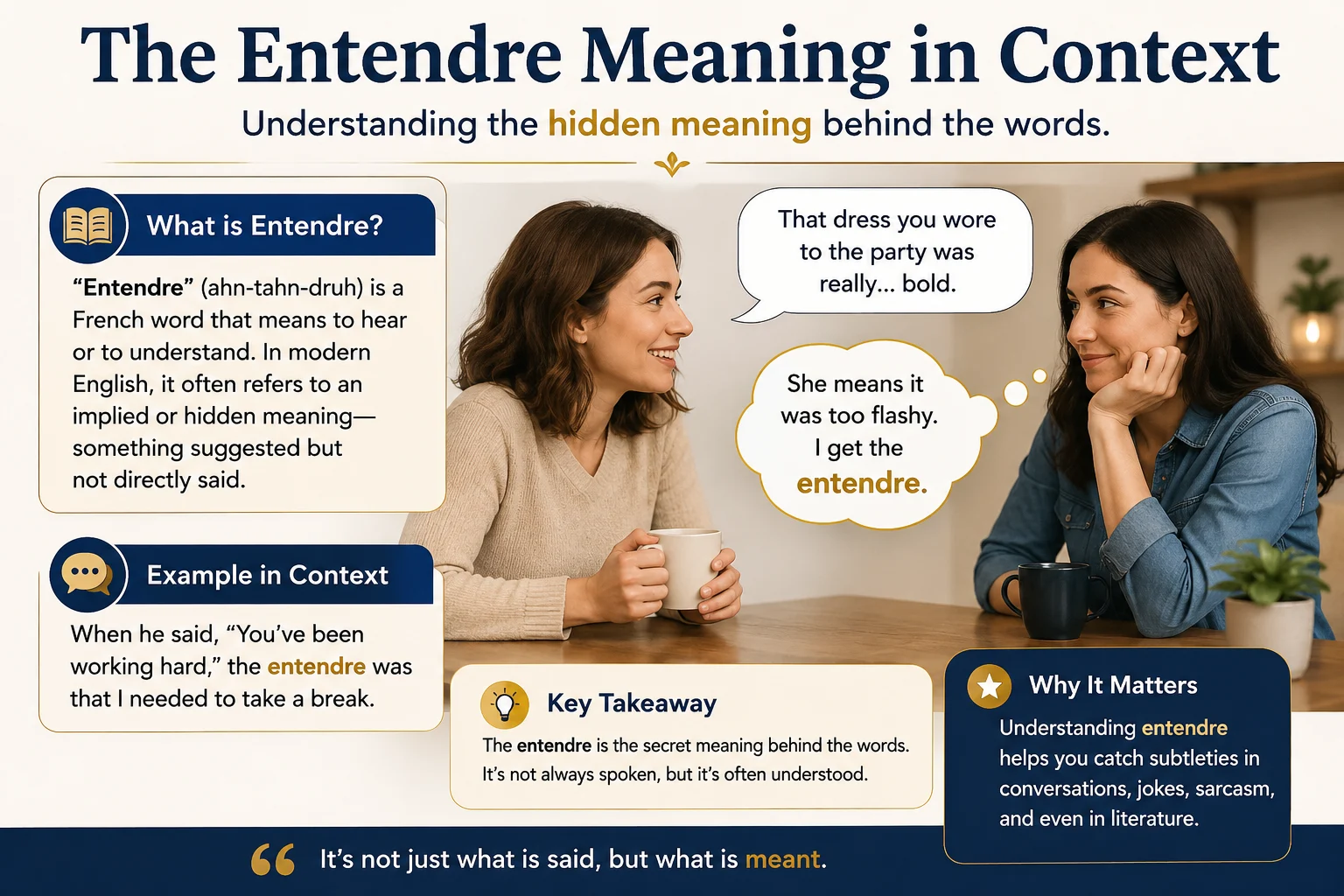
The Entendre Meaning in Context
When people search for the entendre meaning, they’re almost always asking about “double entendre,” since “entendre” by itself isn’t standard English usage on its own. The phrase describes wordplay where a sentence has one meaning on the surface and a second, less obvious meaning underneath, often relying on shared vocabulary or a suggestive undertone.
Most people encounter the term when they’re trying to understand a joke, a line in a movie, or an ad slogan that seems to be saying two things at once. Once you know to listen for it, the entendre meaning becomes easier to spot, since the pattern repeats across comedy, marketing, and casual conversation.
Example sentences:
- “The comedian’s joke was a double entendre — funny on the surface, but with a sharper meaning underneath.”
- “That line in the movie was clearly a double entendre aimed at the adult audience.”
- “Her comment had a double entendre that only the two of them understood.”
- “The pun worked as a double entendre, landing differently depending on who was listening.”
Where the Word Comes From
“Entendre” comes from French, where “entendre” means “to hear” or “to understand.” The phrase “double entendre” literally suggests something that can be “understood two ways.” Despite its French roots, the phrase is actually used more in English than in modern French, where it isn’t a standard expression. The exact history of how it became an English phrase for this specific kind of wordplay is not fully documented, so its precise timeline is uncertain.
That French-but-not-quite-French history is part of what makes the entendre meaning a little unusual among borrowed phrases. Plenty of English words come from French, but few of them describe a concept that the source language itself no longer expresses the same way.
How Double Entendres Work
A double entendre relies on ambiguity. A single word, phrase, or sentence carries two valid readings, and the humor or cleverness comes from the gap between them. The first meaning is usually obvious and safe; the second meaning requires the listener to make a connection, often to something suggestive, ironic, or taboo.
This is different from a simple pun, which usually plays on sound alone. A double entendre plays on meaning, using a sentence that’s grammatically and logically correct on both readings at once, rather than relying purely on similar-sounding words.
Understanding the entendre meaning at this structural level helps explain why it’s considered a more sophisticated form of wordplay than a plain pun. The sentence has to genuinely make sense both ways, which takes more careful construction than simply swapping in a similar-sounding word.
Common Contexts for Double Entendres
- Comedy and stand-up: Comedians frequently use double entendres to get a laugh from part of the audience while keeping the joke technically clean on the surface.
- Advertising: Brands sometimes use a double entendre in a slogan so it reads as clever or cheeky rather than explicit.
- Literature and film titles: Writers use double meanings to add depth or humor that rewards a closer read or a second viewing.
- Everyday conversation: People sometimes use them intentionally in flirtatious or joking exchanges, letting the listener decide which meaning applies.
- Song lyrics: Songwriters often lean on a double entendre to keep lyrics radio-friendly on the surface while hinting at something bolder underneath.
Across all of these contexts, the entendre meaning stays consistent even though the tone shifts depending on the setting. A slogan and a stand-up bit both rely on the same basic mechanism: two readings, held at once, with the audience left to notice the second one.
Is a Double Entendre Always Sexual?
Not always, though that’s the most common association. A double entendre can also play on irony, sarcasm, or an unrelated secondary meaning that isn’t suggestive at all. That said, in most everyday use, when someone points out that a line “has a double entendre,” they usually mean the secondary meaning leans toward the suggestive or risqué side.
This is one of the more common misunderstandings around the entendre meaning: assuming every example must be sexual in nature. In reality, the definition only requires two valid readings, not any specific tone for the second one.
Is It Rude or Offensive to Use?
A double entendre isn’t inherently rude, but it can come across as inappropriate depending on the setting, audience, and how obvious the secondary meaning is. In professional or formal contexts, an overly suggestive double entendre can feel out of place, while in comedy, advertising, or casual conversation, it’s often used deliberately for effect.
Whether a specific line crosses a line often comes down to subtlety. A double entendre that requires some thought to catch tends to feel clever rather than crude, while one that’s too obvious can feel like it’s skipping the wordplay altogether and going straight for the suggestive meaning.
Similar Expressions
- Pun — wordplay based on similar-sounding words, rather than one sentence carrying two full meanings.
- Innuendo — a suggestive implication, often without the wordplay structure of a double entendre.
- Wordplay — a broader term covering any clever or humorous use of language, including double entendres, puns, and other techniques.
- Subtext — an underlying meaning in a piece of writing or dialogue, though not necessarily built around a clever double reading like a double entendre.
- Irony — saying one thing while meaning another, which can overlap with the entendre meaning but doesn’t always involve two simultaneously valid readings.
None of these terms are perfect substitutes for a double entendre. Each describes a related but distinct technique, and mixing them up is a common source of confusion when people first start learning the entendre meaning and how it differs from simpler wordplay.
Example Double Entendres
- “I used to work as a professional banker, but I quickly lost interest.” (plays on “interest” as both a feeling and a financial term)
- “The graveyard down the road is so crowded, people are dying to get in.” (plays on “dying” literally and figuratively)
- “A bicycle can’t stand on its own two wheels because it’s simply two-tired.” (plays on “two-tired” sounding like “too tired”)
These examples clearly show how the entendre meaning depends entirely on holding two readings in mind at once, rather than choosing just one.
Frequently Asked Questions
What is the simplest way to explain the entendre meaning?
It refers to “double entendre,” a word or phrase that can be understood two different ways at once, usually one innocent and one suggestive or ironic. If you remember nothing else about the entendre meaning, remember that both readings need to make sense on their own.
Is entendre a French word?
Yes. “Entendre” comes from French, where it means “to hear” or “to understand.” The full phrase “double entendre” is used more in English than in modern French, which makes the entendre meaning something of a linguistic curiosity.
Is a double entendre always inappropriate?
No. While many double entendres lean suggestive, others rely on irony or wordplay that isn’t sexual at all. Context determines how it lands.
What’s the difference between a double entendre and a pun?
A pun typically plays on similar-sounding words, while a double entendre relies on one sentence carrying two full, logical meanings at once. That structural difference is really the core of the entendre meaning compared to simpler wordplay.
Can double entendres be used in professional writing?
They’re generally avoided in formal or professional writing, since the suggestive reading of the entendre meaning can come across as inappropriate depending on the audience.
Where might I encounter a double entendre?
Common places include stand-up comedy, advertising slogans, song lyrics, film titles, and casual conversation between people who enjoy wordplay. Once you start noticing the entendre meaning in one of these settings, it tends to become easier to spot in the others too.
Can a double entendre be unintentional?
Yes, it can. Sometimes a sentence accidentally carries a second meaning the writer didn’t intend, which technically fits the entendre meaning even though it wasn’t planned as clever wordplay.
Wrapping Up
The entendre meaning ultimately comes down to double meaning: a clever line that works on two levels at once, rewarding anyone who catches the second reading. Once you know to look for that hidden layer, double entendres become much easier to spot in comedy, advertising, and everyday conversation. For a deeper look at how this kind of wordplay has been used historically, the linked Wikipedia entry on double entendre is a useful next stop.