Clout meaning social media explained is simple: clout means influence, recognition, popularity, or social power, especially when someone has enough online influence to attract attention or affect what other people think and do. On social media, clout can come from a strong reputation, a loyal audience, viral content, expertise, or connections with influential people.
- What Does Clout Mean on Social Media?
- Clout Meaning Social Media Explained in Simple Words
- The Direct Definition of Clout
- What Does “For Clout” Mean?
- What Is Clout Chasing?
- What Is a Clout Chaser?
- Is Clout a Positive or Negative Word?
- Positive Example
- Neutral Example
- Negative Example
- Strongly Negative Example
- Clout vs. Popularity
- Clout vs. Fame
- Clout vs. Influence
- Clout Meaning Social Media Explained in Texting
- Clout Meaning Social Media Explained in Comments
- Clout Meaning Social Media Explained in Gaming
- Clout Meaning Social Media Explained in Dating
- Clout Meaning Social Media Explained in the Workplace
- Can Someone Have Clout Without Many Followers?
- Does Going Viral Give Someone Clout?
- How People Gain Clout Online
- Creating Useful Content
- Building Trust
- Developing Expertise
- Building a Reputation
- Collaborating
- Going Viral
- Common Examples of Clout Chasing
- Is Clout Rude or Offensive?
- Alternative Meanings of Clout
- Clout as a Noun
- Clout Pronunciation
- Synonyms for Clout
- Example Sentences With Clout
- Common Misunderstandings About Clout
- How to Tell Whether Clout Is Positive or Negative
- Clout, Reach, Engagement, and Fame
- When to Use Clout
- When Not to Use Clout
- Why Clout Matters in Social Media Culture
- How to Understand “He Did It for Clout”
- How to Understand “She Has Clout”
- How to Understand “Stop Clout Chasing”
- Frequently Asked Questions
- What is the clout meaning social media explained in simple English?
- What does “for clout” mean?
- What does “clout chasing” mean?
- What is a clout chaser?
- Is clout the same as fame?
- Is clout a bad word?
- Final Thoughts on Clout Meaning Social Media Explained
The phrase clout meaning social media explained is useful because “clout” can have slightly different meanings depending on context. When someone says, “She has clout,” they may simply mean that she has influence. When someone says, “He did it for clout,” they usually suggest that he wanted attention or popularity.
The term is especially common in informal online conversations. It appears in comments, captions, videos, memes, group chats, and discussions about influencers and internet culture.
Understanding clout meaning social media explained also requires knowing related expressions such as “clout chasing” and “clout chaser.” These usually have a more negative tone because they suggest that someone is deliberately seeking attention or status. For more insights, read here:- bussin meaning in food slang and caught in 4k meaning with examples.
What Does Clout Mean on Social Media?
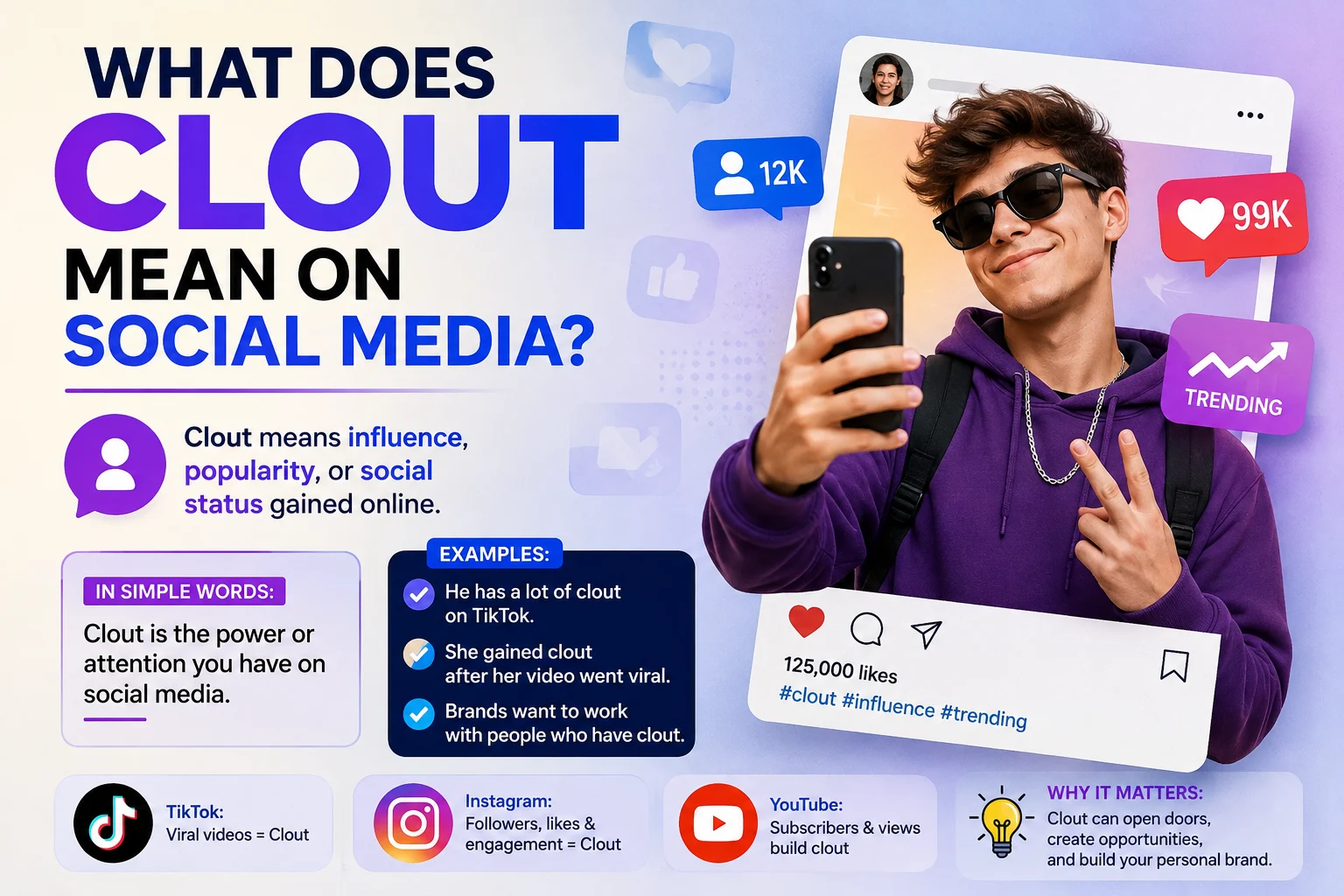
The clearest clout meaning social media explained is online influence, recognition, popularity, or social status.
When someone has clout, people may pay attention to their opinions, content, recommendations, or actions. Their reputation gives them a certain level of social influence.
For example:
“She has a lot of clout in the fashion community.”
This means she is influential and respected within that community.
Another example is:
“He posted the controversy for clout.”
Here, the speaker believes he posted about the controversy mainly to attract attention or gain popularity.
The clout meaning social media explained in these examples is slightly different in tone. The first sentence is neutral or positive, while the second suggests attention-seeking behavior.
Clout Meaning Social Media Explained in Simple Words
In very simple English, clout means influence or social power.
On social media, a person can have clout when their name, opinion, content, or presence carries weight.
Clout can come from:
- A large audience
- A highly engaged audience
- Expertise
- A strong reputation
- Viral content
- Community respect
- Professional success
- Connections with influential people
Having many followers can help someone gain clout, but followers alone do not automatically equal influence.
For example, a creator may have 20,000 followers who actively trust their recommendations. That creator may have significant clout within a specific community.
Another account could have millions of followers but very little influence outside entertainment.
That distinction is important when understanding clout meaning social media explained.
The Direct Definition of Clout
Clout is an informal noun meaning power, influence, or social importance.
In social media language, it often refers to the ability to attract attention, affect conversations, or influence an audience.
For example:
“Her opinion carries a lot of clout.”
This means her opinion has significant influence.
“His online clout increased after the video went viral.”
This means the person’s visibility and influence grew after the video received widespread attention.
The word does not necessarily mean fame. Someone can have clout in a small community without being famous to the general public.
What Does “For Clout” Mean?
“For clout” means for the purpose of gaining attention, popularity, recognition, or influence.
This phrase is common in informal social media conversations.
For example:
“He started the argument for clout.”
The speaker believes the person created or participated in the argument to attract attention.
Another example:
“She posted the private conversation for clout.”
This suggests that the person may have shared the conversation because doing so could generate views, comments, followers, or attention.
The clout meaning social media explained through the phrase “for clout” usually has a negative or suspicious tone.
However, it is important to remember that the phrase often expresses someone’s opinion about another person’s motivation. It does not automatically prove what that person intended.
What Is Clout Chasing?
Clout chasing means trying to gain attention, influence, popularity, or social status, especially through behavior designed to attract public attention.
A person might be called a clout chaser if they appear to:
- Start unnecessary online drama
- Attach themselves to celebrities
- Use controversial topics for attention
- Publicize private conflicts
- Mention popular creators repeatedly
- Create shocking content mainly for engagement
- Join trends without genuine interest
For example:
“Every time a famous creator gets into drama, he makes a video about it. People think he is clout chasing.”
The phrase “clout chasing” is generally negative.
It suggests that someone cares more about attention or status than the subject itself.
Still, accusations of clout chasing should be treated carefully because outsiders cannot always know someone’s real intentions.
What Is a Clout Chaser?
A clout chaser is someone who is perceived as trying to gain clout.
The phrase is usually informal and critical.
For example:
“She keeps creating drama with bigger creators, so people call her a clout chaser.”
In this sentence, the speaker believes the person is using controversy or association with popular people to increase her own visibility.
Being called a clout chaser does not necessarily mean the accusation is true.
Someone may collaborate with a famous creator because they genuinely respect that person. Another observer may interpret the same collaboration as an attempt to gain popularity.
Context matters when interpreting the clout meaning social media explained in real conversations.
Is Clout a Positive or Negative Word?
Clout itself is neither automatically positive nor negative.
Its tone depends on how it is used.
Positive Example
“She used her clout to raise money for the charity.”
Here, clout means useful influence.
Neutral Example
“He has considerable clout in the gaming community.”
This simply describes his influence and reputation.
Negative Example
“He only posted that for clout.”
This suggests that the person’s motivation was attention-seeking.
Strongly Negative Example
“He is just a clout chaser.”
This openly criticizes the person’s motives.
Therefore, the clout meaning social media explained should always include tone. The noun “clout” can be positive or neutral, while phrases such as “clout chasing” are usually negative.
Clout vs. Popularity
Clout and popularity are related, but they are not identical.
Popularity describes how widely known, liked, or followed someone is.
Clout focuses more on influence and social power.
A person may have millions of followers but relatively little influence over what those followers think or buy.
Another person may have a smaller audience but be highly trusted within a specialized community.
That person can have considerable clout.
For example, a respected technology expert might have fewer followers than a major entertainer but more clout among technology professionals.
This is why follower count should not be treated as the only measure of clout.
Clout vs. Fame
Fame means being widely known.
Clout means having influence or social power.
Fame and clout can exist together, but one does not automatically guarantee the other.
A famous actor may have clout because people listen to their opinions.
However, a niche expert can also have strong clout without being famous outside their field.
For example:
“She isn’t a mainstream celebrity, but she has serious clout among professional photographers.”
The sentence shows how clout can exist within a specific community.
Clout vs. Influence
Influence is probably the closest formal synonym for clout.
The main difference is style.
“Influence” sounds more formal:
“She has considerable influence within the industry.”
“Clout” sounds more informal:
“She has serious clout in the industry.”
Both sentences describe a person whose opinions or actions carry weight.
When discussing internet slang, “clout” often sounds more natural because it fits casual online language.
Clout Meaning Social Media Explained in Texting
The clout meaning social media explained in texting is usually the same as its general internet meaning.
For example, someone might text:
“Bro is doing that for clout.”
The message means:
“He is probably doing that to get attention or become more popular.”
Another message might say:
“She actually has clout.”
That means she has genuine recognition or influence.
Because texting is informal, people may use “clout” alongside other slang.
The word can appear in short messages, group chats, comments, captions, memes, and private conversations.
Clout Meaning Social Media Explained in Comments
Social media comments often use clout to judge someone’s behavior.
For example:
“Why are you posting this for clout?”
This is a criticism. The commenter believes the post was made mainly for attention.
Another comment could be:
“That’s real clout.”
This may mean the person has achieved significant recognition or influence.
A third example:
“Stop clout chasing.”
This tells someone to stop doing things that appear designed to attract attention.
The tone can range from playful teasing to serious criticism.
Clout Meaning Social Media Explained in Gaming
The clout meaning social media explained also applies to gaming communities.
A player can gain clout through:
- Competitive achievements
- Exceptional skill
- Tournament success
- Popular gaming content
- Community respect
- Collaborations with respected players
- Expertise in a particular game
For example:
“That player has serious clout in the competitive scene.”
This means the player has a strong reputation and influence within that gaming community.
A person does not need to be famous everywhere to have gaming clout.
Their influence can be limited to a specific group.
Clout Meaning Social Media Explained in Dating
The phrase can also appear in conversations about dating and relationships.
For example:
“He dated her for clout.”
The speaker is suggesting that he was interested in the relationship partly because the other person was famous, influential, or socially important.
Another example:
“They posted their relationship for clout.”
This suggests that the speaker believes the couple wanted attention or social media engagement.
These statements should be interpreted carefully because they involve assumptions about personal motivation.
The clout meaning social media explained in dating conversations is therefore often connected with status, visibility, and public attention.
Clout Meaning Social Media Explained in the Workplace
Clout is not exclusively an internet term.
The word can also describe influence in workplaces and professional environments.
For example:
“She has a lot of clout with senior management.”
This means her opinions carry significant weight with senior management.
A person can gain workplace clout through:
- Experience
- Expertise
- Professional relationships
- Reputation
- Leadership
- Achievements
- Position or authority
The social media meaning is simply a modern informal application of the broader idea of influence.
Can Someone Have Clout Without Many Followers?
Yes.
This is one of the most important points in understanding the clout meaning social media explained.
Followers can contribute to clout, but they are not the only factor.
Someone may have a small audience but enormous influence within a particular community.
For example, a respected moderator in a specialized online community may have more practical influence than a much larger entertainment account.
Similarly, an expert may have strong clout because people trust their knowledge.
Clout is therefore about influence, not just numbers.
Does Going Viral Give Someone Clout?
Going viral can increase clout, but viral attention and clout are not exactly the same.
A viral post can introduce a person to millions of viewers.
If those viewers continue following, trusting, and engaging with that person, the increased visibility may develop into lasting influence.
But a viral moment can also disappear quickly.
Someone can become temporarily famous without developing lasting clout.
Therefore:
Viral attention can contribute to clout, but virality does not automatically equal clout.
How People Gain Clout Online
People can gain online clout in different ways.
Creating Useful Content
Educational, entertaining, informative, or creative content can build recognition.
Building Trust
Consistent and honest communication can encourage audiences to trust someone.
Developing Expertise
Knowledge can create strong influence in specialized communities.
Building a Reputation
Repeatedly producing valuable work can establish credibility.
Collaborating
Working with respected creators can increase visibility and recognition.
Going Viral
Viral content can rapidly increase awareness.
These methods are different from deliberately creating controversy solely to attract attention.
Common Examples of Clout Chasing
People often describe the following behavior as clout chasing:
A creator suddenly comments on every controversy involving a famous influencer.
A person repeatedly mentions a celebrity’s name despite having little connection with them.
Someone creates exaggerated drama because controversial content generates views.
A user publicly reveals private information because they expect a large reaction.
These behaviors may be labeled “clout chasing,” but the label represents an interpretation of someone’s motivation.
It should not automatically be treated as an established fact.
Is Clout Rude or Offensive?
The word “clout” itself is not generally considered offensive.
However, some expressions containing it can be insulting.
For example:
“You’re just a clout chaser.”
This is clearly critical.
“You only did that for clout.”
This can also sound dismissive or accusatory.
By comparison:
“She has a lot of clout in the industry.”
is usually neutral.
Therefore, the word itself is not inherently rude, but its use in accusations can create conflict.
Alternative Meanings of Clout
The social media sense is not the only meaning of “clout.”
The word has other established uses, including a verb meaning to hit or strike someone or something.
For example:
“He clouted the ball over the fence.”
In that sentence, “clouted” has nothing to do with online influence.
Context tells you which meaning is intended.
When “clout” appears in a discussion about followers, influencers, popularity, online drama, or attention, the influence-related meaning is usually the relevant one.
Clout as a Noun
In the social influence sense, clout is a noun.
It refers to power, influence, or social importance.
For example:
“She has considerable clout.”
“He gained clout after becoming a respected creator.”
The noun is generally used as an uncountable noun when it means influence.
You would normally say:
“He has a lot of clout.”
rather than:
“He has many clouts.”
Understanding this grammatical point can help you use the term naturally.
Clout Pronunciation
Clout is pronounced:
KLOWT
It rhymes with:
- Out
- Shout
- Doubt
- About
The pronunciation remains the same when the word means influence or when it refers to another established sense.
Synonyms for Clout
Depending on the context, useful synonyms include:
- Influence
- Power
- Authority
- Status
- Prestige
- Recognition
- Pull
- Reach
- Reputation
- Social power
- Standing
These words are not perfect replacements in every sentence.
“Influence” is usually the closest formal synonym.
“Pull” is informal and can describe someone’s ability to affect decisions.
“Prestige” focuses more on respect and reputation.
“Reach” is particularly relevant to social media but usually describes audience exposure rather than influence itself.
Example Sentences With Clout
Here are natural examples:
- “She has a lot of clout in the fashion industry.”
- “He gained clout after his educational videos became popular.”
- “They accused him of posting the argument for clout.”
- “That creator has serious clout in the gaming community.”
- “She used her clout to promote a helpful campaign.”
- “People think he is clout chasing.”
- “Having millions of followers does not always mean having real clout.”
- “His experience gives him considerable clout among professionals.”
- “The interview increased her online clout.”
- “He was criticized for using the controversy to gain clout.”
Common Misunderstandings About Clout
One common misunderstanding is that clout simply means followers.
That is not accurate.
Followers can contribute to influence, but clout can also come from expertise, trust, reputation, or community standing.
Another misunderstanding is that clout is always negative.
It is not.
A person can use influence responsibly and positively.
For example:
“She used her clout to encourage people to donate.”
Here, clout describes a positive use of influence.
A third misunderstanding is assuming that accusations of clout chasing are automatically true.
They are not.
The phrase usually represents someone’s judgment about another person’s motivation.
How to Tell Whether Clout Is Positive or Negative
Look at the surrounding words.
Positive or neutral:
- “Use your clout”
- “Industry clout”
- “Political clout”
- “Online clout”
- “She has clout”
- “He has considerable clout”
Negative:
- “Clout chasing”
- “Clout chaser”
- “Doing it for clout”
- “Using someone for clout”
- “Desperate for clout”
This is one of the easiest ways to understand the tone of a social media post.
Clout, Reach, Engagement, and Fame
These terms are connected but should not be confused.
Clout means influence or social power.
Reach refers to how many people content can reach.
Engagement refers to interactions such as comments, likes, shares, and similar actions.
Fame means being widely known.
Popularity describes how widely liked or followed someone is.
A creator can have high reach without strong influence.
Someone else can have moderate reach but significant clout within a niche community.
This difference explains why clout cannot be accurately measured by follower count alone.
When to Use Clout
Use “clout” when discussing informal influence, recognition, status, or social power.
For example:
“He has a lot of clout online.”
“She has industry clout.”
“They used their clout to promote the project.”
“Why are you chasing clout?”
The word works especially well in casual conversations and internet language.
When Not to Use Clout
Do not use clout as a replacement for every word related to popularity.
If you mean someone is widely liked, “popular” may be more accurate.
If you mean someone has a large audience, “large following” may be clearer.
If you mean someone is highly knowledgeable, “expert” may be better.
If you mean a post was seen by many people, “high reach” or “widely viewed” may be more precise.
Use clout when influence or social power is the central idea.
Why Clout Matters in Social Media Culture
Social media makes influence highly visible.
People can quickly see follower numbers, views, comments, shares, collaborations, and viral posts.
As a result, users often discuss who has influence and who appears to be seeking it.
The word “clout” gives people a short, informal way to describe this kind of social power.
It can refer to genuine influence or the pursuit of attention.
That is why understanding the clout meaning social media explained can make online conversations easier to interpret.
How to Understand “He Did It for Clout”
When someone says, “He did it for clout,” they are usually saying:
“He did it because he wanted attention, popularity, influence, or social status.”
The phrase often carries doubt about the person’s sincerity.
For example:
“He suddenly started talking about that celebrity after the celebrity became popular.”
Someone might respond:
“He’s doing it for clout.”
The response suggests that the speaker believes the person is trying to benefit from the celebrity’s popularity.
How to Understand “She Has Clout”
“She has clout” generally means:
“She has influence or social power.”
It does not necessarily mean she is seeking attention.
For example:
“She has a lot of clout among professional photographers.”
This means people in that community recognize and respect her influence.
The phrase can therefore be complimentary.
How to Understand “Stop Clout Chasing”
“Stop clout chasing” means:
“Stop doing things mainly to gain attention, popularity, or status.”
It is normally a criticism.
It can be used seriously or jokingly.
For example:
“Bro, stop clout chasing.”
A person may use this comment when they believe someone is exaggerating a situation to get attention.
The seriousness depends on the surrounding conversation.
Frequently Asked Questions
What is the clout meaning social media explained in simple English?
The clout meaning social media explained in simple English is influence, recognition, popularity, or social power online. Someone with clout has a reputation or presence that makes people pay attention to them.
What does “for clout” mean?
“For clout” means doing something to gain attention, popularity, recognition, or influence.
What does “clout chasing” mean?
Clout chasing means trying to gain social attention or status, often through controversial or attention-grabbing behavior.
What is a clout chaser?
A clout chaser is someone who is perceived as deliberately seeking clout or online attention.
Is clout the same as fame?
No. Fame means being widely known, while clout focuses more on influence or social power.
Is clout a bad word?
No. Clout itself is not inherently bad or offensive. Its meaning can be positive, neutral, or negative depending on context.
Final Thoughts on Clout Meaning Social Media Explained
The simplest way to remember clout meaning social media explained is to think of influence.
Clout is the social power or influence a person has. On social media, that influence can come from reputation, expertise, audience trust, viral content, popularity, or community recognition.
The phrase clout meaning social media explained also helps clarify why “clout” is not simply another word for followers. A large audience can help create clout, but real influence depends on how much people notice, trust, respect, or respond to someone.
The phrase “for clout” usually has a more negative meaning because it suggests that someone is acting mainly to gain attention. Likewise, “clout chasing” and “clout chaser” are normally critical expressions.
However, clout itself can be positive. A person can use their influence to raise awareness, support a charitable cause, educate an audience, or encourage helpful action.
If you want a quick noun-based reference, clout can be understood as a form of influence or social power in this context. The exact meaning should always be determined by the surrounding sentence.
Ultimately, clout meaning social media explained comes down to one central idea: having influence, recognition, or status that gives someone social power or attention online.