“Para” most commonly functions as a prefix meaning “beside,” “beyond,” or “abnormal,” borrowed from Greek and used in words like “paranormal,” “paradox,” and “parallel.” It also has separate, well-established meanings as a Spanish word for “for” or “to,” and as informal shorthand for terms like “paraprofessional” or “paragraph,” depending heavily on the specific context in which it’s used.For more insights, read here:- offset meaning and obliterated meaning.
- Quick Definition
- The Para Meaning as a Prefix
- Common Words Built on the Para- Prefix
- Para as a Spanish Word
- Para as Shorthand
- Which Meaning Applies? Context Matters
- Is "Para" Offensive or Rude?
- Common Misunderstanding
- Similar Prefixes and Related Words
- Workplace Context
- Gaming and Online Use
- Frequently Asked Questions
- What is the simplest way to explain the para meaning?
- Is para a Greek or Latin word?
- What does para mean in a school setting?
- Does para always mean "beyond" in English words?
- Is para used the same way in every language?
- Are there other common abbreviations that use para as a base?
- Wrapping Up
Quick Definition
- Para- (prefix): beside, beyond, alongside, or abnormal; borrowed originally from Greek roots.
- Para (Spanish): “for” or “to,” a common, everyday preposition used constantly in speech.
- Para (shorthand): informal clipping for words like “paraprofessional” or “paragraph,” depending on the specific field.
- Example: “The word ‘paranormal’ uses the prefix para- to mean ‘beyond the normal,’ something outside everyday experience.”
The Para Meaning as a Prefix
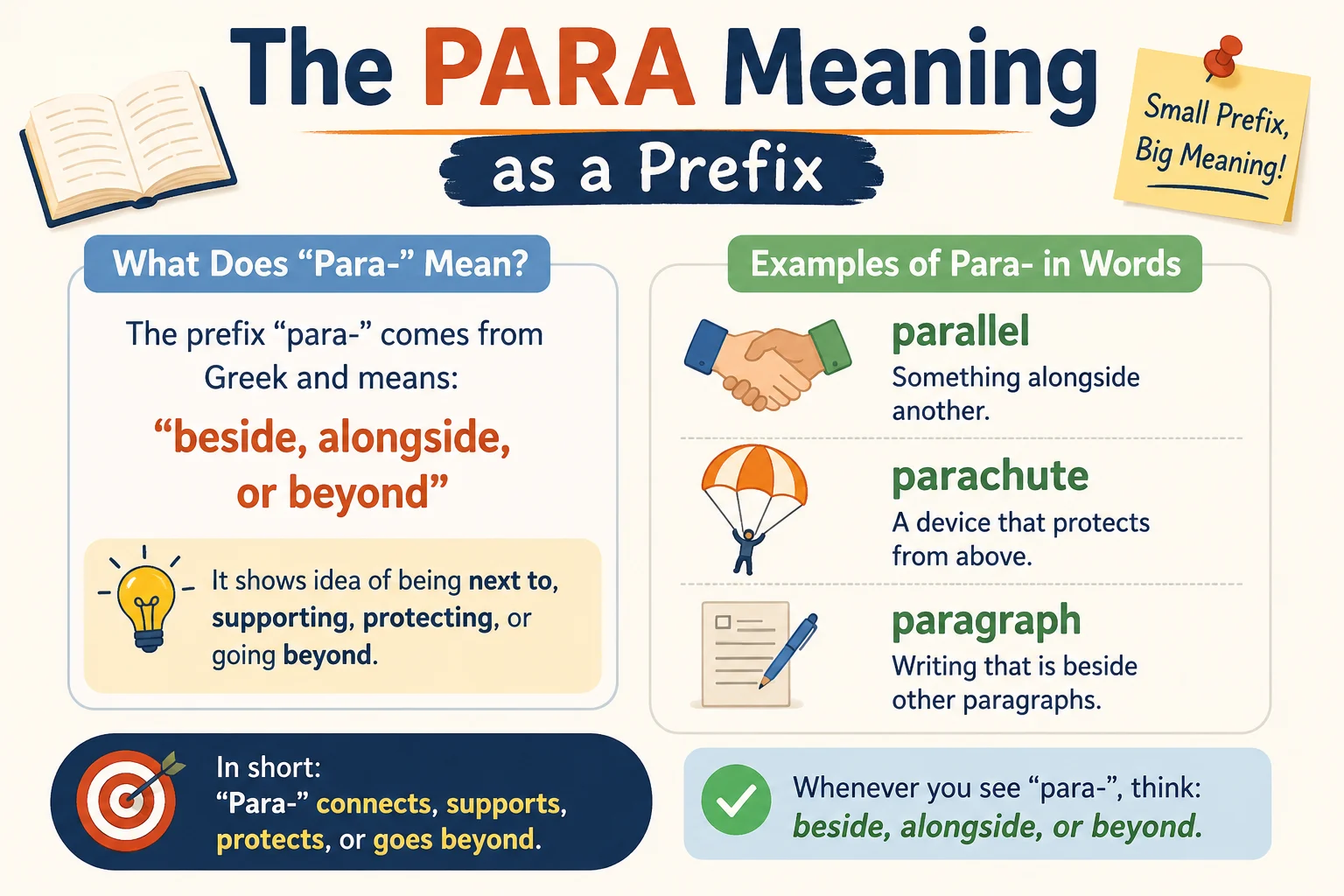
The most common use of the para meaning comes from its role as a prefix in English, borrowed from Greek, where “para” means “beside,” “alongside,” or “beyond.” It shows up in a wide range of everyday and technical words.
Because so many familiar English words are built on this prefix, most people encounter the para meaning without ever consciously thinking about the Greek root behind it, since the words themselves feel like standard English rather than borrowed vocabulary.
Example sentences:
- “The word ‘parallel’ comes from Greek roots meaning lines running beside each other.”
- “A paradox is something that seems to contradict itself, from ‘para-‘ meaning beyond or contrary.”
- “Paranormal events are described as beyond what’s considered normal.”
- “To paraphrase someone means to restate their words beside the original meaning.”
Common Words Built on the Para- Prefix
- Paranormal — beyond what is scientifically explainable or generally considered normal by most standards.
- Paradox — a statement that seems genuinely contradictory, from “beside” or “contrary to” expectation.
- Parallel — lines or ideas running alongside each other continuously without ever meeting or intersecting.
- Paraphrase — to carefully restate something in different words, “beside” the original, exact phrasing.
- Paramedic — someone working directly alongside a doctor, providing urgent emergency medical care in the field.
- Paralegal — someone working alongside a lawyer, assisting closely with everyday legal research and preparation tasks.
- Parasite — an organism that lives beside or on another organism, drawing resources from it.
Looking across these examples, the para meaning consistently circles back to the same core idea of being positioned beside, alongside, or beyond something else, even as the specific words themselves cover wildly different subjects.
Para as a Spanish Word
In Spanish, “para” is a common preposition meaning “for” or “to,” used constantly in everyday speech and writing. This sense is entirely separate from the English prefix, though both trace back to related historical roots in older languages.
- “Esto es para ti” translates naturally to “This is for you,” a very common everyday phrase.
- “Voy para la tienda” means “I’m going to the store,” another frequently heard expression.”
Anyone searching for the para meaning while learning Spanish is almost certainly asking about this preposition, since it’s one of the most frequently used small words in the language, appearing in countless everyday sentences.
Para as Shorthand
In casual, informal English, “para” is sometimes used as shorthand for longer words, depending on the setting.
- Paraprofessional: In education specifically, “para” commonly refers to a paraprofessional, a trained aide who works alongside a certified teacher in a busy classroom.
- Paragraph: In writing or texting contexts specifically, “para” is occasionally used casually to mean “paragraph,” as in “keep it to one para.”
- Paratrooper: In military contexts specifically, “para” can refer informally to a paratrooper.
This shorthand use of the para meaning is entirely informal and depends heavily on the specific field or community using it, unlike the more stable prefix or preposition senses described above.
Which Meaning Applies? Context Matters
Because “para” carries several genuinely different, established meanings, context is essential for understanding which sense applies. A classroom conversation about a “para” almost certainly means a paraprofessional, while a linguistics discussion about “para-” refers to the prefix, and a Spanish sentence uses it as a preposition entirely unrelated to English shorthand.
Figuring out the correct para meaning is really just a matter of noticing the surrounding words. A sentence about doctors and emergency response points toward “paramedic,” while a sentence in Spanish grammar points toward the preposition, and a classroom discussion points toward the teaching aide.
Is “Para” Offensive or Rude?
No. None of the established uses of “para” carry an offensive or rude connotation. It functions neutrally as a prefix, a preposition, or a casual abbreviation, depending entirely on context.
This neutrality is fairly consistent across all versions of the para meaning covered here, since none of them developed from a slur, an insult, or a taboo reference of any kind.
Common Misunderstanding
Some people assume all these different uses of “para” share a single, unified meaning, but that’s not accurate. The prefix’s Greek root, the Spanish preposition, and the informal English shorthand developed along genuinely separate paths, even though they share the same spelling.
This kind of overlap, where unrelated meanings happen to share identical spelling, is fairly common across languages. Understanding that the para meaning isn’t one single concept, but several distinct ones sharing a coincidental spelling, clears up most of the confusion people run into.
Similar Prefixes and Related Words
- Peri- — another Greek-derived prefix meaning “around” or “surrounding,” as in the word “perimeter.”
- Meta- — a prefix meaning “beyond” or “about itself,” somewhat related in spirit to certain uses of para-.
- Sub- — meaning “under” or “below,” a genuinely different directional prefix often contrasted directly with para-.
- Ante- — meaning “before,” a Latin-derived prefix sometimes mistakenly confused with para- due to a vaguely similar sound.
Workplace Context
Beyond education, “para” occasionally shows up in other professional settings as shorthand for a support role that works alongside a more senior or specialized professional, following the same underlying logic as “paralegal” or “paramedic.”
- “The clinic hired two more paras to help during the busy flu season.”
- “As a para, her job includes prepping materials and supporting students one-on-one.”
In these workplace contexts, the para meaning stays tied to its “alongside” root, describing someone who supports rather than replaces a lead professional.
Gaming and Online Use
Occasionally, “para” shows up in gaming or online writing as a casual abbreviation, most often for “paragraph,” especially in roleplay communities where writers describe their preferred reply length.
- “Looking for a partner who writes at least a para per reply.”
- “She prefers short paras over long, detailed responses.”
Frequently Asked Questions
What is the simplest way to explain the para meaning?
It depends on context: as a prefix, it means “beside” or “beyond”; in Spanish, it means “for” or “to”; and informally, it can be shorthand for words like “paraprofessional” or “paragraph.” Context alone usually settles which version of the para meaning applies.
Is para a Greek or Latin word?
The prefix comes from Greek. The Spanish preposition “para” has its own separate linguistic history within Romance languages, which is a big part of why the para meaning splits so cleanly between these two very different uses.
What does para mean in a school setting?
It usually refers to a paraprofessional, a trained classroom aide who works alongside a certified teacher to support students. This use of the para meaning is specific to education and doesn’t relate to the prefix or the Spanish preposition at all.
Does para always mean “beyond” in English words?
Not exactly always, though it’s the most common sense. In some words, it leans more toward “beside” or “alongside” rather than strictly “beyond,” which is part of why the para meaning can feel slightly different from one word to the next.
Is para used the same way in every language?
No. The prefix’s meaning in English differs entirely from its meaning as a preposition in Spanish, even though the spelling is identical. This is a good reminder that the para meaning always needs a language and a context before it can be pinned down.
Are there other common abbreviations that use para as a base?
Yes, a few. Beyond paraprofessional, paragraph, and paratrooper, some fields use “para” informally within longer shorthand terms, though these tend to be specific to a particular workplace or community rather than widely recognized outside it.
Wrapping Up
The para meaning ultimately depends heavily on context: a prefix borrowed from Greek, a common Spanish preposition, or informal shorthand for a longer English word. Recognizing which sense applies makes the word far easier to understand wherever it shows up, whether in a science class, a Spanish lesson, or a school hallway. Keeping these separate senses of the para meaning in mind avoids the confusion of assuming they’re all somehow connected. For a deeper look at how prefixes like this one shape English vocabulary, the Wikipedia entry on Greek prefixes is a useful starting reference.