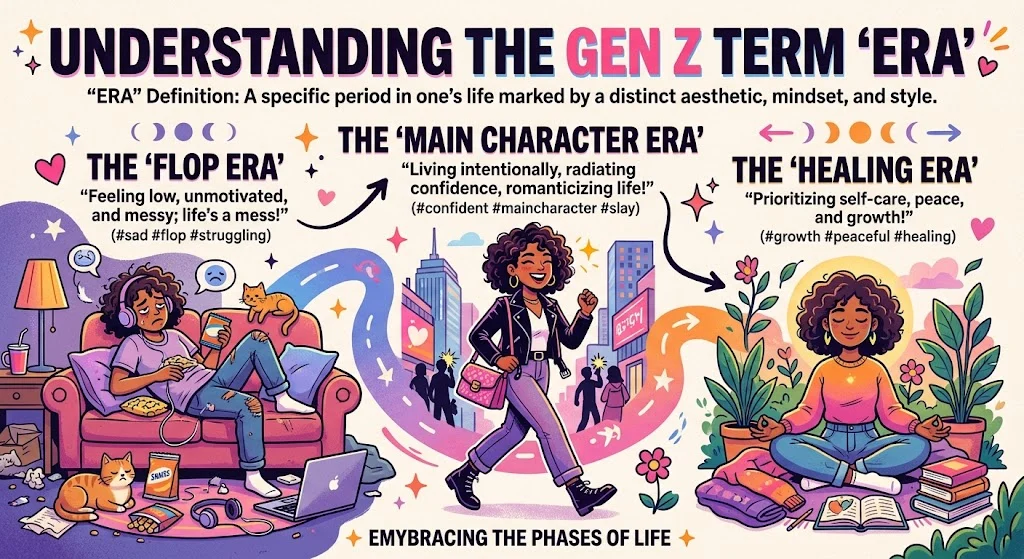
Era Meaning Gen Z With Examples .The phrase “era” has taken on a popular informal meaning in Gen Z language. In this context, “era” refers to a particular phase, mood, lifestyle, habit, or personal period someone is experiencing. It is often used playfully to describe what someone is currently focused on or going through.
- What Does “Era” Mean in Gen Z Slang?
- Why Does Gen Z Use “Era” This Way?
- Era Meaning Gen Z With Examples
- 1. “I’m in my gym era.”
- 2. “She’s in her study era.”
- 3. “I’m in my healing era.”
- 4. “He’s in his travel era.”
- 5. “I’m entering my productive era.”
- 6. “She’s in her single era.”
- 7. “I’m in my lazy era.”
- 8. “He’s in his football era.”
- What Does “My Era” Mean?
- How Is “Era” Used on Social Media?
- Is “Era” Actually Gen Z Slang?
- Is “Era” Used in a Positive or Negative Way?
- Can “Era” Be Used as a Joke?
- Era in Dating and Relationships
- Era in Texting
- Era vs. Phase
- Era vs. Chapter
- Similar Gen Z Expressions
- “In my ___ era”
- “Entering my ___ era”
- “My ___ phase”
- “New chapter”
- “Character development”
- Common Misunderstanding About “Era”
- Is “Era” Formal or Informal?
- Is “Era” Rude or Offensive?
- What Is the Era Meaning Gen Z Uses?
- Why Does “Era” Sound Different in Gen Z Language?
- Era Meaning Gen Z With Examples in Everyday Conversation
- “I’m in my study era.”
- “She’s in her confidence era.”
- “I’m in my cooking era.”
- “He’s in his travel era.”
- “I’m in my quiet era.”
- Era Meaning Gen Z in Social Media Captions
- Era Meaning Gen Z in Texting
- Can “Era” Describe a Negative Phase?
- Era Meaning Gen Z in Dating
- Is “Era” Always a Gen Z Word?
- Era Meaning Gen Z Compared With “Phase”
- Era Meaning Gen Z Compared With “Chapter”
- Common Examples You May See
- How to Understand the Era Meaning Gen Z Uses
- Era Meaning Gen Z in Different Situations
- Personal Growth
- School and Studying
- Fitness
- Travel
- Can “Era” Describe a Mood?
- Why Do People Say “My Era”?
- Is “Era” Used Sarcastically?
- Era Meaning Gen Z and Relationship Language
- Is “Era” Appropriate at Work?
- Is the Era Meaning Gen Z Usage Always Positive?
- Common Mistakes When Using “Era”
- Better Alternatives to “Era”
- Quick Examples of the Expression
- Final Thoughts
For example, someone might say, “I’m in my gym era,” meaning they are currently very focused on working out. Likewise, “She’s in her independent era” suggests that she is embracing independence at this point in her life. more information:-bussin meaning in food slang or 7 rules of life .
What Does “Era” Mean in Gen Z Slang?
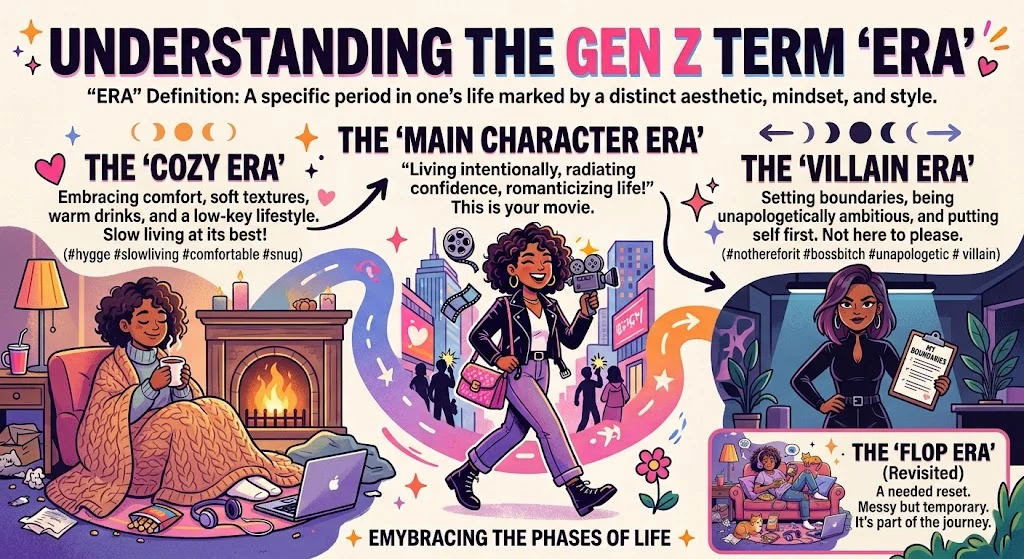
In Gen Z slang, “era” means a current phase or period of someone’s life, personality, interests, or behavior.
The expression usually follows this pattern:
“my + [word] + era”
Examples include:
- “I’m in my study era.”
- “He’s entering his fitness era.”
- “She’s in her travel era.”
- “I’m officially in my quiet era.”
Here, “era” does not necessarily refer to a long historical period. Instead, it describes a temporary or noticeable phase.
This informal use can make ordinary experiences sound humorous, dramatic, or self-aware.
Why Does Gen Z Use “Era” This Way?
The traditional meaning of “era” refers to a significant period of history or a period marked by particular characteristics. Gen Z has extended this idea to everyday personal experiences.
Someone’s “era” can be serious, humorous, temporary, or exaggerated.
For instance, saying “I’m in my cooking era” may simply mean that someone has recently become interested in cooking. It does not suggest that cooking will define their entire life.
This usage is especially useful because it turns a small change in routine into a recognizable personal phase.
Era Meaning Gen Z With Examples
Understanding the expression is easiest through examples. Here are some natural examples of how Gen Z may use “era” informally.
1. “I’m in my gym era.”
Meaning: The person is currently focused on exercising and fitness.
Example:
“I’ve been going to the gym every morning. I’m definitely in my gym era.”
2. “She’s in her study era.”
Meaning: She is currently concentrating heavily on studying.
Example:
“Don’t invite Maya out tonight. She’s in her study era because exams are coming.”
3. “I’m in my healing era.”
Meaning: The person is focusing on emotional recovery, personal growth, or taking better care of themselves.
Example:
“After a stressful year, I’m finally in my healing era.”
4. “He’s in his travel era.”
Meaning: He is currently very interested in traveling or exploring new places.
Example:
“He’s visited three countries this year. He’s definitely in his travel era.”
5. “I’m entering my productive era.”
Meaning: The speaker is trying to become more organized, disciplined, or productive.
Example:
“I cleaned my room, planned my week, and finished my assignments. I’m entering my productive era.”
6. “She’s in her single era.”
Meaning: She is currently single and may be enjoying or embracing that stage of life.
Example:
“She’s not looking for a relationship right now. She’s enjoying her single era.”
7. “I’m in my lazy era.”
Meaning: The person is jokingly saying that they currently want to relax and avoid unnecessary effort.
Example:
“It’s Saturday, I ordered food, and I’m watching movies. I’m in my lazy era.”
8. “He’s in his football era.”
Meaning: Football has become a major interest or focus for him at the moment.
Example:
“He talks about football all day. He’s definitely in his football era.”
What Does “My Era” Mean?
“My era” generally means the phase of life or personal period that someone feels they are currently experiencing.
The exact meaning depends on the word that comes before “era.”
For example:
- “My reading era” = a period when I am reading a lot.
- “My career era” = a period focused on work or professional development.
- “My social era” = a period when I am spending more time socializing.
- “My quiet era” = a period when I prefer peace, privacy, or less social activity.
- “My confidence era” = a period when I feel more confident and self-assured.
The phrase can also be used humorously. Someone might call a short-lived habit an “era” even if it lasts only a few days.
How Is “Era” Used on Social Media?
Online, “era” is often used as a caption, comment, hashtag-style expression, or casual phrase.
For example:
“I’m entering my bookworm era.”
“This is my peaceful era.”
“Welcome to my cooking era.”
“Currently in my no-drama era.”
The expression works well in social media language because it quickly communicates a person’s current mood or lifestyle.
However, it is better to describe this as a modern informal usage rather than claiming that every Gen Z speaker uses it or that it belongs exclusively to one social-media platform.
Is “Era” Actually Gen Z Slang?
“Era” itself is not originally Gen Z slang. It is a standard English noun with a much older meaning referring to a period of time.
What is associated with contemporary Gen Z and internet language is the expanded informal construction of describing personal phases as an “era.”
In other words, the slang-like element comes from the way the word is applied, not from the word itself being newly created.
Is “Era” Used in a Positive or Negative Way?
It can be either positive or negative depending on the phrase.
Positive examples:
- “I’m in my confident era.”
- “She’s in her successful era.”
- “I’m entering my healthy era.”
Negative or humorous examples:
- “I’m in my overthinking era.”
- “He’s in his broke era.”
- “I’m entering my sleep-deprived era.”
The expression often has a playful or self-aware tone, even when the situation itself is frustrating.
Can “Era” Be Used as a Joke?
Yes. One of the most common features of this informal usage is exaggeration.
Someone may describe a very ordinary habit as an “era” for comedic effect.
For example:
“I bought one plant, so apparently I’m in my gardening era.”
The speaker probably does not mean that gardening has become a major historical period of their life. The exaggerated wording makes the sentence humorous.
Era in Dating and Relationships
“Era” can also describe relationship-related phases.
Examples include:
- “I’m in my dating era.”
- “She’s in her single era.”
- “He’s in his relationship era.”
- “I’m in my no-dating era.”
For example:
“After two bad dates, I’m entering my no-dating era.”
This means the person is jokingly saying that they currently want to stop dating.
The phrase can communicate a temporary attitude rather than a permanent decision.
Era in Texting
In texting, “era” is usually casual and easy to understand when the context is clear.
Someone might text:
“I’m in my sleep era 😭”
“I’m entering my study era.”
“My shopping era needs to end.”
“Back in my reading era.”
The surrounding words usually make the intended meaning obvious.
Because this is informal language, it would generally be inappropriate in a formal business email or academic paper unless the expression is being discussed as language.
Era vs. Phase
“Era” and “phase” can be similar, but they do not always feel exactly the same.
A “phase” is a normal word for a temporary period or stage of development.
An “era” can sound more dramatic, intentional, or humorous.
Compare:
“I’m going through a reading phase.”
“I’m in my reading era.”
The first sounds straightforward. The second sounds more playful and internet-influenced.
Era vs. Chapter
“Chapter” is another expression that can describe a period of life.
For example:
“I’m starting a new chapter in my life.”
This usually suggests a meaningful transition or change.
“I’m entering my new era.”
This can also suggest a transformation, but it may sound more dramatic, fashionable, humorous, or self-aware depending on the context.
Similar Gen Z Expressions
Several informal expressions can communicate a similar idea.
“In my ___ era”
Describes a current personal phase.
Example:
“I’m in my fitness era.”
“Entering my ___ era”
Suggests that a new phase is beginning.
Example:
“I’m entering my independent era.”
“My ___ phase”
Describes a temporary period of interest or behavior.
Example:
“I’m going through my baking phase.”
“New chapter”
Usually suggests a meaningful transition.
Example:
“Moving abroad feels like a new chapter.”
“Character development”
A humorous way of describing an experience that supposedly changes someone.
Example:
“That breakup was definitely character development.”
Common Misunderstanding About “Era”
One common misunderstanding is that “era” always refers to a long historical period.
In standard English, it can refer to a significant period of history, such as an era associated with a particular ruler, technology, or cultural development. In contemporary informal speech, however, people can use it much more loosely.
A personal “era” might last months, weeks, or even be used jokingly for a single activity.
The meaning therefore depends strongly on context.
Is “Era” Formal or Informal?
“Era” is a completely standard English word and can be formal or neutral when used in its traditional sense.
For example:
“The Industrial Revolution transformed society during a major historical era.”
The personal construction “my ___ era” is much more casual.
For formal writing, expressions such as “period,” “phase,” “stage,” or “period of development” may be more appropriate depending on the context.
Is “Era” Rude or Offensive?
No. The word “era” is not inherently rude or offensive.
Its tone depends on the phrase and situation. A phrase such as “my lazy era” is usually playful, while “my single era” simply describes a personal situation.
However, joking about another person’s “era” could potentially sound mocking if the context is sensitive.
Era Meaning Gen Z With Examples: How Gen Z Uses the Word
If you searched for “era meaning gen z with examples,” you are likely trying to understand why people use the word “era” to describe ordinary parts of their lives. In modern informal language, “era” often describes a personal phase, mood, interest, habit, or lifestyle. Instead of referring only to a major historical period, people can use it playfully to describe what they are currently experiencing.
For example, someone who has recently started exercising might say, “I’m in my gym era.” A person concentrating on school might say, “I’m in my study era.” The meaning is simple: this activity has become an important part of their current life.
What Is the Era Meaning Gen Z Uses?
The era meaning Gen Z uses is usually a casual way to describe a current period in someone’s life. It can refer to an interest, personality change, emotional state, lifestyle choice, or temporary obsession.
The basic structure is:
“My + [activity, quality, or situation] + era”
Examples include:
- “I’m in my reading era.”
- “She’s in her fitness era.”
- “He’s entering his independent era.”
- “I’m in my peaceful era.”
- “We’re in our travel era.”
In each sentence, “era” suggests a recognizable phase. It does not necessarily mean the phase will last for years. Sometimes the expression is intentionally exaggerated for humor.
Why Does “Era” Sound Different in Gen Z Language?
The traditional meaning of “era” is a period of time, particularly one associated with a distinctive development or set of circumstances. The modern informal usage applies the same basic idea to personal experiences.
This explains why the expression feels natural. Someone’s life can be divided into different periods, just as history can be divided into different eras.
The difference is scale.
A historical era might last decades or centuries. A personal “era” might last several months, a few weeks, or even be used jokingly for a short-lived interest.
That playful exaggeration is an important part of the modern expression.
Era Meaning Gen Z With Examples in Everyday Conversation
The best way to understand the expression is to see how it works in realistic sentences.
“I’m in my study era.”
This means the speaker is currently focused on studying.
Example:
“I deleted my games from my phone because I’m in my study era.”
The sentence suggests a temporary period of increased academic focus.
“She’s in her confidence era.”
This means she is becoming more confident or intentionally presenting herself with greater self-assurance.
Example:
“She stopped worrying about everyone’s opinions and entered her confidence era.”
The expression can make a personal change sound more dramatic and memorable.
“I’m in my cooking era.”
This means the person has recently become interested in cooking.
Example:
“I made pasta, cookies, and homemade bread this week. I think I’m in my cooking era.”
The speaker may be using “era” humorously because the interest is relatively new.
“He’s in his travel era.”
This means traveling has become a major interest or activity for him.
Example:
“He has another trip planned next month. He’s definitely in his travel era.”
“I’m in my quiet era.”
This means the person currently prefers peace, privacy, rest, or less social activity.
Example:
“I’m staying home this weekend because I’m in my quiet era.”
This expression does not necessarily mean the person dislikes other people. It can simply describe a temporary preference for calm.
Era Meaning Gen Z in Social Media Captions
The phrase works particularly well as a short social media caption because it communicates an entire mood in only a few words.
Someone might post a picture of books and write:
“Study era.”
A person sharing vacation photos might write:
“Travel era.”
Someone showing a new fitness routine might write:
“Gym era activated.”
These captions are informal and often intentionally dramatic. The purpose is not to provide a precise definition of the person’s life stage. Instead, the phrase creates a recognizable mood.
It is important, however, not to assume that every Gen Z speaker uses “era” in exactly the same way. Usage can vary by person, community, country, and online environment.
Era Meaning Gen Z in Texting
In texting, “era” can be used as a quick way to describe what someone is currently doing or feeling.
For example:
“I’m entering my productive era.”
“Girl, you’re in your shopping era.”
“I think I’m in my sleep era.”
“My social era is officially over.”
These messages are generally casual and conversational. Friends may use the expression to tease one another or comment on a noticeable change in behavior.
The tone is often lighthearted rather than serious.
Can “Era” Describe a Negative Phase?
Yes. The expression does not have to describe something positive.
Someone might say:
- “I’m in my broke era.”
- “I’m in my overthinking era.”
- “He’s in his chaotic era.”
- “I’m entering my sleep-deprived era.”
These expressions can describe unpleasant circumstances while still sounding humorous.
For example:
“I spent all my money this weekend, so apparently I’m entering my broke era.”
The speaker is not necessarily making a serious statement about their financial situation. The phrase can simply exaggerate a temporary problem for comedic effect.
Era Meaning Gen Z in Dating
The word can also appear when people talk about dating and relationships.
Examples include:
- “I’m in my single era.”
- “She’s in her dating era.”
- “I’m entering my no-dating era.”
- “He’s in his relationship era.”
For example:
“After several disappointing dates, I’m officially in my no-dating era.”
This means the person currently wants to step away from dating.
The expression can sound more playful than saying, “I have decided not to date for a while.”
Is “Era” Always a Gen Z Word?
No. “Era” is not a newly invented Gen Z word. It is an established English noun with a traditional meaning related to a period of time.
What feels modern is the personal construction around it.
When someone says, “The Victorian era,” the word has its conventional historical meaning. When someone says, “I’m in my coffee era,” the word is being used informally to describe a personal phase.
Therefore, the modern usage is better understood as an informal extension of an existing English word.
Era Meaning Gen Z Compared With “Phase”
“Phase” is probably the closest ordinary synonym for this use of “era.”
Compare these sentences:
“I’m going through a reading phase.”
“I’m in my reading era.”
Both communicate a similar idea, but they have different tones.
“Reading phase” sounds neutral and straightforward. “Reading era” sounds more playful, expressive, and internet-friendly.
The word “era” can make a temporary interest sound more significant than it actually is.
Era Meaning Gen Z Compared With “Chapter”
“Chapter” can also describe a period of someone’s life.
For example:
“I’m starting a new chapter in my life.”
This usually suggests an important transition.
By contrast:
“I’m entering my new era.”
This can suggest a transformation but may also be used casually or humorously.
The choice depends on tone. “Chapter” often sounds reflective, while “era” can sound more playful or dramatic.
Common Examples You May See
Here are additional examples that show the range of the expression:
- “I’m in my bookworm era.”
- “She’s entering her career era.”
- “He’s in his fitness era.”
- “I’m in my self-care era.”
- “We’re in our vacation era.”
- “I’m currently in my introvert era.”
- “She’s having a main-character era.”
- “He’s entering his responsible era.”
- “I’m in my no-drama era.”
- “They’re in their adventure era.”
The meaning changes according to the word before “era,” but the basic idea remains the same: a current period characterized by a particular interest, behavior, attitude, or experience.
Era Meaning Gen Z With Examples: Usage, Tone, and Common Questions
If you are searching for “era meaning gen z with examples,” the key idea is simple: Gen Z-style usage often turns “era” into a playful way of describing a current phase of life. A person can be in a study era, fitness era, travel era, healing era, or even a lazy era. The expression usually focuses on what someone is currently doing, feeling, enjoying, or changing.
How to Understand the Era Meaning Gen Z Uses
The modern informal use of “era” is based on the ordinary meaning of a period of time. Instead of talking about a historical period, people apply the word to their own lives.
For example:
“I’m in my reading era.”
This suggests that reading has become a major interest for the speaker recently.
Similarly:
“She’s in her career era.”
This suggests that her work or professional development is currently a major focus.
The expression does not require the period to have a specific length. Someone may describe a long-term lifestyle change as an era, but they can also use it jokingly for something that started yesterday.
Era Meaning Gen Z in Different Situations
The phrase can change slightly depending on the situation. Understanding the context makes the expression easier to interpret.
Personal Growth
People can use “era” when talking about self-improvement or personal development.
Examples:
- “I’m in my self-growth era.”
- “She’s entering her confident era.”
- “I’m in my healthier era.”
These phrases suggest that someone is intentionally working on themselves.
School and Studying
Students may use the expression to describe periods of intense academic focus.
Examples:
- “I’m in my study era.”
- “My exam era has officially started.”
- “I’m entering my productive era.”
Here, the word creates a casual and slightly humorous description of a busy period.
Fitness
Fitness is another natural context for the expression.
Examples:
- “I’m in my gym era.”
- “She’s in her running era.”
- “He’s entering his fitness era.”
The speaker is saying that exercise has become an important part of their current routine.
Travel
Someone who has recently become interested in traveling might say:
“I’m in my travel era.”
A person could also caption vacation pictures with:
“Entering my travel era.”
The expression emphasizes a current lifestyle or interest rather than a permanent identity.
Can “Era” Describe a Mood?
Yes. An “era” can describe a mood or attitude as well as an activity.
For example:
“I’m in my peaceful era.”
This can mean the speaker currently wants calm and fewer conflicts.
Other examples include:
- “I’m in my happy era.”
- “She’s in her independent era.”
- “I’m in my no-drama era.”
- “He’s in his serious era.”
- “I’m in my relaxed era.”
The exact meaning depends on the surrounding conversation.
Why Do People Say “My Era”?
“My era” makes a current experience sound like a distinct period.
Compare:
“I’m exercising more lately.”
with:
“I’m in my fitness era.”
The first statement is direct and neutral. The second is more expressive and playful.
This is one reason the expression works well in casual conversations, captions, comments, and messages.
Is “Era” Used Sarcastically?
It can be.
A person may use “era” to exaggerate an ordinary behavior for humor.
For example:
“I drank coffee three days in a row, so I guess I’m in my coffee era.”
The speaker probably does not believe that drinking coffee represents a major period of their life. The exaggeration is the joke.
Another example:
“I cleaned my room once. Welcome to my organized era.”
This humorous use makes the expression especially flexible.
Era Meaning Gen Z and Relationship Language
The expression can also describe relationship status or dating preferences.
For example:
“I’m in my single era.”
This can simply mean that someone is currently single and comfortable with it.
Another example is:
“I’m entering my dating era.”
This suggests that someone is beginning to date or become more interested in dating.
A person might also say:
“I’m in my no-dating era.”
This usually means they currently prefer to avoid dating.
These expressions can be serious, playful, or somewhere between the two.
Is “Era” Appropriate at Work?
The answer depends on the workplace.
The traditional word “era” is perfectly appropriate in professional writing.
For example:
“The company entered a new era of technological development.”
However, the personal slang-style construction may sound too casual in formal professional communication.
For example:
“I’m in my productivity era.”
This might be fine in a casual team chat, but a formal report would usually use clearer wording such as:
“I am currently focusing on improving productivity.”
Knowing the difference between standard vocabulary and informal internet-style usage helps you choose the right expression.
Is the Era Meaning Gen Z Usage Always Positive?
No. The expression can describe positive, neutral, negative, or humorous situations.
Positive:
“I’m in my confident era.”
Neutral:
“I’m in my study era.”
Negative or humorous:
“I’m in my broke era.”
The word itself does not determine the emotional tone. The accompanying word and context do.
Common Mistakes When Using “Era”
One mistake is assuming that “era” always has to describe something serious or historically important.
In informal language, it can be deliberately exaggerated.
Another mistake is assuming that everyone uses the expression in the same way. Internet language varies between communities, age groups, regions, and individuals.
It is also unnecessary to add “era” to every temporary activity. The expression works best when it adds personality or humor to the statement.
Better Alternatives to “Era”
If you want a more neutral expression, several alternatives are available.
“Phase” is the closest everyday option.
Example:
“I’m going through a reading phase.”
“Chapter” works well when describing a meaningful life transition.
Example:
“I’m starting a new chapter in my life.”
“Period” is more neutral and can work in formal contexts.
Example:
“This is an important period of my career.”
“Stage” can describe a particular point in development.
Example:
“I’m at a new stage in my career.”
These alternatives are useful when the playful tone of “era” is not appropriate.
Quick Examples of the Expression
Here are some natural examples that make the meaning clear:
- “I’m in my study era, so I’ll call you after my exam.”
- “She’s in her fitness era and goes running every morning.”
- “I’m entering my peaceful era and avoiding unnecessary drama.”
- “He’s definitely in his travel era this year.”
- “I think I’m in my cooking era because I make dinner every night.”
- “After graduating, she entered a new career era.”
- “I’m in my reading era and have three books waiting for me.”
- “He’s in his gaming era again.”
- “I’m entering my productive era tomorrow.”
- “She’s enjoying her independent era.”
Each example uses “era” to describe a noticeable period characterized by a particular activity, attitude, or lifestyle.
Final Thoughts
The phrase “era meaning gen z with examples” refers to the modern, informal use of “era” as a way to describe a current phase, mood, interest, or lifestyle. Expressions such as “my gym era,” “my study era,” and “my healing era” make everyday experiences sound more personal and expressive.
The meaning depends on the word that comes before “era” and the context in which it is used. Although “era” is a standard English noun, the “my ___ era” construction is generally casual and can be playful or humorous.
Ultimately, understanding this usage comes down to recognizing the language and context behind the expression.