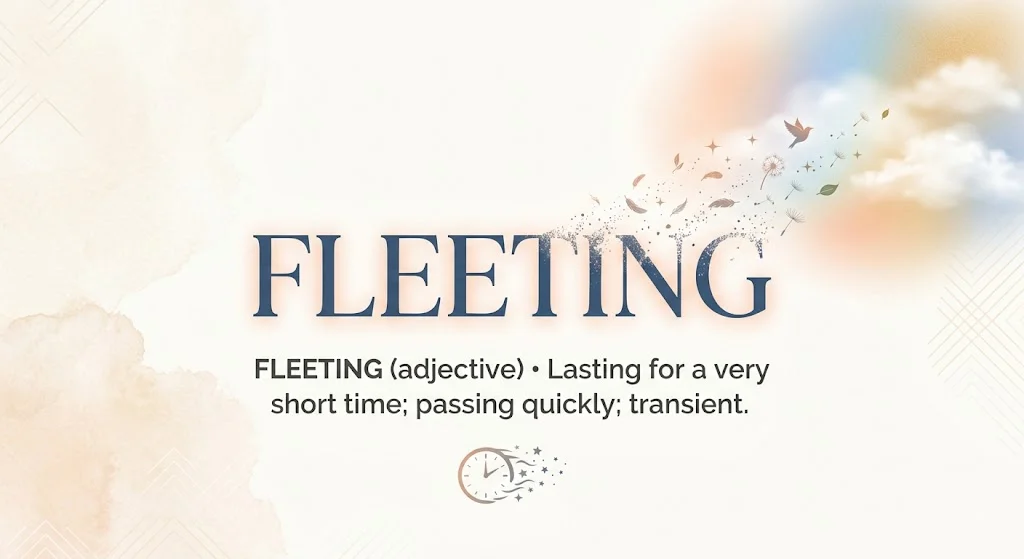
The word “fleeting” means lasting for only a short time. It describes something temporary, brief, or quick to disappear. A fleeting moment, for example, is a moment that passes almost immediately.
- What Does Fleeting Mean?
- Fleeting Meaning in Different Contexts
- Fleeting Moment
- Fleeting Thought
- Fleeting Emotion
- Fleeting Opportunity
- Fleeting Glimpse
- Fleeting Meaning in Everyday English
- Is Fleeting Positive or Negative?
- Fleeting vs. Temporary
- Fleeting vs. Brief
- Synonyms for Fleeting
- Antonyms of Fleeting
- Fleeting in a Sentence
- Common Misunderstanding About “Fleeting”
- What Does “Fleeting Moment” Mean?
- What Does “Fleeting Beauty” Mean?
- What Does “Fleeting Time” Mean?
- Origin of the Word “Fleeting”
- Frequently Asked Questions
- What is the simple meaning of fleeting?
- Is fleeting a positive or negative word?
- What is a synonym for fleeting?
- What is the opposite of fleeting?
- What does a fleeting moment mean?
- Can fleeting describe a person?
- Fleeting Meaning in Everyday Conversations
- The Emotional Meaning of Fleeting
- Fleeting Happiness Meaning
- Fleeting Memory Meaning
- Fleeting Opportunity Meaning
- Fleeting Glimpse Meaning
- Fleeting Thought Meaning
- Fleeting Beauty Meaning
- Fleeting vs. Ephemeral
- Fleeting vs. Passing
- Is “Fleeting” Formal or Casual?
- How to Use Fleeting Correctly
- Common Mistake With Fleeting
- Why Writers Use the Word Fleeting
- Fleeting Meaning in Literature
- Frequently Asked Questions About Fleeting Meaning
- What does fleeting mean in simple words?
- What is an example of something fleeting?
- Does fleeting mean temporary?
- Is fleeting a negative word?
- What is the best synonym for fleeting?
- Fleeting Meaning in Everyday Life
- Fleeting Meaning in Relationships
- Fleeting Meaning in Memories
- Fleeting Meaning in Literature
- Fleeting Meaning and Time
- Fleeting Meaning of a Glimpse
- Fleeting Meaning of an Opportunity
- Fleeting Meaning of an Emotion
- Fleeting Meaning vs. Ephemeral
- Fleeting Meaning vs. Transient
- Fleeting Meaning vs. Short-Lived
- More Examples of Fleeting
- Can “Fleeting” Describe Something Positive?
- Can “Fleeting” Describe Something Negative?
- Is Fleeting a Formal Word?
- Common Mistakes When Using Fleeting
- Final Thoughts
The word is often used for experiences, emotions, thoughts, opportunities, memories, and periods of time that do not last very long. more information:-feining meaning or elicit meaning.

What Does Fleeting Mean?
“Fleeting” means continuing for a very short period before ending or disappearing.
In simple English, if something is fleeting, it does not stay for long.
Examples:
- She experienced a fleeting moment of happiness.
- The opportunity was fleeting, so he acted quickly.
- I caught a fleeting glimpse of the bird.
- Their conversation was brief but meaningful.
The word often carries the idea that something is difficult to hold onto because it passes quickly.
Fleeting Meaning in Different Contexts
The exact feeling of “fleeting” can change slightly depending on what it describes.
Fleeting Moment
A “fleeting moment” is a very brief period of time.
Example:
“We shared a fleeting moment of understanding.”
Here, the understanding existed only briefly.
Fleeting Thought
A fleeting thought is an idea or thought that appears briefly and then disappears from your mind.
Example:
“A fleeting thought of moving abroad crossed her mind.”
The person considered the idea for a short time but did not necessarily act on it.
Fleeting Emotion
A fleeting emotion is a feeling that lasts only briefly.
Example:
“His anger was fleeting, and he soon returned to his usual calm mood.”
Fleeting Opportunity
A fleeting opportunity is a chance that may disappear quickly if you do not take advantage of it.
Example:
“The scholarship offered a fleeting opportunity to study overseas.”
This usage emphasizes the temporary nature of the chance.
Fleeting Glimpse
A fleeting glimpse means seeing someone or something for only a very short time.
Example:
“I had a fleeting glimpse of the actor as he entered the building.”
The person was visible only briefly.
Fleeting Meaning in Everyday English
In everyday English, “fleeting” is commonly used when someone wants to emphasize how quickly something passes.
For example:
“Summer vacations can feel fleeting.”
This means that the vacation seems to pass very quickly.
Another example is:
“She enjoyed a fleeting sense of relief.”
This tells us that the relief was real but did not last very long.
“Fleeting” can therefore describe both time itself and things that exist temporarily within that time.
Is Fleeting Positive or Negative?
“Fleeting” is generally neutral, but it can have a positive, negative, or bittersweet feeling depending on the situation.
A positive example is:
“He experienced a fleeting moment of joy.”
A negative example is:
“She had only a fleeting sense of confidence before the doubts returned.”
A bittersweet example is:
“The reunion gave them a fleeting chance to relive old memories.”
The word itself does not mean good or bad. It mainly emphasizes short duration.
Fleeting vs. Temporary
“Fleeting” and “temporary” are similar, but they are not always interchangeable.
“Temporary” means something is not permanent and will eventually end.
“Fleeting” emphasizes that something lasts for a very short time and often seems to disappear quickly.
For example:
- “She had a temporary job.” — The job was not permanent.
- “She had a fleeting opportunity.” — The opportunity lasted only briefly.
Something temporary could last for months or years, while something described as fleeting is usually much shorter-lived.
Fleeting vs. Brief
“Brief” simply means short in duration.
“Fleeting” often creates a stronger impression of something passing quickly or disappearing almost as soon as it appears.
Compare:
- “We had a brief conversation.”
- “We shared a fleeting moment of connection.”
The first statement focuses on the short length of the conversation. The second suggests that the connection was momentary and perhaps difficult to maintain.
Synonyms for Fleeting
Depending on the context, useful synonyms include:
- Brief
- Short-lived
- Momentary
- Temporary
- Transient
- Passing
- Ephemeral
- Rapid
- Quick
- Evanescent
Some of these have slightly different tones.
“Momentary” emphasizes an extremely short period. “Short-lived” emphasizes that something ends sooner than expected. “Ephemeral” is more literary and often describes things that are beautiful or interesting but do not last.
Antonyms of Fleeting
Words with opposite or contrasting meanings include:
- Permanent
- Lasting
- Enduring
- Long-lasting
- Continuous
- Perpetual
- Eternal
- Sustained
For example:
“A fleeting feeling” contrasts with “a lasting feeling.”
Fleeting in a Sentence
Here are several natural examples:
- The peaceful feeling was fleeting, but I appreciated it.
- She caught a fleeting glimpse of the mountains through the clouds.
- His fleeting hesitation disappeared when he made his decision.
- Childhood can seem fleeting when viewed from adulthood.
- They enjoyed a fleeting moment of silence before the crowd became noisy again.
- The artist captured a fleeting expression on her face.
- Success can sometimes be fleeting if it is not supported by consistent effort.
- I had a fleeting memory of visiting that place as a child.
Common Misunderstanding About “Fleeting”
One common misunderstanding is assuming that “fleeting” means something happens suddenly.
Although something fleeting can happen quickly, the key meaning is short duration, not simply speed.
For example, a thought can be fleeting because it remains in your mind for only a few seconds. It does not necessarily mean that the thought appeared suddenly.
Similarly, a fleeting opportunity may arrive unexpectedly, but the important point is that the opportunity will not remain available for long.
What Does “Fleeting Moment” Mean?
A “fleeting moment” is a very short period that passes quickly.
The expression is often used for meaningful experiences, emotions, connections, or memories.
For example:
“She enjoyed a fleeting moment of peace before the busy day began.”
The phrase can also have a nostalgic or emotional tone because it suggests that something valuable existed only briefly.
What Does “Fleeting Beauty” Mean?
“Fleeting beauty” refers to beauty that does not last for long.
It might describe a sunset, a flower, a temporary expression, or a moment in nature.
For example:
“The photographer wanted to capture the fleeting beauty of the sunset.”
The phrase often emphasizes appreciation because the beautiful scene will soon change or disappear.
What Does “Fleeting Time” Mean?
“Fleeting time” refers to time that seems to pass quickly and cannot be recovered.
For example:
“Make the most of your fleeting time with loved ones.”
This expression emphasizes the temporary nature of life or a particular period.
Origin of the Word “Fleeting”
“Fleeting” comes from the verb “fleet,” meaning to pass quickly or move swiftly. The modern adjective developed from this idea of something that passes rapidly and does not remain for long.
The related expression “time flies” conveys a similar idea: time seems to move quickly and cannot be stopped.
Frequently Asked Questions
What is the simple meaning of fleeting?
Fleeting means lasting for only a short time or passing very quickly.
Is fleeting a positive or negative word?
Fleeting is usually neutral. Its emotional meaning depends on the context. It can describe pleasant, unpleasant, or bittersweet experiences.
What is a synonym for fleeting?
Common synonyms include brief, momentary, short-lived, temporary, transient, and ephemeral.
What is the opposite of fleeting?
Depending on the context, opposites include lasting, permanent, enduring, sustained, and long-lasting.
What does a fleeting moment mean?
A fleeting moment is a very short period that passes quickly, often describing a temporary experience, emotion, or connection.
Can fleeting describe a person?
Usually, “fleeting” describes an experience, moment, thought, opportunity, appearance, or period rather than a person. Saying that a person is “fleeting” would be unusual unless the context gives the word a special meaning.
Fleeting Meaning: Deeper Usage, Examples, and Common Expressions
Understanding the fleeting meaning becomes easier when you look at how the word works in real sentences. “Fleeting” describes something that exists for a short time and then passes away. It can refer to a moment, feeling, thought, opportunity, memory, expression, or experience.
The fleeting meaning is closely connected with the ideas of brevity and impermanence. When something is fleeting, it may be valuable, memorable, or significant precisely because it does not last.
Fleeting Meaning in Everyday Conversations
In everyday English, people use “fleeting” when they want to emphasize that something happened only briefly.
For example:
“I had a fleeting feeling that I had forgotten something.”
This means the feeling appeared for a short time and then disappeared.
Another example is:
“She gave him a fleeting smile before walking away.”
Here, the smile was very brief. The sentence does not necessarily suggest anything negative; it simply highlights how quickly the expression passed.
The fleeting meaning can therefore describe small moments that might otherwise be difficult to explain with the simpler word “short.”
The Emotional Meaning of Fleeting
The word “fleeting” can sometimes create an emotional or reflective tone.
Consider the sentence:
“They enjoyed a fleeting moment together before saying goodbye.”
The word adds more than the idea of a short moment. It suggests that the moment was temporary and perhaps precious because it could not continue.
This is why “fleeting” frequently appears in writing about memories, relationships, happiness, youth, beauty, and time.
For example:
“Her fleeting happiness made the difficult day feel worthwhile.”
The happiness did not last long, but it still had meaning.
Fleeting Happiness Meaning
“Fleeting happiness” means happiness that lasts only briefly.
Someone might say:
“His success brought him fleeting happiness.”
This means the person felt happy after succeeding, but the feeling soon faded.
The phrase does not necessarily mean that the happiness was fake. Instead, it emphasizes its temporary nature.
Fleeting Memory Meaning
A fleeting memory is a memory that briefly comes into your mind and then becomes difficult to recall.
Example:
“A fleeting memory of my childhood suddenly came back to me.”
The memory may appear for only a moment before becoming unclear again.
This usage is especially common when discussing nostalgia, childhood, dreams, or personal experiences.
Fleeting Opportunity Meaning
A fleeting opportunity is a chance that is available for only a short period.
Example:
“She recognized a fleeting opportunity to speak with the director.”
The opportunity might disappear quickly, so the person needs to act before it is gone.
This expression is useful in professional, academic, and everyday situations.
For example:
“Students should take advantage of fleeting opportunities to learn from experienced professionals.”
Here, “fleeting” emphasizes that such opportunities may not remain available indefinitely.
Fleeting Glimpse Meaning
A fleeting glimpse means seeing something or someone for a very short time.
Example:
“I caught a fleeting glimpse of the deer before it disappeared into the trees.”
The phrase is especially useful when something is visible only momentarily.
Other examples include:
- “I caught a fleeting glimpse of her through the crowd.”
- “The photographer captured a fleeting glimpse of the bird.”
- “He had a fleeting glimpse of the old building from the train.”
Fleeting Thought Meaning
A fleeting thought is an idea that enters your mind briefly.
Example:
“A fleeting thought about changing careers crossed his mind.”
The thought does not necessarily represent a serious plan. It may simply be an idea that appeared temporarily.
Another example:
“I had a fleeting thought that I had met her before.”
The speaker briefly considered the possibility and then moved on.
Fleeting Beauty Meaning
“Fleeting beauty” describes beauty that lasts for only a short period.
A sunset is a good example because its appearance changes rapidly.
Example:
“The photographer wanted to capture the fleeting beauty of the sunset.”
The phrase can also describe flowers, expressions, landscapes, youth, or other forms of beauty that naturally change over time.
Fleeting vs. Ephemeral
“Fleeting” and “ephemeral” are close in meaning, but their style is somewhat different.
“Fleeting” is common and natural in everyday English.
“Ephemeral” is more formal or literary and often describes something that exists briefly.
For example:
“Her smile was fleeting.”
This sounds natural in ordinary English.
“The beauty of the flowers was ephemeral.”
This sounds more literary or reflective.
Both words communicate the idea of something not lasting, but “fleeting” is generally easier and more conversational.
Fleeting vs. Passing
“Passing” can also mean temporary or short-lived.
For example:
“He experienced a passing feeling of doubt.”
“He experienced a fleeting feeling of doubt.”
Both sentences work, but “fleeting” can give a stronger impression that the feeling appeared and disappeared quickly.
“Passing” can sometimes sound more neutral, while “fleeting” often carries a slightly more expressive or literary quality.
Is “Fleeting” Formal or Casual?
“Fleeting” is neither extremely formal nor strongly casual. It is a standard English adjective that works well in both everyday and written English.
It is particularly common in descriptive, reflective, literary, and professional writing.
For casual conversation, people may simply say:
“It only lasted a second.”
In more polished writing, someone might say:
“It was a fleeting moment.”
Both communicate a similar idea, but the second expression is more descriptive.
How to Use Fleeting Correctly
“Fleeting” usually appears before a noun.
Common combinations include:
- fleeting moment
- fleeting thought
- fleeting emotion
- fleeting feeling
- fleeting opportunity
- fleeting glimpse
- fleeting memory
- fleeting happiness
- fleeting beauty
- fleeting impression
- fleeting connection
- fleeting sense of relief
Examples:
“His fleeting hesitation disappeared almost immediately.”
“She felt a fleeting sense of excitement.”
“The opportunity was fleeting, but she acted quickly.”
“I remember a fleeting image from that afternoon.”
Common Mistake With Fleeting
A common mistake is treating “fleeting” as a direct synonym for “fast.”
They are related but not identical.
“Fast” usually describes speed.
“Fleeting” describes short duration.
For example:
“The car was fast.”
This tells us about the car’s speed.
“The opportunity was fleeting.”
This tells us that the opportunity did not remain available for long.
Therefore, use “fleeting” when the important idea is that something passes or disappears quickly rather than simply moving at high speed.
Why Writers Use the Word Fleeting
Writers often choose “fleeting” because it communicates brevity while also adding a sense of impermanence.
Compare:
“She had a short moment of happiness.”
“She had a fleeting moment of happiness.”
The second sentence can sound more vivid because “fleeting” suggests that the happiness appeared briefly and then vanished.
This makes the word particularly useful in descriptions involving memories, emotions, relationships, nature, and time.
Fleeting Meaning in Literature
In literature, “fleeting” is often connected with the temporary nature of human experiences.
A writer might describe:
- fleeting youth
- fleeting happiness
- fleeting beauty
- fleeting memories
- fleeting moments
- fleeting dreams
These expressions can emphasize that life changes and that experiences cannot always be preserved.
The literary use does not create a completely different definition. It simply gives the ordinary meaning of “lasting for a short time” a more reflective tone.
Frequently Asked Questions About Fleeting Meaning
What does fleeting mean in simple words?
Fleeting means lasting for only a short time or disappearing quickly.
What is an example of something fleeting?
A smile, a brief thought, a sunset, a short opportunity, or a moment of happiness can all be fleeting.
Does fleeting mean temporary?
Yes, but “fleeting” usually emphasizes that something lasts for a very short time. “Temporary” simply means that something is not permanent.
Is fleeting a negative word?
No. Fleeting is neutral. It can describe positive, negative, or emotionally meaningful experiences.
What is the best synonym for fleeting?
Depending on the sentence, “brief,” “short-lived,” “momentary,” “transient,” or “ephemeral” can work as synonyms.
Fleeting Meaning: More Examples, Contexts, and Common Uses
Understanding the fleeting meaning becomes easier when you see how the word works in different situations. “Fleeting” describes something that exists, happens, or remains for only a short period. It often suggests that something passes quickly and cannot easily be held onto.
The fleeting meaning is especially useful when describing moments, emotions, thoughts, opportunities, memories, and experiences.
Fleeting Meaning in Everyday Life
In everyday English, the fleeting meaning usually refers to something temporary or short-lived.
For example, you might say:
- “I felt a fleeting sense of happiness.”
- “She gave me a fleeting smile.”
- “That was a fleeting opportunity.”
- “I caught a fleeting glimpse of him.”
- “The feeling of excitement was fleeting.”
Each sentence shows the same basic idea: something happened or existed briefly before changing or disappearing.
The fleeting meaning does not necessarily suggest that something was unimportant. In fact, a fleeting experience can sometimes be extremely meaningful precisely because it does not last.
Fleeting Meaning in Relationships
The fleeting meaning can also apply to relationships and emotional connections.
A fleeting connection is a connection that lasts for a short time. Two people might meet during a trip, have an interesting conversation, and then never see each other again.
For example:
“They shared a fleeting connection that neither of them forgot.”
Here, the relationship was temporary, but the experience still had emotional value.
A fleeting romantic feeling can work in the same way. Someone may develop a brief attraction that disappears after a short time.
Fleeting Meaning in Memories
A memory can be described as fleeting when it appears briefly in your mind and then becomes difficult to recall.
For example:
“I had a fleeting memory of my childhood home.”
The fleeting meaning here emphasizes how quickly the memory appeared and disappeared.
A fleeting memory may be incomplete. You might remember a face, a smell, a sound, or a particular scene without remembering all the details.
Fleeting Meaning in Literature
Writers often use “fleeting” because the word can create an emotional sense of impermanence.
The fleeting meaning in literature may describe beauty, youth, happiness, love, time, or life itself.
For example:
“Her fleeting youth became a recurring theme in the novel.”
In literary writing, “fleeting” can make an ordinary idea sound more reflective. Instead of simply saying that something was short, the writer can emphasize how quickly it passed.
The phrase “fleeting beauty” is particularly common in descriptive and poetic writing.
Fleeting Meaning and Time
The fleeting meaning is closely connected with the idea that time passes quickly.
When someone says:
“Time is fleeting,”
they mean that time passes quickly and cannot be stopped.
This expression is often used when discussing life, opportunities, aging, or important experiences.
For example:
“Time is fleeting, so we should appreciate the moments we have.”
The statement does not mean that time literally moves faster. It expresses the feeling that our available time is limited.
Fleeting Meaning of a Glimpse
A “fleeting glimpse” means seeing something for only a very short time.
For example:
“I caught a fleeting glimpse of the mountains through the train window.”
The fleeting meaning is particularly clear here because the mountains were visible only briefly.
Other examples include:
“She caught a fleeting glimpse of the celebrity.”
“He had a fleeting glimpse of the old photograph.”
“I saw a fleeting glimpse of movement behind the curtain.”
Fleeting Meaning of an Opportunity
A fleeting opportunity is an opportunity that may disappear quickly.
For example:
“The company offered a fleeting opportunity to join the international project.”
The fleeting meaning suggests that the chance was available for only a limited period.
This is slightly different from simply calling something a “temporary opportunity.” “Fleeting” gives stronger emphasis to how quickly the opportunity may vanish.
Fleeting Meaning of an Emotion
A fleeting emotion is a feeling that lasts only briefly.
For example:
“She experienced a fleeting feeling of regret.”
“He felt a fleeting sense of fear when he heard the noise.”
“She had a fleeting moment of confidence before becoming nervous again.”
The fleeting meaning in these examples focuses on duration. The emotions are genuine, but they do not continue for long.
Fleeting Meaning vs. Ephemeral
“Fleeting” and “ephemeral” are close in meaning, but they can have different stylistic effects.
“Fleeting” is common and natural in everyday English.
“Ephemeral” is more formal or literary and often describes things that are beautiful, temporary, or short-lived.
For example:
“Her happiness was fleeting.”
This sounds natural in ordinary English.
“The beauty of the flowers was ephemeral.”
This sounds more literary.
Both words communicate the idea of impermanence, but “fleeting” is generally easier and more conversational.
Fleeting Meaning vs. Transient
“Transient” also means temporary or short-lived.
However, “transient” is often used for conditions, states, populations, or things that pass from one place or state to another.
For example:
“He experienced transient confusion.”
By contrast:
“He experienced a fleeting moment of confusion.”
Both can work, but “fleeting” sounds more natural when talking about a brief personal experience or moment.
Fleeting Meaning vs. Short-Lived
“Short-lived” is another close synonym.
If something is short-lived, it does not continue for very long.
If something is fleeting, the emphasis is often on how quickly it passes.
For example:
“Their excitement was short-lived.”
This means the excitement ended relatively soon.
“Their excitement was fleeting.”
This gives the feeling that the excitement appeared briefly and disappeared.
More Examples of Fleeting
Here are additional examples that show the fleeting meaning naturally:
- A fleeting smile appeared on her face.
- He experienced a fleeting moment of doubt.
- The bird gave us a fleeting glimpse before flying away.
- Her fame proved to be fleeting.
- I had a fleeting thought about changing careers.
- The peaceful atmosphere was fleeting.
- He enjoyed a fleeting sense of freedom during the trip.
- Their conversation created a fleeting sense of familiarity.
- The opportunity was fleeting, so she accepted immediately.
- Childhood often seems fleeting when remembered years later.
Can “Fleeting” Describe Something Positive?
Yes. The fleeting meaning does not automatically make something negative.
You can use “fleeting” for positive experiences such as:
- Fleeting happiness
- Fleeting joy
- Fleeting excitement
- Fleeting beauty
- Fleeting peace
- Fleeting success
For example:
“She enjoyed a fleeting moment of happiness.”
The word simply tells us that the happiness did not last long.
Can “Fleeting” Describe Something Negative?
Yes. “Fleeting” can also describe unpleasant experiences.
Examples include:
- Fleeting sadness
- Fleeting fear
- Fleeting anger
- Fleeting doubt
- Fleeting regret
- Fleeting anxiety
For example:
“A fleeting feeling of fear passed through him.”
Again, the main idea is that the feeling was brief.
Is Fleeting a Formal Word?
“Fleeting” is neither extremely formal nor strongly informal. It is a standard English adjective that works well in conversation, journalism, essays, creative writing, and professional communication.
The fleeting meaning is therefore useful in many types of writing.
For everyday conversation, simpler alternatives such as “brief” or “short-lived” may sometimes sound more natural.
For descriptive writing, “fleeting” can provide a more expressive tone.
Common Mistakes When Using Fleeting
One common mistake is using “fleeting” simply to mean “fast.”
That is not quite accurate.
“Fleeting” focuses on duration, while “fast” usually focuses on speed.
For example:
“The car was fast.”
This means the car moved quickly.
“The opportunity was fleeting.”
This means the opportunity existed for only a short time.
Another mistake is assuming that “fleeting” always means unimportant. A fleeting experience can be deeply meaningful even though it lasts only briefly.
Final Thoughts
The fleeting meaning is simple: something that lasts for only a short time or passes quickly. The word can describe a moment, emotion, thought, memory, opportunity, or experience that appears briefly before disappearing.
Understanding the fleeting meaning can help you express the temporary nature of everyday experiences more precisely. Whether you are describing a fleeting moment of happiness, a fleeting memory, or a fleeting opportunity, the word emphasizes how quickly something can pass.
Ultimately, fleeting experiences may be brief, but they can still leave a lasting impression. In this sense, a fleeting moment can sometimes become an important part of a person’s memory and experience.