Big mood meaning relatable slang refers to the phrase “big mood,” used to express strong agreement or identification with a feeling, situation, or post. Saying something is “a big mood” means it captures exactly how you feel, often used as a short, punchy reaction rather than a full sentence. This guide breaks down where the phrase came from, how it’s used across different platforms and contexts, and how it compares to similar relatability-focused slang. For more insights, read here:- bffr meaning and atp meaning texting.
- Big Mood Meaning Relatable Slang: The Direct Definition
- Why "Mood" Alone Isn't Quite the Same
- Origin of Big Mood as Slang
- How Big Mood Spread Across the Internet
- The Emotional Function of Big Mood
- Big Mood as a Form of Digital Empathy
- Big Mood in Workplace-Adjacent Casual Chat
- How People Use Big Mood in Texting and Social Media
- Big Mood in Everyday Conversation
- Big Mood in Memes and Captions
- Is Big Mood Meaning Relatable Slang Ever Offensive?
- Big Mood vs. Similar Slang Terms
- Grammar: How Big Mood Is Used
- Big Mood in Dating and Social Contexts
- Big Mood in Gaming and Online Communities
- Big Mood as a Shorthand for Belonging
- Big Mood Compared to Older Relatability Phrases
- Writing Style: Capitalization and Punctuation
- When Big Mood Might Not Land as Intended
- Common Misunderstandings About Big Mood Meaning Relatable Slang
- Regional and Generational Differences in Use
- How to Use Big Mood Correctly in a Sentence
- Frequently Asked Questions
- What does big mood mean in slang?
- Is big mood the same as just saying "mood"?
- Is it rude to say "big mood" to someone?
- Can big mood apply to negative feelings too?
- Is big mood used the same way on every platform?
- Does big mood require a full sentence to use correctly?
- Is there a way to overuse big mood?
- Does big mood work well in professional messaging?
- Conclusion
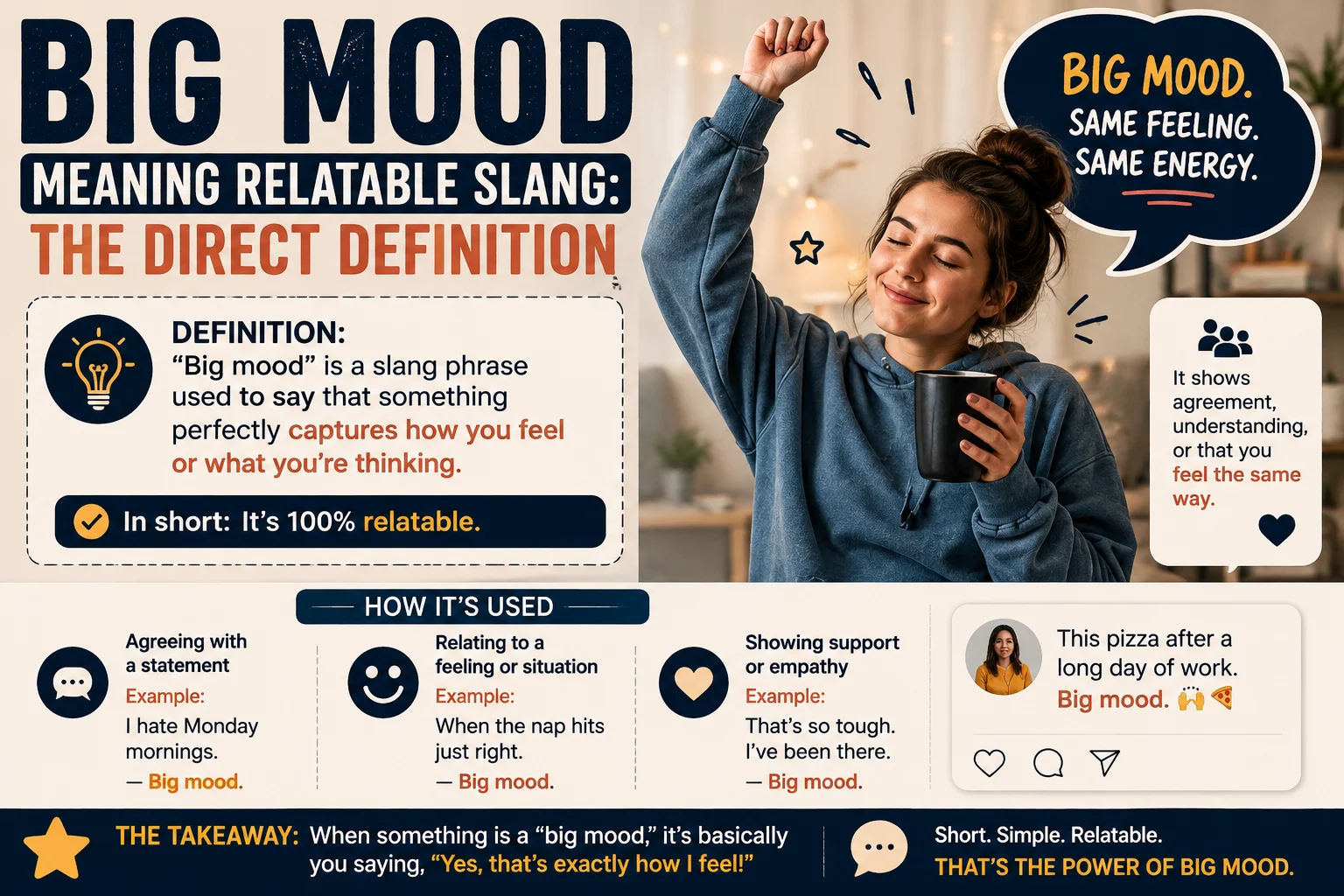
Big Mood Meaning Relatable Slang: The Direct Definition
At its core, big mood meaning relatable slang centers on shared feeling. When someone comments “big mood” under a post, they’re saying “this is exactly how I feel right now” or “I relate to this completely.” It’s less about literal mood in the clinical sense and more about a quick, expressive way of connecting with something emotionally.
The phrase works best as a reaction rather than a description — people rarely say “I am having a big mood” the way they might say “I am having a bad day.” Instead, “big mood” functions almost like an exclamation, pointing at something and saying “same.”
Why “Mood” Alone Isn’t Quite the Same
Understanding big mood meaning relatable slang also means understanding how it differs from simply saying “mood” by itself. Both phrases express relatability, but adding “big” turns up the emotional volume, signaling that something resonates especially strongly rather than just mildly. Someone might reply “mood” to something lightly relatable, but reserve “big mood” for something that feels unusually, almost uncomfortably accurate.
This subtle intensity difference is easy to miss at first glance, but it’s a meaningful part of how fluent slang users choose between the two options depending on how strongly they actually relate to whatever they’re reacting to — a nuance central to grasping big mood meaning relatable slang fully.
Origin of Big Mood as Slang
Like much contemporary internet slang, big mood meaning relatable slang developed informally through social media rather than any official coining process. It builds on the shorter, earlier slang use of “mood” alone, which itself became popular as a quick way of expressing relatability to an image, video, or statement. Adding “big” intensifies that same reaction, emphasizing just how strongly something resonates.
Because exact origins of casual internet slang are rarely documented in real time, and because terms like this spread informally through community use before appearing in any dictionary, the specific point at which “big mood” became widely recognized shorthand should be treated as a general pattern rather than a firmly dated history.
How Big Mood Spread Across the Internet
Like many popular slang phrases, big mood meaning relatable slang likely spread through a combination of memes, comment sections, and casual reposting across multiple platforms, gradually becoming familiar to a much wider audience than whichever specific community first popularized it. This kind of gradual, informal spread is typical of internet slang generally, where a phrase’s popularity often grows through repeated, everyday use rather than any single, traceable moment of invention.
Because tracking the precise spread of internet slang in real time is notoriously difficult, any detailed claim about exactly when or how “big mood” crossed into broader mainstream use should be treated as an approximate pattern rather than a precisely documented timeline.
The Emotional Function of Big Mood
At a deeper level, big mood meaning relatable slang serves an important social function: quickly signaling connection without requiring a lengthy explanation. In a fast-scrolling social media environment, a short phrase that instantly communicates “I understand exactly how you feel” carries real value, letting people bond over shared experience with minimal effort.
This efficiency is part of why the phrase has remained popular. It compresses what might otherwise take several sentences to explain — genuine, specific relatability — into just two simple, familiar words that nearly everyone active on social media recognizes instantly.
Big Mood as a Form of Digital Empathy
Beyond simple relatability, big mood meaning relatable slang can also function as a small act of digital empathy. Responding to someone’s frustrating or embarrassing story with “big mood” validates their experience without requiring advice, solutions, or a lengthy response. It simply says “you’re not alone in feeling this way,” which can feel genuinely comforting even in a brief, casual online exchange.
This validating function helps explain why the phrase feels warm rather than dismissive, even when used in response to mildly negative situations. It’s less about minimizing someone’s experience and more about immediately affirming that their feeling makes complete sense — a core part of why big mood meaning relatable slang resonates so widely.
Big Mood in Workplace-Adjacent Casual Chat
While not typically appropriate for formal workplace communication, big mood meaning relatable slang does sometimes appear in more casual internal messaging platforms among coworkers who already have an informal rapport. A shared frustration about a long meeting or a chaotic Monday might get a quick “big mood” reaction in a casual team chat, though this usage depends heavily on how relaxed and informal a particular workplace culture happens to be.
Because workplace communication norms vary significantly by company, industry, and individual team culture, any general claim about how appropriate this phrase is in professional settings should be treated as highly dependent on specific workplace context rather than a fixed rule.
How People Use Big Mood in Texting and Social Media
The phrase shows up constantly in comments, captions, and reaction posts, typically responding to something relatable, funny, or emotionally resonant. Someone might comment “big mood” under a meme about Monday mornings, or caption their own post “big mood today” to describe their current state in a lighthearted, expressive way.
This usage tends to carry warmth and humor rather than seriousness, similar to saying “I feel this so hard” out loud. Understanding big mood meaning relatable slang in this context mostly comes down to recognizing that casual, communal tone of shared experience rather than reading it as a formal or literal statement about someone’s emotional state.
Big Mood in Everyday Conversation
One of the most common places to see big mood meaning relatable slang play out is in everyday texting between friends. Someone describing an exhausting day, a funny coincidence, or a relatable frustration might get a quick “big mood” in response, signaling instant understanding without needing a longer explanation.
Example: “I just reheated coffee for the third time today and forgot to drink it again — big mood.” This kind of message uses the phrase to acknowledge shared, relatable experience in a quick, familiar way that friends immediately understand, which is really the entire practical value behind big mood meaning relatable slang in everyday texting.
Big Mood in Memes and Captions
Memes and image captions are one of the most natural homes for big mood meaning relatable slang. A picture of a tired cat, an overwhelmed cartoon character, or an exaggerated reaction gif often gets paired with the caption “big mood,” using the phrase to sum up a shared emotional reaction in just two words instead of a longer explanation.
This visual pairing is part of why the phrase spread so effectively — it works as a compact caption that instantly communicates relatability without requiring viewers to read anything lengthy or detailed, which is precisely why big mood meaning relatable slang thrives so naturally in meme culture specifically.
Is Big Mood Meaning Relatable Slang Ever Offensive?
No. Big mood meaning relatable slang carries no offensive or rude connotation. It’s a purely positive, connective phrase used to express relatability and shared feeling, whether the underlying emotion is happy, tired, frustrated, or anything in between.
Because the phrase focuses on connection and shared experience rather than judgment or criticism of anyone, it functions as one of the more universally friendly pieces of slang covered on this site, appropriate across a wide range of casual conversations and platforms. Its consistently positive tone is really one of the defining traits of big mood meaning relatable slang compared to slang that can flip between sincere and sarcastic depending on context.
Big Mood vs. Similar Slang Terms
Several other slang terms overlap with big mood meaning relatable slang, though each carries a slightly different flavor. “Mood” alone conveys the same basic idea with slightly less emphasis than “big mood.” “Same energy” emphasizes a shared vibe or attitude rather than a specific relatable feeling. “Felt that” emphasizes an emotional reaction to something just witnessed or read, often used as a direct response to a specific statement. “This is so me” makes the relatability explicitly personal rather than describing a general shared feeling.
Understanding these small distinctions helps clarify exactly what makes “big mood” stand out among this broader family of relatability-focused slang terms, and pinpointing those differences is a useful way to fully grasp big mood meaning relatable slang alongside its closest cousins.
Grammar: How Big Mood Is Used
Because big mood meaning relatable slang functions more like an exclamation than a standard sentence, it doesn’t always follow typical grammar rules. It’s most often used as a standalone phrase — simply “big mood” on its own — rather than embedded within a longer, grammatically complete sentence. When it does appear within a sentence, it usually follows a colon or dash, as in “reheating coffee for the third time: big mood.”
This flexible, informal grammar is common across reaction-based internet slang more broadly, where the goal is quick emotional communication rather than strict sentence structure — another reminder that big mood meaning relatable slang prioritizes feeling over formal grammar.
Big Mood in Dating and Social Contexts
In dating conversations and casual social exchanges, big mood meaning relatable slang often shows up as a lighthearted way of bonding over shared quirks, frustrations, or funny situations. A match describing an awkward first-date habit might get a playful “big mood” in response, signaling shared understanding and building rapport through relatability rather than direct compliments.
This usage highlights the phrase’s social bonding function — it’s less about analyzing a situation and more about quickly signaling “I get it, and I relate.”
Big Mood in Gaming and Online Communities
Gaming chats and online communities also use big mood meaning relatable slang frequently, particularly in reaction to a shared frustration, an unlucky moment, or a funny in-game situation. A player losing a match in an unlucky, frustrating way might get responses of “big mood” from teammates who’ve experienced the same thing, using the phrase as quick, communal commiseration within fast-moving chat conversations.
Because platform-specific popularity is difficult to measure precisely and shifts constantly, any claim about exactly how common the phrase is on a specific platform or within a specific gaming community should be treated as a general impression rather than firmly measured data. Even so, this communal, commiserating use fits naturally into the fast-paced back-and-forth typical of gaming chat culture, another everyday example of big mood meaning relatable slang in action.
Big Mood as a Shorthand for Belonging
Part of what makes big mood meaning relatable slang so appealing is the small sense of belonging it creates. Agreeing that something is “a big mood” signals membership in a shared experience, even among strangers commenting on the same post. This quick, low-effort way of bonding over a relatable moment is part of a broader pattern in online culture, where short, recognizable phrases help people feel connected across large, often anonymous platforms.
This sense of belonging doesn’t require deep personal disclosure — commenting “big mood” takes only a few seconds, yet it still communicates genuine understanding, which is part of why big mood meaning relatable slang has remained so consistently popular across such a wide range of online spaces.
Big Mood Compared to Older Relatability Phrases
Every generation develops its own version of a phrase meaning “I relate to this so much.” Big mood meaning relatable slang fits into this long tradition, following earlier expressions like “story of my life,” “tell me about it,” and “preach” that have expressed similar sentiment in casual English for decades. What’s different is the format — short, meme-friendly, and built for captions and comment sections rather than spoken conversation.
This pattern of compressing an existing casual sentiment into a shorter, punchier phrase is common throughout internet slang more broadly, and “big mood” represents a fairly typical example of how relatability gets reshaped for fast-paced social media commentary.
Writing Style: Capitalization and Punctuation
Big mood meaning relatable slang stays consistent regardless of capitalization, but style choices can shift the tone slightly. Lowercase “big mood” tends to feel casual and understated, common in quick texts or comments. Fully capitalized “BIG MOOD” often adds extra emphasis, similar to saying it enthusiastically out loud, and shows up more often in captions meant to grab attention. Adding punctuation, like “big mood??” or “BIG MOOD!!,” pushes the emotional intensity further, signaling heightened relatability or excitement.
None of these stylistic variations change the underlying definition — they simply adjust how strongly the reaction comes across, giving people a flexible way to fine-tune tone without needing an entirely different phrase to express the same core big mood meaning relatable slang carries.
When Big Mood Might Not Land as Intended
Because big mood meaning relatable slang depends on shared cultural familiarity, there’s some risk of it falling flat with someone unfamiliar with casual internet slang. A comment that reads as warm and relatable to a regular social media user might simply confuse someone less familiar with how the phrase functions, especially without any additional context or explanation nearby.
This risk is fairly low in casual online spaces, where most audiences already recognize the phrase, but it’s worth keeping in mind when writing for a broader, more general audience that might not share the same familiarity with big mood meaning relatable slang or current internet slang generally.
Common Misunderstandings About Big Mood Meaning Relatable Slang
One common misunderstanding is assuming “big mood” describes a specific, named emotion, similar to saying someone is “happy” or “sad.” In reality, big mood meaning relatable slang is less about naming a specific feeling and more about signaling broad, immediate relatability to whatever is being described.
Another misunderstanding treats the phrase as sarcastic or dismissive. In nearly all common usage, it’s genuinely warm and affirming, expressing real connection rather than mockery, even when the underlying situation being described is mildly negative or frustrating.
A third misunderstanding assumes the phrase requires a serious or significant situation to apply. In practice, “big mood” gets used just as often for small, mundane relatable moments — like forgetting a coffee cup — as it does for bigger, more meaningful shared experiences.
Regional and Generational Differences in Use
Like most contemporary internet slang, big mood meaning relatable slang tends to be most familiar among younger social media users, particularly those active in spaces where quick, expressive captions and comments are part of everyday communication style. Older or less frequently online audiences may encounter the phrase less often or need brief context the first time they see it.
Because slang popularity shifts constantly and varies significantly across communities and platforms, general claims about which age groups or regions use the phrase most should be treated as broad tendencies rather than precise, measurable data.
How to Use Big Mood Correctly in a Sentence
Because the phrase depends heavily on context, it helps to see a few natural examples. As a standalone reaction: “Forgot my umbrella again — big mood.” As a caption: “Big mood energy today, send snacks.” As a response to someone else’s story: “Wait, big mood, that happened to me too.”
In each case, “big mood” works as a quick, expressive reaction rather than a detailed explanation, reflecting how naturally the phrase fits into fast-paced, casual conversation.
Frequently Asked Questions
What does big mood mean in slang?
Big mood meaning relatable slang describes strong agreement or identification with a feeling, situation, or post, often used as a short, expressive reaction.
Is big mood the same as just saying “mood”?
They’re closely related, though “big mood” adds extra emphasis, signaling an especially strong sense of relatability compared to the shorter version alone.
Is it rude to say “big mood” to someone?
No. It’s a warm, connective phrase expressing relatability, not criticism or mockery, and is generally received as friendly and affirming.
Can big mood apply to negative feelings too?
Yes. It can describe relatable frustration, exhaustion, or minor negativity just as easily as positive or funny situations.
Is big mood used the same way on every platform?
Its core meaning stays consistent, though exact frequency and popularity can vary somewhat depending on the specific platform or community.
Does big mood require a full sentence to use correctly?
No. It’s most commonly used as a short, standalone reaction rather than embedded in a longer, formally structured sentence.
Is there a way to overuse big mood?
Like most slang, repeating it constantly can dilute its impact, though there’s no strict rule limiting how often it can be used in casual conversation.
Does big mood work well in professional messaging?
Generally no, unless the workplace culture is already very casual. Most professional settings call for more formal language instead.
Conclusion
Big mood meaning relatable slang ultimately comes down to one warm, simple idea: relatability expressed quickly and affectionately. Whether reacting to a funny meme, a relatable frustration, or a shared quirky habit, the phrase gives casual conversation an easy, friendly way to say “I feel this” without needing a longer explanation, making it one of the more genuinely warm additions to modern internet slang.