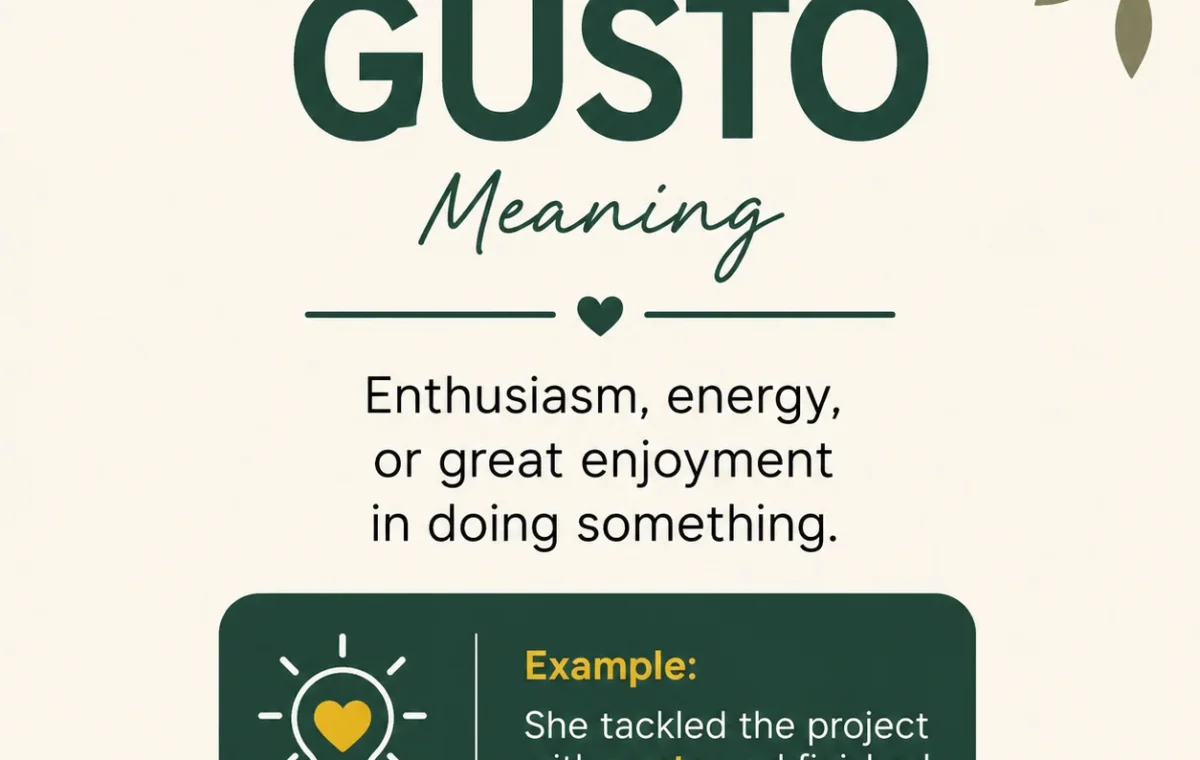
The gusto meaning is enthusiastic energy or enjoyment, especially when someone does something with obvious eagerness and pleasure. In simple terms, if you do something “with gusto,” you do it wholeheartedly, energetically, and with real enthusiasm.
- Quick Answer
- Gusto Meaning in Plain English
- What Part of Speech Is Gusto?
- Gusto Pronunciation
- Gusto Meaning: Examples in Sentences
- What Does “With Gusto” Mean?
- Gusto vs. Enthusiasm: Is There a Difference?
- Synonyms for Gusto
- Is Gusto Formal or Informal?
- Common Collocations With Gusto
- Common Mistakes to Avoid
- A Quick Correction
- Gusto Origin and Etymology
- How to Remember the Word
- Gusto in Everyday English
- Related Words and Expressions
- Quick Usage Cheat-Sheet
- Frequently Asked Questions
- What does gusto mean?
- What does “with gusto” mean?
- Is gusto a positive word?
- Is gusto a noun or an adjective?
- What is a synonym for gusto?
- Is gusto an English word?
- How do you pronounce gusto?
- Can gusto describe food?
- Final Thoughts
It’s a cheerful, expressive word that can describe eating, working, performing, speaking, or enjoying an experience. You’ll often see it in the phrase with gusto, which is the most common everyday use.More information:-ghosting someone meaning dating advice or gaara tattoo meaning .
Quick Answer
| Word | Meaning | Example |
|---|---|---|
| Gusto | Energetic enthusiasm or enjoyment | She sang with gusto. |
| Part of speech | Noun | His gusto impressed the team. |
| Pronunciation | /ˈɡʌstoʊ/ | “GUS-toh” |
| Common phrase | with gusto | They cheered with gusto. |

Gusto Meaning in Plain English
The gusto meaning centers on doing or experiencing something with strong enthusiasm and pleasure. It suggests more than simply participating. There’s spirit, eagerness, and often a sense that the person is fully enjoying what they’re doing.
For example, “Maya attacked the project with gusto” means Maya worked on it with lively energy and determination. The sentence doesn’t necessarily mean she was aggressive; “attacked” is figurative, while gusto supplies the sense of energetic commitment.
The word can also describe appetite or enjoyment, especially in older or literary usage. A person who eats with gusto is eating heartily and with obvious enjoyment.
The gusto meaning is also useful when a writer wants to show that enthusiasm is visible rather than merely felt. When someone asks, “What is the gusto meaning?” the shortest useful answer is “enthusiastic enjoyment or energetic participation.”
What Part of Speech Is Gusto?
Gusto is a noun. It names a quality or manner of doing something rather than an action itself.
Understanding the gusto meaning helps you distinguish this expressive noun from calmer words such as interest or willingness.
Common grammatical patterns include:
- with gusto — with enthusiastic energy
- great gusto — a large amount of enthusiasm
- considerable gusto — noticeable energy or enjoyment
- do something with gusto — perform an action enthusiastically
You normally wouldn’t use it as a verb. Saying “He gustoes through his work” would be incorrect in standard English.
Gusto Pronunciation
The standard English pronunciation is /ˈɡʌstoʊ/, approximately GUS-toh.
The first syllable sounds like “guss,” as in “gusto” with the stress at the beginning. The second syllable is lighter.
A useful pronunciation tip: don’t stress the second syllable. Say GUS-toh, not “gus-TOH.”
Gusto Meaning: Examples in Sentences
Seeing the word in context makes its tone much easier to understand. Here are natural examples:
- She tackled the new assignment with gusto.
She approached it with energetic enthusiasm. - The children ate the birthday cake with gusto.
They ate eagerly and clearly enjoyed it. - He told the story with gusto.
His storytelling was lively and enthusiastic. - The choir sang the final verse with gusto.
The singers performed with strong energy and feeling. - After the break, the team returned to work with gusto.
They resumed their work enthusiastically. - She defended her idea with gusto.
She expressed her position with force, confidence, and enthusiasm.
Notice that the word usually adds emotional color. “She sang” is neutral; “she sang with gusto” creates a picture of someone singing energetically and wholeheartedly.
In a sentence about a performer, the gusto meaning can suggest confidence, animation, and pleasure in the performance. For learners, the easiest way to grasp the gusto meaning is to picture someone putting extra energy into an ordinary task.
What Does “With Gusto” Mean?
The phrase with gusto means with enthusiasm, energy, eagerness, or enjoyment.
It’s flexible enough for both positive and humorous contexts. You might say, “He cleaned the kitchen with gusto,” if someone is unusually energetic about a household chore. You could also say, “The audience applauded with gusto,” meaning the applause was enthusiastic and vigorous.
The phrase is common in both speech and writing, although it can sound slightly colorful or expressive compared with plain alternatives such as “enthusiastically.”
That distinction is central to the gusto meaning: the person is not simply doing something; they are doing it with spirit. The gusto meaning can therefore be positive without implying that the person is loud or excessively emotional.
Gusto vs. Enthusiasm: Is There a Difference?
Enthusiasm and gusto overlap, but they aren’t perfect substitutes.
| Word | Main idea | Typical feel |
| Gusto | Lively enjoyment and energetic participation | Vivid, expressive |
| Enthusiasm | Strong interest or excitement | Neutral, versatile |
| Zeal | Intense enthusiasm for a cause or goal | Strong, sometimes serious |
| Eagerness | Strong desire to do something | Focused on willingness |
| Vigor | Physical or mental energy | More about force than enjoyment |
If you want a neutral term for professional writing, enthusiasm may be the safer choice. If you want to make the sentence feel more animated, gusto often works better.
In descriptive writing, the gusto meaning gives a sentence a stronger sense of movement and personality.
Synonyms for Gusto
Depending on context, useful synonyms include:
- enthusiasm — strong interest and excitement
- eagerness — readiness or strong desire
- zest — lively enjoyment and energy
- zeal — intense enthusiasm, often for a cause
- vigor — strength and energy
- spirit — lively energy or determination
- exuberance — very energetic, cheerful enthusiasm
- relish — enjoyment, especially of an experience or activity
These words aren’t interchangeable in every sentence. “She ate with relish” can suggest enjoyment of food, while “she worked with zeal” often suggests dedication to a goal. Gusto sits comfortably between energetic enthusiasm and obvious enjoyment.
Knowing the gusto meaning makes it easier to decide whether this word or a more neutral synonym fits your sentence.
Is Gusto Formal or Informal?
The word is neither strongly slangy nor highly formal. It is standard English, but it has a lively, expressive tone.
In a business report, “The team completed the task enthusiastically” may sound more neutral. In a speech, article, review, or personal story, “The team completed the task with gusto” can sound warmer and more vivid.
So, use the term when you want energy to be felt in the sentence rather than merely reported.
Common Collocations With Gusto
A collocation is a combination of words that commonly appear together. With this noun, the most familiar pattern is with gusto.
Common examples include:
- eat with gusto
- work with gusto
- sing with gusto
- perform with gusto
- attack a task with gusto
- embrace something with gusto
- cheer with gusto
- speak with gusto
These combinations work because the word naturally emphasizes energetic participation.
The gusto meaning also explains why the word works naturally beside action verbs such as eat, sing, work, cheer, and perform. In everyday conversation, the gusto meaning is often conveyed most naturally through the phrase “with gusto.”
Common Mistakes to Avoid
One common mistake is treating the word as though it means only “happiness.” It usually carries a stronger idea of enthusiastic energy or hearty enjoyment.
Another mistake is assuming it must describe physical activity. You can show gusto while speaking, arguing, studying, writing, performing, eating, or working.
Also remember that gusto is a noun. Use “with gusto,” “his gusto,” or “great gusto,” rather than inventing a verb form.
The gusto meaning is useful here because it reminds you that the noun describes a quality of enthusiastic action, not the action itself.
A Quick Correction
Incorrect: She gustoes through every assignment.
Better: She works through every assignment with gusto.
For writers, the gusto meaning is useful when you want to make enthusiasm feel concrete rather than abstract.
Gusto Origin and Etymology
The English noun comes from Italian gusto, meaning “taste” or “liking,” and is related to the idea of enjoying something. English adopted the word in the 17th century.
Its history helps explain why the modern term can connect enthusiasm with enjoyment. The sense developed beyond literal taste toward a figurative sense of relish, enjoyment, and spirited participation.
The related Spanish word gusto can also mean “taste,” “liking,” or “pleasure,” depending on context. However, the English usage discussed here is the standard English noun.
How to Remember the Word
Think of gusto as doing something with extra spirit.
A simple memory line is:
Gusto = energy + enthusiasm + enjoyment.
The gusto meaning is easiest to remember as enthusiastic energy mixed with enjoyment. Imagine someone taking an ordinary activity and turning up the enthusiasm. That mental picture captures the word better than simply memorizing “enthusiasm.”
Gusto in Everyday English
You’re most likely to encounter this term in the phrase with gusto. It appears in conversations, journalism, reviews, essays, fiction, and descriptive writing.
For example, a food writer might say that someone “dug into the meal with gusto.” A sports writer might describe a player who “celebrated with gusto.” A teacher could praise a student who “participated with gusto.”
The expression works especially well when the writer wants the reader to picture visible energy rather than quiet interest.
The gusto meaning is especially clear in these contexts because the word turns an ordinary action into something vivid and spirited.
Related Words and Expressions
Several nearby words can help you express different shades of meaning:
- Zest — lively enjoyment or excitement.
- Relish — strong enjoyment, often of an experience.
- Enthusiasm — strong interest or excitement.
- Zeal — intense dedication or enthusiasm.
- Vigor — strength, force, or energy.
- Verve — energetic style, confidence, and liveliness.
A good rule is to choose gusto when enjoyment and energetic action are both important.
Once you understand the gusto meaning, the phrase “with gusto” becomes easy to recognize and use accurately.
Quick Usage Cheat-Sheet
| If you mean… | Try… |
| Strong interest | enthusiasm |
| Energetic enjoyment | gusto |
| Enjoyment of an experience | relish |
| Lively excitement | zest |
| Intense dedication | zeal |
| Physical or mental energy | vigor |
Updated for 2026: The basic meaning and standard usage remain stable in contemporary English.
Frequently Asked Questions
What does gusto mean?
The gusto meaning is enthusiastic energy, eagerness, or enjoyment in doing something. It often suggests that a person participates wholeheartedly and visibly enjoys the activity.
What does “with gusto” mean?
“With gusto” means doing something energetically, enthusiastically, or with obvious enjoyment. For example, “She sang with gusto” means she sang with lively energy and feeling.
Is gusto a positive word?
Usually, yes. It normally conveys an appealing sense of enthusiasm, energy, or enjoyment, although the surrounding context can make the expression humorous or exaggerated.
Is gusto a noun or an adjective?
Gusto is a noun. It names the quality of enthusiastic energy or enjoyment, as in “He worked with gusto.”
What is a synonym for gusto?
Common synonyms include enthusiasm, zest, zeal, eagerness, relish, spirit, and vigor. The best choice depends on whether you want to emphasize enjoyment, eagerness, dedication, or energy.
Is gusto an English word?
Yes. It is an established English noun borrowed from Italian. English uses it especially to describe spirited enjoyment or enthusiastic participation.
How do you pronounce gusto?
In standard English, it is pronounced /ˈɡʌstoʊ/, roughly GUS-toh, with the stress on the first syllable.
Can gusto describe food?
Yes. A person can eat “with gusto,” meaning they eat heartily and with obvious enjoyment. The usage connects with the word’s older association with taste and liking.
Final Thoughts
The gusto meaning is easiest to remember as enthusiastic energy mixed with enjoyment. It’s especially useful when plain words such as “interest” or “effort” don’t capture the lively spirit behind an action. If you want a vivid synonym for enthusiasm, gusto can add personality without sounding like slang. For a broader look at the idea behind the word, explore enthusiasm and discover more practical word guides on SmartWording.com.