Invictus is a Latin word meaning “unconquered” or “undefeated,” carrying a strong sense of resilience across many centuries of use. It’s most widely known today through the poem “Invictus” by William Ernest Henley, which uses the word to express deep resilience and inner strength in the face of genuine hardship.For more insights, read here:- entendre meaning and elicit meaning.
- Quick Definition
- The Invictus Meaning in Everyday Use
- Where the Word Comes From
- The Poem and Its Meaning
- Common Contexts for "Invictus"
- Is "Invictus" Used Informally?
- Common Misunderstanding
- Similar Words and Expressions
- Workplace and Motivational Use
- Dating and Personal Identity Context
- Frequently Asked Questions
- What is the simplest way to explain the invictus meaning?
- Is invictus a real Latin word?
- What is the poem Invictus about?
- Is invictus connected to Nelson Mandela?
- What is the Invictus Games?
- Why do people get invictus tattooed instead of writing it out in English?
- Wrapping Up
Quick Definition
- Invictus (adjective, Latin): unconquered, undefeated, or unyielding in spirit even under significant pressure.
- Example: “She got the word invictus tattooed on her wrist after fully recovering from her illness.”
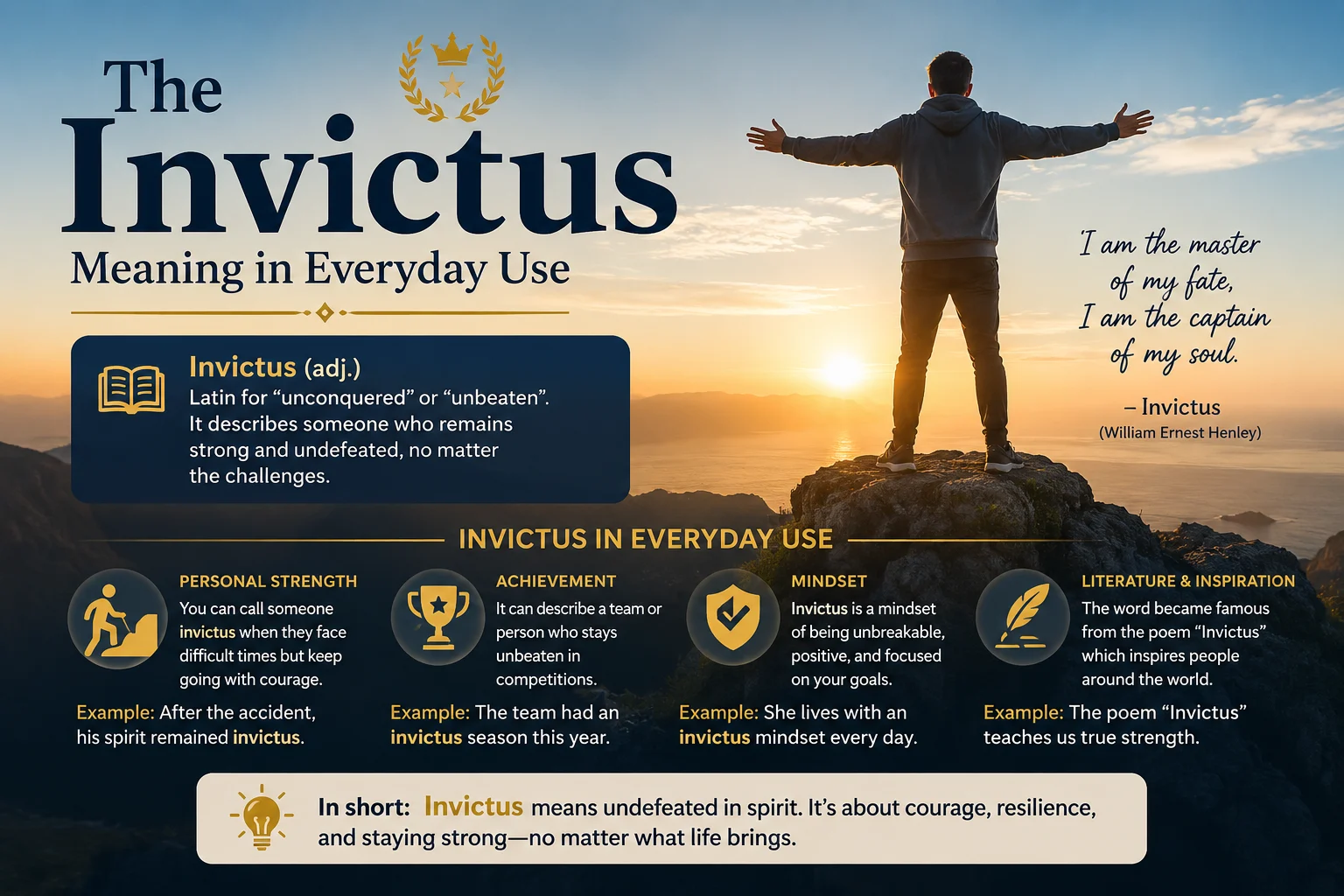
The Invictus Meaning in Everyday Use
In everyday use, the invictus meaning usually points to a sense of inner resilience: the idea of remaining unbeaten in spirit even when facing serious difficulty, loss, or pain. It’s rarely used in ordinary conversation as a standalone word, but it shows up often in tattoos, mottos, and inspirational contexts.
People are typically drawn to the word specifically because it carries real, genuine weight without needing much explanation. A single Latin word feels more permanent and deliberate than an English phrase, which is part of why the invictus meaning resonates so strongly with people marking a personal turning point.
Example sentences:
- “He chose invictus as his personal motto after fully surviving the accident.”
- “The team named their entire comeback season ‘Invictus’ to reflect their shared determination.”
- “She reads the poem Invictus quietly whenever she needs a reminder to keep going.”
- “The gym printed the word invictus across the wall to inspire members during genuinely hard workouts.”
Where the Word Comes From
“Invictus” comes directly from Latin, where it means “unconquered” or “invincible,” built from “in-” (not) and “victus” (conquered, from the verb “vincere,” meaning “to conquer”). The word was used in ancient Rome, including as part of religious and military titles referring to being undefeated. Its most famous modern use comes from the 1875 poem “Invictus” by the English poet William Ernest Henley, written while he was recovering from serious illness and the amputation of a leg.
This layered history is part of what gives the invictus meaning so much weight today. It isn’t a modern invention dressed up to sound impressive; it’s a genuinely old word that has carried a consistent sense of being unbeaten across many centuries of use.
The Poem and Its Meaning
Henley’s poem “Invictus” describes facing hardship and suffering without giving up one’s inner sense of control and dignity, closing with the well-known idea that the speaker remains the master of their own fate and mind, no matter the circumstances. The poem has since become widely associated with resilience, particularly in contexts involving illness, imprisonment, and overcoming adversity. Nelson Mandela is often connected to the poem, since he reportedly drew strength from it during his imprisonment, though the exact details of how and when he first encountered it are less clearly documented and should be treated with some caution.
This connection between the poem and real, well-documented historical figures has done a lot to keep the invictus meaning alive in modern culture. Rather than staying a piece of Victorian-era poetry, it became a phrase people actively reach for during genuinely difficult chapters of their own lives.
Common Contexts for “Invictus”
- Tattoos: The word itself, or specific lines from the poem, are commonly chosen as tattoos symbolizing resilience, survival, and personal strength.
- Mottos and quotes: Individuals and organizations sometimes proudly adopt “invictus” as a personal or team motto to represent resilience.
- Sports and military contexts: The word is sometimes used in team names or events associated with overcoming adversity, such as the Invictus Games, a sporting event for wounded, injured, or sick armed forces personnel and veterans.
- Literature and film titles: The word and poem have inspired various creative works referencing themes of resilience, courage, and quiet endurance.
- Academic and institutional mottos: Some schools and organizations have proudly adopted “invictus” as part of a broader motto emphasizing perseverance and grit.
Across all of these settings, the invictus meaning stays remarkably consistent, always circling back to the same core idea of remaining unbeaten despite outside pressure.
Is “Invictus” Used Informally?
Not really, and it isn’t slang. “Invictus” stays fairly consistent across contexts, mostly appearing in formal, symbolic, or inspirational settings rather than casual conversation or texting. It doesn’t carry an alternate or hidden meaning online, and its use doesn’t shift much by platform or region.
Because the invictus meaning is so stable and consistent, people rarely misuse it or bend it toward a different sense over time. Unlike genuine slang, which can shift quickly, this word has kept essentially the same weight and tone for well over a century.
Common Misunderstanding
Some people assume “invictus” is simply a stylish or invented word rather than an actual Latin term with a specific, documented meaning. In reality, it’s a real Latin adjective with a long history that predates its modern popularity, including its use in ancient Roman titles referring to gods and emperors as “unconquered.”
This misunderstanding is understandable given how often the word shows up in modern branding and tattoos, disconnected from any explicit Latin lesson. Still, the invictus meaning traces back through genuine historical use, not a trend invented for aesthetic purposes.
Similar Words and Expressions
- Unconquered — the direct English translation of invictus.
- Undefeated — close in meaning, often used in sports and competitive contexts.
- Resilient — describes the quality of bouncing back from hardship, related in spirit though not a direct translation.
- Indomitable — similar in tone, describing something that can’t be subdued or defeated.
- Fortitude — related in spirit, emphasizing steady inner strength during hardship rather than the state of being fully unbeaten itself.
None of these words are exact synonyms for the invictus meaning. Each captures a related but slightly different angle on resilience, whether that’s the state of being unbeaten, the quality of enduring, or the strength required to keep going.
Workplace and Motivational Use
Occasionally, “invictus” shows up in workplace or team settings, especially around themes of overcoming genuine setbacks, hitting a target after failure, or rebuilding after a difficult period. It’s less common than more casual English phrases, but it fits naturally in mission statements, team names, or motivational messaging.
- “The team adopted ‘invictus’ as their rallying word after a rough quarter.”
- “Leadership carefully printed the invictus meaning on the office wall as a reminder during the turnaround.”
Dating and Personal Identity Context
Some people incorporate “invictus” into their personal identity, dating profiles, or written bios, especially after overcoming a significant personal challenge like illness, loss, or a major life change.
- “Invictus is more than a tattoo for her, it’s a reminder of what she survived.”
- “He mentioned the invictus meaning in his bio to explain why the word matters so much to him.”
Frequently Asked Questions
What is the simplest way to explain the invictus meaning?
It means “unconquered” in Latin, and it’s widely associated with resilience and inner strength, largely due to the famous poem of the same name. That single idea, staying unbeaten despite hardship, captures most of what people mean when they use the word.
Is invictus a real Latin word?
Yes. It’s a genuine Latin adjective meaning “unconquered” or “undefeated,” used in ancient Rome long before its modern popularity through poetry, which is part of why the invictus meaning carries so much historical weight.
What is the poem Invictus about?
It describes facing hardship without losing one’s inner sense of control and dignity, ending with the idea that the speaker remains in charge of their own fate and mind. That closing sentiment is really the heart of the invictus meaning as most readers remember it.
Is invictus connected to Nelson Mandela?
He’s often associated with the poem, having reportedly drawn strength from it during his imprisonment, though some specific historical details about this connection are less firmly documented. This link is part of why the invictus meaning carries such strong associations with personal courage under extreme pressure.
What is the Invictus Games?
It’s a sporting event for wounded, injured, or sick armed forces personnel and veterans, taking its name from the poem’s themes of resilience and overcoming adversity. The event’s name is a direct nod to the invictus meaning of remaining unbeaten in spirit, regardless of physical setbacks.
Why do people get invictus tattooed instead of writing it out in English?
A single Latin word often feels more permanent and symbolic than a translated phrase, and it can be a quieter, more personal way of expressing the invictus meaning without spelling out the exact story behind it.
Wrapping Up
The invictus meaning ultimately centers on one powerful idea: remaining unconquered in spirit, even when circumstances are genuinely difficult. Whether encountered through the poem, a tattoo, or a personal motto, the word carries a consistent message of resilience across all of these contexts. For a deeper look at the poem itself and its history, the Wikipedia entry on Invictus is a useful starting reference.