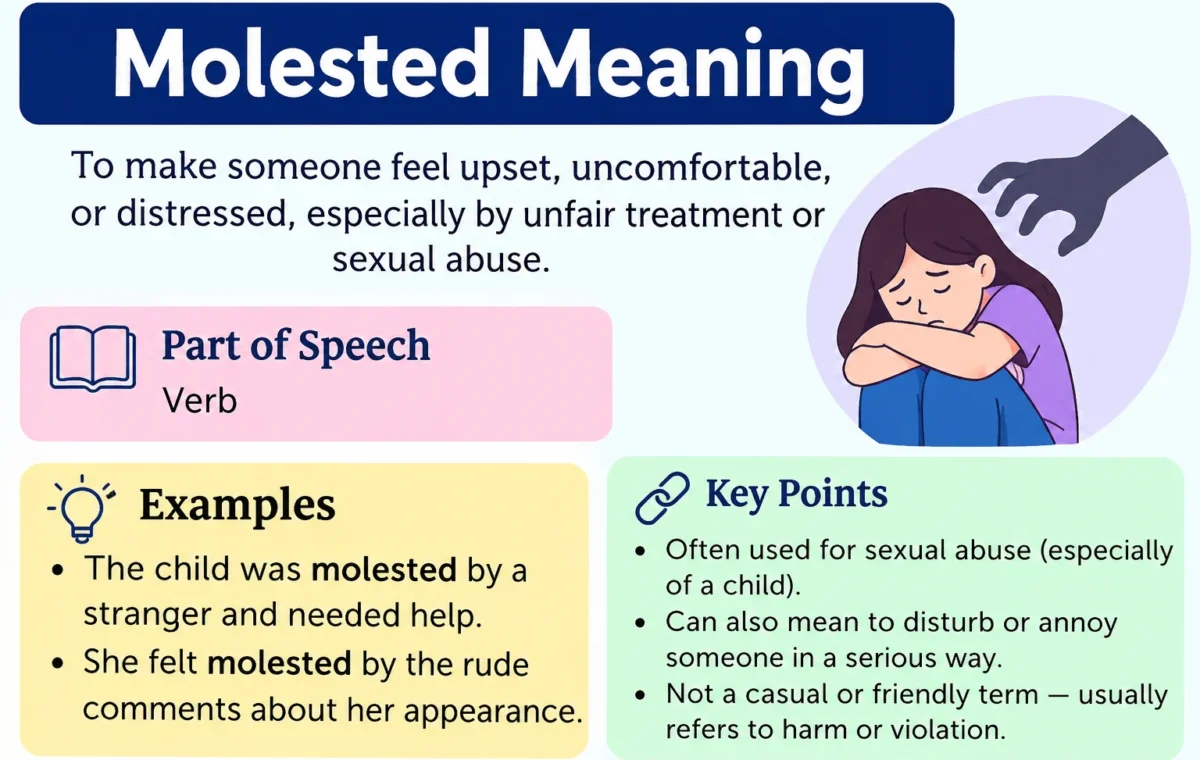
The molested meaning is generally connected with being subjected to unwanted sexual contact or sexual abuse, especially when the victim is a child. In older or broader English, molest can also mean to bother, harass, disturb, or interfere with someone, although that sense is now uncommon. Because the modern sense is serious and sensitive, choosing the right wording matters.MORE information:-gusto meaning or gypsy meaning .
- Quick Answer
- Molested Meaning in Modern English
- Part of Speech and Pronunciation
- What Does Molested Mean in Different Contexts?
- 1. Sexual Abuse or Unwanted Sexual Contact
- 2. Bothered, Harassed, or Disturbed
- Molested Meaning vs. Similar Words
- Examples of Molested in Sentences
- Formal vs. Informal: Which Word Should You Use?
- Common Mistakes to Avoid
- Mistake 1: Treating It as a Synonym for “Annoyed”
- Mistake 2: Assuming Every Use Is Sexual
- Mistake 3: Using the Word Without Checking the Facts
- Mistake 4: Confusing “Molested” With “Harassed”
- Synonyms and Close Alternatives
- Is “Molested” Always About Children?
- A Note About Sensitive Language
- Etymology and Word History
- How to Remember the Word
- Related Words and Phrases
- Quick Usage Cheat-Sheet
- Frequently Asked Questions
- What Is the Simple Meaning of Molested?
- Is Molested a Bad Word?
- What Is Another Word for Molested?
- Can Molested Mean Bothered?
- How Do You Pronounce Molested?
- Is Molested Only Used for Children?
- What Is the Difference Between Molested and Harassed?
- What Is the Difference Between Molested and Assaulted?
- Final Thoughts
Quick Answer
| Word | Meaning | Example |
|---|---|---|
| molested | subjected to unwanted sexual contact or abuse; historically, bothered or harassed | “The report stated that the child had been molested.” |
| Part of speech | Past tense and past participle of molest | “He was accused of molesting a child.” |
| Pronunciation | /məˈlɛstɪd/ | muh-LEST-id |
| Modern use | Usually refers to sexual abuse | The term should be used carefully and accurately. |
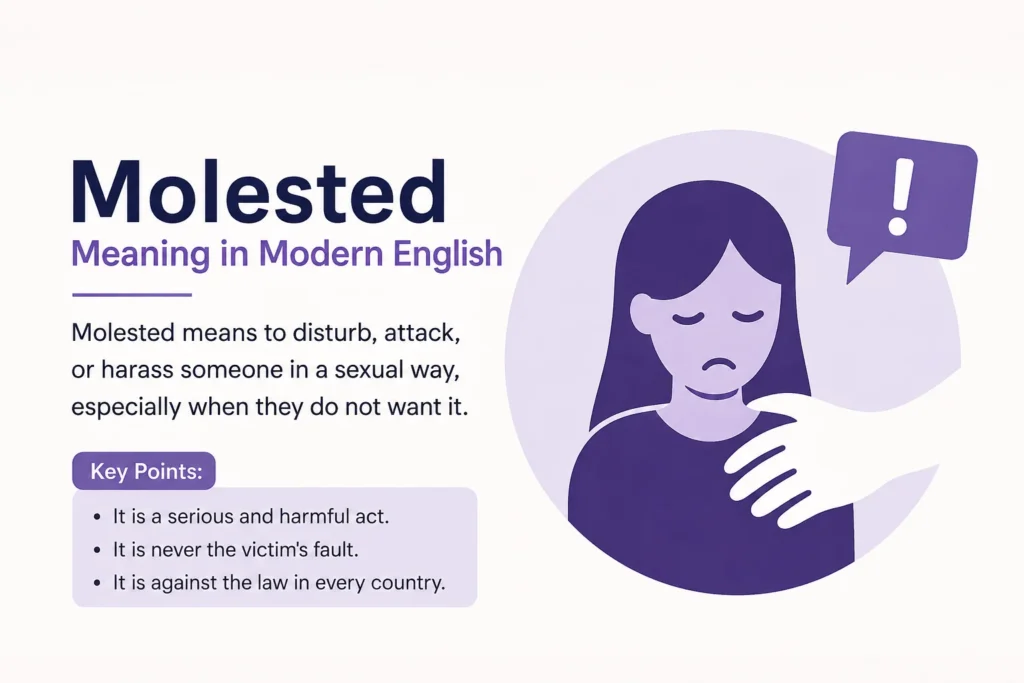
Molested Meaning in Modern English
In present-day English, molested most commonly describes a person who has been subjected to unwanted sexual touching, sexual contact, or sexual abuse. It is particularly associated with cases involving children, although the word can describe sexual abuse involving people of different ages.
So, if someone asks, “What does molested mean?”, the safest short answer is: it usually means sexually abused or subjected to unwanted sexual contact.
The molested meaning should not be softened into something as mild as “annoyed.” In modern usage, the sexual sense is dominant, especially in American English.
Part of Speech and Pronunciation
Molested is the past tense and past participle of the verb molest.
- Base verb: molest
- Past tense: molested
- Past participle: molested
- IPA: /məˈlɛstɪd/
- Simple pronunciation: muh-LEST-id
The stress falls on the second syllable: LEST.
A useful point for learners is that the ending is pronounced as a separate syllable, giving the word three syllables: muh-LEST-id.
What Does Molested Mean in Different Contexts?
The modern meaning is usually sexual, but historical English used molest more broadly.
1. Sexual Abuse or Unwanted Sexual Contact
This is the standard contemporary sense. It can refer to unwanted sexual touching, sexual exploitation, or sexual abuse.
Example: “The survivor said she had been molested as a child.”
2. Bothered, Harassed, or Disturbed
This older sense means to trouble, annoy, interfere with, or harass someone. It can still appear in historical writing or older translations, but it is unusual in ordinary modern conversation.
Example: “The traveler asked not to be molested during his rest.”
Here, the sentence does not necessarily describe sexual behavior. It uses an older sense meaning disturbed or bothered.
Understanding this distinction is important because modern readers will usually interpret the word through its sexual meaning.
Molested Meaning vs. Similar Words
Several related terms can overlap, but they aren’t interchangeable in every sentence.
| Term | Typical meaning | Important nuance |
| Molested | Subjected to sexual abuse or unwanted sexual contact | Serious term; often associated with abuse of children |
| Abused | Harmed, mistreated, or exploited | Broader; may be physical, emotional, sexual, or financial |
| Assaulted | Attacked or subjected to unlawful force or contact | Legal meaning varies by jurisdiction |
| Harassed | Subjected to repeated unwanted behavior | Does not automatically mean sexual contact |
| Exploited | Unfairly used for another person’s benefit | Focuses on misuse of power or vulnerability |
| Groped | Touched sexually without consent | More specific than the broader category of abuse |
| Bothered | Annoyed or disturbed | Much milder and usually unrelated to sexual abuse |
The molested meaning is therefore narrower and more serious than bothered, while abused is often broader.
Examples of Molested in Sentences
Here are natural examples showing how the term appears in modern English:
- “The investigation found evidence that the child had been molested.”
- “She spoke publicly about being molested when she was young.”
- “The article discussed how survivors of abuse can seek support.”
- “He was accused of molesting a minor.”
- “The historical text says the villagers were molested by soldiers,” where the older sense may mean harassed or disturbed.
Notice the context in each example. The surrounding words usually make the intended sense clear.
Formal vs. Informal: Which Word Should You Use?
The term is serious in both speech and writing, but it isn’t always the most precise choice.
In news, legal, academic, or professional writing, consider whether a more specific term is available. Depending on the verified facts, phrases such as sexual abuse, sexual assault, unwanted sexual contact, or child sexual abuse may communicate the situation more precisely.
In everyday conversation, people may use molested because it is familiar and direct. Still, don’t use it casually to mean “annoyed” or “bothered.” That older meaning can easily cause confusion.
The molested meaning in a modern sentence should be inferred from context, but writers should make the intended sense unmistakable.
Common Mistakes to Avoid
Mistake 1: Treating It as a Synonym for “Annoyed”
In modern English, saying someone was “molested” normally carries a sexual-abuse meaning. If you simply mean “bothered,” choose annoyed, disturbed, or harassed, depending on the situation.
Mistake 2: Assuming Every Use Is Sexual
Older literature can use molest in the sense of disturb or trouble. Historical context matters.
Mistake 3: Using the Word Without Checking the Facts
Because the term describes serious abuse, it should not be used as a casual accusation. In reporting or professional writing, use wording supported by reliable information.
Mistake 4: Confusing “Molested” With “Harassed”
Harassment can involve repeated unwanted conduct, including verbal or sexual behavior, but it doesn’t automatically mean sexual touching or abuse.
Synonyms and Close Alternatives
There is no perfect synonym for every context. Choose based on what actually happened.
- Sexually abused — direct and broad.
- Sexually assaulted — useful when the facts and legal context support the term.
- Groped — specific to unwanted sexual touching.
- Harassed — broader and often focused on repeated unwanted conduct.
- Abused — general term that requires context.
- Exploited — emphasizes misuse of power, trust, or vulnerability.
- Attacked — broad and less specific.
The phrase molested meaning is best understood by comparing it with these alternatives rather than treating them as identical.
Is “Molested” Always About Children?
No. The modern word can refer to sexual abuse involving a person of any age. However, it is especially common in discussions of child sexual abuse, which is why many dictionaries and ordinary examples associate it strongly with children.
The molested meaning depends on the sentence, but the contemporary sexual sense should be expected unless historical context points elsewhere.
A Note About Sensitive Language
Words describing sexual abuse carry emotional and legal weight. If you’re writing about a real person, survivor, court case, or news event, accuracy should come before dramatic wording.
It can also be more respectful to focus on the person’s experience rather than defining them by what happened to them. For example, “a person who was sexually abused” may be preferable in some contexts to repeatedly labeling someone as “a molested person.”
For learners, this is an important usage lesson: knowing a dictionary definition isn’t enough. Register, context, and sensitivity matter too.
Etymology and Word History
Molest entered English through French and ultimately traces back to Latin molestare, meaning to annoy, trouble, or vex, related to Latin molestus, meaning troublesome or burdensome.
The older English sense was therefore much broader than the dominant modern sexual-abuse sense. Over time, the sexual sense became strongly established, while the general sense of “bother or disturb” became uncommon.
That history explains why older texts may contain a use that feels surprising to modern readers.
How to Remember the Word
Think of molest → molested as a verb describing serious unwanted interference, with modern English strongly associating it with sexual abuse.
For everyday writing, remember this simple rule:
If you mean “annoyed,” don’t use “molested.”
If you mean sexual abuse or unwanted sexual contact, make sure the wording accurately reflects the facts and context.
Related Words and Phrases
These terms are useful when reading or writing about the subject:
- molest — the base verb.
- molesting — the present participle or gerund.
- sexual abuse — a broad term for abusive sexual behavior.
- child sexual abuse — sexual abuse involving a child.
- sexual assault — a term whose precise legal meaning depends on jurisdiction.
- consent — agreement to participate in an activity.
- survivor — often used for someone who has experienced abuse or violence.
For a neutral vocabulary guide, these terms should be defined according to their context rather than treated as exact substitutes.
Quick Usage Cheat-Sheet
Use “molested” when:
- The sentence concerns the modern sexual-abuse sense.
- The facts support that description.
- The context makes the meaning clear.
Use another word when:
- You only mean “annoyed” or “bothered.”
- You are describing repeated unwanted behavior that is better called harassment.
- A more precise legal or factual term is available.
The molested meaning is serious enough that precision is more important than stylistic variety.
Frequently Asked Questions
What Is the Simple Meaning of Molested?
The modern molested meaning is usually being subjected to unwanted sexual contact or sexual abuse. The word is especially common in discussions of child sexual abuse.
Is Molested a Bad Word?
It isn’t a swear word, but it is a serious and sensitive term. It describes abuse, so it should not be used casually or jokingly.
What Is Another Word for Molested?
Depending on the facts, alternatives include sexually abused, sexually assaulted, or groped. These terms have different meanings, so choose the one that is most accurate.
Can Molested Mean Bothered?
Yes, historically molest could mean to bother, disturb, or harass. That sense is uncommon today, and modern readers will usually understand the word in its sexual-abuse sense.
How Do You Pronounce Molested?
It is pronounced muh-LEST-id, with IPA /məˈlɛstɪd/. The main stress is on “lest.”
Is Molested Only Used for Children?
No. It can describe sexual abuse involving adults as well as children. However, contemporary usage frequently connects the term with child sexual abuse.
What Is the Difference Between Molested and Harassed?
Molested usually refers to sexual abuse or unwanted sexual contact in modern English. Harassed is broader and can describe repeated unwanted behavior that may be verbal, physical, sexual, or otherwise disturbing.
What Is the Difference Between Molested and Assaulted?
Both can describe serious wrongdoing, but their meanings aren’t identical. Assaulted is broader and can refer to unlawful physical or sexual attacks, while molested in modern English usually points specifically to sexual abuse or unwanted sexual contact.
Final Thoughts
The molested meaning is generally associated with unwanted sexual contact or sexual abuse, while the older meaning can refer to being bothered or disturbed. Because this is a serious and sensitive term, it’s important to use it accurately and avoid treating it as a casual synonym for “annoyed.” Understanding the context, tone, and history of the word can help you choose clearer and more respectful language. For more practical vocabulary guides, explore other word meanings and usage tips on SmartWording.
For more background on abuse, see Wikipedia.