Paramore Meaning .“Paramore” is an old-fashioned English noun meaning a lover or romantic partner, especially a secret or illicit lover. The word is now uncommon in everyday English and is mainly encountered in historical, literary, or artistic contexts.More insights information:-offset meaning or nimrod meaning .
- What Does Paramore Mean?
- Paramore as a Noun
- Paramore Meaning in Modern English
- Paramore in Historical and Literary Contexts
- Is Paramore a Slang Word?
- Paramore Meaning and Romantic Relationships
- Paramore vs. Lover
- Paramore vs. Partner
- Common Misunderstanding About Paramore
- Examples of Paramore in a Sentence
- Is Paramore Offensive?
- Origin of Paramore
- Synonyms for Paramore
- Antonyms for Paramore
- Frequently Asked Questions
- What is the simple meaning of paramore?
- Is paramore still used today?
- Is paramore a synonym for lover?
- Is paramore a gender-specific word?
- Is Paramore the band related to the word?
- Is paramore a modern slang term?
- Paramore Meaning in Different Contexts
- Paramore in Historical Writing
- Paramore in Literature
- Paramore in Poetry
- Why Does Paramore Sound Old-Fashioned?
- Paramore Meaning vs. Mistress
- Paramore Meaning vs. Beloved
- Paramore Meaning vs. Sweetheart
- Can Paramore Mean Boyfriend or Girlfriend?
- Is Paramore Used in Everyday Conversation?
- Paramore Meaning in Modern Creative Writing
- Common Mistakes When Using Paramore
- Paramore Meaning and Tone
- How to Use Paramore Correctly
- Related Words to Paramore
What Does Paramore Mean?
The word “paramore” refers to a person with whom someone has a romantic or sexual relationship, particularly when the relationship is outside marriage or otherwise socially disapproved of.
In older English, the term could describe either a male or female lover. Its meaning is closely connected with the idea of a romantic attachment that may be secret or unconventional.
Example:
“According to the old story, the nobleman secretly visited his paramore.”
Paramore as a Noun
Paramore is a noun.
It can refer to:
- A lover
- A romantic companion
- A secret lover
- In historical contexts, a person involved in an extramarital relationship
The word has an archaic or literary tone today. Calling someone a “paramore” in ordinary conversation would sound unusual and deliberately old-fashioned.
Paramore Meaning in Modern English
In modern English, “paramore” is rarely used as a normal word for a boyfriend, girlfriend, or partner.
Depending on the context, modern alternatives might include:
- Lover
- Partner
- Romantic partner
- Boyfriend
- Girlfriend
- Companion
- Secret lover
However, these words are not exact equivalents in every situation. “Paramore” traditionally carries a stronger suggestion of a lover involved in a secret, forbidden, or socially questionable relationship.
Paramore in Historical and Literary Contexts
The word appears primarily in older literature and historical writing. Writers could use it to describe a lover, particularly when discussing romance, adultery, courtship, or relationships outside conventional marriage.
Because of this history, “paramore” can give a sentence a dramatic, romantic, or antiquated feeling.
Example:
“The queen’s rumored paramore became the subject of court gossip.”
Here, “paramore” emphasizes the person’s role as a lover rather than simply a spouse or ordinary companion.
Is Paramore a Slang Word?
No. “Paramore” is not normally considered modern slang.
It is better described as an archaic or obsolete literary noun. Although someone could use it creatively today, that usage would generally be intentional rather than ordinary contemporary speech.
For example, a novelist might write:
“The mysterious stranger was rumored to be her paramore.”
The word gives the sentence a historical or dramatic flavor.
Paramore Meaning and Romantic Relationships
The romantic sense of “paramore” is important because the word does not simply mean “friend” or “companion.”
Traditionally, it identifies someone as a lover. In some contexts, it can specifically suggest an affair or relationship that is hidden from others.
For example:
“Her husband discovered that she had been meeting a paramore.”
In this sentence, the word suggests a romantic relationship outside the marriage.
Paramore vs. Lover
“Paramore” and “lover” are closely related, but their tone is different.
“Lover” remains a normal English word and can describe a romantic or sexual partner. “Paramore” is much less common and has an old-fashioned or literary quality.
Compare:
“She introduced him as her lover.”
“She introduced him as her paramore.”
The first sentence sounds modern and natural. The second sounds historical, poetic, or deliberately dramatic.
Paramore vs. Partner
“Partner” is much broader and more neutral than “paramore.”
A partner may refer to someone in a romantic relationship, marriage, business relationship, or other partnership depending on context. “Paramore,” by contrast, specifically refers to a lover.
Therefore, replacing “partner” with “paramore” can significantly change the tone and implication of a sentence.
Common Misunderstanding About Paramore
One common misunderstanding is assuming that “paramore” is simply an elegant modern synonym for “boyfriend” or “girlfriend.”
Although it can refer broadly to a lover, its historical usage carries particular associations with secret or illicit romantic relationships. It is therefore not always an appropriate replacement for modern relationship terms.
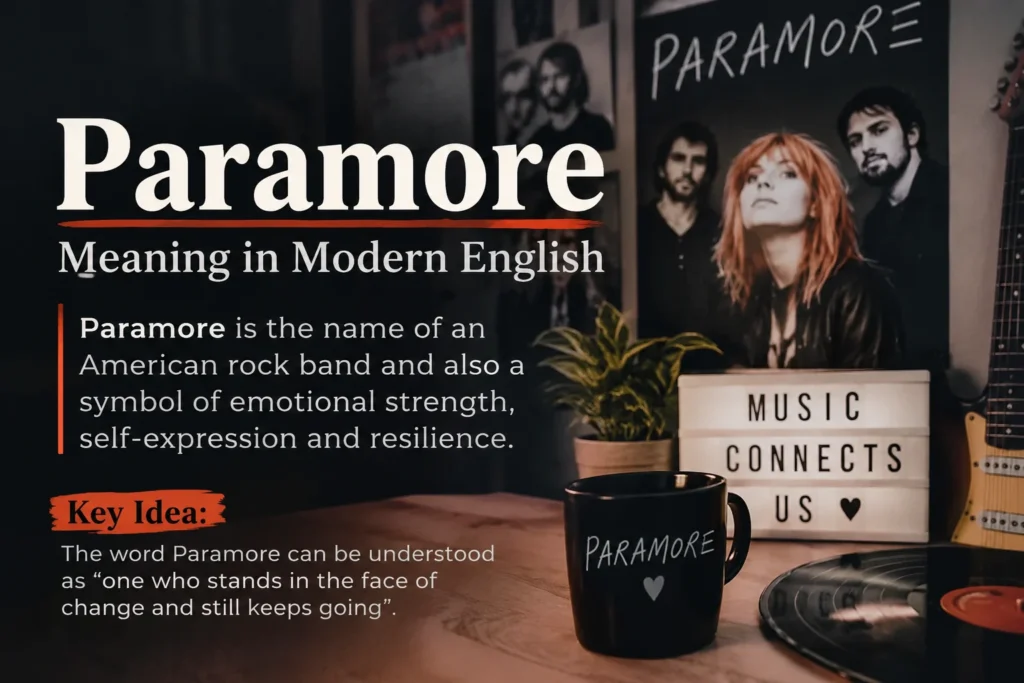
Another important point is that “paramore” is different from “Paramore,” the proper name of the American rock band. When capitalized as “Paramore,” it generally refers to the band rather than the historical noun.
Examples of Paramore in a Sentence
Here are some original examples:
- “The duke was rumored to have a secret paramore.”
- “The novel tells the story of a woman and her forbidden paramore.”
- “His former paramore appeared unexpectedly at the estate.”
- “The poet described his paramore with passionate admiration.”
- “Court gossip focused on the king and his alleged paramore.”
These examples reflect the word’s historical and literary character rather than typical modern conversation.
Is Paramore Offensive?
The word itself is not inherently offensive. However, because it can imply an illicit or extramarital romantic relationship, calling someone a “paramore” may carry a negative or judgmental implication depending on context.
In historical writing, the term can simply describe a lover. In modern conversation, however, using it about a real person could sound dramatic, mocking, or accusatory.
Origin of Paramore
“Paramore” comes from Anglo-Norman and Middle English usage and is related to the French expression “par amour,” meaning “by love” or “for love.”
The word developed into a noun referring to a lover. Its historical development explains why it has a strongly romantic association.
Because historical spellings and usages varied, references to its development should be treated with appropriate attention to the period and source.
Synonyms for Paramore
Depending on the context, possible synonyms include:
- Lover
- Beloved
- Romantic partner
- Sweetheart
- Companion
- Mistress
- Admirer
These are not perfect equivalents. Words such as “mistress” can carry a more specific meaning, while “sweetheart” is generally warmer and less suggestive of secrecy.
Antonyms for Paramore
There is no single exact antonym for “paramore.” Depending on the intended contrast, possible terms include:
- Stranger
- Non-romantic companion
- Acquaintance
- Platonic friend
The best opposite depends on whether the writer wants to contrast romantic involvement with friendship, unfamiliarity, or lack of emotional attachment.
Frequently Asked Questions
What is the simple meaning of paramore?
“Paramore” means a lover or romantic partner, especially one involved in a secret or illicit relationship.
Is paramore still used today?
It is rarely used in ordinary modern English. You are more likely to encounter it in historical writing, literature, poetry, or creative works.
Is paramore a synonym for lover?
Yes, “lover” is one of its closest modern equivalents, although “paramore” has a distinctly old-fashioned and sometimes illicit connotation.
Is paramore a gender-specific word?
No. Historically, “paramore” could refer to a lover regardless of gender.
Is Paramore the band related to the word?
The capitalized “Paramore” commonly refers to the American rock band. The lowercase noun “paramore” is an older English word meaning a lover. The two uses should be distinguished by context.
Is paramore a modern slang term?
No. It is better classified as an archaic or literary English noun rather than contemporary slang.
Paramore Meaning: Deeper Contexts, Usage, and Related Words
Understanding the paramore meaning requires more than simply translating it as “lover.” The word has a distinctly historical and literary character, and its exact implication can change depending on the sentence.
In modern English, people rarely use “paramore” in everyday conversation. When it does appear, it often creates an old-fashioned, romantic, dramatic, or slightly scandalous tone.
Paramore Meaning in Different Contexts
The paramore meaning is generally connected with romantic or sexual love, but context determines what the writer intends.
Paramore in Historical Writing
In historical writing, “paramore” may describe a lover involved in a relationship outside marriage or accepted social expectations.
Example:
“The king’s alleged paramore became the subject of political gossip.”
Here, “paramore” emphasizes the person’s role as a lover rather than simply identifying them as a friend or companion.
Paramore in Literature
Authors may use “paramore” because it sounds more literary than the modern word “lover.”
Example:
“The heroine secretly exchanged letters with her paramore.”
The word immediately gives the sentence a historical or romantic atmosphere.
Paramore in Poetry
Poetry often favors words with emotional or dramatic associations. “Paramore” can therefore appear in poetic descriptions of love, longing, secrecy, or forbidden relationships.
Example:
“Across the silent garden, she waited for her distant paramore.”
This use is stylistic rather than ordinary conversational English.
Why Does Paramore Sound Old-Fashioned?
The word “paramore” belongs to an older layer of English vocabulary. Modern speakers generally choose simpler terms such as “partner,” “lover,” “boyfriend,” or “girlfriend.”
As a result, “paramore” can sound:
- Archaic
- Literary
- Romantic
- Dramatic
- Historical
- Slightly scandalous
The tone depends heavily on context.
For example, saying “my partner” sounds neutral and contemporary. Saying “my paramore” sounds intentionally literary and may suggest a secret or forbidden relationship.
Paramore Meaning vs. Mistress
“Paramore” and “mistress” can overlap in meaning, but they are not interchangeable in every sentence.
A “mistress” traditionally refers to a woman who has a continuing sexual or romantic relationship with a man who is married to someone else. “Paramore” is broader and can refer to a lover without necessarily specifying gender.
Example:
“The novelist portrayed her as the prince’s paramore.”
This does not automatically establish every detail of the relationship. The surrounding context must provide that information.
Paramore Meaning vs. Beloved
“Beloved” emphasizes affection and emotional attachment. “Paramore” emphasizes the person’s role as a lover.
Compare:
“She was his beloved.”
“She was his paramore.”
“Beloved” sounds affectionate and poetic, while “paramore” sounds more historical and can carry implications of secrecy or forbidden romance.
Paramore Meaning vs. Sweetheart
“Sweetheart” is a warm and affectionate term for someone a person loves. It does not normally suggest an illicit relationship.
“Paramore,” however, has a more serious and historically charged tone.
Example:
“My sweetheart is waiting at home.”
“My paramore is waiting at the old estate.”
The second sentence sounds much more literary because of the unusual vocabulary.
Can Paramore Mean Boyfriend or Girlfriend?
In a broad sense, “paramore” can refer to a boyfriend, girlfriend, or other romantic lover. However, it should not automatically be treated as a direct modern synonym for these terms.
The difference is mainly one of tone and implication.
“Boyfriend” and “girlfriend” are ordinary modern relationship terms. “Paramore” is uncommon and tends to evoke historical, literary, or secret romantic relationships.
Is Paramore Used in Everyday Conversation?
Usually, no.
A modern speaker would generally say:
- “My partner”
- “My boyfriend”
- “My girlfriend”
- “My lover”
- “My romantic partner”
Using “paramore” in casual conversation may make the speaker sound deliberately theatrical or humorous.
For example:
“He called her his paramore.”
This sounds more like dialogue from a historical novel than ordinary modern speech.
Paramore Meaning in Modern Creative Writing
Although uncommon in everyday English, “paramore” can be useful in creative writing.
Writers may choose it when they want to communicate a sense of:
- Forbidden love
- Historical romance
- Secret relationships
- Courtly drama
- Passion
- Emotional secrecy
The word can establish atmosphere without requiring a long explanation.
Example:
“The castle walls concealed the identity of the queen’s paramore.”
The vocabulary immediately suggests secrecy and historical drama.
Common Mistakes When Using Paramore
One mistake is treating “paramore” as a completely neutral replacement for “partner.”
Because of its historical associations, it can imply more than simple companionship.
Another mistake is assuming that everyone will recognize the word. Many modern English speakers may understand it only from context.
A third mistake is confusing lowercase “paramore,” the historical noun, with “Paramore,” the name of the American rock band.
Capitalization and context are therefore important.
Paramore Meaning and Tone
Tone is one of the most important aspects of this word.
A writer choosing “paramore” instead of “lover” is often making a stylistic choice.
For example:
“She was his lover.”
This is direct and contemporary.
“She was his paramore.”
This feels more literary, historical, and potentially secretive.
Neither sentence is automatically better. The appropriate choice depends on the audience and context.
How to Use Paramore Correctly
Use “paramore” when the context supports an old-fashioned or literary meaning of lover.
Good usage:
“The prince secretly visited his paramore.”
“The historical account mentions the king’s alleged paramore.”
“The novel follows a woman who risks everything for her paramore.”
Avoid using it when a simple modern relationship term would be clearer.
For example, in a workplace conversation, “my paramore” would sound unnecessarily unusual if you simply mean “my partner.”
Related Words to Paramore
Several English words are connected with the same general idea of romantic attachment.
Lover — a person involved in a romantic or sexual relationship.
Beloved — someone deeply loved or cherished.
Sweetheart — an affectionate term for someone loved romantically.
Partner — a modern, neutral term for someone in a romantic relationship.
Mistress — traditionally, a woman involved in a continuing relationship with a married man.
These words overlap, but their meanings and emotional implications differ.
Final Thoughts1:
The paramore meaning is best understood as “lover,” especially in historical or literary contexts. Today, the word is uncommon and often creates an old-fashioned or dramatic tone. For a related vocabulary concept, Lover provides useful background on romantic relationships.