Flabbergasted means utterly astonished or genuinely shocked, often to the point of being completely speechless. It describes a stronger reaction than simple surprise, usually because something happened that felt completely unexpected or hard to believe. For more insights, read here:- entendre meaning and feining meaning.
- Quick Definition
- The Flabbergasted Meaning in Everyday Use
- How Strong Is "Flabbergasted" Compared to Other Words?
- Origin of "Flabbergasted"
- Is "Flabbergasted" Formal or Informal?
- Texting and Social Media Use
- Common Misunderstanding
- Workplace Context
- Gaming and Online Community Use
- Dating and Relationship Context
- Similar Expressions
- Frequently Asked Questions
- What is the simplest way to explain the flabbergasted meaning?
- Is flabbergasted a formal word?
- Can flabbergasted describe good news?
- What's the difference between flabbergasted and surprised?
- Where does the word flabbergasted come from?
- Wrapping Up
Quick Definition
- Flabbergasted (adjective): overwhelmed completely with shock, astonishment, or disbelief.
- Example: “I was flabbergasted when I opened the door and saw the whole street had come to surprise me.”
The Flabbergasted Meaning in Everyday Use
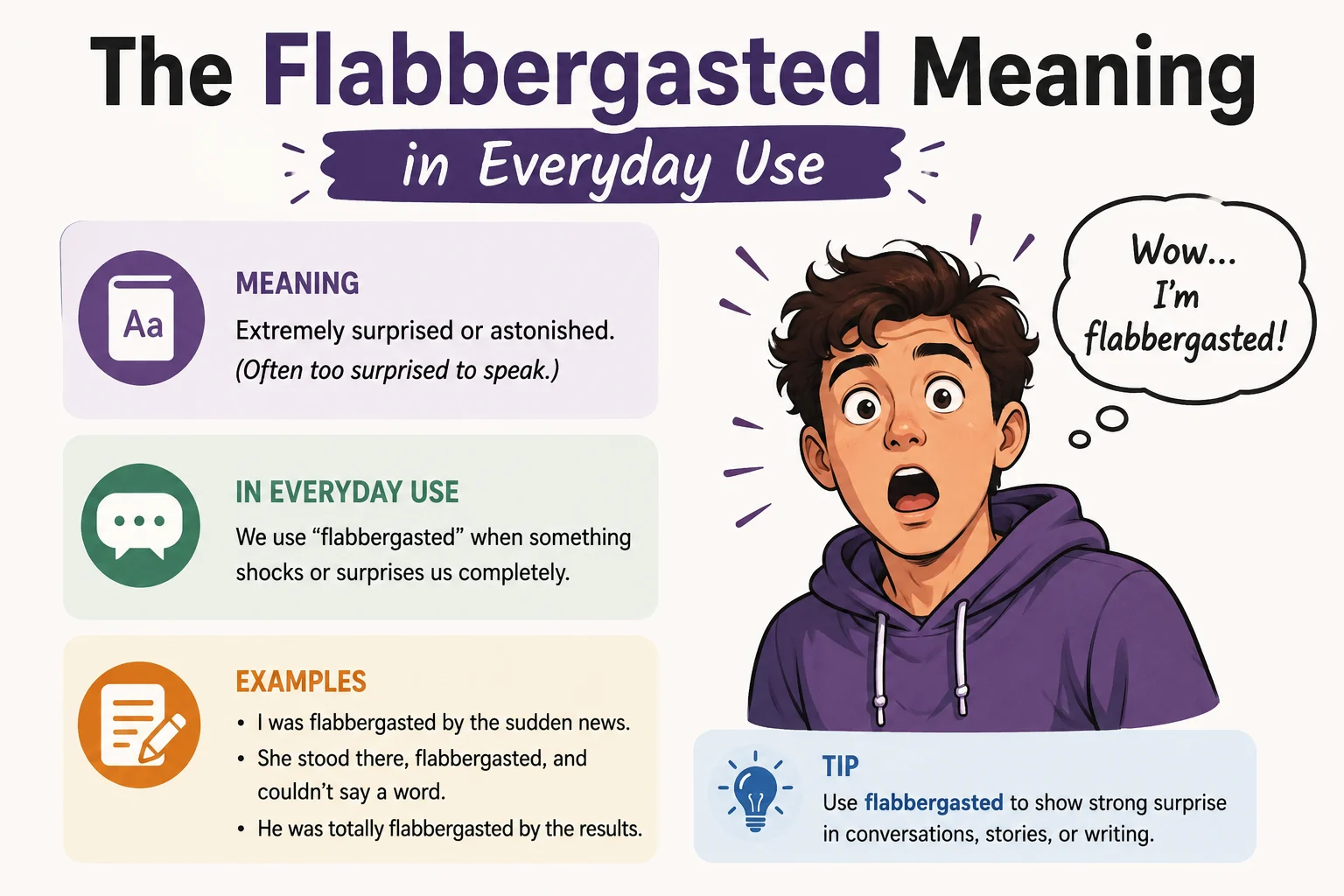
In everyday conversation, the flabbergasted meaning usually points to a reaction so strong it briefly leaves someone unable to respond normally. It’s not used for mild surprise; it’s reserved for moments that genuinely knock someone off balance.
People often reach for this particular word specifically because milder options like “surprised” don’t feel strong enough to capture how much a moment actually threw them off. Reaching for “flabbergasted” instead signals to the listener that this wasn’t an ordinary surprise.
Example sentences:
- “She was flabbergasted when she found out she’d won the scholarship.”
- “I’m still flabbergasted that he showed up an entire hour late without even apologizing.”
- “The whole office was flabbergasted by the sudden announcement.”
- “We were all completely flabbergasted when the results came back totally reversed.”
How Strong Is “Flabbergasted” Compared to Other Words?
Not every surprised reaction earns the word “flabbergasted.” It sits toward the stronger end of the surprise scale, above words like “surprised” or “startled,” and closer to “stunned” or “shocked.”
Picking the right word on this scale matters more than people often realize. Reaching for the flabbergasted meaning to describe something only mildly unexpected can come across as exaggerated, while saving it for a genuinely jaw-dropping moment gives it much more impact.
| Word | Intensity | Typical Use |
|---|---|---|
| Surprised | Mild | A minor, everyday, ordinary surprise |
| Startled | Mild-Moderate | A sudden, quick jolt |
| Astonished | Strong | A genuinely impressive or unexpected event |
| Flabbergasted | Very Strong | Overwhelming shock, often leaving someone speechless |
| Stunned | Very Strong | Shock that briefly stops someone in their tracks |
Origin of “Flabbergasted”
“Flabbergasted” dates back to the late 1700s in English, though its exact origin is uncertain. Some sources suggest it may be a playful blend of “flabby” and “aghast,” while others treat it as a piece of expressive slang from that era whose roots aren’t clearly documented. Because the exact etymology isn’t settled, dictionaries generally describe its origin as unknown or uncertain rather than pointing to one confirmed source.
That uncertainty is fairly common for expressive, sound-heavy words like this particular one. The flabbergasted meaning has stayed remarkably stable and consistent for over two centuries even though its exact birth story remains unclear, which says something about how naturally the word fits the reaction it describes.
Is “Flabbergasted” Formal or Informal?
“Flabbergasted” works in both casual and semi-formal writing. It’s common enough in everyday conversation, journalism, and storytelling, though it leans slightly informal compared to more neutral words like “astonished” or “amazed.” It isn’t slang, and it doesn’t carry a hidden or alternate meaning online or on any particular platform.
The flabbergasted meaning stays consistent whether it shows up in a news article, a personal essay, or a casual conversation with friends, which makes it a fairly safe word to reach for across most everyday writing situations.
Texting and Social Media Use
In texts and captions, the flabbergasted meaning is often used with a bit of humor or exaggeration, especially for reactions to something ridiculous, unexpected, or dramatic, rather than only for serious shock.
- “I’m literally flabbergasted that they cancelled the show with zero warning.”
- “Flabbergasted doesn’t even begin to cover how I felt when I saw the bill.”
- “Absolutely flabbergasted that this took three emails to sort out.”
This lighter, exaggerated use doesn’t replace the word’s core sense of genuine shock; it just applies that same everyday intensity to smaller, everyday frustrations for comic effect.
Common Misunderstanding
Some people assume “flabbergasted” only applies to bad news or negative shock, but that’s not accurate. It can describe a positive shock just as easily, like an unexpected gift, a surprise proposal, or good news that feels too big to process right away.
This misunderstanding probably comes from the word’s slightly harsh, comedic sound, which can make it feel like it belongs with negative reactions more than positive ones. In reality, the flabbergasted meaning is neutral about whether the news is good or bad; it only describes the intensity of the reaction itself, regardless of the direction that reaction points.
Workplace Context
In professional settings, “flabbergasted” occasionally shows up to describe a strong reaction to unexpected news, like a sudden policy change, a surprising decision, or an unusual result. It’s less common than more neutral words like “surprised” in formal reports, but it fits naturally in spoken workplace conversation or a casual email between colleagues, and the flabbergasted meaning still lands with plenty of impact even in a professional setting.
- “Honestly, I was flabbergasted when I heard about the merger.”
- “The team was flabbergasted by how quickly the project got approved.”
Even in professional contexts, the flabbergasted meaning doesn’t shift much from its everyday sense; it simply signals that the reaction was stronger than a typical response to workplace news.
Gaming and Online Community Use
The flabbergasted meaning also turns up occasionally in gaming chat and online communities, usually describing a reaction to a surprising win, a shocking upset, or an unexpected twist in a game or story.
- “Absolutely and completely flabbergasted by that comeback, nobody at all saw it coming.”
- “The whole server was flabbergasted when the final boss dropped that item.”
Even in casual gaming contexts, the word carries the same weight it does everywhere else: it’s reserved for moments that genuinely surprised everyone involved and playing, not just a routine win or an ordinary loss.
Dating and Relationship Context
The flabbergasted meaning also shows up occasionally in dating and relationship stories, usually describing a strong reaction to something a partner said or did, whether that’s a surprise gesture, an unexpected confession, or a shocking piece of news about the relationship.
- “I was absolutely flabbergasted when he showed up with flowers for no reason at all.”
- “She left me flabbergasted with how casually she brought up moving across the country.”
In this context, the word works the same way it does everywhere else across daily life: it signals that the reaction went well beyond a simple, ordinary moment of surprise.
Similar Expressions
- Astonished — a strong reaction to something impressive or unexpected, without the same emphasis on being left speechless.
- Stunned — close in intensity, often implying the person briefly can’t move or react.
- Dumbfounded — very similar to flabbergasted, emphasizing confusion alongside the shock.
- Gobsmacked — a British-leaning informal synonym with almost identical meaning and intensity.
- Bewildered — leans more toward confusion than shock, and is generally milder than flabbergasted.
- Speechless — describes the effect rather than the feeling itself, often used alongside or instead of the flabbergasted meaning to describe the same moment.
None of these words are perfect substitutes for each other. Each carries a slightly different shade of shock, confusion, or disbelief, so choosing between them often comes down to exactly how a person genuinely reacted in that particular moment.
Frequently Asked Questions
What is the simplest way to explain the flabbergasted meaning?
It means being so shocked or astonished that you’re momentarily speechless or unable to react normally. If you remember nothing else about the flabbergasted meaning, remember that it’s always intense.
Is flabbergasted a formal word?
It’s fairly neutral. It’s common in everyday speech and casual writing, and while it isn’t slang, it leans slightly informal compared to words like “astonished,” so the flabbergasted meaning fits comfortably in most writing situations.
Can flabbergasted describe good news?
Yes. It can describe positive shock just as easily as negative shock, such as an unexpected gift or surprising good news. The flabbergasted meaning doesn’t lean one way or the other emotionally.
What’s the difference between flabbergasted and surprised?
“Surprised” covers a much wider range of reactions, from mild to strong. “Flabbergasted” specifically describes the strongest end of that range, close to disbelief, which is the main thing separating the two words.
Where does the word flabbergasted come from?
Its exact origin is uncertain. It appeared in English in the late 1700s, and some sources suggest it may combine “flabby” and “aghast,” though this isn’t fully confirmed, so the flabbergasted meaning’s history remains a bit of a mystery.
Wrapping Up
Understanding the flabbergasted meaning really comes down to intensity: it’s reserved for the moments that genuinely knock you speechless, whether the news is wonderful or terrible. Once you know how strong the word really is, it becomes an easy, natural choice for describing reactions that go well beyond ordinary surprise, in writing, conversation, or casual texting. For a deeper look at how English vocabulary like this develops over time, the linked Wikipedia entry is a solid starting reference.