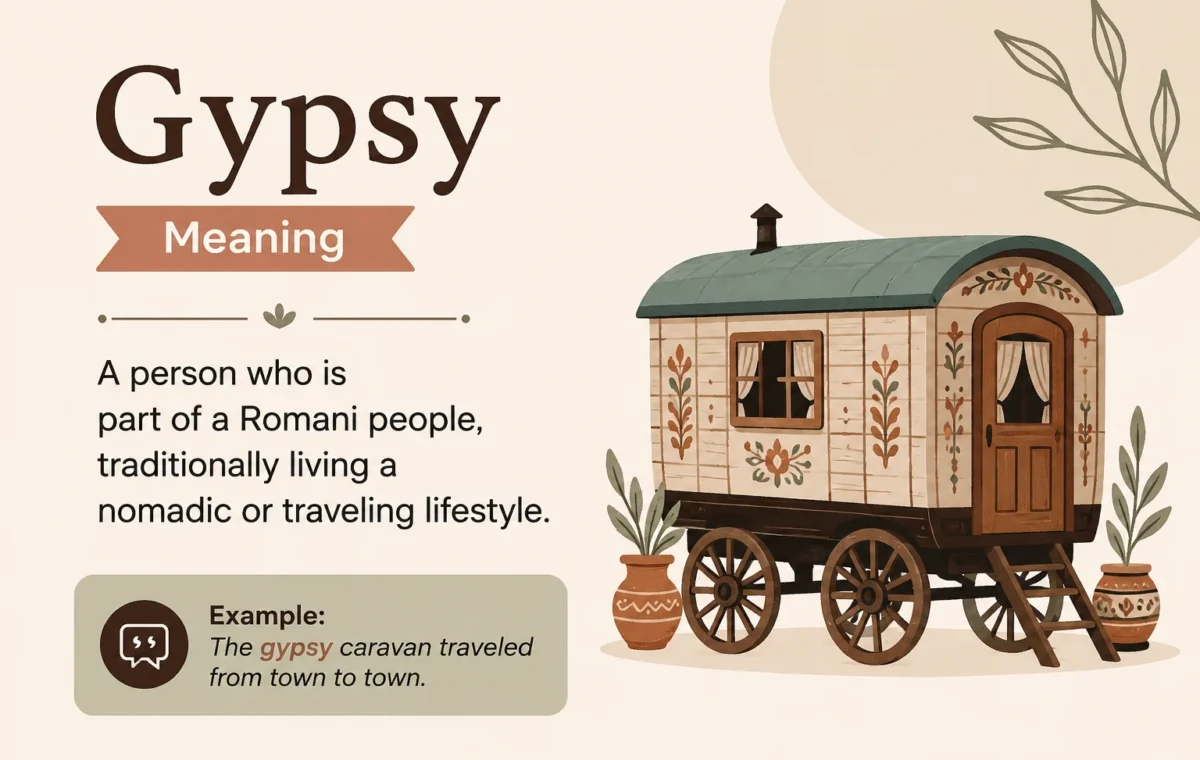
Gypsy meaning generally refers to a member of the Romani people, an ethnic group whose ancestors migrated from the Indian subcontinent and whose communities became established across Europe and elsewhere. The word has also developed a broader, informal sense for someone who travels frequently or seems to prefer a nomadic lifestyle.
- Quick Answer: What Does Gypsy Mean?
- Gypsy Meaning in Simple English
- Part of Speech and Pronunciation
- The Historical Meaning of the Term
- Is “Gypsy” an Offensive Word?
- A useful rule
- Gypsy vs. Romani: What's the Difference?
- Examples of the Word in Sentences
- Figurative Meaning: A Person Who Travels
- Common Collocations and Phrases
- Gypsy caravan
- Gypsy music
- Gypsy lifestyle
- Gypsy spirit
- Common Mistakes to Avoid
- Mistake 1: Treating every traveler as Romani
- Mistake 2: Assuming all Romani people prefer the same label
- Mistake 3: Using stereotypes as definitions
- Mistake 4: Confusing Romani with Irish Travellers
- Mistake 5: Treating “Gypsy” as automatically forbidden
- Related Words and Better Alternatives
- A Quick Usage Cheat Sheet
- How to Remember the Meaning
- Frequently Asked Questions
- What does gypsy mean in simple terms?
- Is Gypsy the same as Romani?
- Is the word Gypsy offensive?
- What is the correct pronunciation?
- What is the difference between Gypsy and gipsy?
- What is a respectful alternative to Gypsy?
- Does Gypsy mean a nomadic person?
- What is another word for someone who travels a lot?
- Why Context Matters With This Term
- Historical Use vs. Modern Use
- What Does “Gypsy” Mean in Literature?
- How Writers Should Use the Term
- When “Romani” Is the Better Choice
- When a Different Word Is Better
- Synonyms and Near-Synonyms
- For the ethnic meaning
- For the figurative traveling meaning
- Related Terms You May Encounter
- Romani
- Romany
- Roma
- Nomad
- Traveler
- Can You Use the Word in a Positive Way?
- Common Search Questions About the Term
- A Simple Decision Guide
- Key Takeaways
- Internal Link Ideas for SmartWording
- Gypsy Meaning in Everyday English
- Gypsy Meaning in Historical Writing
- Is Gypsy Meaning Always the Same?
- Examples of Gypsy in Sentences
- Gypsy Meaning vs. Nomad Meaning
- Example
- Gypsy Meaning and the Spelling “Gipsy”
- Understanding Gypsy Meaning in Different Contexts
- Why Context Matters for Gypsy Meaning
- How to Use the Word Respectfully
- Common Phrases and Their Alternatives
- Why “Romani” Can Be More Precise
- A Writer's Quick Checklist
- Related Vocabulary
- Final Usage Tip
- Final Thoughts
However, there’s an important usage point: Gypsy can be considered outdated or offensive when used as a general label for Romani people, although some individuals and communities use or accept the term for themselves. In careful modern writing, Romani or a specific community name is often the better choice.More information:-gusto meaning or elicit meaning .
Quick Answer: What Does Gypsy Mean?
| Term | Meaning | Example |
|---|---|---|
| Gypsy | A traditional English term associated with the Romani people; also used informally for a frequent traveler | “The novel features a Gypsy character.” |
| Romani | A modern term commonly used for the ethnic group | “She is researching Romani history.” |
| Gipsy | Mainly a UK spelling variant | “The older text uses the spelling gipsy.” |
| Gypsy in informal use | A person who moves frequently or dislikes staying in one place | “He has a gypsy spirit and loves traveling.” |
The spelling gipsy is mainly British, while gypsy is the more common spelling in American English. Cambridge gives the pronunciation as /ˈdʒɪp.si/ in both UK and US English.
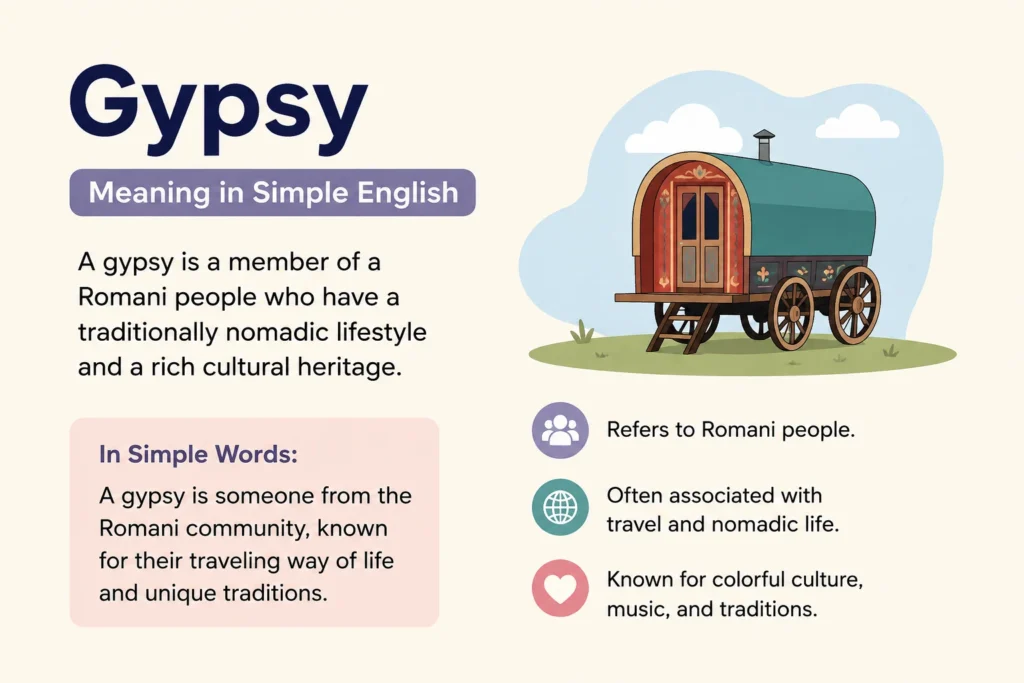
Gypsy Meaning in Simple English
In simple terms, the historical meaning describes a person belonging to the Romani ethnic group, whose ancestors came from northern India and later migrated through regions of the Middle East and Europe. The group includes many distinct communities with their own histories, traditions, and identities.
The term also acquired a figurative meaning. Someone who constantly travels, moves from place to place, or avoids settling down may be described as having a “gypsy spirit.” That figurative use appears in older and informal English, but it can still carry cultural baggage.
For that reason, context matters more than a dictionary definition alone.
Part of Speech and Pronunciation
Part of speech: Noun; sometimes used attributively in compounds.
Pronunciation: /ˈdʒɪp.si/
Simple phonetic: JIP-see
UK spelling: gypsy or gipsy
US spelling: gypsy
The plural is normally gypsies. Cambridge lists gipsy as a mainly UK variant of the same word.
The Historical Meaning of the Term
The history behind the label is more complicated than the word might suggest.
The ancestors of the Romani people originated in the Indian subcontinent. Over centuries, Romani communities migrated westward and eventually established themselves in many parts of Europe and other regions.
The English word Gypsy arose from a historical misconception that connected these people with Egypt. That mistaken association influenced the development of the English name.
Today, scholars generally distinguish between the historical label and the group’s own identity. Romani is widely used as a more precise ethnic term.
It’s also important not to treat every traveling community as Romani. For example, Irish Travellers are a distinct ethnic and cultural group and should not automatically be called Romani or Gypsies.
Is “Gypsy” an Offensive Word?
Sometimes, yes.
The word isn’t automatically offensive in every context. Some people identify with Gypsy and may use it positively as part of their personal, family, or community identity. At the same time, others consider the word outdated, stereotypical, or insulting, particularly when it is used by outsiders.
That means writers should consider who is being described, why the term is being used, and whether the person or community prefers it.
For neutral contemporary writing, Romani people is generally a safer choice when referring specifically to the ethnic group.
A useful rule
If you’re writing about a real person or community:
- Use the name the person or community uses for itself.
- Prefer Romani when you need a neutral general term.
- Don’t assume that all traveling people are Romani.
- Avoid stereotypes involving crime, fortune-telling, dishonesty, or poverty.
- Preserve Gypsy in historical quotations, titles, names, or contexts where the term is specifically relevant.
Cambridge identifies some related labels as explicitly offensive, illustrating why word choice around ethnic groups deserves care.
Gypsy vs. Romani: What’s the Difference?
The two words aren’t always interchangeable.
| Feature | Gypsy | Romani |
| Type | Historical/common English label | Modern ethnic term |
| Tone | Can be neutral, dated, or offensive depending on context | Generally more neutral |
| Identity | Some people use it for themselves | Widely used for the ethnic group |
| Best for formal writing | Usually avoid unless context requires it | Often preferred |
| Meaning | Can have figurative meanings | Primarily refers to Romani identity |
A writer discussing contemporary ethnicity will usually be clearer with Romani. A historian discussing older English sources may need to use Gypsy because it reflects the language of the period.
Examples of the Word in Sentences
Here are examples showing different contexts:
- “The museum exhibition explores the history of Romani communities in Europe.”
- “The nineteenth-century book repeatedly uses the word Gypsy.”
- “She described herself as a Gypsy and explained that the word was part of her family identity.”
- “The character is portrayed as a traveler with a restless, wandering spirit.”
- “The journalist replaced the outdated label with Romani in the revised article.”
- “The novel contains several historical references to Gypsy caravans.”
- “He has a restless nature and is always moving from one city to another.”
Notice how the seventh sentence doesn’t require the ethnic label at all. If the intended idea is simply someone who travels often, words such as nomad, traveler, or wanderer may communicate the meaning more accurately.
Figurative Meaning: A Person Who Travels
The word has sometimes been used figuratively to describe someone who moves frequently.
For example:
“She has a gypsy spirit and rarely stays in one city for more than a year.”
Here, the speaker isn’t necessarily referring to Romani identity. Instead, the intended idea is a person who enjoys freedom, travel, change, and an unsettled lifestyle.
Still, modern writers may want to choose a clearer alternative because the figurative expression is closely connected to the ethnic term.
Better choices include:
- free spirit
- traveler
- wanderer
- nomad
- adventurer
- restless traveler
- roaming person
These alternatives make the intended meaning explicit without assigning an ethnic label to someone’s personality.
Common Collocations and Phrases
Older English contains several expressions using the term.
Gypsy caravan
A Gypsy caravan traditionally refers to a caravan associated with traveling communities. In historical writing, the phrase may appear naturally, particularly when discussing older sources.
Gypsy music
This phrase has appeared historically in descriptions of music associated with Romani performers or traditions. In modern writing, it’s often better to identify the particular musical tradition, community, or style instead.
Gypsy lifestyle
This expression may refer either to Romani culture in older writing or, figuratively, to a life characterized by frequent travel. Because those meanings can become blurred, more precise wording is usually preferable.
Gypsy spirit
This is a figurative expression for a person who loves freedom, travel, or an unsettled lifestyle. Alternatives such as free spirit or adventurous nature are often clearer.
Common Mistakes to Avoid
A few mistakes appear repeatedly in writing about this term.
Mistake 1: Treating every traveler as Romani
Traveling frequently does not make someone Romani. Ethnicity and lifestyle are different concepts.
Mistake 2: Assuming all Romani people prefer the same label
Romani communities aren’t culturally identical. Individual preferences can differ, so don’t assume that one label works for everyone.
Mistake 3: Using stereotypes as definitions
Ideas about fortune-telling, theft, deception, or perpetual wandering are stereotypes, not definitions of an ethnic group.
Mistake 4: Confusing Romani with Irish Travellers
These are distinct communities. A general reference to “travelers” shouldn’t automatically be converted into either ethnic label.
Mistake 5: Treating “Gypsy” as automatically forbidden
The word has a complicated history. Some people use it as a self-description, while others reject it. The right approach is to consider context and identity rather than applying an absolute rule.
Related Words and Better Alternatives
If you’re trying to express the ethnic meaning, Romani is often the clearest modern option. Cambridge also defines Romany as referring to a Gypsy or to the language associated with Gypsy people.
If you’re trying to express the figurative meaning of someone who travels constantly, consider:
- Nomad — a person who moves from place to place, traditionally without permanent settlement.
- Traveler — someone who travels, without implying ethnicity.
- Wanderer — someone who moves around, often with a literary or poetic tone.
- Adventurer — someone who seeks exciting experiences or unfamiliar places.
- Roamer — someone who moves freely from one place to another.
- Free spirit — a person who values independence and resists convention.
These aren’t perfect synonyms. The best choice depends on what you actually mean.
A Quick Usage Cheat Sheet
| If you mean… | Prefer… |
| The ethnic group | Romani people |
| A specific person’s identity | The term they use for themselves |
| Someone who travels often | Traveler, nomad, or wanderer |
| A historical source | Preserve the original terminology when relevant |
| A formal academic article | Romani or the specific community name |
| A fictional historical setting | Use the historically appropriate term, with care |
For more background, see the Wikipedia article on Romani people. Romani people
How to Remember the Meaning
Think of the word in two layers:
Historical layer: a traditional English label associated with the Romani people.
Figurative layer: someone who moves around frequently or dislikes staying in one place.
The second sense is easier to replace with a more precise word. If you mean ethnicity, say Romani when that is appropriate. If you mean constant travel, say traveler, nomad, or wanderer.
Frequently Asked Questions
What does gypsy mean in simple terms?
The traditional English term refers to a member of the Romani people, an ethnic group with ancestral origins in the Indian subcontinent. It can also have an informal figurative meaning referring to someone who travels frequently.
Is Gypsy the same as Romani?
Not exactly. Romani is a widely used modern term for the ethnic group, while Gypsy is an older English label that some people use for themselves but others find offensive or outdated.
Is the word Gypsy offensive?
It can be, depending on the speaker, listener, and context. Some Romani people use the term as part of their identity, while others strongly prefer Romani or another community-specific name.
What is the correct pronunciation?
The standard pronunciation is /ˈdʒɪp.si/, approximately JIP-see. The same basic pronunciation is used in both British and American English.
What is the difference between Gypsy and gipsy?
They are spelling variants. Gypsy is the more common spelling in American English, while gipsy is mainly associated with British English.
What is a respectful alternative to Gypsy?
When referring to the ethnic group, Romani or Romani people is often the most neutral choice. For an individual, the most respectful option is to use the person’s preferred identity label.
Does Gypsy mean a nomadic person?
It can have a figurative meaning related to traveling or living a mobile lifestyle, but Gypsy should not be used as a synonym for every nomadic person. Ethnicity and nomadic lifestyle are different things.
What is another word for someone who travels a lot?
Depending on the context, traveler, nomad, wanderer, roamer, or adventurer may work. These words describe movement or lifestyle without making an assumption about ethnicity.
Why Context Matters With This Term
Words connected to ethnicity, culture, and identity often carry meanings beyond their dictionary definitions. This is especially true here because the term has been used in different ways across different periods and communities.
In historical books, literature, newspapers, and older documents, you may encounter the word frequently. Understanding what the writer meant requires looking at the time period and context rather than automatically applying today’s preferred terminology.
In modern professional or academic writing, precision is more important. If you’re discussing the ethnic group, Romani is generally clearer and more neutral. If you’re describing someone who travels frequently, choose a word that directly describes that behavior instead.
Historical Use vs. Modern Use
The difference between historical and modern usage can be easy to miss.
| Context | Typical wording | Best approach |
|---|---|---|
| Historical document | Gypsy / Gipsy | Preserve the historical wording when relevant |
| Modern academic writing | Romani people | Prefer precise, contemporary terminology |
| Personal identity | Gypsy, Romani, or another identity | Follow the person’s preference |
| Frequent traveler | Traveler / wanderer / nomad | Avoid using an ethnic label figuratively |
| Literature | Depends on the author’s period and purpose | Explain the context if necessary |
A historical novel, for example, may deliberately use terminology that reflects its setting. A modern news article has a different responsibility: it should normally use terminology that is accurate and respectful today.
What Does “Gypsy” Mean in Literature?
Literature has played a major role in shaping popular ideas about the term. Older novels, poems, plays, and travel writing sometimes portray Romani characters through romanticized or negative stereotypes.
Common literary images include:
- traveling groups and caravans
- freedom and independence
- fortune-telling
- wandering from place to place
- mystery and unfamiliarity
- music and performance
These themes can be useful when analyzing a historical text, but they shouldn’t be mistaken for factual descriptions of Romani people.
A student writing a literary analysis should distinguish between what a text portrays and what is historically or culturally accurate.
How Writers Should Use the Term
If you’re writing an article, essay, report, or story, ask yourself one simple question:
What exactly am I trying to describe?
If you’re referring to an ethnic identity, use Romani where appropriate.
If you’re describing frequent travel, use traveler, nomad, wanderer, or another precise term.
If you’re quoting an older source, retaining its original terminology may be necessary because changing it could alter the historical meaning.
This small distinction can make your writing much more accurate.
When “Romani” Is the Better Choice
Romani is usually preferable when you’re discussing the ethnic group in contemporary contexts.
For example:
Less precise:
“The Gypsy community has a long history in Europe.”
More neutral:
“The Romani community has a long history in Europe.”
Even better, when you know the particular community being discussed, use its specific name. Romani identity encompasses diverse communities rather than one completely uniform culture.
When a Different Word Is Better
Sometimes the writer isn’t talking about ethnicity at all.
Consider this sentence:
“After years in one city, Mark finally embraced a gypsy lifestyle.”
The intended meaning appears to be that Mark enjoys moving and traveling. In that case, the sentence can be clearer as:
“After years in one city, Mark finally embraced a nomadic lifestyle.”
Or:
“After years in one city, Mark finally embraced a life of travel.”
The replacement isn’t merely more polite; it’s more precise because it says exactly what the writer intends.
Synonyms and Near-Synonyms
There isn’t one perfect synonym because the term has more than one sense.
For the ethnic meaning
- Romani — the most useful modern general term.
- Romany — another term associated with Romani people and their language.
- Roma — commonly used in some contexts as a collective designation.
For the figurative traveling meaning
- Nomad — emphasizes a mobile lifestyle.
- Traveler — neutral and straightforward.
- Wanderer — suggests movement without a fixed destination.
- Roamer — informal and emphasizes moving around.
- Adventurer — focuses more on seeking experiences.
- Free spirit — emphasizes independence rather than travel itself.
These words aren’t interchangeable in every sentence. Nomad, for instance, can describe a lifestyle, while wanderer often has a more literary tone.
Related Terms You May Encounter
Romani
A widely used term referring to the ethnic group traditionally associated with the older English label.
Romany
A variant term that can refer to Romani people and, in some contexts, their language.
Roma
A collective term used in various contexts for Romani people. Usage can vary among communities and organizations.
Nomad
A person who moves from place to place rather than living permanently in one location. The word describes a lifestyle, not a particular ethnicity.
Traveler
A broad term for someone who travels. It carries no necessary implication about ethnic background.
Can You Use the Word in a Positive Way?
Yes, but the answer depends heavily on the person and context.
Some people use the term as part of their own identity, cultural history, family name, or community tradition. Others consider it a slur or an unwanted label because of its historical use in derogatory stereotypes.
That’s why a blanket rule such as “the word is always offensive” or “the word is never offensive” is too simplistic.
A better principle is respect and specificity. Use the terminology that people use for themselves whenever you know it.
Common Search Questions About the Term
People often encounter the word in older books, songs, films, family histories, and historical documents. That can create confusion because the meaning and social acceptability of a term can change over time.
If you’re researching an older source, don’t automatically replace every occurrence with Romani. First determine whether the source is using the term as an ethnic designation, a stereotype, a historical label, or a figurative description.
That distinction is especially important in academic writing.
A Simple Decision Guide
Use this quick test before choosing a word:
Are you talking about an ethnic group?
→ Consider Romani or the specific community’s preferred name.
Are you talking about someone who travels frequently?
→ Use traveler, nomad, or wanderer.
Are you discussing an old document?
→ The historical term may need to remain, especially in quotation or textual analysis.
Are you describing someone’s personal identity?
→ Use the person’s preferred terminology.
Are you writing for a modern professional audience?
→ Choose the most precise and neutral term available.
Key Takeaways
- The traditional English label has a historical connection with the Romani people.
- It can also appear in older or informal figurative expressions about traveling.
- The spelling gipsy is particularly associated with British English.
- Some people use the term as a self-description, while others find it offensive.
- Romani is often the clearest neutral choice in contemporary writing.
- A traveler isn’t necessarily Romani, and a Romani person isn’t necessarily nomadic.
- Historical texts should be interpreted within their original context.
- When describing travel rather than ethnicity, choose a word such as nomad, traveler, or wanderer.
Internal Link Ideas for SmartWording
For readers who want to explore related vocabulary, useful internal links could include:
- Nomad Meaning
- Wanderer Meaning
- Romani Meaning
These topics naturally extend the discussion while helping readers distinguish between ethnicity, identity, and lifestyle vocabulary.
Gypsy Meaning: More Examples, Context, and Usage Tips
Understanding gypsy meaning becomes easier when you separate the historical definition from the way the word is used in modern English. The term has traditionally referred to the Romani people, while dictionaries also record a broader sense for someone who frequently travels or does not stay in one place for long.
This distinction matters because a word can have a dictionary meaning while also carrying social or historical associations. If you’re reading an old novel, writing an article, or simply trying to understand something you heard, context can completely change how the expression should be interpreted.
Gypsy Meaning in Everyday English
In everyday English, the word may appear in two broad ways.
The first is the ethnic meaning, referring to the Romani people. The second is a figurative meaning, describing someone who moves frequently or enjoys a mobile lifestyle. Cambridge records both senses in its English dictionaries.
For example:
“The historical account describes a Gypsy community living in the region.”
Here, the reference is ethnic and historical.
Compare that with:
“He has a gypsy spirit and loves moving from city to city.”
Here, the writer is describing someone’s lifestyle rather than ethnicity.
The second sentence can be rewritten more precisely as:
“He has a nomadic spirit and loves moving from city to city.”
That version makes the intended idea clearer.
Gypsy Meaning in Historical Writing
Historical writing often presents terminology that differs from modern preferences. A nineteenth-century book, newspaper, or travel account may use Gypsy because that was the terminology familiar to its author and readers.
When analyzing such material, don’t automatically assume that the historical usage represents modern recommended language.
For example, a student might write:
“The author uses the term Gypsy repeatedly to describe the traveling community.”
That is a legitimate observation about the source.
A modern article could instead say:
“The author uses an older term for Romani people throughout the book.”
The second version separates the author’s language from the writer’s own terminology.
Is Gypsy Meaning Always the Same?
No. Context determines the intended sense.
| Context | Likely meaning | Better modern wording |
|---|---|---|
| Historical document | Historical ethnic label | Preserve source wording when necessary |
| Modern ethnic discussion | Romani identity | Romani |
| Travel metaphor | Someone who moves frequently | Nomad or traveler |
| Literature | Depends on the text | Explain the historical context |
| Personal identity | Depends on the individual | Use their preferred term |
This is one reason simply memorizing gypsy meaning isn’t enough. You also need to recognize the situation in which the word appears.
Examples of Gypsy in Sentences
Here are several examples showing how context changes interpretation:
- “The historian examined records concerning Romani communities.”
- “The old novel describes a Gypsy caravan traveling through the countryside.”
- “She called herself a Gypsy and explained that the term was part of her family identity.”
- “The character has a restless, gypsy-like spirit.”
- “The writer replaced the older label with Romani in the revised edition.”
- “His friends describe him as a traveler who rarely stays anywhere for long.”
- “The documentary explores Romani culture and history.”
- “The nineteenth-century source uses the word Gypsy several times.”
- “She wanted a nomadic lifestyle rather than a permanent home.”
- “The phrase reflects an older literary idea of the wandering Gypsy.”
The examples demonstrate an important writing principle: describe the exact idea you mean.
Gypsy Meaning vs. Nomad Meaning
These terms can overlap in casual writing, but they’re not identical.
A nomad is a person who moves from one place to another rather than remaining permanently settled. That is a description of lifestyle or movement.
Gypsy, by contrast, has a specific historical connection with the Romani people and also has a figurative use related to traveling. Calling every nomadic person a Gypsy therefore creates a misleading connection between lifestyle and ethnicity.
If your sentence is about travel, nomad is usually more precise.
Example
Less precise:
“She lives like a Gypsy because she moves every few months.”
More precise:
“She lives a nomadic lifestyle because she moves every few months.”
The second sentence communicates the intended idea without making an unnecessary ethnic reference.
Gypsy Meaning and the Spelling “Gipsy”
You may also encounter gipsy, especially in British English.
Cambridge identifies gipsy as a mainly UK spelling and gives the same pronunciation as gypsy: /ˈdʒɪp.si/, approximately JIP-see.
So these forms are related:
- gypsy — common spelling
- gipsy — mainly British variant
- Gypsy — capitalized when used as a proper ethnic or identity label in a particular context
- gypsies — common plural spelling
The spelling itself doesn’t resolve the question of whether the term is appropriate. Context and identity still matter.
Understanding Gypsy Meaning in Different Contexts
The phrase gypsy meaning can vary depending on whether a speaker is discussing ethnicity, history, literature, or a person’s lifestyle. In its traditional sense, the term has been used for the Romani people, but modern writers often prefer Romani for a neutral reference to the ethnic group. In informal language, the word may also describe someone who travels often, enjoys an unsettled lifestyle, or moves from one place to another. For that figurative sense, nomad, traveler, wanderer, or free spirit can be more precise alternatives.
Why Context Matters for Gypsy Meaning
Another important part of gypsy meaning is understanding its historical and cultural context. The term appears frequently in older books, newspapers, songs, and other forms of literature, so readers may encounter it even when modern writers would choose different wording. Some people still use the term as part of their own identity, while others consider it outdated or offensive. Because of these differences, the safest approach is to consider the context, avoid stereotypes, and use Romani or the person’s preferred terminology when discussing identity.
How to Use the Word Respectfully
If you’re writing about a real community, precision should come before convenience.
A few practical rules can help:
- Use Romani when referring to the ethnic group in neutral contemporary writing.
- Use a community’s specific name when you know it.
- Follow an individual’s preferred identity label.
- Don’t describe all travelers as Romani.
- Don’t use stereotypes as if they were definitions.
- Keep historical terminology when discussing an original source, but make the context clear.
- If you’re describing travel rather than ethnicity, use traveler, nomad, or wanderer.
This approach makes your writing both clearer and more respectful.
Common Phrases and Their Alternatives
Some older expressions remain recognizable in English, but modern alternatives can be more precise.
| Older or figurative phrase | Possible alternative |
| gypsy lifestyle | nomadic lifestyle |
| gypsy spirit | free spirit |
| gypsy traveler | traveler |
| gypsy-like existence | constantly traveling life |
| Gypsy community | Romani community, when that is what is meant |
There isn’t a rule that every historical phrase must be changed. If you’re discussing the wording of a particular book, song, film, or historical document, preserving the original term may actually be necessary.
Why “Romani” Can Be More Precise
Romani directly identifies the ethnic group rather than relying on an older English label. Cambridge lists Romany as a noun that can refer to a Gypsy or to the language associated with Gypsy people.
For a modern article, consider:
“The article discusses Romani history in Europe.”
This is more specific than:
“The article discusses Gypsy history in Europe.”
The first sentence also avoids forcing a historical label into a contemporary context.
A Writer’s Quick Checklist
Before publishing a sentence containing this term, ask:
- Am I talking about ethnicity or travel?
- Is the reference historical or contemporary?
- Does the person or community use this label themselves?
- Would Romani be more precise?
- Would traveler or nomad express my intended meaning better?
- Am I accidentally repeating a stereotype?
If you can answer those questions, your usage will usually be much clearer.
Related Vocabulary
Understanding gypsy meaning also helps distinguish several related terms.
Romani — a widely used modern term connected with the ethnic group.
Romany — a related term that can refer to Romani people or their language.
Nomad — someone whose lifestyle involves moving from place to place.
Traveler — someone who travels, either occasionally or frequently.
Wanderer — someone who moves around without a fixed destination, often with a literary tone.
Roamer — an informal word for someone who moves freely from place to place.
These words may overlap in certain sentences, but they don’t carry exactly the same meaning.
Final Usage Tip
The easiest way to remember gypsy meaning is to separate identity from lifestyle.
If the sentence concerns the ethnic group, think Romani. If it concerns someone who enjoys constant travel, think traveler, nomad, or wanderer. If the word appears in an old source, consider its historical setting before deciding what the author intended.
That simple distinction prevents many common vocabulary mistakes and makes your writing more accurate.
Final Thoughts
Understanding gypsy meaning requires looking beyond a simple dictionary definition. The term has a long history connected with the Romani people, but its modern acceptability varies depending on context and personal identity. For neutral contemporary writing, Romani is often the clearer choice, while traveler, nomad, or wanderer may be better when you simply mean someone who moves from place to place. You can learn more about the Romani people and their history on Wikipedia.