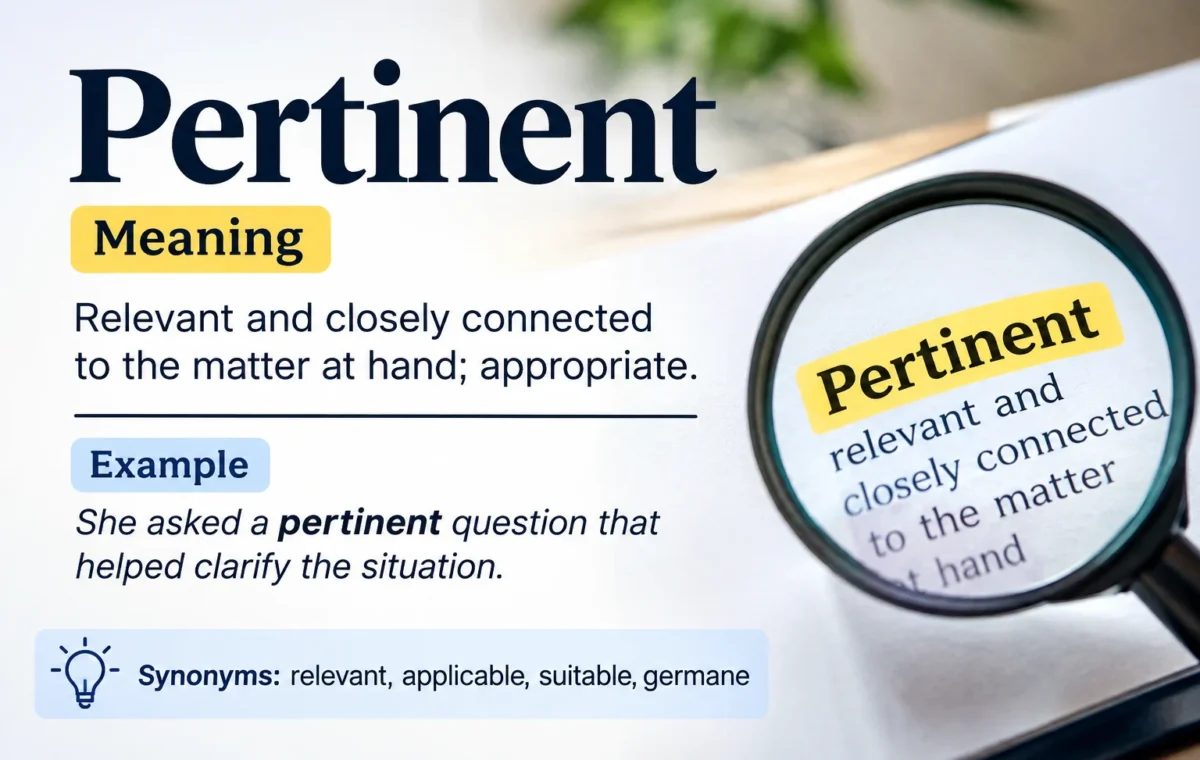
“Pertinent” means relevant or directly related to the subject being discussed. If something is pertinent to a situation, it has a clear connection to that situation and is useful to consider.
- What Does Pertinent Mean?
- Pertinent as an Adjective
- Pertinent Meaning in Simple English
- Pertinent vs. Relevant
- Pertinent Meaning in a Sentence
- Pertinent Meaning in Academic Writing
- Pertinent Meaning in the Workplace
- Pertinent Meaning in Legal Contexts
- Pertinent Questions
- Pertinent Information
- Pertinent Meaning in Everyday Conversation
- Is Pertinent a Positive or Negative Word?
- Common Misunderstanding About Pertinent
- Synonyms for Pertinent
- Antonyms for Pertinent
- Pertinent vs. Important
- Pertinent vs. Appropriate
- Origin of Pertinent
- Frequently Asked Questions
- What is the simple meaning of pertinent?
- What is an example of pertinent?
- Is pertinent a synonym for relevant?
- Is pertinent a formal word?
- What is the opposite of pertinent?
- Is pertinent the same as important?
- How to Use Pertinent Correctly
- Pertinent Meaning in Formal English
- Pertinent Information vs. Unnecessary Information
- Pertinent Meaning in Communication
- Pertinent Meaning in an Argument
- Pertinent Evidence
- Pertinent Facts
- Pertinent Experience
- Pertinent Details
- Pertinent Questions vs. Irrelevant Questions
- Pertinent Meaning in Education
- Pertinent Meaning in Workplace Communication
- Pertinent Meaning in Legal Language
- Pertinent Meaning in Business Writing
- Can Pertinent Describe a Person?
- Is “Pertinently” a Word?
- Pertinent vs. Relevant vs. Germane
- Pertinent vs. Applicable
- Pertinent vs. Material
- Easy Way to Remember Pertinent
- Final Thoughts:
For example:
“Please provide any pertinent information about the incident.”
Here, “pertinent” means information that is relevant to the incident.MORE INSIGHTS INFORMATION:-pegged meaning or paramore meaning .
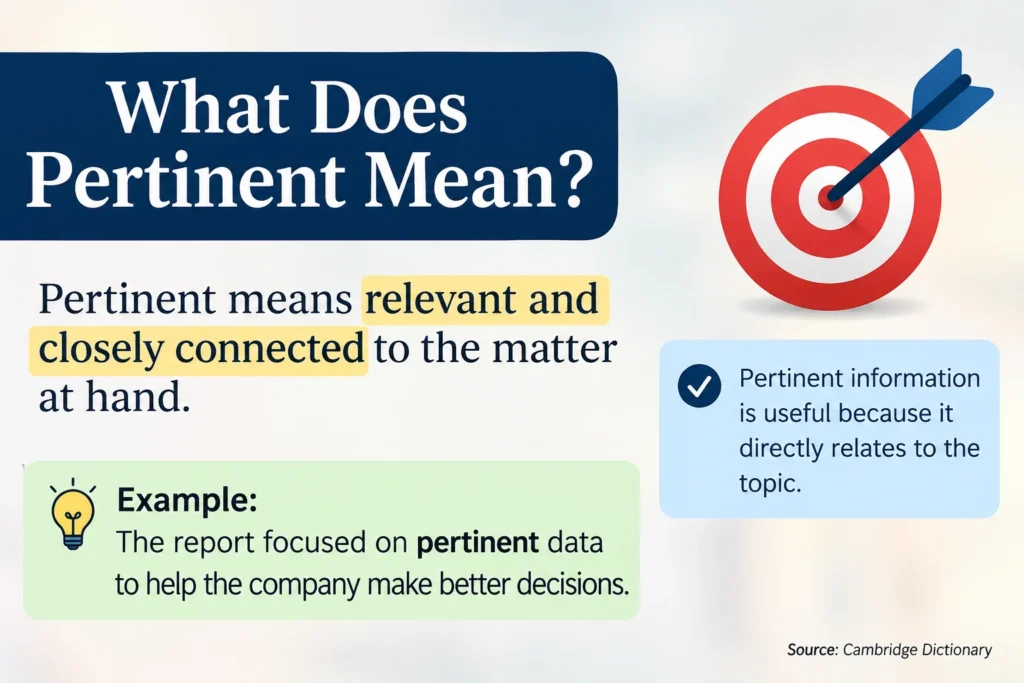
What Does Pertinent Mean?
The simplest pertinent meaning is “relevant to a particular matter.”
The word is often used when someone wants to emphasize that information, questions, facts, or details are connected to the topic at hand.
Examples:
- “She asked several pertinent questions.”
- “The lawyer presented pertinent evidence.”
- “Only pertinent details should be included in the report.”
- “His experience was pertinent to the position.”
In each example, “pertinent” indicates that something has a meaningful connection to the subject.
Pertinent as an Adjective
“Pertinent” is an adjective.
It describes something that is relevant, applicable, or closely connected to a particular matter.
Common structures include:
- Pertinent information
- Pertinent details
- Pertinent questions
- Pertinent facts
- Pertinent evidence
- Pertinent issues
- Pertinent experience
Example:
“The committee considered all pertinent evidence before making its decision.”
Pertinent Meaning in Simple English
In simple English, “pertinent” means “important because it is relevant to what you are talking about.”
For example:
“Is this information pertinent to the case?”
This means:
“Is this information relevant to the case?”
The word “pertinent” is somewhat more formal than “relevant,” so it is especially common in professional, academic, legal, and official writing.
Pertinent vs. Relevant
“Pertinent” and “relevant” are very close in meaning.
“Relevant” is the more common everyday word.
“Pertinent” often sounds more formal and can emphasize that something has a direct connection to the matter being considered.
Compare:
“Please provide any relevant information.”
“Please provide any pertinent information.”
Both sentences are correct, but “pertinent” gives the second sentence a slightly more formal tone.
Pertinent Meaning in a Sentence
Here are several examples:
“Her previous experience was pertinent to the new role.”
This means her previous experience was directly relevant to the job.
“The witness was asked several pertinent questions.”
This means the questions were directly related to the matter under discussion.
“The report contains pertinent information about the project.”
This means the information is relevant and useful for understanding the project.
“Please remove any details that are not pertinent to the discussion.”
This means unrelated details should be removed.
Pertinent Meaning in Academic Writing
“Pertinent” is useful in academic writing when discussing information that directly relates to a research question, argument, or subject.
Example:
“The researcher reviewed the pertinent literature before developing the study.”
Here, “pertinent literature” means research and published material relevant to the subject.
Another example:
“Students should focus on the pertinent evidence when evaluating the argument.”
The word helps distinguish useful information from material that is unrelated to the topic.
Pertinent Meaning in the Workplace
In professional settings, “pertinent” commonly describes information, questions, experience, documents, or issues that relate directly to a task.
Examples:
“Please send me any pertinent documents before the meeting.”
“Her previous management experience is pertinent to this position.”
“Let’s focus on the pertinent issues rather than unrelated concerns.”
The word has a professional and precise tone.
Pertinent Meaning in Legal Contexts
“Pertinent” is also common in legal language.
A lawyer, judge, or legal document may use the word to describe information, evidence, facts, or questions that are relevant to a legal matter.
Example:
“The court considered the pertinent facts before reaching its decision.”
Here, “pertinent” means facts that directly relate to the case.
Because legal language can have specialized meanings, the exact interpretation of “pertinent” in a legal document should always be understood from the surrounding text.
Pertinent Questions
A “pertinent question” is a question that is directly relevant to the subject.
For example:
“During the interview, the manager asked several pertinent questions about the candidate’s experience.”
The questions were connected to the purpose of the interview.
By contrast, an unrelated question would not normally be described as pertinent.
Pertinent Information
“Pertinent information” means information that is relevant and useful for a particular situation.
Example:
“Please include any pertinent information in your application.”
This means the applicant should include information that directly relates to what is being requested.
This phrase is common in formal instructions and professional communication.
Pertinent Meaning in Everyday Conversation
Although “pertinent” is perfectly understandable in everyday English, it sounds more formal than words such as “relevant” or “related.”
For casual conversation, someone might say:
“That isn’t relevant.”
In formal writing, they might say:
“That information is not pertinent to the matter.”
Both communicate a similar idea, but the second has a more formal tone.
Is Pertinent a Positive or Negative Word?
“Pertinent” is generally neutral.
It does not inherently express praise or criticism. It simply indicates that something is relevant or connected to a particular subject.
For example:
“That was a pertinent question.”
This may be positive because the question was useful and relevant.
However:
“The lawyer objected because the question was not pertinent.”
Here, the word is being used to explain why something is considered unrelated.
The surrounding sentence determines the tone.
Common Misunderstanding About Pertinent
One common misunderstanding is thinking that “pertinent” simply means “important.”
Although something pertinent may be important, the central idea is relevance.
For example, a piece of information can be very interesting but not pertinent to the topic.
Imagine a meeting about a company’s budget. The color of someone’s shoes might be interesting, but it is not pertinent to the budget discussion.
Therefore:
Pertinent = relevant to the matter.
Important = having significance or value.
The two concepts can overlap, but they are not identical.
Synonyms for Pertinent
Common synonyms include:
- Relevant
- Applicable
- Related
- Appropriate
- Germane
- Connected
- Material
- Suitable
“Relevant” is usually the easiest and most natural substitute.
“Germane” is another close synonym, but it is also relatively formal.
Antonyms for Pertinent
Common opposites include:
- Irrelevant
- Unrelated
- Inapplicable
- Extraneous
- Immaterial
- Inappropriate
For example:
“The additional details were irrelevant to the discussion.”
This communicates the opposite of saying that the details were pertinent.
Pertinent vs. Important
These words are sometimes confused.
“Important” means significant or valuable.
“Pertinent” means directly relevant to the matter.
Something can be important without being pertinent.
Example:
“Climate change is an important issue, but it may not be pertinent to a discussion about office furniture.”
This distinction makes the meaning of “pertinent” easier to understand.
Pertinent vs. Appropriate
“Pertinent” means relevant to a particular subject.
“Appropriate” means suitable or proper for a particular situation.
For example:
“Her question was pertinent to the discussion.”
Her question was relevant.
“Her language was appropriate for the meeting.”
Her language was suitable.
These words can overlap in some contexts, but they describe different qualities.
Origin of Pertinent
“Pertinent” comes from Latin roots associated with the idea of belonging to or relating to something. It entered English through French and developed its modern sense of being relevant or applicable to a particular matter.
The precise historical development and dates of individual stages should be verified against a reputable etymological dictionary before publication.
Frequently Asked Questions
What is the simple meaning of pertinent?
Pertinent means relevant or directly connected to a particular subject or situation.
What is an example of pertinent?
“Please provide any pertinent information about the accident.” Here, “pertinent” means information relevant to the accident.
Is pertinent a synonym for relevant?
Yes. “Relevant” is one of the closest and most common synonyms for “pertinent.”
Is pertinent a formal word?
Yes. “Pertinent” is somewhat formal and is especially common in academic, professional, legal, and official writing.
What is the opposite of pertinent?
Common opposites include “irrelevant,” “unrelated,” “inapplicable,” and “extraneous.”
Is pertinent the same as important?
Not exactly. “Pertinent” means relevant, while “important” means significant or valuable. Something can be important without being relevant to a particular discussion.
Pertinent Meaning: Deeper Usage, Examples, and Word Differences
The word “pertinent” is useful when you need to describe something that has a direct connection to a particular subject. While its basic meaning is simple, understanding how it works in different situations can help you use it more naturally.
How to Use Pertinent Correctly
“Pertinent” normally describes information, questions, facts, details, evidence, issues, or other things that are relevant to a specific matter.
Common patterns include:
- pertinent information
- pertinent details
- pertinent questions
- pertinent facts
- pertinent evidence
- pertinent issues
- pertinent experience
- pertinent points
For example:
“Please include all pertinent details in your application.”
The sentence means that the applicant should include details that directly relate to the application.
Another example:
“The manager asked a few pertinent questions during the interview.”
The questions were relevant to the interview and its purpose.
Pertinent Meaning in Formal English
“Pertinent” is particularly useful when writing in a formal or professional style.
Instead of saying:
“Please give us information that is relevant to the case.”
A formal version might be:
“Please provide all pertinent information concerning the case.”
Both sentences have essentially the same meaning, but “pertinent” gives the second sentence a more formal tone.
This makes the word useful in reports, essays, business communication, academic writing, and official documents.
Pertinent Information vs. Unnecessary Information
One of the easiest ways to understand the word is to compare pertinent information with unnecessary information.
Suppose someone is preparing a report about a company’s financial performance.
Pertinent information might include:
- Revenue
- Expenses
- Profits
- Financial projections
- Major investments
Information about an employee’s favorite movie would normally not be pertinent to the financial report.
Therefore, “pertinent” helps separate information that belongs to a subject from information that does not.
Pertinent Meaning in Communication
Good communication often depends on staying focused on the subject.
For example:
“Please keep your comments pertinent to the discussion.”
This means that comments should remain relevant to what the group is discussing.
The expression can be useful in meetings, interviews, debates, classrooms, and formal discussions.
It may sound somewhat strict, depending on the situation.
Pertinent Meaning in an Argument
In an argument or debate, a pertinent point is one that directly supports or challenges the issue being discussed.
Example:
“The speaker raised a pertinent point about the proposed policy.”
The point was relevant to the policy discussion.
By contrast:
“The speaker mentioned his favorite restaurant.”
Unless the restaurant has some connection to the policy, that detail would not be pertinent.
Pertinent Evidence
“Pertinent evidence” refers to evidence that is relevant to the matter being considered.
Example:
“The investigators examined all pertinent evidence before reaching a conclusion.”
The phrase emphasizes that only evidence connected to the issue is being considered.
The word does not by itself establish whether the evidence is reliable, accurate, or sufficient. It only describes its relevance.
Pertinent Facts
A “pertinent fact” is a fact that has a meaningful connection to the subject.
Example:
“The attorney highlighted several pertinent facts during the hearing.”
The facts were relevant to the matter being discussed.
This phrase is common in formal contexts because it allows writers to distinguish relevant facts from background information.
Pertinent Experience
The phrase “pertinent experience” is especially useful in employment and professional contexts.
It means previous experience that is relevant to a particular job, task, or responsibility.
Example:
“Applicants should describe their most pertinent experience on their resumes.”
If someone is applying for a software engineering position, programming experience would generally be more pertinent than unrelated experience.
Pertinent Details
“Pertinent details” are details that directly matter to the subject.
Example:
“The doctor asked the patient to provide any pertinent details about the symptoms.”
The phrase suggests that only information relevant to the situation should be provided.
This does not necessarily mean every pertinent detail is equally important. It simply means the details have a direct connection to the matter.
Pertinent Questions vs. Irrelevant Questions
A pertinent question addresses the subject being discussed.
For example:
During a job interview:
“What experience do you have with project management?”
This is pertinent if the position involves managing projects.
A question such as:
“What is your favorite sports team?”
would generally not be pertinent unless the conversation has a specific reason for discussing it.
This distinction is useful when evaluating whether a conversation is focused.
Pertinent Meaning in Education
Teachers and students can use “pertinent” when discussing information that relates directly to a lesson, assignment, or research topic.
Example:
“Students should include only pertinent sources in their research paper.”
This means the sources should directly relate to the subject of the paper.
Another example:
“The professor raised a pertinent question about the author’s argument.”
The question was relevant to understanding or evaluating the argument.
Pertinent Meaning in Workplace Communication
In the workplace, “pertinent” can make communication more precise.
Examples:
“Please forward any pertinent documents to the legal team.”
“Let’s focus on the pertinent issues before making a decision.”
“Her experience is highly pertinent to this project.”
The word is professional without being overly technical.
Pertinent Meaning in Legal Language
The word frequently appears in formal discussions of legal matters because relevance is important when considering evidence, arguments, and facts.
Example:
“The court reviewed the pertinent facts before making its ruling.”
In this sentence, “pertinent” simply means relevant to the matter.
It is important not to assume that something being described as pertinent automatically means it is legally admissible, decisive, or sufficient. Those are separate concepts.
Pertinent Meaning in Business Writing
Business writers may use “pertinent” to keep reports and recommendations focused.
Example:
“Management reviewed all pertinent financial information before approving the proposal.”
The phrase identifies the financial information that relates directly to the decision.
Another example:
“Include any pertinent market data in the presentation.”
This means the presentation should contain market data that directly relates to its purpose.
Can Pertinent Describe a Person?
Usually, “pertinent” describes information, facts, questions, details, or matters rather than a person.
It would be unusual to say:
“She is pertinent.”
Instead, you would normally say:
“Her experience is pertinent to the position.”
Or:
“She provided pertinent information.”
The word describes the relevance of something to a particular matter.
Is “Pertinently” a Word?
Yes. “Pertinently” is the adverbial form of “pertinent.”
It means in a relevant or directly applicable manner.
Example:
“The researcher pertinently addressed the main concern.”
However, “pertinently” is less common than “pertinent.” In many sentences, a simpler construction using “relevant” may sound more natural.
Pertinent vs. Relevant vs. Germane
These three words are close in meaning.
| Word | Main Meaning | Typical Tone |
|---|---|---|
| Pertinent | Directly relevant to a matter | Formal |
| Relevant | Connected to the subject | Neutral |
| Germane | Closely related to the matter | Formal |
Examples:
“That information is relevant.”
“That information is pertinent.”
“That information is germane to the discussion.”
All three can communicate a similar idea, but “relevant” is generally the most natural choice in everyday English.
Pertinent vs. Applicable
“Applicable” means suitable for use in a particular situation or relevant under particular circumstances.
“Pertinent” focuses more directly on relevance to the subject.
For example:
“The rule is applicable to this situation.”
“The information is pertinent to the investigation.”
The rule applies to the situation, while the information relates to the investigation.
Pertinent vs. Material
“Material” can mean important or relevant, especially in formal contexts.
For example:
“The witness provided material evidence.”
“The witness provided pertinent evidence.”
The words may overlap, but “material” can carry specialized meanings in areas such as law and finance. “Pertinent” more generally emphasizes relevance.
Easy Way to Remember Pertinent
A simple memory trick is:
Pertinent = related to the point.
If a detail helps answer the question, understand the subject, or address the issue being discussed, it may be pertinent.
For example:
Question: “What caused the company’s financial loss?”
Pertinent information: sales figures, expenses, market conditions, and financial records.
Unrelated information: an employee’s favorite color.
Final Thoughts:
The word “pertinent” means directly relevant or connected to a particular subject or situation. It is especially useful for describing information, questions, facts, evidence, or details that matter to the topic. For a related concept, Relevance provides useful background on how information connects to a particular subject.