Ate and Left No Crumbs Meaning: What This Phrase Actually Means
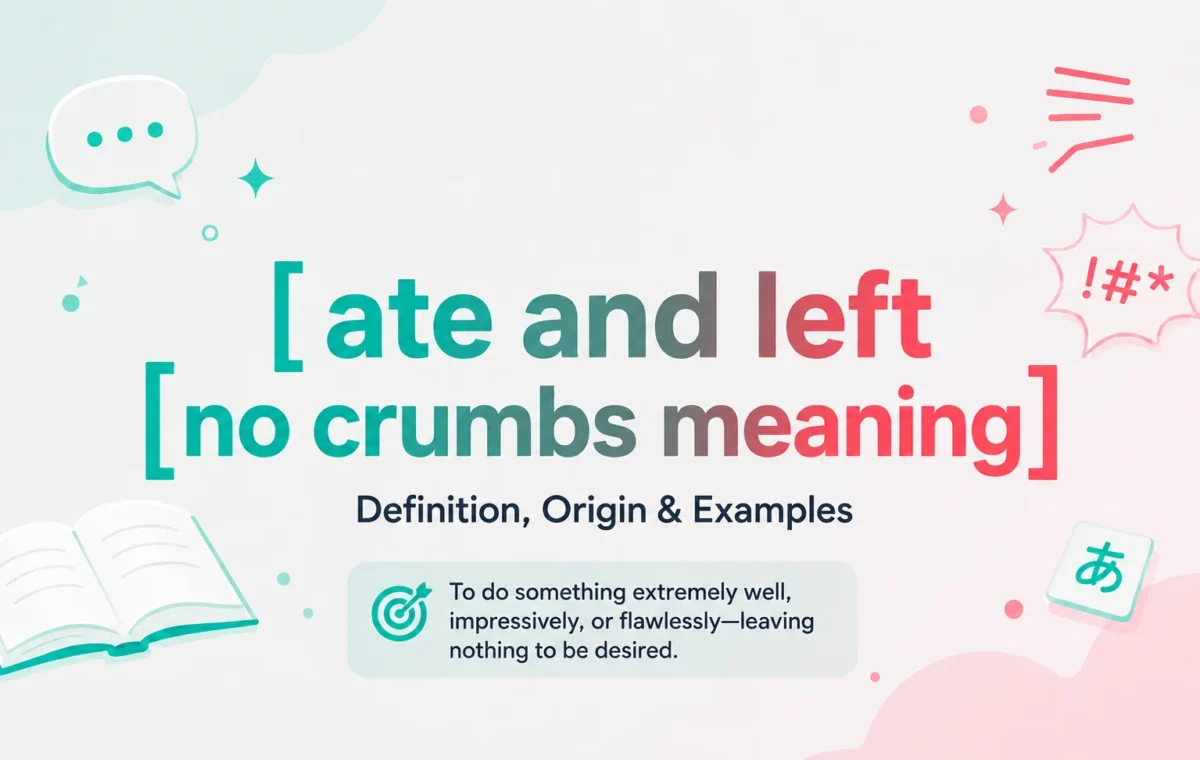
“Ate and left no crumbs” means someone did something so perfectly, flawlessly, or impressively that there’s absolutely nothing left to criticize or find fault with. It’s a slang compliment used to praise a performance, look, or achievement that was executed with total precision, leaving no weak spot behind whatsoever. For more insights, read here:- flabbergasted meaning and twat meaning.
- Ate and Left No Crumbs Meaning: What This Phrase Actually Means
- Quick Answer
- The Ate and Left No Crumbs Meaning in Everyday Use
- Breaking Down the Phrase
- Where the Phrase Comes From
- Is "Ate and Left No Crumbs" the Same as Just "Ate"?
- Texting and Social Media Use
- Dating and Relationship Context
- Is It Rude or Offensive?
- Common Misunderstanding
- Similar Slang Expressions
- Workplace Context
- Gaming Context
- Music, Fashion, and Performance Context
- Comparing Intensity Across Compliment Slang
- When Not to Use the Phrase
- How the Phrase Fits Into Broader Slang Trends
- Variations and Related Phrasing
- Regional and Community Variation
- Why the Phrase Resonates With So Many People
- A Final Note on Tone
- Examples Across Different Situations
- Frequently Asked Questions
- What is the simplest way to explain the ate and left no crumbs meaning?
- Is "ate and left no crumbs" the same as "slayed"?
- Can this phrase be used for things other than performances?
- Is the phrase considered rude or offensive?
- Where does the crumbs imagery come from?
- Does the phrase work the same way in written and spoken use?
- Does the phrase have a negative or opposite version?
- Is it okay to use this phrase in a professional context?
- Wrapping Up
Quick Answer
- Ate and left no crumbs (slang phrase): did something perfectly, with no flaws or room for criticism whatsoever.
- Example: “Her performance at the show ate and left no crumbs, everyone in the audience was completely blown away.”
- The shorter version “ate” alone is often used the same general way, with “left no crumbs” adding that extra layer of emphasis.
The Ate and Left No Crumbs Meaning in Everyday Use
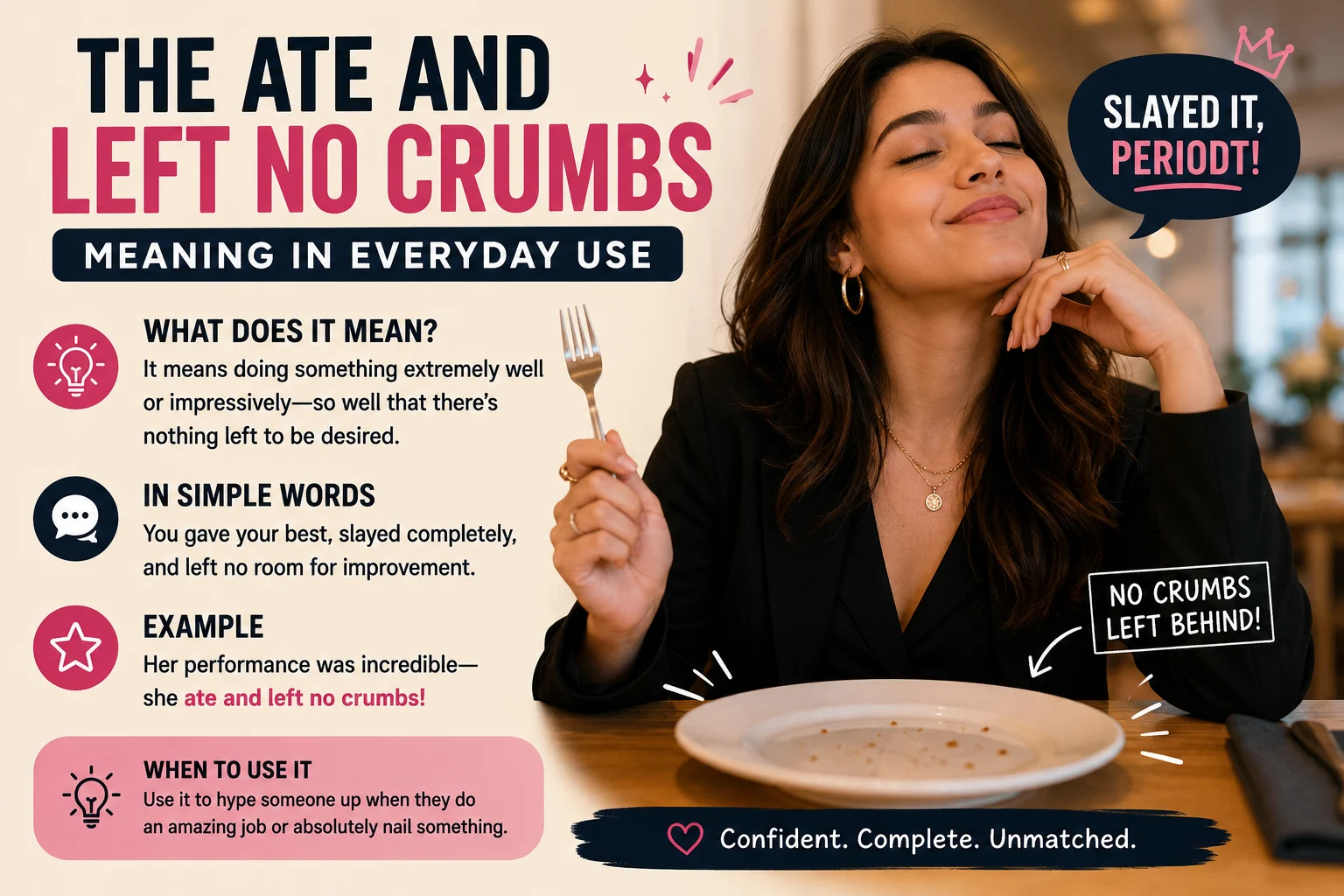
At its core, the ate and left no crumbs meaning centers on flawless execution. “Ate” by itself is already slang for doing something extremely well, and adding “left no crumbs” pushes that praise even further, implying the performance was so complete and precise that not a single mistake or weak point remains.
People often reach for the full phrase specifically because “ate” alone, while strong, doesn’t always feel intense enough for a truly standout moment. The ate and left no crumbs meaning adds that extra layer of certainty, making clear there’s genuinely nothing left to critique.
Example sentences:
- “She walked into that interview with total confidence and ate and left no crumbs, impressing everyone in the room.”
- “His outfit at the event? Ate and left no crumbs, absolutely no notes from anyone who saw it.”
- “The team’s presentation ate and left no crumbs, the client signed on the spot.”
- “That cover of the song ate and left no crumbs, better than the original honestly.”
Breaking Down the Phrase
Understanding the ate and left no crumbs meaning is easier once you separate its two parts.
- “Ate”: slang for doing something impressively well, often used as a standalone compliment, as in “she ate.”
- “Left no crumbs”: an image borrowed from eating food so thoroughly and cleanly that literally nothing is left behind, no mess, no leftovers, no evidence of imperfection.
Put together, the full phrase intensifies the compliment, suggesting the performance wasn’t just good, it was so complete that there’s nothing left to pick apart or criticize. Each half of the ate and left no crumbs meaning reinforces the other, building toward one unified idea of total, undeniable excellence.
Where the Phrase Comes From
The exact origin of “ate and left no crumbs” is uncertain, though it grew out of broader slang use of the word “ate” as a compliment for doing something exceptionally well. The “crumbs” imagery builds naturally on that idea, painting a picture of someone finishing a task so cleanly that not even a trace of imperfection remains. Because slang phrases like this typically spread through spoken and online conversation rather than documented writing, pinpointing a precise origin point isn’t possible with full confidence.
What’s clearer is how the ate and left no crumbs meaning fits into a broader pattern of food-based slang expressions used to describe impressive performances, joining other phrases that borrow eating imagery to express enthusiasm and approval.
Is “Ate and Left No Crumbs” the Same as Just “Ate”?
They’re closely related, but not identical in intensity. “Ate” alone is already a strong compliment, but “ate and left no crumbs” pushes it further, emphasizing that the performance was not just good, but complete and flawless, with genuinely nothing left to critique.
- “She ate.” — a strong compliment on its own.
- “She ate and left no crumbs.” — an even stronger version, emphasizing total flawlessness.
Choosing between the shorter and longer versions often comes down to just how impressed the speaker genuinely is. Reaching for the full ate and left no crumbs meaning signals an extra degree of enthusiasm that the shorter “ate” doesn’t quite capture on its own.
Texting and Social Media Use
The ate and left no crumbs meaning shows up constantly in captions, comments, and texts, almost always as enthusiastic praise for a performance, outfit, or achievement.
- “This look ate and left no crumbs, I’m obsessed.”
- “That speech ate and left no crumbs, standing ovation energy.”
- “You ate and left no crumbs with this project, seriously impressive.”
- “This recipe ate and left no crumbs, best thing I’ve made all year.”
In written, informal contexts like these, the phrase adds energy and enthusiasm that a plainer compliment like “great job” simply can’t match, which is a big part of why the ate and left no crumbs meaning has stuck around in casual writing.
Dating and Relationship Context
Occasionally, the phrase shows up in a dating or relationship context, usually praising someone’s appearance, confidence, or how they handled a specific moment.
- “He showed up to the date looking like he ate and left no crumbs.”
- “The way she handled that awkward moment? Ate and left no crumbs, no cap.”
- “Their wedding toast ate and left no crumbs, half the room was in tears laughing.”
In this context, the ate and left no crumbs meaning gets applied to a personal, often emotional moment, praising someone for handling a situation with real confidence or grace.
Is It Rude or Offensive?
No, the phrase is entirely positive. There’s no offensive or negative connotation behind the ate and left no crumbs meaning; it’s used purely as praise, celebrating someone’s skill, style, or performance.
Because the phrase carries no negative undertone at all, it’s genuinely safe to use across most casual contexts, whether that’s complimenting a friend, a coworker’s presentation, or a stranger’s outfit online.
Common Misunderstanding
Some people assume the phrase is literally about food or eating, but it has nothing to do with actual meals. The “eating” and “crumbs” imagery is entirely figurative, describing flawless performance rather than anything related to food.
This misunderstanding is understandable at first glance, since the words themselves sound like they belong in a kitchen conversation. Once someone learns the figurative sense, though, the ate and left no crumbs meaning becomes much easier to spot and use confidently in everyday conversation.
Similar Slang Expressions
- “Ate” — the shorter version of the same compliment, without the added emphasis.
- “Slayed” — a similar compliment for doing something impressively well.
- “No notes” — implies something was so well done there’s no feedback or criticism to give.
- “Served” — another slang term for performing or presenting something impressively.
- “Ate that up” — a close variation, similar in tone but slightly less intense than the full ate and left no crumbs meaning.
None of these expressions are exact substitutes. Each carries a slightly different flavor of enthusiasm, but they all share the same underlying idea of celebrating a genuinely impressive performance.
Workplace Context
Though more casual than most workplace language, the phrase occasionally shows up informally among younger colleagues praising a presentation, pitch, or piece of work.
- “That pitch deck ate and left no crumbs, the client loved it.”
- “She handled that client call and left no crumbs, seriously smooth.”
- “His quarterly report ate and left no crumbs, cleanest data I’ve seen all year.”
Even in professional settings, when used appropriately among peers, the ate and left no crumbs meaning translates well into workplace praise, since it communicates genuine, enthusiastic approval of a job well done.
Gaming Context
In gaming, the phrase sometimes describes a flawless play, match, or performance that leaves opponents with nothing to come back with.
- “That comeback ate and left no crumbs, absolutely no way back for the other team.”
- “His gameplay tonight ate and left no crumbs, flawless from start to finish.”
- “The final round ate and left no crumbs, opponents didn’t stand a chance.”
This gaming use fits neatly into the broader ate and left no crumbs meaning, since a flawless, dominant win leaves absolutely nothing at all for the opposing team to criticize or point to as a genuine weakness.
Music, Fashion, and Performance Context
The phrase is especially common in discussions of music releases, fashion moments, and live performances, where fans use it to describe something that exceeded expectations completely.
- “That album ate and left no crumbs, every single track on it is genuinely a hit.”
- “Her red carpet look ate and left no crumbs, best dressed of the entire night by far.”
- “The encore performance ate and left no crumbs, the crowd went completely silent in awe.”
Across entertainment and fashion commentary, the ate and left no crumbs meaning captures a specific kind of enthusiastic, no-holds-barred praise that plainer words like “good” or “nice” simply can’t convey with the same energy.
Comparing Intensity Across Compliment Slang
Not every compliment carries the same weight, and understanding where the ate and left no crumbs meaning sits on that scale helps clarify exactly how strong a compliment it really is.
- “Good job” — a mild, general compliment.
- “She did great” — a step up, but still fairly plain.
- “She ate” — a strong, enthusiastic compliment.
- “She ate and left no crumbs” — the most intense version, signaling total, flawless excellence with nothing left to critique.
Placed on this scale, it becomes clear the ate and left no crumbs meaning sits firmly at the top, reserved for genuinely standout moments rather than everyday, run-of-the-mill praise.
When Not to Use the Phrase
Even though the ate and left no crumbs meaning is entirely positive, it’s still worth being thoughtful about when to use it. Because it’s casual, internet-driven slang, it may not always fit smoothly into highly formal writing, like a professional report, an academic paper, or a formal cover letter, where a more traditional compliment might read more naturally to the intended audience.
- Fits naturally: casual texts, social captions, conversations with friends, informal team chats.
- Less natural fit: formal emails to senior leadership, academic writing, legal documents.
Recognizing this distinction helps make sure the ate and left no crumbs meaning lands the way it’s intended, as an enthusiastic, casual compliment rather than something that feels out of place in a more serious setting.
How the Phrase Fits Into Broader Slang Trends
The ate and left no crumbs meaning fits into a larger pattern of slang that borrows vivid, everyday imagery to express enthusiasm more colorfully than plain adjectives can. Food-based expressions in particular tend to spread quickly, since eating is such a universally relatable experience that the imagery translates easily across different groups and contexts.
This broader pattern helps explain why a phrase built around something as ordinary as crumbs managed to become such a widely recognized way to express enthusiastic praise. The everyday, familiar image makes the ate and left no crumbs meaning easy to grasp instantly, even for someone hearing the phrase for the very first time.
Variations and Related Phrasing
Speakers often adapt the core phrase slightly depending on the situation, while keeping the underlying ate and left no crumbs meaning intact.
- “Ate that whole thing up, no crumbs left behind.”
- “Not a single crumb left after that performance.”
- “She ate, and I mean she really left absolutely no crumbs.”
These small variations show how flexible the phrase can be in casual speech, stretching or rearranging slightly without losing the core sense of flawless, complete execution that defines the ate and left no crumbs meaning at its heart.
Regional and Community Variation
The ate and left no crumbs meaning stays fairly consistent across different English-speaking communities online, though the frequency of use can vary depending on the specific online community or platform culture someone spends the most time in. It doesn’t carry a different meaning in different regions; it’s simply used more or less often depending on the community.
Because slang like this spreads primarily through everyday online conversation, exact usage frequency across different platforms is difficult to measure precisely, so any claim about where the phrase is most common should be treated as a general impression rather than a confirmed, verified statistic.
Why the Phrase Resonates With So Many People
Part of what makes the ate and left no crumbs meaning so appealing is how vivid and specific it feels compared to more generic praise. Saying someone “did a great job” is accurate but forgettable, while saying they “ate and left no crumbs” paints an actual picture, one of total, satisfying completeness, that sticks in the listener’s mind far longer.
This vividness is really the phrase’s biggest strength. Rather than simply stating that something was good, the ate and left no crumbs meaning shows the listener exactly how good, using an image anyone can immediately picture and understand clearly without any further explanation needed at all.
A Final Note on Tone
Slang like this evolves quickly, and the exact popularity of the ate and left no crumbs meaning may shift over time as new expressions emerge and older ones fade from everyday use. That said, the underlying idea, celebrating flawless, complete execution, is likely to persist in some form even if the specific wording eventually changes.
For now, though, the phrase remains a vivid, widely understood way to hand out one of the strongest compliments available in casual, modern everyday conversation, whether that’s online, in a group chat, or spoken aloud among friends celebrating someone’s genuinely impressive achievement.
Examples Across Different Situations
To really solidify how the phrase works, it helps to see it applied across a wider range of situations, since the underlying compliment stays the same even as the subject matter shifts dramatically from one example to the next.
- “The chef’s tasting menu ate and left no crumbs, every course was better than the last.”
- “Her thesis defense ate and left no crumbs, the panel had nothing left to push back on.”
- “The stand-up set ate and left no crumbs, the whole room was in tears laughing by the end.”
- “His marathon time ate and left no crumbs, a new personal best by nearly ten minutes.”
- “The renovation ate and left no crumbs, the place looks like a completely different house.”
Seeing the phrase applied across cooking, academics, comedy, sports, and home improvement makes clear just how flexible and widely applicable this single compliment has become in everyday casual conversation, regardless of the specific field, activity, or achievement being celebrated and praised by the person using it.
Frequently Asked Questions
What is the simplest way to explain the ate and left no crumbs meaning?
It means someone did something so well and so flawlessly that there’s nothing left to criticize, a strong compliment for an impressive performance or achievement. That single idea, total flawlessness, covers most of how the phrase gets used.
Is “ate and left no crumbs” the same as “slayed”?
They’re similar in spirit, both praising an impressive performance, though “ate and left no crumbs” specifically emphasizes total flawlessness with nothing left to critique, while “slayed” leans slightly more toward general confidence and style.
Can this phrase be used for things other than performances?
Yes. It can describe outfits, presentations, speeches, gameplay, or really any situation where someone executed something impressively and completely. The ate and left no crumbs meaning is flexible enough to stretch across nearly any category of achievement.
Is the phrase considered rude or offensive?
No, it’s entirely positive slang, used to celebrate and praise someone’s skill, style, or achievement. There’s no version of the ate and left no crumbs meaning that carries a negative or hurtful undertone.
Where does the crumbs imagery come from?
It builds on the idea of eating something so cleanly and thoroughly that no crumbs are left behind, symbolizing a performance with no flaws or leftover imperfections. This visual is really the anchor for the entire ate and left no crumbs meaning, giving an otherwise abstract compliment a concrete, easy-to-picture image.
Does the phrase work the same way in written and spoken use?
Yes, largely. Whether typed in a caption or said out loud among friends, the ate and left no crumbs meaning stays consistent, though spoken delivery often adds extra emphasis through tone that written text has to convey through punctuation or emojis instead.
Does the phrase have a negative or opposite version?
Not exactly a direct opposite, though people sometimes say someone “left crumbs” to imply the reverse of the ate and left no crumbs meaning, suggesting a performance had noticeable flaws or missed the mark somewhere.
Is it okay to use this phrase in a professional context?
It depends on the workplace culture. Among casual, younger teams it can work fine informally, but the ate and left no crumbs meaning is generally too casual for formal reports, client-facing documents, or communication with senior leadership.
Wrapping Up
Understanding the ate and left no crumbs meaning really comes down to recognizing it as an enthusiastic, modern way to say someone did something perfectly, with absolutely nothing left to criticize. Whether it’s praising an outfit, a presentation, or a performance, the phrase captures a specific kind of flawless execution that leaves no room for doubt. For a broader look at how internet slang develops and spreads, the Wikipedia entry on internet slang is a useful starting reference.