What Does Congruent Mean in Math?
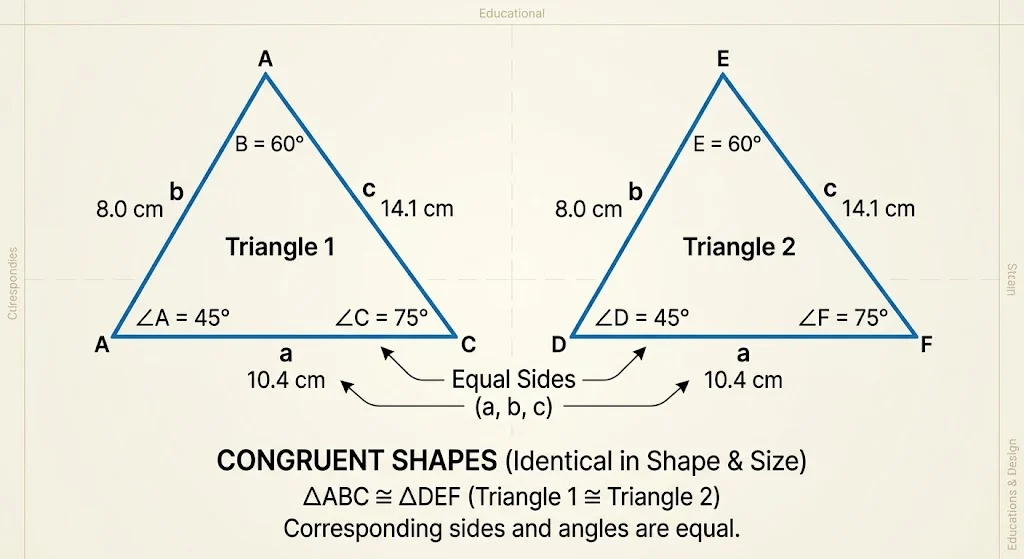
In math, “congruent” means that two shapes have the same size and the same shape. They may be positioned differently, rotated, or flipped, but their corresponding sides and angles remain equal.
- What Does Congruent Mean in Math?
- A Simple Example
- What Is the Congruent Symbol?
- What Makes Two Shapes Congruent?
- Congruent vs. Similar
- Congruent Triangles
- SSS
- SAS
- ASA
- AAS
- HL
- Examples of Congruent Figures
- What Does Congruent Mean in Geometry?
- Common Misunderstanding About Congruence
- Congruent in a Sentence
- Why Is Congruence Important in Math?
- Frequently Asked Questions
- Does congruent mean equal in math?
- What is the symbol for congruent?
- Can congruent shapes be different sizes?
- Can a rotated shape still be congruent?
- What is the difference between congruent and similar?
- Congruent Shapes in Mathematics
- How Can You Tell If Shapes Are Congruent?
- What Does Congruent Mean in Math for Triangles?
- Congruent vs. Similar Figures
- Congruence and Geometric Transformations
- A Practical Example
- Common Mistakes Students Make
- How to Identify Congruent Figures
- A Simple Method for Checking Congruence
- Congruent Angles
- Congruent Line Segments
- Can Congruent Figures Look Different?
- Congruent vs. Equal
- Why Congruence Matters in Geometry
- Congruence in Geometry Proofs
- What Does Congruent Mean in Math Problems?
- Common Mistakes to Avoid
- Easy Way to Remember Congruence
- Final Thoughts
For example, if two triangles have matching side lengths and matching angle measures, they are congruent triangles.MORE information:-unprecedented meaning or spider lily meaning .
What Does Congruent Mean in Math?
The mathematical definition of congruent is having exactly the same shape and size.
Two geometric figures are congruent when one can be moved, rotated, or reflected so that it matches the other exactly. These movements do not change the figure’s size or shape.
Congruent figures can look different at first because they may face different directions or appear in different positions.
A Simple Example
Imagine two squares. Each square has four sides measuring 5 inches.
Even if one square is turned 45 degrees or moved to another location, the two squares are still congruent because their corresponding sides and angles are equal.
What Is the Congruent Symbol?
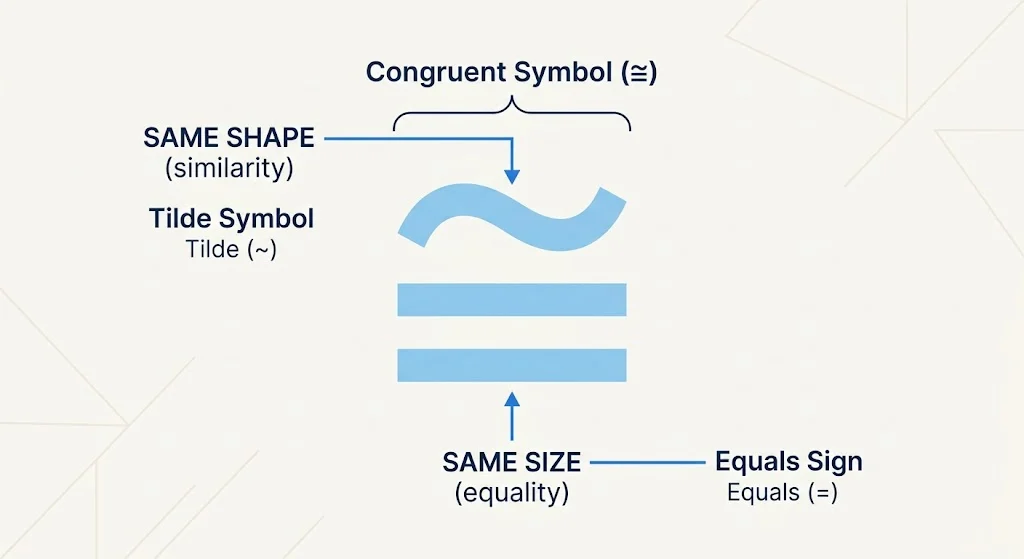
The symbol for congruence is:
≅
It looks like an equals sign with a small wavy line above it.
For example:
△ABC ≅ △DEF
This means that triangle ABC is congruent to triangle DEF.
The order of the letters is important because it identifies which vertices correspond to each other.
What Makes Two Shapes Congruent?
Two figures are congruent when their corresponding measurements match.
Important characteristics include:
- Corresponding sides have equal lengths.
- Corresponding angles have equal measures.
- The overall shape is identical.
- The figures have the same size.
- One figure can be moved, rotated, or reflected to match the other.
For polygons, all corresponding sides and angles must match for the figures to be congruent.
Congruent vs. Similar
Congruent and similar are related mathematical ideas, but they do not mean the same thing.
Congruent shapes have the same shape and the same size.
Similar shapes have the same shape but can have different sizes.
For example, two rectangles measuring 4 × 6 inches and 8 × 12 inches are similar because their proportions match. However, they are not congruent because their sizes are different.
A useful way to remember the difference is:
Congruent = same shape + same size
Similar = same shape + possibly different size
Congruent Triangles
Congruent triangles are triangles that have exactly the same shape and size.
Geometry commonly uses several tests to prove that two triangles are congruent.
SSS
SSS means Side-Side-Side.
If all three corresponding sides of two triangles have equal lengths, the triangles are congruent.
SAS
SAS means Side-Angle-Side.
If two corresponding sides and the included angle are equal, the triangles are congruent.
ASA
ASA means Angle-Side-Angle.
If two corresponding angles and the included side are equal, the triangles are congruent.
AAS
AAS means Angle-Angle-Side.
If two corresponding angles and a corresponding non-included side are equal, the triangles are congruent.
HL
HL means Hypotenuse-Leg and applies specifically to right triangles.
If two right triangles have equal hypotenuses and one corresponding leg of equal length, they are congruent.
Examples of Congruent Figures
Here are some simple examples:
- Two circles with the same radius are congruent.
- Two squares with sides measuring 8 cm are congruent.
- Two triangles with matching corresponding sides and angles are congruent.
- Two rectangles with the same corresponding side lengths are congruent.
A figure does not stop being congruent simply because it has been rotated or reflected.
What Does Congruent Mean in Geometry?
In geometry, congruence describes an exact match between figures in terms of both shape and size.
For example:
△ABC ≅ △XYZ
This notation tells us that the triangles correspond in the stated order:
- A corresponds to X.
- B corresponds to Y.
- C corresponds to Z.
Therefore, corresponding sides and angles have equal measurements.
Common Misunderstanding About Congruence
A common mistake is to think that shapes must look identical in their current positions to be congruent.
That is not necessary.
A triangle can be turned upside down, rotated, or reflected and still be congruent to the original triangle. These transformations change its position or orientation, not its size or shape.
Another common mistake is confusing congruent with similar. Similar figures can have different sizes, while congruent figures must have the same size.
Congruent in a Sentence
Here are a few examples of how the term can be used in mathematics:
- “The two triangles are congruent because their corresponding sides and angles match.”
- “Use the SAS theorem to prove that the triangles are congruent.”
- “The two squares are congruent even though one has been rotated.”
- “Congruent figures have the same size and shape.”
Why Is Congruence Important in Math?
Congruence is especially important in geometry because it allows mathematicians and students to establish that two figures have identical measurements.
It is used when:
- Proving geometric theorems
- Comparing triangles and polygons
- Finding unknown angles or side lengths
- Solving geometry problems
- Understanding geometric transformations
- Establishing relationships between figures
Once two figures are proven congruent, corresponding parts can be treated as equal.
Frequently Asked Questions
Does congruent mean equal in math?
Not exactly. Congruent means two geometric figures have the same shape and size. Their corresponding sides and angles are equal.
What is the symbol for congruent?
The symbol is ≅. For example, △ABC ≅ △DEF means the two triangles are congruent.
Can congruent shapes be different sizes?
No. Congruent shapes must have the same size as well as the same shape.
Can a rotated shape still be congruent?
Yes. Rotation does not change a figure’s size or shape, so a rotated figure can still be congruent to the original.
What is the difference between congruent and similar?
Congruent figures have the same shape and size. Similar figures have the same shape but may have different sizes.
Congruent Shapes in Mathematics
When learning geometry, it is important to understand what does congruent mean in math because congruence is used to compare geometric figures. Two shapes are congruent when they have exactly the same shape and size, even if they are placed in different positions.
For example, one triangle may point upward while another points downward. If their corresponding sides and angles are equal, the triangles are still congruent.
How Can You Tell If Shapes Are Congruent?
To determine what does congruent mean in math, look at the corresponding parts of the figures. Congruent figures have matching measurements.
You can check:
- Corresponding sides have equal lengths.
- Corresponding angles have equal measures.
- The overall shape remains the same.
- The figures have the same size.
A figure may be moved, rotated, or reflected without losing its congruence.
What Does Congruent Mean in Math for Triangles?
Triangles are one of the most common examples used to explain what does congruent mean in math. Two triangles are congruent when their corresponding sides and angles match.
Geometry uses several rules to prove triangle congruence.
SSS: Side-Side-Side
If all three corresponding sides of one triangle are equal to the three corresponding sides of another triangle, the triangles are congruent.
For example, if one triangle has sides of 4 cm, 5 cm, and 6 cm, and another triangle has the same three side lengths, the two triangles are congruent.
SAS: Side-Angle-Side
SAS proves congruence when two corresponding sides and the angle between them are equal.
This method is useful when a geometry problem gives two side measurements and the included angle.
ASA: Angle-Side-Angle
ASA means Angle-Side-Angle. If two corresponding angles and the side between them are equal, the triangles are congruent.
AAS: Angle-Angle-Side
AAS uses two corresponding angles and a corresponding side to establish congruence.
HL: Hypotenuse-Leg
HL applies specifically to right triangles. If the hypotenuse and one corresponding leg are equal, the right triangles are congruent.
Congruent vs. Similar Figures
Understanding what does congruent mean in math becomes easier when you compare congruent figures with similar figures.
Congruent figures have the same shape and same size. Similar figures have the same shape but can have different sizes.
For example, two squares measuring 5 cm on each side are congruent. A square measuring 5 cm and another measuring 10 cm are similar, but they are not congruent.
A simple memory trick is:
Congruent = same shape + same size
Similar = same shape + different or possibly different size
Congruence and Geometric Transformations
Another useful part of understanding what does congruent mean in math is knowing how transformations affect figures.
Three common transformations preserve congruence:
- Translation: Moving a figure without changing its orientation or size.
- Rotation: Turning a figure around a fixed point.
- Reflection: Flipping a figure across a line.
These transformations do not stretch or shrink the original figure. Therefore, the resulting figure remains congruent to the original.
A Practical Example
Suppose you have two rectangles. The first rectangle is 8 inches long and 3 inches wide. The second rectangle has the same dimensions but is turned vertically.
Although the rectangles may look different because of their orientation, they have the same corresponding measurements. Therefore, they are congruent.
This example shows why what does congruent mean in math is more than simply asking whether two shapes look alike. Their measurements must match exactly.
Common Mistakes Students Make
Students sometimes confuse congruence with similarity. Remember that similar figures can be enlarged or reduced, while congruent figures cannot be changed in size.
Another mistake is assuming that two congruent figures must face the same direction. They do not. A rotation or reflection can change the appearance without changing congruence.
It is also important to match corresponding vertices correctly when writing a congruence statement. In △ABC ≅ △DEF, A corresponds to D, B corresponds to E, and C corresponds to F.
How to Identify Congruent Figures
Understanding what does congruent mean in math becomes easier when you know what to look for in a geometry problem. Start by comparing the corresponding parts of two figures. If their matching sides and angles have equal measurements and the figures are the same size and shape, they are congruent.
The figures do not have to face the same direction. One can be rotated, reflected, or moved while remaining congruent to the other.
A Simple Method for Checking Congruence
When solving a problem, use this process:
- Identify the two figures.
- Match their corresponding vertices.
- Compare the corresponding side lengths.
- Compare the corresponding angle measures.
- Determine whether the figures have the same size and shape.
- Apply the appropriate congruence rule when necessary.
This method gives you a practical way to apply what does congruent mean in math instead of simply memorizing the definition.
Congruent Angles
Two angles are congruent when they have exactly the same measure.
For example, a 45° angle is congruent to another 45° angle. The angles can point in different directions, but their measures are equal.
This illustrates an important part of what does congruent mean in math: the position of a geometric object does not determine whether it is congruent. Its corresponding measurement does.
Congruent Line Segments
Two line segments are congruent when they have the same length.
For example, a segment measuring 6 centimeters is congruent to another segment measuring 6 centimeters. The segments may be drawn at different angles, but their lengths are identical.
This concept is often used when comparing sides of triangles, rectangles, polygons, and other geometric figures.
Can Congruent Figures Look Different?
Yes. Congruent figures can look different because of their position or orientation.
Imagine two identical triangles. One triangle points upward while the other points sideways. If the corresponding sides and angles match, the triangles are still congruent.
This is one of the most important ideas behind what does congruent mean in math. Congruence is based on measurements and shape, not simply on how a figure appears on a page.
Congruent vs. Equal
The words “equal” and “congruent” are related but are not always interchangeable.
In geometry, we commonly say that numbers or measurements are equal. We use congruent to describe geometric figures, angles, and line segments that have matching measurements.
For example:
- 8 = 8 describes equality between numbers.
- Two 8-cm line segments are congruent.
- Two 60° angles are congruent.
Understanding this distinction can make geometry terminology much clearer.
Why Congruence Matters in Geometry
Congruence is useful because it allows mathematicians to compare geometric figures precisely.
If two triangles have been proven congruent, their corresponding sides and angles have equal measurements. This can help you find an unknown value without measuring the figure directly.
For example, suppose two triangles are proven congruent and one triangle has a side measuring 10 cm. If that side corresponds to an unknown side in the other triangle, the unknown side must also measure 10 cm.
This practical application shows why learning what does congruent mean in math is important for solving geometry problems.
Congruence in Geometry Proofs
Congruence frequently appears in geometry proofs. A proof may provide several measurements and ask you to show that two figures are congruent.
For triangles, common methods include:
- SSS — Side-Side-Side
- SAS — Side-Angle-Side
- ASA — Angle-Side-Angle
- AAS — Angle-Angle-Side
- HL — Hypotenuse-Leg for right triangles
After proving two triangles congruent, you can use corresponding parts to determine additional measurements.
What Does Congruent Mean in Math Problems?
When a question asks whether two figures are congruent, do not rely only on their appearance.
Instead, examine their measurements and corresponding parts. Ask:
- Do the corresponding sides have the same lengths?
- Do the corresponding angles have the same measures?
- Are the figures the same overall size?
- Can one figure be moved, rotated, or reflected to match the other?
If the necessary conditions are satisfied, the figures are congruent.
Common Mistakes to Avoid
One common mistake is confusing congruent figures with similar figures. Similar figures have the same shape but may have different sizes. Congruent figures must have both the same shape and the same size.
Another mistake is thinking that rotation changes congruence. It does not. Rotating a figure changes its orientation but does not change its measurements.
Students may also match the wrong corresponding vertices when writing a congruence statement. Always check the order of the letters carefully.
Easy Way to Remember Congruence
A simple memory rule is:
Congruent = same shape + same size
Similar = same shape + possibly different size
If you remember this distinction, you will have a strong foundation for understanding what does congruent mean in math and recognizing congruent figures in geometry exercises.
Final Thoughts
What does congruent mean in math? It means that two geometric figures have exactly the same shape and size. Their position, direction, or orientation can change, but their corresponding measurements remain equal.
Congruence is especially important when studying triangles, geometric proofs, transformations, angles, and line segments. Once you understand how corresponding parts work, many geometry problems involving congruence become much easier to solve.
For more information about the broader mathematical field, see Geometry on Wikipedia.