Bussin meaning in food slang describes food that tastes exceptionally good — delicious, flavorful, and genuinely impressive. Saying a meal is “bussin” is high praise, similar to calling it incredible or amazing, and the word has become one of the most recognizable pieces of modern food slang. This guide breaks down the word’s cultural roots, how it’s used across texting, social media, and food content, and how it compares to similar slang used to praise great food. For more insights, read here:- bolo meaning and bffr meaning.
- Bussin Meaning in Food Slang: The Direct Definition
- Why Bussin Feels More Intense Than "Delicious"
- Origin of Bussin as Slang
- Why Crediting the Origins of Bussin Matters
- How Bussin Became Mainstream Food Slang
- Bussin as Part of a Broader Food Slang Trend
- How People Use Bussin in Texting and Social Media
- Bussin in Food Reviews and Food Content
- Bussin Bussin: The Doubled Intensifier
- Is the Bussin Meaning in Food Slang Ever Offensive?
- Bussin vs. Similar Food Slang
- Bussin in Home Cooking and Family Meals
- Bussin and Food Photography Culture
- The Cultural Significance of Food Slang Like Bussin
- Bussin in Comparison to Regional Food Compliments
- Writing Style: Capitalization and Emphasis
- When Bussin Might Not Land as Intended
- Grammar: How Bussin Is Used
- Bussin in Workplace and Casual Settings
- Common Misunderstandings About the Bussin Meaning in Food Slang
- Regional and Generational Differences in Use
- How to Use Bussin Correctly in a Sentence
- Frequently Asked Questions
- What does bussin mean in food slang?
- Where did the word bussin come from?
- Is bussin only used for food?
- Is it rude to say food is bussin?
- What does "bussin bussin" mean?
- Is bussin appropriate to use at work?
- Does bussin only describe taste, or can it describe presentation too?
- Is there a risk of overusing bussin?
- Conclusion
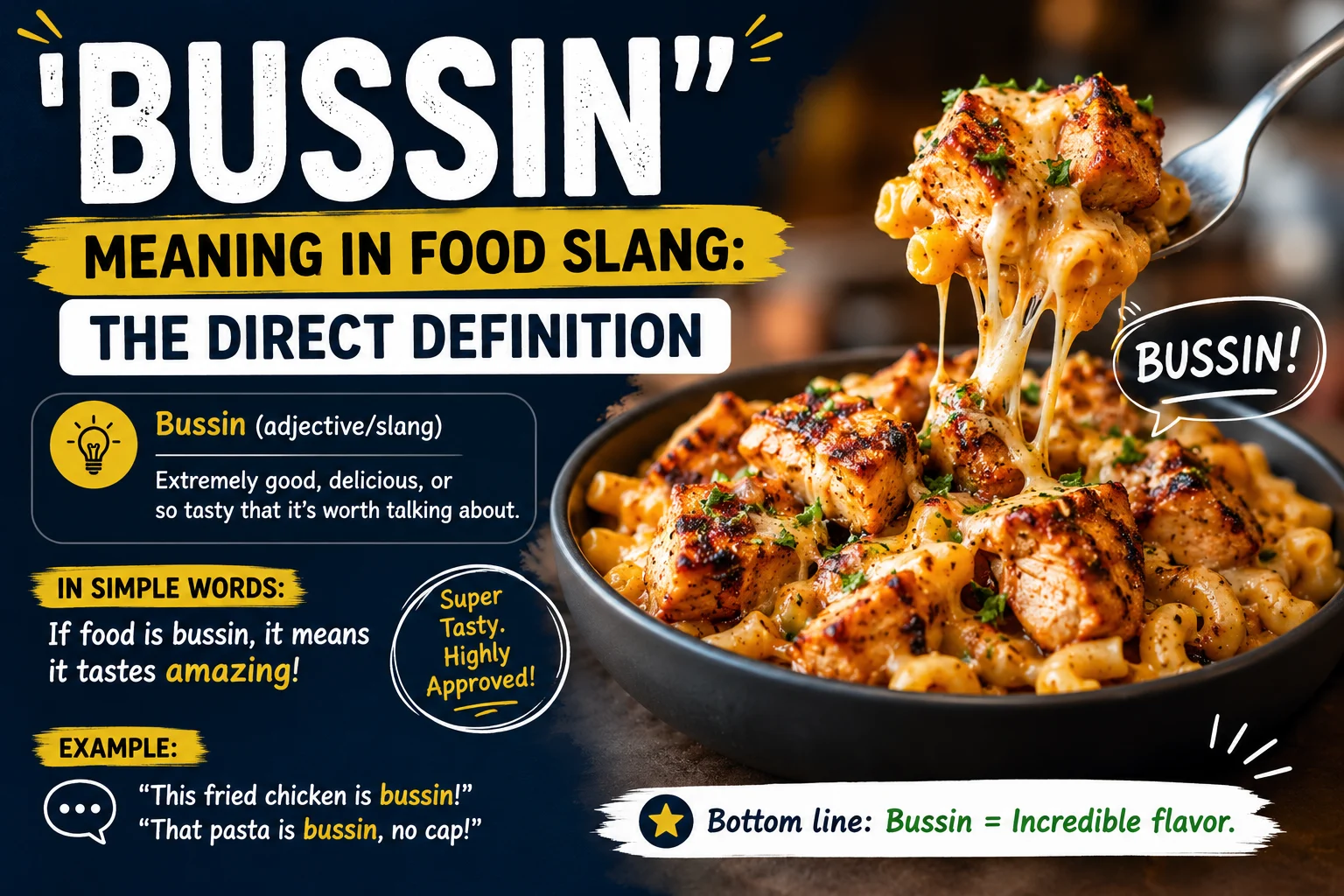
Bussin Meaning in Food Slang: The Direct Definition
At its core, bussin meaning in food slang centers on genuine culinary excellence. If someone takes a bite of food and says “this is bussin,” they mean it tastes outstanding — well-seasoned, satisfying, and worth talking about. The word signals real enthusiasm, not polite or lukewarm approval.
Unlike more neutral words like “good” or “tasty,” bussin carries real energy and excitement. It’s the kind of word people reach for when food genuinely exceeds expectations, rather than simply meeting them.
Why Bussin Feels More Intense Than “Delicious”
Part of what makes bussin meaning in food slang so effective is the gap between it and more formal, neutral food vocabulary. Words like “delicious” or “tasty” are perfectly accurate, but they carry a fairly calm, measured tone. “Bussin,” by contrast, sounds excited even before the listener knows what it means, largely because of how it’s typically delivered — often with emphasis, enthusiasm, or exclamation.
This emotional intensity is part of why the word resonates so strongly in short-form video and social media content specifically, where quick, high-energy reactions tend to perform better than calm, understated praise.
Origin of Bussin as Slang
Bussin meaning in food slang has roots in African American Vernacular English, a dialect that has contributed enormously to mainstream American slang over many decades, including a large number of words now widely used across social media and everyday conversation. The word likely built on an earlier, more general use of “bussin'” to describe something excellent or impressive, later narrowing specifically toward food in much of its current popular usage.
Because exact origins of casual slang are rarely documented in real time, and because terms like this spread informally through community use long before appearing in any dictionary, the specific timeline of “bussin” narrowing toward food-specific use should be treated as a general pattern rather than a firmly dated history.
Why Crediting the Origins of Bussin Matters
Understanding bussin meaning in food slang fully means recognizing that the word didn’t simply appear out of nowhere on a viral food video. It grew out of a specific linguistic community with a long history of shaping mainstream American English, often without much public credit or awareness of that origin among casual users encountering the word for the first time online.
This pattern isn’t unique to “bussin” — a significant portion of widely used internet slang traces back to African American Vernacular English specifically, and losing sight of that origin can make a word feel culturally weightless, even though its roots are very real and well documented by linguists. Using the term casually isn’t inherently disrespectful, but a full understanding of bussin meaning in food slang includes understanding where the word came from, not just how to use it correctly in a sentence.
How Bussin Became Mainstream Food Slang
Like many terms with roots in specific cultural communities, bussin meaning in food slang spread into broader mainstream use gradually, largely through social media platforms built around short-form video and food content specifically. Once a term gains traction on widely used platforms, it tends to spread quickly, often reaching audiences far removed from its original linguistic context within a relatively short period of time.
Because tracking the exact spread of internet slang is notoriously difficult — there’s rarely a single, clearly documented starting point — any detailed claim about precisely when or how “bussin” crossed into mainstream food-related use should be treated as an approximate pattern rather than a precisely dated history.
Bussin as Part of a Broader Food Slang Trend
Bussin meaning in food slang fits into a much larger, ongoing trend of expressive food vocabulary spreading through social media, where short, punchy words often communicate enthusiasm more effectively than detailed, technical descriptions of flavor or technique. This broader trend has reshaped how many people talk about food online, favoring quick, relatable reactions over lengthy, formal reviews.
This shift toward short, expressive food commentary has also helped normalize casual, slang-heavy language in spaces that might once have leaned more formal, such as restaurant reviews or recipe videos, further reinforcing how naturally bussin meaning in food slang fits into today’s food-focused internet culture.
How People Use Bussin in Texting and Social Media
The word shows up constantly in texting, social media captions, and comment sections responding to food photos or videos. Someone might comment “this looks bussin” under a photo of a home-cooked meal, or caption their own food post “this is actually bussin, no cap.”
This usage tends to carry genuine enthusiasm rather than sarcasm, similar to saying “this is incredible” out loud with real excitement. Understanding bussin meaning in food slang in this context mostly comes down to recognizing that sincere, high-energy praise rather than reading it as exaggeration or irony.
Scrolling through comment sections under popular food videos is often the fastest way to see this pattern of bussin meaning in food slang play out naturally in real conversation.
Bussin in Food Reviews and Food Content
Food-focused content creators and casual reviewers have embraced bussin meaning in food slang as a quick, expressive way to signal a strong recommendation. A short video reviewing a new restaurant might end with the reviewer simply saying “this is bussin,” using the word as a concise, confident endorsement rather than a lengthy explanation of specific flavors or techniques.
This usage reflects how naturally the word fits into fast-paced, casual food content, where quick, punchy reactions often communicate enthusiasm more effectively than detailed, formal restaurant-review language, which is exactly why bussin meaning in food slang has become such a staple of online food commentary specifically.
Bussin Bussin: The Doubled Intensifier
One notable variation on bussin meaning in food slang is the doubled form, “bussin bussin,” used to emphasize an even higher level of deliciousness than the single word alone. Repeating the word functions similarly to adding “extremely” or “incredibly” in more formal English, pushing the intensity of the compliment even further.
This doubling pattern isn’t unique to this particular slang term — repetition for emphasis shows up across many casual English expressions — but it’s become a recognizable, specific feature of how people express especially strong enthusiasm about food, adding an extra layer of intensity to the base bussin meaning in food slang covered throughout this guide.
Is the Bussin Meaning in Food Slang Ever Offensive?
No. Bussin meaning in food slang carries no offensive or rude connotation. It’s a purely positive, enthusiastic compliment, and using it to describe food is not considered inappropriate or disrespectful in any common context.
That said, because the term has roots in a specific cultural and linguistic community, it’s worth using it with some awareness of that background rather than treating it as a spontaneous, culturally weightless internet invention. Using slang thoughtfully, with some recognition of its origins, is generally seen as more respectful than using it without any awareness of where it comes from.
Bussin vs. Similar Food Slang
Several other slang terms overlap with bussin meaning in food slang, though each carries a slightly different flavor of praise. “Fire” broadly describes something excellent, applying to food, music, fashion, or nearly anything impressive, without being food-specific. “Slaps” often describes food or music with a particularly satisfying, immediate impact — “this sauce slaps.” “Hits different” emphasizes that something feels unexpectedly, uniquely good in a specific moment, sometimes tied to context like timing or mood. “No cap this is good” emphasizes sincerity behind the compliment rather than describing the food’s specific quality.
Understanding these small distinctions helps clarify exactly what bussin meaning in food slang adds compared to this broader family of enthusiastic food-related expressions.
Bussin in Home Cooking and Family Meals
Beyond restaurant reviews and viral food videos, bussin meaning in food slang shows up just as naturally around home-cooked meals and family gatherings. A teenager complimenting a parent’s cooking might say “mom, this is actually bussin,” using the word to express genuine, enthusiastic appreciation in a way that feels more personal and immediate than a simple “this is good.”
This everyday, domestic use highlights how far the word has traveled from its earlier, more general slang roots — it now comfortably describes a homemade family dinner just as easily as a trending restaurant dish featured in a viral video.
Bussin and Food Photography Culture
Social media’s heavy emphasis on food photography and short-form video has given bussin meaning in food slang a particularly natural home. A beautifully plated dish photographed for social media often gets captioned simply “bussin,” pairing a visually striking image with a short, high-energy word that captures the anticipated taste experience in just one syllable.
This pairing between visual content and quick, expressive captions reflects broader trends in how people communicate online generally, favoring short, punchy reactions over lengthy written descriptions, especially in visually driven spaces built around quick scrolling and fast engagement.
The Cultural Significance of Food Slang Like Bussin
Food has long been a powerful way for communities to express identity, creativity, and connection, and slang describing food often reflects that broader cultural significance. Bussin meaning in food slang fits into this pattern, offering a distinctly modern, internet-native way of expressing the same enthusiasm people have always shown toward genuinely great food, across generations and communities.
Recognizing this connection helps frame the word as part of an ongoing tradition rather than a disposable trend — food-related slang has existed in various forms for a very long time, and “bussin” represents merely the latest chapter in that much longer story.
Bussin in Comparison to Regional Food Compliments
Different regions and communities have long had their own distinctive ways of praising exceptional food, often tied closely to local culture, cuisine, and language. Bussin meaning in food slang, having spread widely through social media, now sits somewhat differently than these more localized, traditional expressions — it functions as a broadly recognized, internet-native compliment rather than one rooted in a single specific regional cuisine or dialect.
Because regional food slang varies enormously and is difficult to catalog comprehensively, specific comparisons between “bussin” and any particular regional expression should be treated as general observation rather than a definitive, exhaustive comparison.
Writing Style: Capitalization and Emphasis
Bussin meaning in food slang stays consistent regardless of capitalization, but stylistic choices can shift tone slightly. Lowercase “bussin” tends to feel casual and conversational, common in quick texts or comments among friends. Fully capitalized “BUSSIN” often adds extra emphasis, similar to saying it loudly and enthusiastically, and shows up more often in captions meant to grab attention quickly while scrolling. Adding extra letters, like “bussinnn,” or exclamation points pushes the enthusiasm even further, visually mimicking excited spoken emphasis.
None of these stylistic variations change the underlying definition — they simply adjust how strongly the compliment comes across, giving people a flexible way to fine-tune enthusiasm without needing an entirely different word to express the same core bussin meaning in food slang carries.
When Bussin Might Not Land as Intended
Because bussin meaning in food slang depends on shared cultural familiarity, there’s some risk of it falling flat with someone unfamiliar with casual internet slang or food-focused social media content. A caption that reads as an enthusiastic compliment to a regular social media user might simply confuse someone less familiar with current slang, especially without any additional context nearby.
This risk is fairly low within casual online food communities, where most audiences already recognize the term, but it’s worth keeping in mind when writing for a broader, more general audience that might not share the same familiarity with bussin meaning in food slang or current internet slang generally.
Grammar: How Bussin Is Used
Because bussin meaning in food slang functions primarily as a descriptive adjective, it typically follows familiar English sentence patterns: “this is bussin,” “that food was bussin,” or simply “bussin” as a standalone reaction. Unlike some slang built around unusual grammar, bussin generally slots into ordinary sentence structure without requiring special rules or unusual placement.
This straightforward grammar is part of why the word has spread so easily — it doesn’t require learning new sentence patterns, just substituting a more expressive, enthusiastic word in place of a more neutral one like “good” or “delicious.”
Bussin in Workplace and Casual Settings
While not typically appropriate for formal professional communication, bussin meaning in food slang does sometimes appear in casual workplace conversations, particularly around shared meals, potlucks, or office lunches. A coworker bringing in homemade food might genuinely hear “this is bussin” from colleagues in a relaxed, informal office culture, though the word remains distinctly casual rather than appropriate for client-facing or formal written communication.
Because workplace communication norms vary significantly by company, industry, and individual team culture, any general claim about how appropriate this phrase is in professional settings should be treated as highly dependent on specific workplace context.
Common Misunderstandings About the Bussin Meaning in Food Slang
One common misunderstanding assumes bussin meaning in food slang is a completely new, spontaneous internet invention with no cultural history behind it. In reality, the term has genuine linguistic roots, and its viral spread through social media represents amplification of existing language rather than a word invented from nothing.
Another misunderstanding assumes the word only applies to extravagant or fancy food. In practice, bussin gets applied just as often to simple home-cooked meals, fast food, or snacks as it does to elaborate restaurant dishes — the word describes taste and satisfaction, not price or complexity.
A third misunderstanding treats “bussin” as interchangeable with any positive food word without recognizing its specific intensity. Because it signals genuinely exceptional taste rather than mild approval, using it for food that’s merely “fine” or “decent” can feel like an overstatement to people familiar with the word’s intended emphasis.
Regional and Generational Differences in Use
Like most contemporary slang, bussin meaning in food slang tends to be most familiar among younger social media users, particularly those active in spaces where food content and casual reaction videos are especially popular. Older or less frequently online audiences may encounter the term less often or need brief context the first time they see it used.
Because slang popularity shifts constantly and varies significantly across communities and platforms, general claims about which age groups or regions use the term most should be treated as broad tendencies rather than precise, measurable data.
How to Use Bussin Correctly in a Sentence
Because bussin meaning in food slang depends heavily on genuine enthusiasm, it helps to see a few natural examples. As a direct compliment: “This burger is absolutely bussin.” As a caption: “Tried the new taco spot — bussin, no notes.” As an emphasized reaction: “The wings were bussin bussin, I need the recipe.”
In each case, “bussin” communicates strong, sincere praise for how something tastes, fitting naturally into casual conversation, captions, and quick reactions alike.
Frequently Asked Questions
What does bussin mean in food slang?
Bussin meaning in food slang describes food that tastes exceptionally good — delicious, flavorful, and genuinely impressive, rather than just adequate.
Where did the word bussin come from?
It has roots in African American Vernacular English, later becoming widely popularized through social media, particularly around food content.
Is bussin only used for food?
While it’s most commonly associated with food, it can occasionally describe other impressive things too, though food remains its most recognized and common use.
Is it rude to say food is bussin?
No. It’s a genuine compliment, expressing enthusiasm and appreciation rather than criticism or sarcasm.
What does “bussin bussin” mean?
It’s an emphasized version of the original word, used to signal an even higher level of deliciousness than “bussin” alone.
Is bussin appropriate to use at work?
Generally only in casual, relaxed workplace settings, such as around shared meals, rather than formal or client-facing communication.
Does bussin only describe taste, or can it describe presentation too?
It primarily describes taste, though it can occasionally extend to overall food experience, including presentation, when the food genuinely impresses on multiple levels.
Is there a risk of overusing bussin?
Like most slang, using it constantly for every meal can dilute its impact, so many people reserve it specifically for food that genuinely stands out.
Conclusion
Bussin meaning in food slang ultimately comes down to one enthusiastic idea: deliciousness worth genuinely celebrating. Whether reacting to a home-cooked meal, a viral food video, or a favorite restaurant dish, the word gives casual conversation a warm, expressive way to say “this is amazing” without needing a longer explanation, making it one of the most genuinely fun additions to modern food vocabulary.