Bolo meaning most commonly refers to “be on the lookout,” an acronym originally used by police and security teams to alert others to watch for a specific person, vehicle, or situation. Over time, the term crossed into everyday slang, now used more broadly to mean “keep an eye out” or “stay alert” for something. This guide covers the acronym’s formal law enforcement roots, its casual spread into texting and social media, and the other established meanings the word carries in fashion and boxing. For more insights, read here:- big mood meaning relatable slang and bffr meaning.
- BOLO Meaning: The Direct Definition
- Origin of BOLO as an Acronym: The Bolo Meaning Behind the Letters
- BOLO in Police Procedurals and Popular Media
- The Psychology Behind Quick Alert Language
- BOLO in Neighborhood Watch and Community Safety Groups
- BOLO Alerts and Public Trust
- Comparing BOLO to Other Law Enforcement Acronyms
- Why the Word Sticks: Memorability and Simplicity
- Teaching Someone Unfamiliar With BOLO
- How BOLO Is Used in Law Enforcement and Security
- BOLO in Everyday Slang and Texting
- BOLO in Social Media and Online Communities
- Other Established Meanings of BOLO
- Distinguishing the Alert Meaning From These Other Uses
- Why BOLO Still Feels Efficient Today
- Is the BOLO Meaning Ever Offensive?
- BOLO vs. Similar Terms
- Grammar: How BOLO Is Used
- BOLO in Workplace and Community Communication
- Common Misunderstandings About the BOLO Meaning
- Regional and Generational Differences in Use
- How to Use BOLO Correctly in a Sentence
- Frequently Asked Questions
- What does BOLO mean?
- Is BOLO only used by police?
- Does BOLO have other meanings?
- Is BOLO rude or offensive?
- Can BOLO be used for low-stakes situations?
- Is BOLO used the same way everywhere?
- Does BOLO ever appear in writing without capital letters?
- Can BOLO be used jokingly?
- Conclusion
BOLO Meaning: The Direct Definition
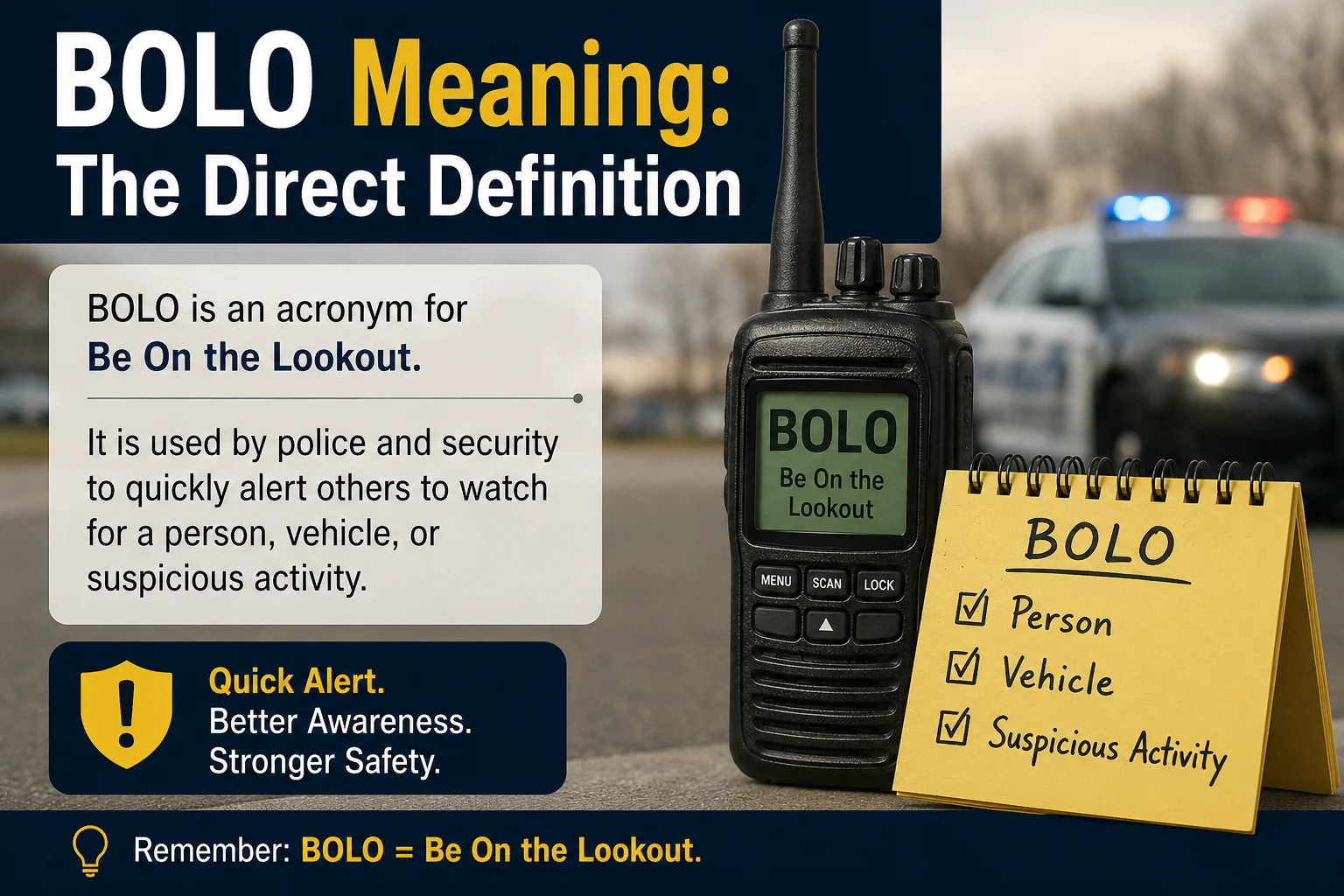
At its core, bolo meaning centers on alertness and attention. As an acronym for “be on the lookout,” it originally functioned as a quick, efficient way for law enforcement and security personnel to communicate a warning or request for vigilance. “There’s a BOLO out for a stolen vehicle” means officers have been alerted to watch for that specific car.
In everyday slang, bolo meaning has broadened beyond formal alerts. People now use it casually to mean “watch out for this” or “keep this on your radar,” even in situations that have nothing to do with law enforcement or security.
This shift from formal alert to casual everyday phrase is a common pattern in language more broadly, where terms originally built for one specific, professional purpose gradually get adopted for lighter, more general use once enough people become familiar with them.
Origin of BOLO as an Acronym: The Bolo Meaning Behind the Letters
BOLO developed as law enforcement shorthand, condensing the phrase “be on the lookout” into a quick, four-letter term suited for radio communication and written reports. This kind of acronym is common in professional and emergency communication generally, where speed and clarity matter enormously in time-sensitive situations.
Because exact historical details about when this specific acronym was first adopted are difficult to trace with full precision, the specific timeline of BOLO’s origin within law enforcement communication should be treated as a general pattern rather than a firmly documented history.
BOLO in Police Procedurals and Popular Media
Much of the general public’s familiarity with bolo meaning likely comes from television shows, films, and news coverage depicting police work. Crime dramas and procedural shows frequently feature characters issuing or receiving a “BOLO,” reinforcing the term’s association with active, urgent investigation. This kind of media exposure has probably played a meaningful role in spreading the acronym beyond people who work directly in law enforcement or security.
Because specific claims about individual shows, episodes, or exact media influence are difficult to verify precisely without direct research, general statements about media’s role in popularizing the term should be treated as a reasonable pattern rather than a documented, measurable fact.
The Psychology Behind Quick Alert Language
Acronyms like BOLO exist because urgent, time-sensitive situations benefit from language that’s fast to say, write, and understand. Bolo meaning fits into a broader category of alert-focused shorthand designed to reduce the time between noticing a potential issue and communicating it clearly to others. This efficiency matters enormously in law enforcement, where seconds can meaningfully affect outcomes.
This same psychological principle — shorter, punchier language spreading faster and easier — likely helps explain part of why the term found a second life in casual online warnings as well. A single word carrying built-in urgency communicates more efficiently than a longer, more detailed explanation, which is valuable in both emergency radio calls and quick social media comments alike.
BOLO in Neighborhood Watch and Community Safety Groups
Beyond formal law enforcement, many neighborhood watch groups and community safety organizations have adopted bolo meaning into their own informal communication. A local social media group might post “BOLO: suspicious vehicle circling the block twice tonight,” borrowing the term’s alert function for grassroots, community-based safety efforts rather than official police business.
This adoption reflects how thoroughly the acronym has moved beyond its original, strictly professional context, becoming a recognizable shorthand for community-level vigilance as well. Because the specific structure and formality of neighborhood watch communication varies significantly by community, general claims about how consistently this usage appears should be treated as an observed pattern rather than a universal standard.
BOLO Alerts and Public Trust
Part of what gives bolo meaning its lasting weight, even in casual use, is the underlying association with public safety and community trust. A formal BOLO issued by police carries real institutional authority behind it, backed by investigation and specific descriptions meant to help the public assist safely and accurately. This authority doesn’t automatically transfer to every casual, informal use of the word, but it does color how seriously people tend to treat the term even outside strictly official contexts.
This is part of why misuse or exaggeration of the term — using “BOLO” dramatically for very minor, low-stakes situations — can sometimes feel slightly jarring to people who associate the word primarily with genuine public safety concerns. Most casual users navigate this naturally, reserving the more dramatic tone for situations that genuinely warrant extra attention.
Comparing BOLO to Other Law Enforcement Acronyms
Bolo meaning is just one example of how law enforcement and emergency services rely heavily on acronyms for fast, clear communication. Similar shorthand exists throughout these fields — terms describing suspect status, case classifications, or emergency response types all follow this same basic pattern of compressing important information into quick, memorable letters.
Understanding this broader pattern helps explain why BOLO specifically caught on in casual conversation more than many other law enforcement acronyms: its underlying phrase, “be on the lookout,” translates naturally and usefully into everyday situations in a way that more technical or specialized law enforcement terminology typically doesn’t, which is a big part of why bolo meaning made such an easy jump into common slang.
Why the Word Sticks: Memorability and Simplicity
Part of the reason bolo meaning has traveled so far beyond its original context comes down to simple memorability. Four letters, easy to say, easy to type, and immediately understandable once explained — these traits make the acronym unusually well-suited for spreading informally, compared to longer or more complicated law enforcement terminology that rarely crosses over into everyday slang.
This kind of linguistic efficiency is a common trait among successful slang terms generally, not just BOLO specifically. Words and phrases that are short, phonetically simple, and easy to embed naturally into a sentence tend to spread further and last longer than clunkier alternatives, regardless of how useful or accurate those alternatives might be.
Teaching Someone Unfamiliar With BOLO
For someone encountering bolo meaning for the first time, the quickest explanation usually works best: it’s a way of saying “watch out for this” or “keep an eye out,” borrowed originally from police terminology. Providing one clear example — like a lost pet alert or a scam warning — often communicates the concept faster than a lengthy definition on its own.
Because the term bridges both formal and casual contexts, it’s also worth briefly mentioning its law enforcement roots when introducing someone to the word, since that background helps explain why bolo meaning carries a slightly more serious undertone compared to purely casual slang invented without any professional origin at all.
How BOLO Is Used in Law Enforcement and Security
Within its original professional context, bolo meaning remains tied to formal alerts. Police departments issue a “BOLO” when officers need to watch for a specific suspect, vehicle, or missing person, often distributed through radio communication, internal bulletins, or public safety announcements. Security teams in retail, corporate, or event settings sometimes use the term similarly, alerting staff to watch for a specific individual or situation.
This formal usage tends to be precise and action-oriented, focused on a specific description or situation rather than a vague, general warning. Understanding bolo meaning in this professional context helps explain why the term carries a slightly more serious, official tone compared to its casual slang usage, even when the exact same four letters get used casually just a few sentences later in a completely different conversation.
BOLO in Everyday Slang and Texting
Outside law enforcement, bolo meaning has spread into everyday casual language, particularly in texting and social media. Someone might text a friend “bolo for my package, it’s supposed to arrive today” or comment “bolo for scammers in the replies” under a social media post, borrowing the term’s original sense of alertness for much lower-stakes situations.
This casual usage keeps the core meaning intact — watch out, stay alert — while dropping the formal, professional weight of its law enforcement origins. Understanding bolo meaning in this context mostly comes down to recognizing a lighter, more conversational version of the same basic idea, adapted comfortably for everyday, low-stakes situations.
BOLO in Social Media and Online Communities
Social media users frequently borrow bolo meaning to warn others about scams, misleading posts, or suspicious accounts. A comment like “bolo, this account is impersonating a real brand” uses the term to quickly flag a potential problem, echoing its original function as a concise, actionable alert.
This usage tends to appear most often in community-driven spaces where users look out for one another, such as marketplace groups, fan communities, or forums focused on shopping deals and scam awareness. Because online safety terminology and community norms shift over time, specific claims about platform-by-platform popularity of this usage should be treated as a general impression rather than firmly measured data. Even so, this protective, community-oriented usage is a natural extension of bolo meaning in its original alert-focused sense.
Other Established Meanings of BOLO
Beyond the “be on the lookout” acronym, “bolo” has other genuinely established meanings worth knowing. A “bolo tie” is a type of Western-style necktie made of a cord with decorative metal tips, closed with an ornamental clasp, commonly associated with Southwestern American fashion. In boxing, a “bolo punch” refers to a specific, looping punch technique, distinct from a standard hook or jab.
Because these meanings are entirely unrelated to the law enforcement acronym, context almost always makes clear which sense of “bolo” is intended — a sentence about fashion or boxing points clearly toward one of these alternate meanings, while a sentence about alertness or warning points toward the “be on the lookout” sense of bolo meaning instead.
Distinguishing the Alert Meaning From These Other Uses
Because “bolo” carries genuinely separate meanings, readers encountering the word for the first time sometimes need a moment to figure out which sense applies. Surrounding vocabulary usually resolves this quickly: words like “suspect,” “vehicle,” “warning,” or “watch out” point toward the alert-focused bolo meaning, while words like “necktie,” “clasp,” or “punch” point toward the unrelated fashion or boxing senses instead.
This kind of contextual disambiguation is common with short, borrowed acronyms and words that happen to overlap with existing English vocabulary. Rather than causing lasting confusion, it usually resolves within the first few words of a sentence, once the surrounding topic becomes clear — a reminder that context does most of the real work in identifying which sense of bolo meaning applies at any given moment.
Why BOLO Still Feels Efficient Today
Part of what keeps bolo meaning useful, decades after its original law enforcement adoption, is its sheer brevity. In fast-moving conversations — whether over police radio or a group text — a single, recognizable word that instantly communicates “pay attention to this” saves real time compared to a longer, spelled-out request. This efficiency likely helped the term survive its crossover from professional jargon into everyday slang relatively intact.
Because short, memorable words tend to spread more easily than longer phrases, it’s not surprising that bolo meaning found a comfortable home in casual texting, where speed and brevity are already valued just as much as they are in emergency radio communication.
Is the BOLO Meaning Ever Offensive?
No. Bolo meaning carries no offensive or rude connotation in any of its established uses. Whether referring to a law enforcement alert, a casual warning among friends, or an unrelated fashion or boxing term, the word functions purely descriptively, without any built-in insult or negative judgment.
Because the term originates in professional law enforcement communication, some casual users choose to use it thoughtfully, aware that its origins carry real weight in contexts involving public safety, even as its slang usage has become considerably lighter and more casual. This awareness doesn’t require avoiding the casual version of bolo meaning altogether — it simply means recognizing that the same word carries very different stakes depending on who’s using it and why.
BOLO vs. Similar Terms
Several other expressions overlap with bolo meaning, though each carries a slightly different tone or context. “Heads up” is a more general, casual way of alerting someone to something worth noticing, without the specific urgency BOLO can carry in formal contexts. “Watch out” often implies a more immediate, direct warning about danger, rather than the slightly broader, ongoing alertness BOLO typically suggests. “Keep an eye out” is closely related in meaning, often used interchangeably with casual BOLO usage in everyday conversation.
Understanding these small distinctions helps clarify exactly what bolo meaning contributes that these related expressions don’t always capture: a background of formal, professional alertness terminology now adapted for everyday casual use.
Grammar: How BOLO Is Used
Because bolo meaning functions as both a noun and a casual verb-like expression, it shows some flexibility in sentence structure. As a noun: “Police issued a BOLO for the suspect’s vehicle.” As a casual alert: “Bolo, there’s construction on Main Street today.” As part of a longer phrase: “Everyone, bolo for updates on the schedule change.”
This flexible grammar mirrors how many acronyms eventually blend into everyday speech, gradually taking on a life beyond their original, strictly formal usage.
BOLO in Workplace and Community Communication
Workplaces, particularly those involving security, retail loss prevention, or safety-focused industries, sometimes use bolo meaning in internal communication much closer to its original law enforcement sense. A retail loss prevention team might issue an internal “BOLO” for a known shoplifter, closely mirroring the term’s formal police usage.
Community organizations and neighborhood safety groups also sometimes adopt the term, issuing informal “BOLOs” about suspicious activity, lost pets, or local safety concerns. This usage sits somewhere between the fully formal law enforcement sense and the more casual, everyday slang version, reflecting the term’s flexible range across different levels of seriousness.
Common Misunderstandings About the BOLO Meaning
One common misunderstanding is assuming “BOLO” always refers to something urgent or dangerous. While it can signal serious situations in law enforcement contexts, everyday casual usage often applies to much lower-stakes situations, like watching for a delivery or a friend’s arrival.
Another misunderstanding treats bolo meaning as a single, fixed term with only one possible interpretation. In reality, the bolo tie and bolo punch meanings are entirely legitimate, established alternate uses, unrelated to the “be on the lookout” acronym, and context is essential for identifying which meaning applies in a given sentence.
A third misunderstanding assumes the term originated purely as internet slang. In fact, the “be on the lookout” sense predates casual internet use significantly, rooted in formal law enforcement and security communication before spreading into everyday conversational use.
Regional and Generational Differences in Use
Familiarity with bolo meaning can vary depending on someone’s exposure to law enforcement terminology, regional dialect, or general media consumption. Some people encounter the term primarily through police procedural shows or news coverage, while others pick it up casually through social media or friend groups already using it informally.
Because usage patterns and familiarity shift over time and vary significantly by community, general claims about which groups use the term most frequently should be treated as broad tendencies rather than precise, measurable data.
How to Use BOLO Correctly in a Sentence
Because the term spans formal and casual contexts, it helps to see a few natural examples. In a formal alert: “Officers issued a BOLO for a missing hiker last seen near the trailhead.” In casual texting: “Bolo, I think I left my keys at your place.” In online warning: “Bolo for this seller, several buyers reported issues with shipping.”
Each of these examples uses “bolo” to communicate the same underlying idea — pay attention, stay alert — regardless of how formal or casual the surrounding context happens to be.
Frequently Asked Questions
What does BOLO mean?
Bolo meaning most commonly stands for “be on the lookout,” used to alert someone to watch for a specific person, situation, or thing.
Is BOLO only used by police?
No. While it originated in law enforcement, bolo meaning has spread into everyday casual slang, texting, and social media warnings as well.
Does BOLO have other meanings?
Yes. “Bolo tie” refers to a Western-style necktie, and “bolo punch” is a specific boxing technique, both unrelated to the “be on the lookout” acronym.
Is BOLO rude or offensive?
No. It’s a neutral, descriptive term across all of its established meanings, without any built-in negative connotation.
Can BOLO be used for low-stakes situations?
Yes. Casual usage often applies to everyday, low-stakes situations, like watching for a delivery, rather than exclusively serious law enforcement alerts.
Is BOLO used the same way everywhere?
Its core meaning stays consistent, though familiarity and frequency of use can vary depending on region, community, and exposure to law enforcement terminology.
Does BOLO ever appear in writing without capital letters?
Yes. Casual texting and social media often use lowercase “bolo,” while formal law enforcement documents typically keep it capitalized as an acronym.
Can BOLO be used jokingly?
Yes, often. Friends sometimes use it playfully for very minor situations, borrowing the term’s alertness for a lighthearted, exaggerated effect rather than genuine urgency.
Conclusion
Bolo meaning ultimately comes down to one clear idea: attentiveness — staying alert and watching for something specific, whether that’s a formal police alert, a casual heads-up between friends, or a warning shared within an online community. Rooted in law enforcement shorthand before spreading into everyday language, the term remains a quick, practical way to ask others to pay attention, carrying just enough of its original seriousness to still feel meaningful even in its lightest, most casual form.