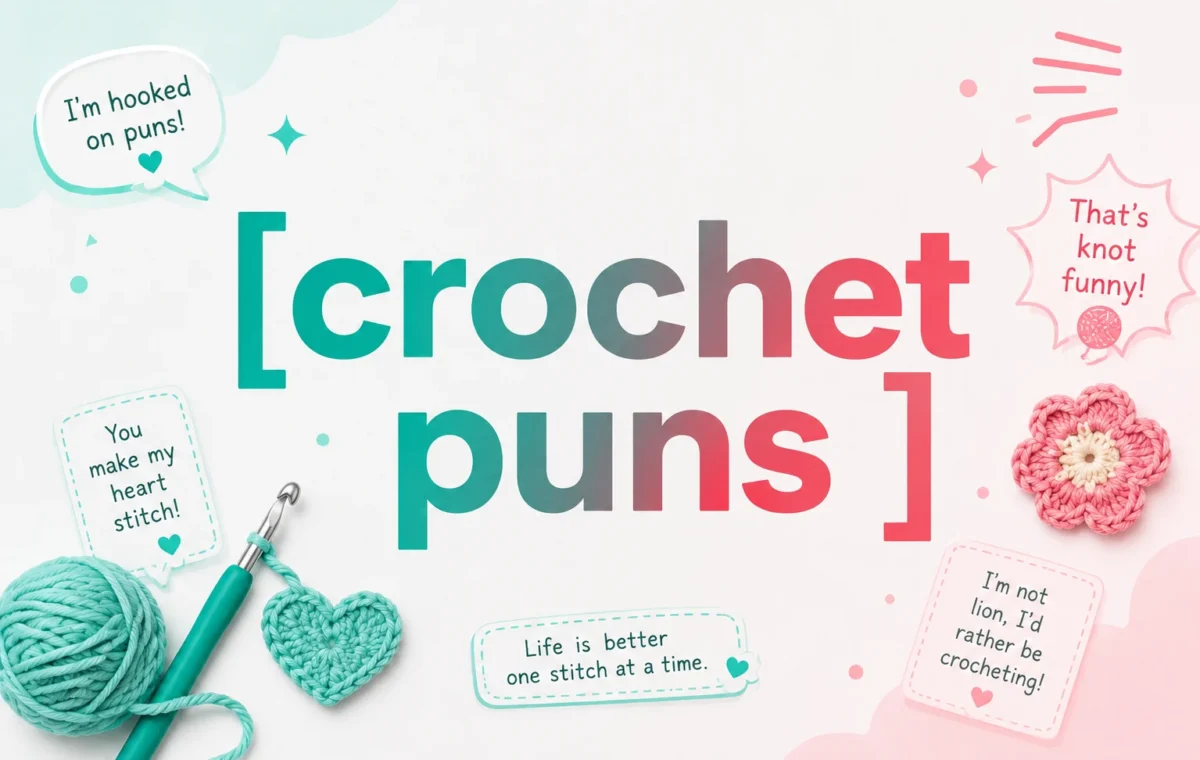
Crochet puns are jokes and wordplay built around crochet terms like hook, yarn, stitch, and skein. Crafters use them for Instagram captions, greeting cards, shop names, and general banter with other yarn lovers. Below is a full collection organized by where you’ll actually use them. For more insights, read here:- consort meaning and chulo meaning.
- Why Crochet Puns Are So Popular
- Funny Crochet Puns
- Cute Crochet Puns for Cards and Gifts
- Crochet Puns for Instagram Captions
- Crochet Puns for Shop and Business Names
- Common Crochet Terms Used in Puns
- When to Use This Kind of Wordplay (and When to Skip It)
- A Short History of Puns in Craft Communities
- Crochet Puns vs. Knitting Puns
- How to Write Your Own Crochet Puns
- Frequently Asked Questions
- What are some good crochet puns for beginners?
- Are crochet puns only for social media?
- What crochet term is used most often in puns?
- Can crochet puns be used for a business name?
- Do crochet puns work if someone doesn't crochet?
- Are crochet puns and knitting puns interchangeable?
- Wrapping Up
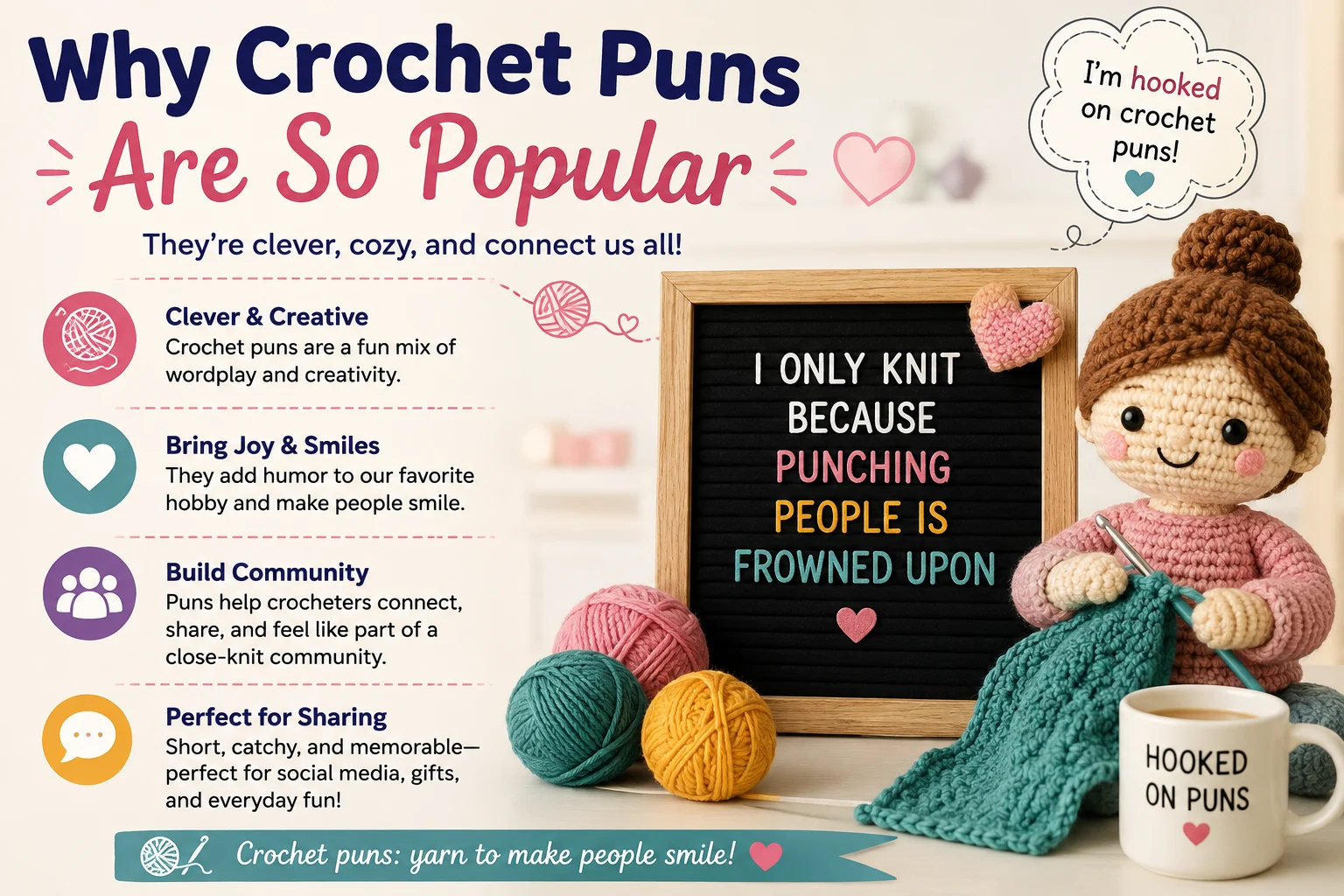
Why Crochet Puns Are So Popular
The crochet community is large and active online, and this kind of wordplay gives crafters an easy way to add personality to a project post, a handmade gift tag, or a small business name. Because crochet has so many distinct terms — hook, stitch, yarn, skein, gauge, frog — there’s a lot of raw material to work with, which is part of why crochet puns keep showing up in craft groups and hobby forums.
Puns built around a specific hobby or craft tend to spread quickly within that hobby’s community, since the humor depends heavily on shared, specialized vocabulary. Someone outside the craft might not immediately get why “hooked” is funny, but anyone who’s spent time with a crochet hook understands the joke instantly. That built-in shared context is a big part of why this style of wordplay keeps circulating in fiber-arts spaces.
Funny Crochet Puns
These work well for casual captions or chatting with other crafters:
- “I’m hooked on crochet.”
- “Crochet? I hardly know it!”
- “Yarn over and out.”
- “I’ve got a lot of loose ends, but I’m working on it.”
- “This project has me in stitches.”
- “I’m having a yarn-tastic day.”
- “Sorry, I can’t. I’m booked and hooked.”
- “Let’s not frog this friendship.”
- “I don’t do drama, I do double crochet.”
- “Life is short, crochet more.”
Cute Crochet Puns for Cards and Gifts
If the gift is handmade, a short line on the tag adds a nice touch:
- “You’re sew special.”
- “Hooked on you.”
- “Made with love, one stitch at a time.”
- “I whipped this up just for you.”
- “Wool always be friends.”
- “You mean a skein deal to me.”
- “Yarn my heart, one loop at a time.”
- “Feeling extra stitchy about you.”
Crochet Puns for Instagram Captions
Short, punchy lines work best for photo captions:
- “Yarn what you love.”
- “Hook, line, and stitcher.”
- “Currently booked and hooked.”
- “Just here for the fiber content.”
- “My happy place has a hook in it.”
- “Stitch please.”
- “Yarn today, gone tomorrow.”
- “Hooked on a feeling (and a skein).”
Crochet Puns for Shop and Business Names
Small crochet businesses often lean on wordplay for a memorable name. A few examples worth knowing:
- “Hooked & Stitched”
- “Yarn It Up”
- “Loop de Loop Crochet Co.”
- “Stitch Please Studio”
- “The Frog Pond” (a nod to “frogging,” or unraveling a project)
- “Wool You Marry Me Designs” (popular for wedding-related crochet items)
- “Skein of Dreams”
- “Hooked for Life”
Names like these tend to stick in people’s memory better than a plain, literal description of the shop, which is likely one reason so many small fiber-arts businesses lean into wordplay when naming their storefront.
Common Crochet Terms Used in Puns
Understanding the terms behind this wordplay makes the jokes land better. A little familiarity with the vocabulary goes a long way, especially if you’re writing for an audience that includes both experienced crafters and total beginners:
- Hook — the tool used to crochet, and the basis for lines like “I’m hooked.”
- Yarn — the material, often swapped in for “learn,” “earn,” or “yearn.”
- Stitch — a single crochet unit, easy to pair with “in stitches” or “stitch please.”
- Frog / Frogging — unraveling a project, since it sounds like “rip it, rip it.”
- Skein — a bundle of yarn, close enough to “deal” for a soft pun.
- Gauge — how tight or loose the stitches are, used less often but still workable.
- Granny square — a classic crochet motif, occasionally used in family-related jokes.
When to Use This Kind of Wordplay (and When to Skip It)
Crochet puns fit naturally in casual, friendly settings: social captions, handmade gift tags, craft fair signage, or chatting in a fiber-arts group. They’re less suited to formal writing or professional communication outside the craft world, where the joke might not land with people unfamiliar with the hobby.
It’s also worth reading the room a little. A pun-heavy caption feels right on a personal craft account, but a formal product listing description might do better with a straightforward one, saving the wordplay for the caption or the packaging instead. A quick rule of thumb: if the audience already knows crochet vocabulary, the joke will land fast; if not, it’s worth adding a touch of context so the humor doesn’t fall flat.
A Short History of Puns in Craft Communities
Wordplay has been part of hobby culture for a long time, well before social media made it easy to share a caption with thousands of people at once. Knitters, quilters, gardeners, and bakers all have their own versions of this same habit: taking the specific vocabulary of the craft and bending it into a joke that only makes full sense to someone inside that world. Crochet is no exception, and its terminology happens to lend itself especially well to this kind of wordplay, since so many of its core words already sound close to everyday English words and phrases.
The exact origin of any individual pun is usually impossible to pin down, since this kind of casual wordplay tends to spread informally through conversation, craft fairs, and online groups rather than being credited to one specific person. What’s clear is that the format took off alongside the broader growth of craft communities on social platforms, where a short, punchy caption travels much further than a long paragraph ever could.
Crochet Puns vs. Knitting Puns
Crochet and knitting share some vocabulary, so their pun styles overlap a bit, but each craft has its own specific terms too. Knitting leans on words like “needle,” “purl,” and “cast on,” while crochet sticks closer to “hook,” “stitch,” and “yarn.” If you’re writing for a mixed audience of both crocheters and knitters, it’s worth double-checking that the specific term you’re using actually applies to the craft you’re referencing, since mixing them up is a common mistake among people newer to fiber arts.
How to Write Your Own Crochet Puns
Once you know the basic pattern, you can build new ones yourself:
- Start with a common crochet term (hook, yarn, stitch, skein).
- Find a common English word or phrase it sounds like or fits into.
- Swap the word in and check that it still makes sense out loud.
- Read it back to see if it’s clear enough for someone outside the hobby to follow.
This approach works for card messages, captions, pattern names, or even naming a new small business. The best results usually come from starting with a term you use often, since the wordplay tends to feel more natural when it’s built around vocabulary you’re already comfortable with. It also helps to say the line out loud a few times before using it, since some combinations read fine on paper but feel clunky the moment they’re spoken.
Frequently Asked Questions
What are some good crochet puns for beginners?
Simple, well-known ones work best for beginners: “I’m hooked on crochet,” “Yarn over and out,” and “Crochet? I hardly know it!” are all easy to use and widely understood.
Are crochet puns only for social media?
No. This kind of wordplay shows up just as often on handmade gift tags, craft fair banners, greeting cards, and shop names as it does in captions.
What crochet term is used most often in puns?
“Hook” is probably the most common, since it fits naturally into phrases like “I’m hooked” or “hook, line, and stitcher.”
Can crochet puns be used for a business name?
Yes, and many small crochet shops do exactly that. Names like “Hooked & Stitched” or “Yarn It Up” are common examples of wordplay used as branding.
Do crochet puns work if someone doesn’t crochet?
Some of the simpler ones still land, since they lean on familiar words like “hooked” or “stitched.” The more technical ones, like gauge-based jokes, work best for an audience already familiar with the craft.
Are crochet puns and knitting puns interchangeable?
Not always. Some general fiber-arts jokes work for both crafts, but term-specific ones don’t cross over cleanly, since “hook” belongs to crochet and “needle” belongs to knitting. It’s a small distinction, but it matters if you’re writing for a group that includes both knitters and crocheters, since a mismatched term can pull people out of the joke instead of landing it.
Wrapping Up
If you’re putting together captions, gift tags, or a shop name, this list of crochet puns should cover most everyday situations. Mixing a few funny lines with a couple of cute ones usually gives the best variety for different occasions, and once you understand the core vocabulary of crochet, coming up with new ones on your own gets a lot easier.