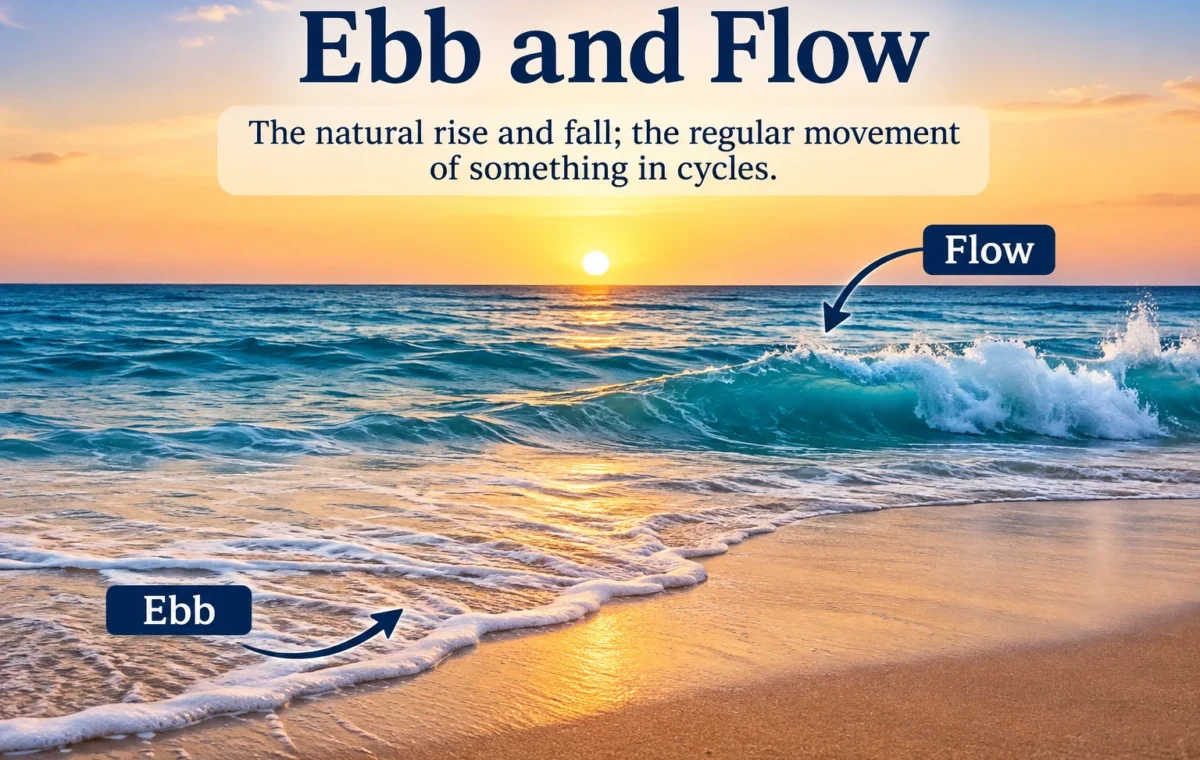
Ebb and Flow Meaning.The phrase “ebb and flow” means the regular rise and fall, increase and decrease, or coming and going of something over time. It is commonly used to describe changing circumstances, emotions, relationships, activity, or natural processes.consort meaning or chulo meaning.
- What Does Ebb and Flow Meaning?
- Ebb and Flow in Different Contexts
- Life
- Relationships
- Emotions
- Business and Work
- Creativity
- Ebb and Flow as a Figurative Expression
- Is “Ebb and Flow” Positive or Negative?
- Ebb and Flow Examples
- What Is the Origin of “Ebb and Flow”?
- Common Misunderstanding
- Ebb and Flow vs. Ups and Downs
- Similar Expressions
- Frequently Asked Questions
- What does “ebb and flow” mean in simple terms?
- What does “ebb and flow” mean in a relationship?
- Is “ebb and flow” an idiom?
- Is “ebb and flow” positive or negative?
- What is another word for “ebb and flow”?
- Can “ebb and flow” describe emotions?
For example:
“Life has its ebb and flow, with periods of success followed by challenges.”
What Does Ebb and Flow Meaning?
“Ebb and flow” describes a pattern in which something increases and then decreases, or moves forward and backward in a natural cycle.
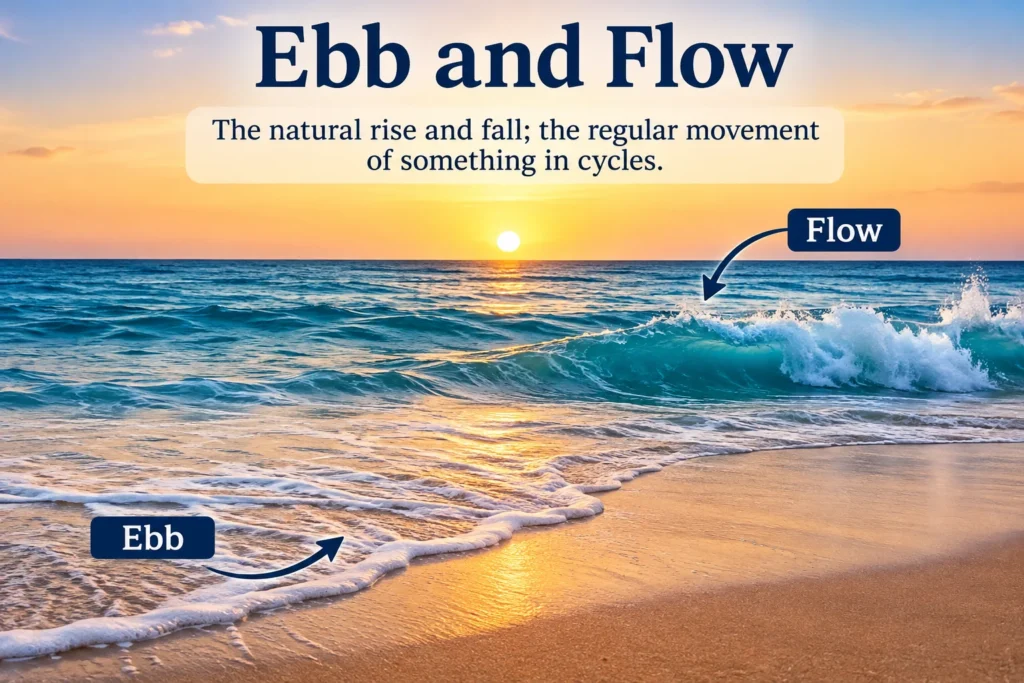
The phrase comes from the movement of the sea:
- Ebb means the tide moves away from the shore.
- Flow means the tide moves toward the shore.
In everyday English, however, the expression is usually figurative rather than literal.
For example:
“Work comes in an ebb and flow throughout the year.”
This means that work becomes busy at some times and quieter at others.
Ebb and Flow in Different Contexts
The expression can apply to many situations where conditions naturally change.
Life
People often use “ebb and flow” to describe changing periods in life.
“Everyone experiences the ebb and flow of life.”
Here, the phrase suggests that life naturally contains both easier and more difficult periods.
Relationships
“Ebb and flow” can describe changes in closeness, communication, or emotional connection.
“Friendships often have an ebb and flow as people become busy with different parts of their lives.”
It does not necessarily suggest that a relationship is failing. It can simply describe natural changes over time.
Emotions
The phrase can describe feelings that become stronger and weaker.
“Her confidence has an ebb and flow depending on the situation.”
The meaning is that her confidence fluctuates rather than remaining constant.
Business and Work
Businesses can experience periods of high and low activity.
“The restaurant experiences an ebb and flow of customers throughout the day.”
Here, customer numbers rise and fall according to the time of day.
Creativity
Writers, artists, and other creative people may use the expression to describe changes in inspiration.
“Creative inspiration has its own ebb and flow.”
This suggests that periods of strong inspiration can alternate with quieter periods.
Ebb and Flow as a Figurative Expression
Although the phrase originates from the movement of tides, “ebb and flow” is now widely used metaphorically.
It can describe anything that changes naturally between higher and lower levels.
For example:
- the ebb and flow of emotions
- the ebb and flow of conversation
- the ebb and flow of life
- the ebb and flow of business
- the ebb and flow of popularity
- the ebb and flow of energy
The expression often carries the idea that these changes are normal and recurring, rather than completely random.
Is “Ebb and Flow” Positive or Negative?
“Ebb and flow” is generally neutral.
It does not automatically mean that something is good or bad. The surrounding context determines the tone.
For example:
“The ebb and flow of the seasons is beautiful.”
This has a positive tone.
By contrast:
“The ebb and flow of the economy makes planning difficult.”
This describes a challenge without making the expression itself negative.
The phrase can also have a reflective or philosophical tone when used to describe life, relationships, or personal experiences.
Ebb and Flow Examples
Here are some natural examples of the expression:
- “The ebb and flow of life can teach us to adapt to change.”
- “Our motivation has an ebb and flow, especially during busy weeks.”
- “The business follows the usual ebb and flow of seasonal demand.”
- “Their friendship has experienced an ebb and flow over the years.”
- “The conversation had a natural ebb and flow.”
- “She learned to accept the ebb and flow of her creative energy.”
- “Tourism in the area follows the ebb and flow of the seasons.”
- “The ebb and flow of the ocean creates a calming rhythm.”
What Is the Origin of “Ebb and Flow”?
The expression is based on the movement of tides.
“Ebb” refers to the movement of water away from the shore as the tide falls, while “flow” refers to the movement toward the shore as the tide rises. The two words came to be paired to describe alternating movement.
The expression later developed a broader figurative use for situations that repeatedly rise and fall or increase and decrease.
The basic idea remains connected to the natural rhythm of the tides.
Common Misunderstanding
One common misunderstanding is that “ebb and flow” refers only to the ocean.
It can certainly be used literally when discussing tides, but in modern English it is very often figurative.
For example:
“The ebb and flow of the tide” is literal.
“The ebb and flow of emotions” is figurative.
Another point is that “ebb and flow” does not necessarily mean rapid change. The changes may happen gradually over hours, days, seasons, or years.
Ebb and Flow vs. Ups and Downs
“Ebb and flow” and “ups and downs” can sometimes communicate similar ideas, but they have different tones.
Ebb and flow often suggests a natural, recurring rhythm or gradual change.
Ups and downs more directly emphasizes positive and negative experiences.
Compare:
“Life has its ebb and flow.”
This sounds reflective and suggests a natural cycle.
“Life has its ups and downs.”
This more directly emphasizes good and difficult experiences.
Similar Expressions
Depending on the context, similar expressions include:
- rise and fall
- ups and downs
- fluctuations
- changing fortunes
- coming and going
- waxing and waning
- shifting patterns
- cycles of change
“Waxing and waning” is particularly similar when describing something that becomes stronger and then weaker.
Frequently Asked Questions
What does “ebb and flow” mean in simple terms?
It means that something naturally goes through periods of increase and decrease, or comes and goes over time.
What does “ebb and flow” mean in a relationship?
It can describe natural changes in closeness, communication, attention, or emotional connection within a relationship.
Is “ebb and flow” an idiom?
Yes. “Ebb and flow” is commonly used as an idiomatic expression, especially when it describes changing situations rather than literal tides.
Is “ebb and flow” positive or negative?
It is generally neutral. The phrase describes change and fluctuation, while the surrounding context determines whether that change is viewed positively or negatively.
What is another word for “ebb and flow”?
Depending on the context, alternatives include “rise and fall,” “ups and downs,” “fluctuation,” “waxing and waning,” and “changing patterns.”
Can “ebb and flow” describe emotions?
Yes. It can describe emotions, motivation, confidence, energy, or other feelings that naturally become stronger and weaker over time.
Final Thoughts
The ebb and flow meaning centers on the natural movement between higher and lower levels, much like the changing movement of the tides. In everyday English, the expression can describe life, emotions, relationships, work, creativity, business, and many other situations that naturally change over time.
Understanding this expression also helps you recognize why it often sounds more reflective than simply saying something “goes up and down.” It suggests a continuing rhythm of change rather than a single event. This natural rhythm of change is what makes “ebb and flow” such a useful expression in everyday English.