Deadass meaning centers on complete seriousness or sincerity — it’s a way of saying “I’m not joking” or “I genuinely mean this.” Used constantly in casual speech and texting, “deadass” adds emphasis to a statement, letting the listener know the speaker is being fully honest rather than exaggerating or playing around. This guide breaks down the word’s cultural roots, how it’s used across different everyday contexts, and how it compares to similar sincerity-focused slang. For more insights, read here:- clapped meaning and caught in 4k meaning with examples.
- Deadass Meaning: The Direct Definition
- Why Deadass Feels More Convincing Than "Really"
- Origin of Deadass as Slang
- How Deadass Became Mainstream Slang
- Deadass Compared to Older Emphasis Words
- The Emotional Function of Deadass
- How People Use Deadass in Texting and Social Media
- Deadass in Everyday Conversation
- Deadass vs. Similar Slang Terms
- Grammar: How Deadass Is Used
- Is the Deadass Meaning Ever Offensive?
- Deadass in Dating and Social Contexts
- Deadass in Workplace and Formal Settings
- Deadass in Music and Pop Culture
- Deadass Alongside Other NYC-Rooted Slang
- Writing Style: Emphasis and Punctuation
- Typing Deadass vs. Saying It Out Loud
- When Deadass Might Not Land as Intended
- Teaching Someone Unfamiliar With Deadass
- Common Misunderstandings About the Deadass Meaning
- Why Crediting the Origins of Deadass Matters
- Regional and Generational Differences in Use
- How to Use Deadass Correctly in a Sentence
- Frequently Asked Questions
- What does deadass mean in slang?
- Where does the word deadass come from?
- Is deadass a rude word?
- Is deadass the same as no cap?
- Can deadass be used as a question?
- Is deadass appropriate for work messages?
- Does deadass always require an exclamation of surprise?
- Is there a risk of overusing deadass?
- Conclusion
Deadass Meaning: The Direct Definition
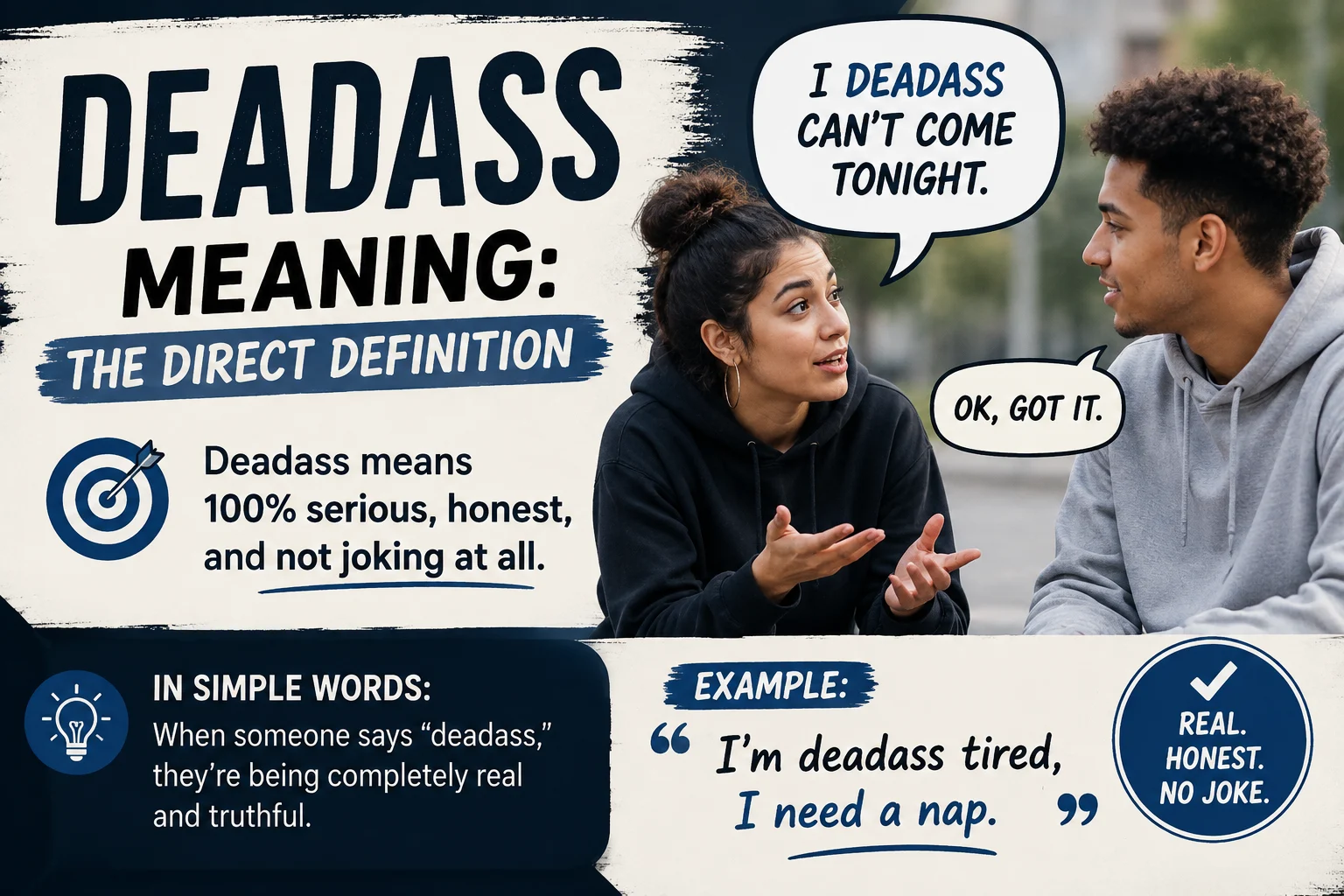
At its core, deadass meaning centers on emphasis and sincerity. Saying “I’m deadass tired” or “deadass, that’s the best meal I’ve had all year” signals genuine emotion or truth behind the statement, cutting through any doubt about whether the speaker is exaggerating for effect. It functions almost like an intensifier, similar to “seriously” or “genuinely,” just with a distinctly casual, contemporary edge.
The word can also stand entirely on its own as a reply, confirming something someone else just said: if a friend shares surprising news, replying simply “deadass?” asks for confirmation, while “deadass” as a statement confirms it’s true.
Why Deadass Feels More Convincing Than “Really”
Part of what makes deadass meaning so effective is the gap between it and more neutral confirmation words like “really” or “honestly.” Those words are accurate, but they carry a fairly calm, measured tone. “Deadass,” by contrast, sounds emphatic and grounded even before the listener processes the full sentence, largely because of its distinctive, punchy sound and casual delivery.
This emotional weight is part of why the word resonates so strongly in spoken conversation and voice messages specifically, where tone and emphasis carry real communicative power beyond the literal words themselves.
Origin of Deadass as Slang
Deadass meaning traces back to African American Vernacular English, a dialect that has shaped an enormous amount of mainstream American slang over many decades, with particularly strong associations to New York City speech patterns specifically. The word likely developed by combining “dead” — already used informally to mean “completely” or “totally,” as in “dead serious” — with “ass,” a common informal intensifier attached to adjectives in casual English.
Because exact origins of casual slang are rarely documented in real time, and because terms like this spread informally through community and regional speech long before appearing in any dictionary, the specific timeline of when “deadass” became widely recognized shorthand should be treated as a general pattern rather than a firmly dated history.
How Deadass Became Mainstream Slang
Like many terms with roots in specific cultural and regional communities, deadass meaning spread into broader mainstream use gradually, through a mix of music, social media, television, and everyday conversation among people connected to these communities and beyond. Once a term gains traction through widely consumed media and platforms, it tends to spread quickly, often reaching audiences far removed from its original regional context.
Because tracking the exact spread of internet and regional slang is notoriously difficult — there’s rarely a single, clearly documented starting point — any detailed claim about precisely when or how “deadass” crossed into broader mainstream use should be treated as an approximate pattern rather than a precisely dated history.
Deadass Compared to Older Emphasis Words
Every generation develops its own version of a phrase meaning “I’m completely serious.” Deadass meaning fits into this long tradition, following older expressions like “no joke,” “I swear,” and “dead serious” that have expressed similar sincerity in casual English for decades. What’s different is the format — a single, punchy, distinctly regional word built for quick, emphatic delivery rather than a longer phrase.
This pattern of compressing an existing casual sentiment into a shorter, more distinctive word is common throughout slang more broadly, and “deadass” represents a fairly typical example of how sincerity gets reshaped for fast-paced, everyday conversation.
The Emotional Function of Deadass
At a deeper level, deadass meaning serves an important communicative function: quickly signaling genuine sincerity without requiring a lengthy explanation. In fast-moving conversation, whether spoken or texted, a short word that instantly communicates “I am completely serious right now” carries real value, cutting through potential doubt or confusion immediately.
This efficiency helps explain why the word has remained so popular. It compresses what might otherwise take a longer, more deliberate explanation — genuine, specific sincerity — into a single, familiar word that carries real emotional weight for anyone familiar with its use.
How People Use Deadass in Texting and Social Media
The word shows up constantly in texting, comments, and captions, typically emphasizing that a statement is completely sincere. Someone might text “deadass, I almost missed my flight,” or comment under a surprising post “wait, deadass?” to express genuine disbelief while asking for confirmation.
This usage tends to carry real emotional weight, distinguishing genuine statements from jokes or exaggeration. Understanding deadass meaning in this context mostly comes down to recognizing that sincere, emphatic tone rather than treating it as purely decorative slang.
Scrolling through casual texting exchanges or comment sections is often the fastest way to see this pattern of deadass meaning play out naturally in real conversation.
Deadass in Everyday Conversation
One of the most common places to see deadass meaning play out is casual, in-person or spoken conversation between friends. Someone describing an unbelievable experience might add “deadass” for emphasis, reinforcing that despite how the story sounds, every word of it is true.
Example: “I deadass saw a celebrity at the grocery store today, no joke.” This kind of message uses the word to preempt any doubt the listener might have about the story’s accuracy, adding weight to an otherwise surprising claim, which is really the entire practical value behind deadass meaning in everyday storytelling.
Deadass vs. Similar Slang Terms
Several other slang terms overlap with deadass meaning, though each carries a slightly different flavor of emphasis. “No cap” affirms honesty directly, often used to preface or follow a statement rather than modify it internally. “FR FR” (for real, for real) doubles down on sincerity through repetition. “NGL” (not gonna lie) signals honesty, often before admitting something slightly embarrassing or unexpected. “Dead serious,” a slightly more traditional phrase, closely overlaps with “deadass” but reads as marginally more formal.
Understanding these small distinctions helps clarify exactly what deadass meaning adds compared to this broader family of sincerity-focused slang, and pinpointing those differences makes it easier to choose the right word for a given moment.
Grammar: How Deadass Is Used
Because deadass meaning functions primarily as an intensifier, it slots flexibly into sentences in several positions. It can begin a sentence — “deadass, I forgot my keys again” — appear in the middle — “I deadass thought today was Friday” — or stand entirely alone as a reply confirming or questioning something just said.
This flexibility is common across intensifier-based slang more broadly, where the word’s main job is adding emotional emphasis rather than following strict grammatical placement rules.
Is the Deadass Meaning Ever Offensive?
No. Deadass meaning carries no inherently offensive or rude connotation, despite technically containing the word “ass” within it. In casual, everyday use, the word functions purely as an intensifier signaling sincerity, not as an insult or vulgar statement directed at anyone.
That said, because the word includes mild profanity-adjacent language, it’s not typically appropriate for formal writing, professional emails, or conversations with people who might be uncomfortable with casual language, even though it’s rarely considered genuinely rude among people who use it regularly.
Deadass in Dating and Social Contexts
In dating conversations and casual social exchanges, deadass meaning often shows up when someone wants to make clear they’re being genuinely sincere rather than playing games or exaggerating. A message like “I deadass think you’re one of the funniest people I’ve met” uses the word to add real weight to a compliment, distinguishing it from casual flattery.
This usage reflects the word’s broader social function — helping communicate authenticity in situations, like early dating conversations, where sincerity can sometimes be hard to gauge through text alone.
Deadass in Workplace and Formal Settings
Because deadass meaning includes mildly casual, profanity-adjacent language, it’s generally not appropriate for professional emails, workplace messaging with clients, or formal written communication. Even relatively relaxed workplace cultures typically still expect written communication to avoid this kind of casual slang, especially in contexts involving people outside a close, informal team.
This doesn’t mean the underlying sentiment — genuine sincerity or emphasis — can’t be communicated at work. It simply means choosing a more formal alternative, like “I’m being completely serious” or “honestly,” rather than the casual, slang version common in everyday conversation.
Deadass in Music and Pop Culture
Deadass meaning has appeared frequently in music, particularly hip-hop and rap lyrics closely tied to New York City culture, where the word’s distinctive rhythm and emphasis fit naturally into spoken and rapped delivery. This presence in music likely helped reinforce the word’s recognition well beyond its original regional speech community, introducing it to listeners who might not have otherwise encountered it in everyday conversation.
Because specific claims about individual songs, artists, or exact cultural moments are easy to get wrong without direct verification, any particular pop-culture reference tied to the word’s spread should be checked against a reliable source before being cited as fact. What’s clear is that music has historically played a significant role in carrying regional slang, including deadass meaning, into much broader public awareness.
Deadass Alongside Other NYC-Rooted Slang
Deadass meaning sits alongside a number of other words and phrases closely associated with New York City speech that have similarly spread into wider national and even international use over time. This pattern reflects the broader influence major cities and specific cultural communities often have on the evolution of casual English, introducing regionally rooted vocabulary to audiences far beyond where it originated.
Recognizing this pattern helps frame the word within a longer, ongoing tradition of regional slang shaping mainstream language, rather than treating it as an isolated or random internet phenomenon disconnected from any real linguistic history.
Writing Style: Emphasis and Punctuation
Deadass meaning stays consistent regardless of spelling or punctuation, but style choices can shift tone slightly. Standard lowercase “deadass” tends to feel calm and conversational, common in relaxed texting. Adding extra letters, like “deadassss,” mimics stretched-out spoken emphasis, often used for extra comedic or emotional effect. A standalone “deadass?” with a question mark shifts the word from a statement into a request for confirmation, changing its function within the conversation entirely.
None of these stylistic variations change the underlying definition — they simply adjust how strongly the sincerity comes across, giving people a flexible way to fine-tune tone without needing an entirely different word to express the same core deadass meaning.
Typing Deadass vs. Saying It Out Loud
While deadass meaning works equally well in spoken conversation and written text, the word’s delivery can shift its intensity noticeably. Spoken aloud, it often carries strong vocal emphasis, sometimes stretched out for extra effect (“deeeadass”). In text, capitalization, repetition, or surrounding punctuation typically substitutes for that vocal emphasis, helping convey the same emotional weight without an actual voice behind it.
This crossover between spoken and written emphasis isn’t unique to this particular word, but it does highlight how flexible casual slang tends to be, adapting naturally to whichever communication format is being used in the moment.
When Deadass Might Not Land as Intended
Because deadass meaning depends on shared cultural and regional familiarity, there’s some risk of the word being misread by someone unfamiliar with its casual, sincere function, particularly in written text without tone of voice to clarify intent. A message that reads as genuinely emphatic to someone used to the term might simply confuse someone encountering it for the first time.
This risk is fairly low in casual conversation among people who already share this vocabulary, but it’s worth remembering when communicating with a broader or less familiar audience, especially in writing where deadass meaning relies on tone that isn’t always obvious from text alone.
Teaching Someone Unfamiliar With Deadass
For someone encountering deadass meaning for the first time, the quickest explanation usually works best: it’s a way of saying “I’m completely serious” or “I’m not exaggerating,” borrowed from casual, regionally rooted American slang. Providing one clear example — like confirming an unbelievable but true story — often communicates the concept faster than a lengthy definition on its own.
Because the word blends casual delivery with genuine sincerity, it’s also worth briefly mentioning its cultural and regional roots when introducing someone to deadass meaning, since that context helps explain why it carries the emotional weight it does, rather than functioning as empty filler language.
Common Misunderstandings About the Deadass Meaning
One common misunderstanding assumes deadass meaning is somehow related to death or morbid topics because of the word “dead” within it. In reality, “dead” here functions purely as an informal intensifier meaning “completely” or “totally,” similar to its use in phrases like “dead tired” or “dead serious,” with no connection to literal death at all.
Another misunderstanding treats the word as rude or vulgar simply because it contains “ass.” In practice, the word is widely used casually across many everyday, non-vulgar contexts, and most listeners familiar with the slang don’t register it as offensive language at all.
A third misunderstanding assumes deadass is a brand-new internet invention. In reality, the term has meaningful roots in earlier community and regional speech patterns, and its spread through texting and social media represents amplification of existing slang rather than a completely new coinage.
Why Crediting the Origins of Deadass Matters
Understanding deadass meaning fully means recognizing that the word didn’t appear spontaneously online. It developed within specific speech communities with deep linguistic histories, long before becoming widely used across broader American slang. Losing sight of that origin can make the word feel culturally weightless, even though its roots are real and well documented by linguists studying American Vernacular English and regional speech patterns.
Using the term casually isn’t inherently disrespectful, but a complete understanding of deadass meaning includes some awareness of where it came from, not just how to use it correctly in a sentence.
Regional and Generational Differences in Use
Deadass meaning carries particularly strong associations with New York City speech, though it has spread widely across the broader United States and beyond through texting, social media, and everyday casual conversation. Younger speakers and those in heavily online spaces tend to use the word more frequently than older or less digitally connected audiences.
Because slang popularity shifts constantly and varies significantly across regions and communities, general claims about exactly how common the word is in a specific region or age group should be treated as broad tendencies rather than precise, measurable data.
How to Use Deadass Correctly in a Sentence
Because the word depends heavily on tone and context, it helps to see a few natural examples. As emphasis: “I deadass studied all night for that test.” As a standalone confirmation: “Deadass, I’m not lying.” As a question seeking confirmation: “Wait, deadass? That actually happened?”
In each case, “deadass” reinforces sincerity, whether confirming a surprising fact, emphasizing a personal statement, or questioning something someone else just shared.
Frequently Asked Questions
What does deadass mean in slang?
Deadass meaning centers on complete seriousness or sincerity, used to emphasize that a statement is genuinely true rather than exaggerated or joking.
Where does the word deadass come from?
It has roots in African American Vernacular English, with particularly strong associations to New York City speech, later spreading widely through social media and texting.
Is deadass a rude word?
Not typically. Despite containing “ass,” it’s widely used casually and isn’t considered vulgar or offensive in most everyday contexts, though it remains too casual for formal writing.
Is deadass the same as no cap?
They’re closely related, both expressing sincerity, though “no cap” typically frames a statement directly, while “deadass” functions more flexibly as an intensifier throughout a sentence.
Can deadass be used as a question?
Yes. Saying “deadass?” on its own is a common way to ask for confirmation after hearing something surprising or hard to believe.
Is deadass appropriate for work messages?
Generally no, since it’s distinctly casual slang. Formal alternatives like “seriously” or “honestly” fit professional communication better.
Does deadass always require an exclamation of surprise?
No. It can express calm, matter-of-fact sincerity just as easily as excited disbelief, depending entirely on the surrounding tone of the conversation.
Is there a risk of overusing deadass?
Like most intensifiers, using it constantly can dilute its emphasis, so many people reserve it specifically for moments that genuinely call for extra sincerity.
Conclusion
Deadass meaning, at its heart, is about sincerity — a short, punchy way of confirming that a statement is genuinely true rather than exaggerated or joking. Rooted in African American Vernacular English and closely tied to New York City speech before spreading widely through texting and social media, the word remains one of the most efficient ways to add real emotional weight to a sentence, without needing a longer, more formal explanation to get the point across.