“Duly noted” means “I have acknowledged what you said.” It’s a short, formal-sounding way to confirm you’ve heard, understood, and registered a comment, instruction, or piece of feedback. For more insights, read here:- discrete meaning and crochet puns.
- Quick Definition
- The Duly Noted Meaning in Everyday Use
- Sincere vs. Sarcastic Use
- Origin of "Duly Noted"
- Workplace and Professional Context
- Texting and Casual Use
- Is "Duly Noted" Rude or Offensive?
- Duly Noted in Writing and Messaging Apps
- Similar Expressions
- Frequently Asked Questions
- What does duly noted mean in a text message?
- Is duly noted a sarcastic phrase?
- Where does the phrase duly noted come from?
- Is it okay to say duly noted at work?
- What can I say instead of duly noted?
- Does duly noted always require a follow-up action?
- Wrapping Up
Quick Definition
- Duly noted (phrase): acknowledged appropriately; noted as expected or required.
- Example: “Duly noted — I’ll update the report before Friday.”
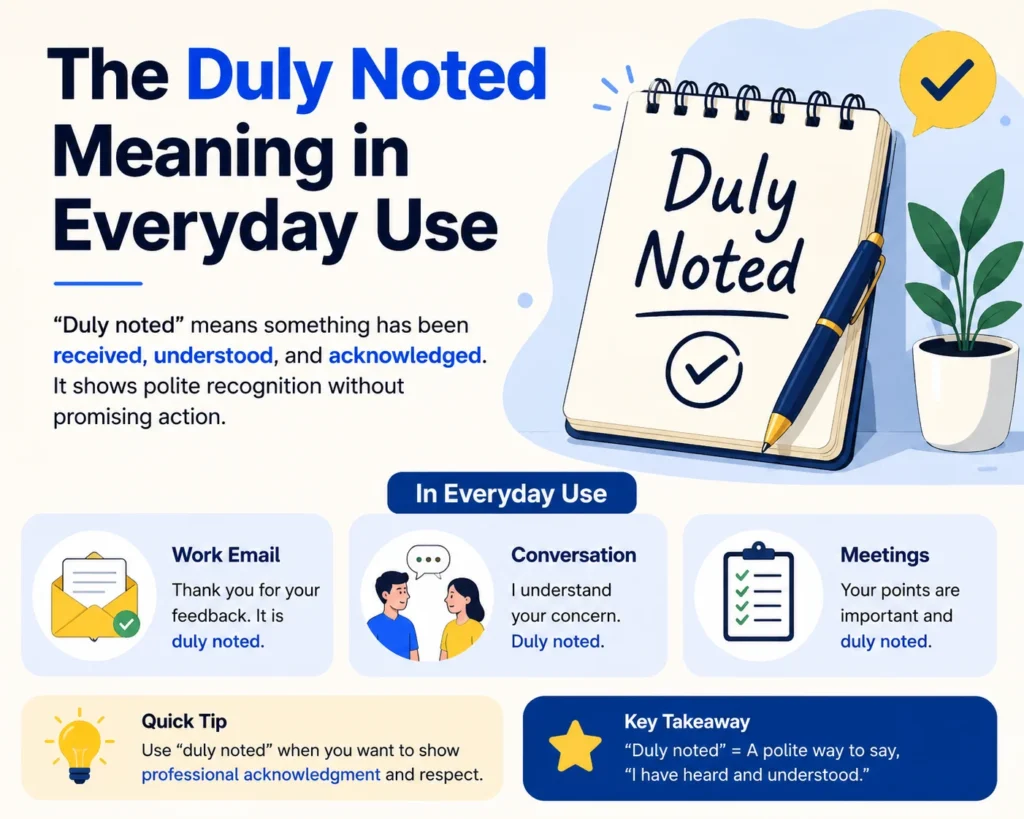
The Duly Noted Meaning in Everyday Use
In everyday conversation, the duly noted meaning is closer to a polite confirmation than a full response. It tells the other person their point registered, without necessarily agreeing, disagreeing, or promising any specific action beyond simply remembering it.
The phrase works almost like a placeholder response. It buys the speaker a moment to acknowledge something without committing to a longer reaction, which is exactly why it shows up so often in situations where someone wants to move a conversation along without dropping the topic entirely.
Example sentences:
- “Duly noted. I’ll bring it up at the next meeting.”
- “You mentioned the deadline moved up. Duly noted.”
- “Duly noted, thanks for flagging that before I submitted it.”
- “Duly noted — let’s revisit this once the numbers come in.”
Sincere vs. Sarcastic Use
This is where the duly noted meaning gets more interesting. The exact same words can land two very different ways depending on tone, context, and relationship.
Sincere use: A genuine acknowledgment, often in professional or formal settings, confirming that feedback or information has been received and will be considered.
- “Duly noted. I appreciate you pointing that out.”
Sarcastic use: A dismissive or annoyed reply, often used when someone feels they’re being lectured, corrected unnecessarily, or told something they already know.
- “Duly noted,” said flatly, after being told for the third time to double-check their work.
Written text strips out tone of voice, so the duly noted meaning in a text message or email can be genuinely ambiguous. Readers often rely on the relationship and the situation to decide which version is intended.
A few contextual clues can help narrow it down. A quick, single-word “Duly noted.” with no punctuation softening it often reads flatter and more sarcastic, while a version paired with a follow-up sentence, like “Duly noted, I’ll fix that today,” tends to read as sincere. Capitalization, punctuation, and what comes immediately after the phrase all shape how a reader interprets it.
Origin of “Duly Noted”
“Duly” is an older English adverb meaning “in a due, proper, or fitting manner,” and it still shows up in formal and legal English today, as in “duly signed” or “duly authorized.” Paired with “noted,” the phrase originally carried a formal, procedural tone, similar to language used in meetings, courtrooms, or official correspondence. The exact point when it crossed over into casual, everyday speech is uncertain, but its formal roots are likely part of why it can sound clipped or curt when used sarcastically today.
That formal backbone is really the key to understanding the duly noted meaning as it’s used now. Even in its most sarcastic form, the phrase still borrows its punch from sounding overly official, almost like a small joke about bureaucratic language dropped into an ordinary conversation.
Workplace and Professional Context
“Duly noted” shows up often in workplace communication, particularly in emails, meeting notes, and quick replies to feedback. In this context, the duly noted meaning usually stays professional and neutral, confirming receipt of information without committing to any specific next step.
- “Duly noted — I’ll loop in the design team.”
- “Your concerns about the timeline are duly noted and will be discussed on Monday.”
Because it sounds formal, it can also be used deliberately to keep a reply short and non-committal, especially when someone doesn’t want to expand on their reaction in writing.
The workplace duly noted meaning tends to lean toward the neutral, professional end of the spectrum rather than the sarcastic one, largely because email and meeting notes are usually kept on record. Most people are more careful about tone in written work communication than they would be in a casual text to a friend, which nudges the phrase toward its sincere reading in that setting.
Texting and Casual Use
Outside the office, “duly noted” is often used more casually, sometimes with a wink of humor, since the phrase sounds a bit stiff for everyday texting. People use it half-jokingly to sound overly formal or businesslike among friends.
- “Duly noted, I will absolutely not be forgetting your birthday this year.”
In this kind of exchange, the phrase isn’t meant literally as formal acknowledgment; it’s closer to a playful nod that pokes fun at its own formality.
Among friends, the duly noted meaning almost flips its usual register: instead of sounding stiff or bureaucratic, it becomes a small joke precisely because it’s so out of place in a relaxed conversation. That contrast is part of the appeal, since dropping formal-sounding language into an informal chat can come across as funny rather than cold.
Is “Duly Noted” Rude or Offensive?
On its own, “duly noted” isn’t rude or offensive. It becomes dismissive only through tone, context, or repetition, particularly when used to shut down further discussion rather than genuinely acknowledge a point. In writing, it’s worth considering how the reader might interpret it, especially if the topic is sensitive.
Repetition matters more than most people expect. Hearing “duly noted” once rarely bothers anyone, but hearing it repeatedly from the same person, especially after raising a concern more than once, can start to feel like the speaker is being brushed off rather than heard. The duly noted meaning shifts from acknowledgment to dismissal largely through that kind of pattern, rather than through the words themselves.
Duly Noted in Writing and Messaging Apps
In messaging apps and group chats, the duly noted meaning often depends heavily on what surrounds it. A thumbs-up emoji or a laughing emoji right after it usually signals the lighter, joking version. A period and nothing else can come across as clipped, especially in a chat where longer, warmer replies are the norm.
Because there’s no tone of voice in text, some people avoid the phrase altogether in messaging apps and opt for something more clearly warm, like “got it, thank you!” instead, specifically to avoid the ambiguity that can come with a bare “duly noted.”
Similar Expressions
- “Noted.” — a shorter, more clipped version with a similar meaning, often used the same way, sincerely or sarcastically.
- “Got it.” — more casual and warmer in tone, without the formal edge.
- “Understood.” — leans more sincere and professional, without much sarcastic use.
- “Point taken.” — closer to acknowledging that someone made a valid argument, rather than simply confirming receipt of information.
- “Copy that.” — borrowed from radio communication, similar in function but with a different, more casual feel than the duly noted meaning usually carries.
None of these phrases are perfect one-to-one substitutes. Each carries a slightly different weight, so swapping one in for “duly noted” can shift the tone of a sentence even when the core message stays the same.
Frequently Asked Questions
What does duly noted mean in a text message?
It usually means the sender has acknowledged what was said, though tone can be hard to read in text. It could be sincere or slightly sarcastic depending on the conversation, and figuring out the intended duly noted meaning often comes down to the relationship between the people texting.
Is duly noted a sarcastic phrase?
Not inherently. It can be sincere or sarcastic depending on tone and context. In formal settings, it’s usually genuine; in casual conversation, it can carry a dismissive edge, and the duly noted meaning shifts accordingly.
Where does the phrase duly noted come from?
“Duly” is a formal English word meaning “properly” or “as required,” often used in legal and official language. The exact point the phrase became common in everyday speech is uncertain.
Is it okay to say duly noted at work?
Yes, it’s common and generally professional, especially in emails or meetings when confirming that feedback or information has been received.
What can I say instead of duly noted?
“Noted,” “got it,” or “understood” all work as alternatives, depending on how formal or casual you want the reply to sound. Each shifts the duly noted meaning slightly toward warmer or more neutral territory, so it’s worth picking based on the relationship and setting.
Does duly noted always require a follow-up action?
Not necessarily. The phrase confirms acknowledgment, not commitment. Sometimes a follow-up naturally comes later, but the duly noted meaning by itself doesn’t promise any specific next step.
Wrapping Up
Understanding the duly noted meaning really comes down to reading the room: the same three words can sound genuinely appreciative or quietly annoyed depending on who’s saying them and why. Once you notice the tone cues around it, the phrase becomes easy to use, and easy to interpret, in almost any setting. For a broader look at how formal phrases like this one function within the English language, the linked Wikipedia entry is a solid starting reference.