ERA Meaning .The word “era” refers to a distinct period of time, especially one marked by particular events, characteristics, people, or developments. For example, you might hear someone say, “We are entering a new era of technology.”
- What Does ERA Mean?
- ERA as a Part of Speech
- Different Meanings and Uses of Era
- 1. A Historical Period
- 2. A Period Defined by a Person or Group
- 3. A Period of Technological or Social Change
- 4. A Personal Phase of Life
- Examples of Era in a Sentence
- Era in Modern Informal English
- What Is the Tone of Era?
- Era vs. Age
- Era vs. Period
- Common Synonyms for Era
- What Is the Origin of the Word Era?
- Common Misunderstanding About Era
- Is Era an Acronym?
- Frequently Asked Questions
- What is the simple meaning of era?
- Is era a noun?
- Can era refer to a short period?
- What is the difference between an era and a period?
- Is era formal or informal?
- What is another word for era?
- ERA Meaning in History
- ERA Meaning in Everyday English
- ERA Meaning on Social Media and in Casual Speech
- ERA Meaning in Technology
- ERA Meaning in Business and Careers
- What Does “End of an Era” Mean?
- What Does “New Era” Mean?
- ERA Meaning in Culture
- ERA Meaning in Sports
- ERA Meaning in Personal Life
- ERA Meaning vs. Age
- ERA Meaning vs. Period
- ERA Meaning vs. Epoch
- Common Phrases With Era
- A New Era
- End of an Era
- Golden Era
- Modern Era
- Digital Era
- How to Use Era Correctly in a Sentence
- Is Era Formal or Informal?
- Does Era Have a Negative Meaning?
- Can Era Be Used for the Future?
- Can Era Refer to a Person's Life?
- ERA Meaning Through Simple Examples
- How the ERA Meaning Changes With Context
- Historical Context
- Career Context
- Cultural Context
- Personal Context
- ERA Meaning in the Phrase “New Era”
- ERA Meaning in “End of an Era”
- ERA Meaning in “Golden Era”
- ERA Meaning in Modern Slang-Like Expressions
- Examples of ERA in Professional Writing
- Examples of ERA in Casual Conversation
- ERA Meaning and the Expression “In an Era”
- ERA Meaning and the Expression “During an Era”
- ERA Meaning and the Expression “End of an Era”
- ERA Meaning vs. Chapter
- ERA Meaning vs. Phase
- ERA Meaning vs. Generation
- Common Mistakes When Using Era
- Mistake 1: Assuming Every Era Has a Fixed Length
- Mistake 2: Treating Era as Automatically Historical
- Mistake 3: Assuming Era Is Slang
- Mistake 4: Confusing “Era” With the Baseball Abbreviation
- Is “ERA Meaning” Different From “Era Definition”?
- Quick Guide to the ERA Meaning
- Frequently Asked Questions About ERA Meaning
- What is the main ERA meaning?
- Can I use era for my personal life?
- Is era a slang word?
- What does “end of an era” mean?
- What does “new era” mean?
- What is the difference between era and phase?
- Final Thoughts
In simple terms, an era is a period that is considered different or significant enough to be identified as a separate stage in history or life. more information:-what does subordinate mean at work or feining meaning .
What Does ERA Mean?
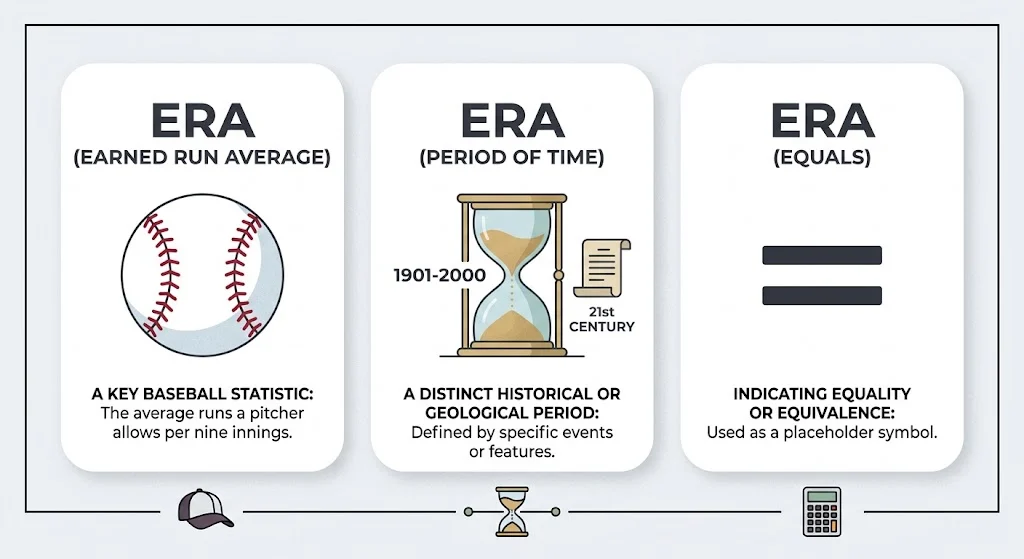
ERA means a period of time that is distinguished by certain characteristics, events, or circumstances.
For example:
- The Victorian era was known for major social and industrial changes.
- The digital era has transformed how people communicate.
- The team began a new era under its new manager.
The length of an era can vary. It may last for decades, centuries, or even longer. In informal modern usage, people may also use “era” for a shorter personal period, such as a particular phase of their life.
ERA as a Part of Speech
“Era” is primarily a noun.
Pronunciation: /ˈɪərə/ in British English and /ˈɪrə/ in American English
Simple pronunciation: “EE-ruh”
Example:
“Her career entered a successful new era.”
Here, “era” is a noun referring to a particular period in her career.
Different Meanings and Uses of Era
1. A Historical Period
The most traditional use of “era” describes a significant period in history.
For example:
“The Renaissance era influenced European art, literature, and science.”
In this sense, an era is usually connected with major historical or cultural developments.
2. A Period Defined by a Person or Group
“Era” can describe a period associated with an influential leader, artist, athlete, political figure, or organization.
For example:
“The club enjoyed its most successful era under its legendary coach.”
The phrase does not necessarily mean that the person controlled the entire period. It simply identifies that period with their influence or achievements.
3. A Period of Technological or Social Change
The word is also commonly used for periods defined by developments in society or technology.
Examples include:
- the industrial era
- the information era
- the digital era
- the space age or era of space exploration
Example sentence:
“Artificial intelligence may shape a new era of scientific discovery.”
4. A Personal Phase of Life
In contemporary informal English, people sometimes use “era” to describe a personal stage or lifestyle phase.
For example:
“I’m entering my fitness era.”
“She is in a completely different era of her life now.”
This usage is more casual than the traditional historical meaning. It treats a personal phase as if it were a recognizable period with its own identity.
Examples of Era in a Sentence
Here are some natural examples showing how the word works in different contexts:
- “The invention changed the world and began a new era of communication.”
- “Historians often study the political changes of this era.”
- “The company entered a new era after the merger.”
- “She looks back fondly on that era of her childhood.”
- “The artist became particularly influential during this era.”
- “We may be witnessing a new era in medical technology.”
- “The end of the championship marked the beginning of a new era for the team.”
- “Many people associate the 1990s with a distinctive cultural era.”
Era in Modern Informal English
The word “era” has become especially flexible in casual English. People may use it to describe a personal identity, interest, habit, or lifestyle phase.
Examples include:
- “my reading era”
- “my travel era”
- “my study era”
- “my quiet era”
- “my career era”
In these expressions, the speaker usually means a period when a particular activity, mood, style, or priority is especially important to them.
For example:
“I’m in my reading era.”
This does not necessarily describe a historically recognized period. It simply means the person is currently spending a lot of time reading or identifying strongly with reading.
What Is the Tone of Era?
“Era” is a neutral word in formal English. It is appropriate in academic writing, historical discussions, journalism, professional communication, and everyday conversation.
Its tone changes slightly depending on context.
In historical writing, it sounds precise and descriptive:
“The Roman era had a lasting influence on European civilization.”
In casual conversation, it can sound playful:
“I’m officially entering my cooking era.”
The second example uses “era” creatively to describe a personal phase.
Era vs. Age
“Era” and “age” can have similar meanings, but they are not always interchangeable.
An era is generally a distinct period identified by particular events or characteristics.
An age can also refer to a historical period, but it may emphasize the broader condition or defining feature of that period.
For example:
“The industrial era brought enormous economic changes.”
“The Industrial Age transformed manufacturing.”
Both expressions refer to a period associated with industrial development, although the preferred term can depend on the historical context.
Era vs. Period
“Period” is a broader and more general word.
A period can refer to almost any span of time:
“The meeting period lasted two hours.”
An era usually suggests that the period has particular importance, identity, or distinguishing characteristics.
For example:
“The company went through a difficult period.”
“The company entered a new era.”
The second sentence suggests a meaningful transition into a new stage.
Common Synonyms for Era
Depending on context, synonyms or near-synonyms for “era” include:
- Age
- Period
- Epoch
- Time
- Phase
- Stage
- Chapter
- Generation
These words are not perfect replacements in every sentence.
“Epoch,” for example, is more formal and often suggests a particularly important historical period. “Chapter” is more figurative and is frequently used for personal experiences or stages of life.
What Is the Origin of the Word Era?
The English word “era” ultimately comes through Latin and Greek usage associated with a system or point used for reckoning time. Over time, its meaning developed into the modern sense of a distinctive period or historical age.
The word is now firmly established in English and is commonly used when discussing history, culture, politics, technology, and personal life.
Because etymological histories can involve several stages of borrowing and semantic development, the exact historical pathway should be checked against a specialist etymological dictionary when detailed origin information is required.
Common Misunderstanding About Era
One common misunderstanding is that an era must always last hundreds or thousands of years.
That is not necessarily true.
An era can refer to a long historical period, but English speakers can also use the word more flexibly for a recognizable stage in an institution, career, relationship, cultural movement, or personal life.
For example:
“Her first album marked the beginning of a new era in her career.”
This does not mean the era must have a predetermined length. Its duration depends on the context.
Is Era an Acronym?
“ERA” can also appear in capital letters as an abbreviation or acronym in specialized contexts.
One well-known example is “ERA” meaning “earned run average” in baseball. In that context, it is unrelated to the ordinary noun “era.”
Because capitalized abbreviations can have different meanings across fields, the surrounding context is important when interpreting “ERA.”
Frequently Asked Questions
What is the simple meaning of era?
An era is a distinct period of time characterized by particular events, conditions, people, or developments.
Is era a noun?
Yes. “Era” is a noun.
Example: “The company has entered a new era.”
Can era refer to a short period?
Yes. Although “era” traditionally refers to significant historical periods, informal English can use it for a shorter personal or cultural phase.
What is the difference between an era and a period?
“Period” is a broad term for a span of time, while “era” usually suggests a distinct or significant period with recognizable characteristics.
Is era formal or informal?
“Era” is a neutral word and works in both formal and informal contexts. Its casual use in phrases such as “my travel era” is more playful and contemporary.
What is another word for era?
Depending on the context, alternatives include “age,” “period,” “epoch,” “phase,” “stage,” and “chapter.”
ERA Meaning in Different Contexts
Understanding the “ERA meaning” becomes easier when you look at how the word is used in real sentences. Although “era” usually refers to a distinct period of time, its meaning can shift slightly depending on whether you are discussing history, culture, technology, sports, careers, or everyday life.
The most common “ERA meaning” is a period that is recognized because of particular events, characteristics, people, or developments. An era does not have to have a fixed length. It can describe a long historical period or, in informal English, a shorter stage of someone’s life.
ERA Meaning in History
The historical “ERA meaning” refers to a period associated with important events, civilizations, movements, rulers, or cultural developments.
For example:
“The Victorian era influenced architecture, literature, fashion, and social life.”
In this sentence, “era” identifies a recognizable historical period. The Victorian era is associated with the reign of Queen Victoria and the broader social and industrial changes that took place during that time.
Other examples include:
- The medieval era
- The Renaissance era
- The colonial era
- The modern era
- The digital era
The exact boundaries of an era can sometimes vary depending on the historian or subject being discussed. Unlike a calendar year, an era is often defined by its significance rather than by a universally agreed starting and ending date.
ERA Meaning in Everyday English
The everyday “ERA meaning” can be much broader than its historical use.
People often use “era” to describe a recognizable stage in their own lives. For example:
“I’m entering a new era of my life.”
Here, the speaker is not necessarily referring to a historical period. Instead, “era” describes a meaningful personal transition.
You might hear someone say:
- “I’m in my study era.”
- “This is my travel era.”
- “I’m entering my career era.”
- “She is in her fitness era.”
- “He has started a completely new era.”
This modern usage is usually informal and expressive. It gives a particular phase of life a stronger sense of identity.
ERA Meaning on Social Media and in Casual Speech
The modern “ERA meaning” is sometimes connected with the way people describe personal phases online and in casual conversation.
Expressions such as “my healing era,” “my gym era,” or “my reading era” use the word metaphorically. The speaker is presenting a current interest, lifestyle, goal, or emotional phase as a distinct chapter.
For example:
“I’m in my early-morning workout era.”
This means the person is currently focused on exercising early in the morning. It does not suggest that the phase is historically significant.
This type of usage is conversational and playful. It should not be confused with the traditional historical meaning of “era.”
ERA Meaning in Technology
The “ERA meaning” is also useful when talking about major technological changes.
Terms such as “the digital era” and “the information era” describe periods in which technology has significantly influenced society.
For example:
“We are living in an era of rapid technological development.”
Here, “era” emphasizes that technology is shaping a recognizable period of modern life.
Another example is:
“The internet created a new era of communication.”
The sentence suggests that communication changed significantly after the widespread adoption of internet technology.
ERA Meaning in Business and Careers
In business, “era” can describe an important stage in the history of a company, industry, or professional career.
For example:
“The company entered a new era after appointing its new chief executive.”
The phrase “new era” suggests a significant change in direction, leadership, strategy, or identity.
Similarly:
“Her promotion marked the beginning of a new era in her career.”
Here, the “ERA meaning” is connected to a new stage rather than a specific historical period.
Businesses may also describe major changes as the beginning or end of an era:
- the end of an era
- the beginning of a new era
- a new era of innovation
- an era of growth
- an era of change
These expressions are common because they make a transition sound meaningful and significant.
What Does “End of an Era” Mean?
“End of an era” is one of the most common expressions involving the word “era.”
It means that an important or recognizable period has come to an end.
For example:
“His retirement marked the end of an era for the football club.”
This does not necessarily mean that the club itself ended. Instead, a particular period associated with the player came to an end.
The expression can also be used in everyday situations:
“Moving away from my hometown feels like the end of an era.”
The speaker is describing the end of an important personal chapter.
What Does “New Era” Mean?
A “new era” refers to the beginning of a different or changed period.
For example:
“The organization is entering a new era.”
This may indicate a change in leadership, technology, strategy, culture, or circumstances.
The phrase can be formal:
“The agreement marked the beginning of a new era in international cooperation.”
It can also be casual:
“New haircut, new job, new era.”
The second example is more playful and personal.
ERA Meaning in Culture
The “ERA meaning” can also describe a period characterized by particular cultural trends.
For example:
“The 1980s were a distinctive cultural era.”
This suggests that the decade had recognizable music, fashion, entertainment, social trends, and artistic styles.
People sometimes refer to an artist’s “era” when discussing a particular period of their career.
For example:
“Fans often remember this album as an important era in the singer’s career.”
In this context, “era” refers to a recognizable phase of the artist’s creative development.
ERA Meaning in Sports
In sports, “era” can describe a period when a team, athlete, coach, or style of play had a strong influence.
For example:
“The team dominated the league during this era.”
The word can also describe a period associated with a famous athlete:
“The club’s championship era transformed its reputation.”
However, sports has another important use of the capitalized abbreviation “ERA.”
In baseball, ERA stands for “earned run average.” It is a statistical measure used primarily for pitchers. This meaning is different from the ordinary noun “era.”
Therefore, context matters. If someone writes “the team entered a new era,” they mean a period of time. If a baseball statistic lists “ERA,” it may refer to earned run average.
ERA Meaning in Personal Life
One of the most flexible modern uses of the word describes a person’s current stage of life.
For example:
“I’m in my learning era.”
This can mean that the person is currently focused on education, developing skills, reading, or personal growth.
Another example is:
“She says she is entering her independent era.”
The phrase suggests that she is beginning a stage in which independence has become an important part of her life.
This informal use is not a strict dictionary category separate from the main definition. Rather, it is an extended use of the basic idea of a distinct period.
ERA Meaning vs. Age
“Era” and “age” can sometimes be used in similar ways, but they are not always identical.
An age can describe a historical period or a period dominated by a particular characteristic.
For example:
“The Space Age changed public interest in science.”
An era can similarly describe a recognizable period:
“The space exploration era inspired generations of scientists.”
The distinction is often subtle. “Era” tends to emphasize a distinct period, while “age” can emphasize the defining condition or characteristic of that time.
ERA Meaning vs. Period
“Period” is one of the closest general alternatives to “era.”
However, “period” is more neutral and broadly applicable.
For example:
“I lived there for a short period.”
You would not normally replace “period” with “era” in that sentence because there is no suggestion of a significant or distinctive stage.
Compare:
“The company experienced a difficult period.”
“The company entered a difficult era.”
The second sentence sounds more dramatic and suggests a broader stage in the company’s history.
ERA Meaning vs. Epoch
“Epoch” is another word associated with a significant period of time.
However, “epoch” generally sounds more formal or specialized than “era.”
For example:
“The invention marked a new epoch in scientific history.”
The same idea could be expressed as:
“The invention marked the beginning of a new era in scientific history.”
“Era” is much more common in ordinary English.
Common Phrases With Era
Several phrases commonly appear with “era.”
A New Era
“A new era” describes a new period that begins after an important change.
Example:
“The discovery opened a new era of scientific research.”
End of an Era
This means that a recognizable period has ended.
Example:
“Her retirement was the end of an era.”
Golden Era
A “golden era” refers to a period regarded as especially successful, prosperous, influential, or enjoyable.
Example:
“Many fans consider the team’s championship years its golden era.”
The phrase is subjective, so different people may disagree about which period deserves that description.
Modern Era
The “modern era” generally refers to relatively recent or contemporary history, although its exact boundaries depend on the subject and context.
Example:
“Technology has transformed life in the modern era.”
Digital Era
The “digital era” refers broadly to a period in which digital technology has become central to communication, business, entertainment, and everyday life.
Example:
“Businesses have had to adapt quickly to the digital era.”
How to Use Era Correctly in a Sentence
The simplest way to use “era” is to place it after a descriptive word or phrase.
Examples:
- “The ancient era left a lasting cultural legacy.”
- “The company is entering a new era.”
- “That was an unforgettable era of my life.”
- “The digital era changed communication.”
- “The athlete defined an era of the sport.”
You can also use “era” with possessive expressions:
“During her era, the company expanded rapidly.”
Or with “of”:
“It was an era of major social change.”
Is Era Formal or Informal?
The word itself is neutral and can be used in formal and informal English.
Formal example:
“The invention contributed to a new era of industrial development.”
Informal example:
“I’m entering my cooking era.”
The difference comes mainly from the surrounding language. The noun “era” itself is not inherently slang.
Does Era Have a Negative Meaning?
No. “Era” is normally neutral.
Its emotional tone depends on the words surrounding it.
For example:
“An era of prosperity”
has a positive association.
“An era of conflict”
has a negative association.
“An unforgettable era”
can express nostalgia.
Therefore, the word itself does not automatically communicate a positive or negative judgment.
Can Era Be Used for the Future?
Yes. “Era” can refer to a future period.
For example:
“Scientists may be entering a new era of discovery.”
The speaker is describing a period that they believe is beginning or may begin in the future.
This is common when discussing technological, scientific, political, or cultural developments.
Can Era Refer to a Person’s Life?
Yes. In both formal and informal writing, “era” can describe a significant stage associated with someone’s life or career.
For example:
“Her early career was a productive era for the artist.”
In casual language, the expression can become more personal:
“I’m leaving my procrastination era behind.”
This means the speaker wants to move away from a period characterized by procrastination.
ERA Meaning: Practical Examples, Comparisons, and Everyday Usage
The “ERA meaning” becomes especially clear when you see the word used in complete sentences. An era is generally a recognizable period of time that has its own defining characteristics. Depending on the context, it can describe a historical period, a stage in a career, a cultural movement, or even a personal phase of life.
The word is flexible, but the basic idea remains the same: an era is a period that stands out from the periods before or after it.
ERA Meaning Through Simple Examples
One of the easiest ways to understand the “ERA meaning” is through everyday examples.
Consider these sentences:
- “The country entered a new era after the election.”
- “The invention began a new era of communication.”
- “That was a memorable era in her career.”
- “Many people remember the 1990s as a distinctive cultural era.”
- “I am entering a new era of personal growth.”
In each example, “era” identifies a particular stage or period.
The length of the period is not necessarily the same in every sentence. An historical era can last for centuries, while a personal “era” may describe only a few months or years.
How the ERA Meaning Changes With Context
The basic “ERA meaning” stays connected to time, but the context determines what kind of period the speaker has in mind.
Historical Context
In history, an era normally refers to a significant period associated with particular events, rulers, movements, or developments.
Example:
“The industrial era transformed manufacturing and transportation.”
Here, “era” refers to a broad historical period.
Career Context
In a career, “era” can describe a successful or influential stage.
Example:
“Her championship years represented an important era in her career.”
The speaker is identifying a particular part of her professional life.
Cultural Context
In culture, “era” can describe a period recognized for its music, fashion, entertainment, art, or social trends.
Example:
“The 1980s became a memorable era in popular culture.”
Personal Context
In informal speech, an “era” can represent a personal phase.
Example:
“I’m entering my reading era.”
This means the person is currently spending a lot of time reading or has made reading an important part of their lifestyle.
ERA Meaning in the Phrase “New Era”
“New era” is one of the most common combinations involving the word.
It means a new period has begun or is beginning.
For example:
“The new technology could create a new era of communication.”
The phrase can be used in serious writing:
“The agreement marked the beginning of a new era in diplomatic relations.”
It can also be playful:
“New job, new apartment, new era.”
In the second example, the phrase describes a personal transition rather than a historical event.
ERA Meaning in “End of an Era”
The phrase “end of an era” refers to the conclusion of a recognizable or meaningful period.
For example:
“His retirement marked the end of an era for the club.”
The club has not necessarily ended. Instead, the period associated with that particular person has come to a close.
The phrase can also express nostalgia:
“Leaving my childhood home feels like the end of an era.”
This use is emotional and personal rather than historical.
ERA Meaning in “Golden Era”
A “golden era” refers to a period that is considered especially successful, influential, prosperous, or enjoyable.
For example:
“Fans often describe those championship years as the team’s golden era.”
The phrase contains a judgment. Calling something a “golden era” means the speaker views that period particularly positively.
It is therefore useful to remember that “golden era” is not necessarily an objective historical classification.
ERA Meaning in Modern Slang-Like Expressions
Although “era” itself is not slang, its informal use has become common in expressions describing personal phases.
Examples include:
- “my gym era”
- “my study era”
- “my travel era”
- “my cooking era”
- “my quiet era”
- “my creative era”
For example:
“I’m officially in my cooking era.”
The speaker probably means that cooking has become a major interest or activity in their current life.
This usage is casual and often humorous. It should not be interpreted as meaning that the person has entered a historically important period.
Examples of ERA in Professional Writing
The “ERA meaning” also works naturally in professional and academic writing.
Examples:
“The discovery introduced a new era of medical research.”
“The organization is entering an era of technological transformation.”
“The policy marked a significant era in the institution’s development.”
“Researchers continue to examine the social changes of this era.”
These examples show that “era” is not limited to casual conversation. It is a standard English noun suitable for serious writing.
Examples of ERA in Casual Conversation
In everyday conversation, people may use “era” more loosely.
Examples:
“That was a completely different era of my life.”
“We are entering a new era.”
“I miss that era.”
“That song reminds me of an old era.”
“I’m leaving my late-night study era behind.”
These examples often carry emotional or nostalgic meaning.
ERA Meaning and the Expression “In an Era”
The phrase “in an era” simply means during a particular period.
For example:
“Artists in that era experimented with new forms.”
This means artists during that particular period experimented with new forms.
Another example:
“Technology developed rapidly in that era.”
The phrase is especially common when the specific period has already been established in the surrounding discussion.
ERA Meaning and the Expression “During an Era”
“During an era” is another straightforward construction.
Example:
“Many important inventions appeared during this era.”
Here, “era” functions as a noun referring to the period being discussed.
You could also say:
“During the digital era, communication changed dramatically.”
The phrase makes it clear that the event or development occurred within a particular period.
ERA Meaning and the Expression “End of an Era”
The phrase is worth learning because it appears frequently in news articles, sports discussions, entertainment writing, and everyday speech.
For example:
“The final performance marked the end of an era.”
This means that the final performance brought a particular period to a close.
Another example:
“The store’s closure was the end of an era for the neighborhood.”
The phrase can therefore describe something historical, professional, cultural, or deeply personal.
ERA Meaning vs. Chapter
“Chapter” is often used metaphorically for a stage of life.
For example:
“I am starting a new chapter in my life.”
You can express a similar idea with “era”:
“I am entering a new era of my life.”
However, “chapter” usually sounds more personal and suggests a sequence of life experiences. “Era” can sound broader or more dramatic.
Both words can work when describing major personal transitions.
ERA Meaning vs. Phase
“Phase” generally refers to a stage that may be temporary.
For example:
“His interest in photography was just a phase.”
“Era” usually gives the period greater significance:
“His photography era influenced his entire career.”
This does not mean that every “era” must be permanent. It simply gives the period a stronger sense of identity or importance.
ERA Meaning vs. Generation
“Generation” usually refers to a group of people born around the same period or to a particular stage of technological or cultural development.
For example:
“Each generation experiences technology differently.”
An era, by contrast, is a period of time itself.
Therefore:
“The digital era”
and
“the younger generation”
refer to different concepts.
Common Mistakes When Using Era
Mistake 1: Assuming Every Era Has a Fixed Length
There is no universal rule that an era must last a specific number of years.
Its length depends on the context.
Mistake 2: Treating Era as Automatically Historical
The word can refer to history, but it can also describe careers, businesses, culture, technology, and personal life.
Mistake 3: Assuming Era Is Slang
The noun “era” is standard English. Expressions such as “my gym era” are informal, but the word itself is not inherently slang.
Mistake 4: Confusing “Era” With the Baseball Abbreviation
In baseball statistics, “ERA” commonly means earned run average. That is a separate abbreviation from the ordinary noun “era.”
Is “ERA Meaning” Different From “Era Definition”?
Not really. Both searches generally seek information about what the word “era” means.
“ERA meaning” is a natural search phrase, while “era definition” sounds slightly more dictionary-like.
Both can lead to explanations of the word’s definition, usage, examples, synonyms, and context.
Quick Guide to the ERA Meaning
Here is the simplest way to remember the word:
“Era” = a distinct or recognizable period of time.
Historical example:
“The Victorian era.”
Professional example:
“A new era in her career.”
Cultural example:
“The golden era of cinema.”
Personal example:
“My travel era.”
Common expression:
“The end of an era.”
Baseball abbreviation:
“ERA = earned run average.”
The surrounding context tells you which meaning is intended.
Frequently Asked Questions About ERA Meaning
What is the main ERA meaning?
The main “ERA meaning” is a distinct or recognizable period of time characterized by particular events, conditions, people, or developments.
Can I use era for my personal life?
Yes. In informal English, “era” can describe a meaningful personal stage, such as “my study era” or “my travel era.”
Is era a slang word?
No. “Era” is a standard English noun. Some modern expressions using it are informal and playful.
What does “end of an era” mean?
“End of an era” means that an important, recognizable, or meaningful period has come to an end.
What does “new era” mean?
A “new era” is a newly beginning period that is different or significant because of a change or development.
What is the difference between era and phase?
A phase is generally a stage or temporary period, while an era usually suggests a more distinctive or significant period.
Final Thoughts
The “ERA meaning” is simple at its core: it describes a distinct period of time. The word can be used for historical periods, cultural movements, technological developments, professional careers, sports, and personal experiences.
In formal English, “era” is a neutral and useful noun. In casual language, it can become more expressive, especially in phrases such as “my study era” or “my travel era.”
The most important point is to focus on context. When you understand what period the speaker is identifying, the meaning of “era” becomes clear.
For a related concept, an epoch is another term used to describe a significant period of time.