What does tentative mean in a sentence is a common question for students, writers, and anyone double-checking their word choice. Tentative means not fully certain, decided, or fixed — it describes something provisional, subject to change, or done with hesitation. When used in a sentence, it usually signals that a plan, agreement, or statement isn’t final yet. This guide walks through the word’s origin, its use across business, legal, medical, and everyday conversation, along with clear example sentences for each context. For more insights, read here:- snake tattoo meaning and sagacious meaning.
- What Does Tentative Mean in a Sentence: The Direct Answer
- Origin and Etymology of Tentative
- Tentative in a Sentence: Examples Across Contexts
- Tentative vs. Tentatively vs. Tentativeness
- Tentative in Business and Scheduling
- Tentative in Legal and Academic Writing
- Tentative in Medical and Scientific Contexts
- Tentative Agreements in Negotiation and Diplomacy
- What Does Tentative Mean in a Sentence About Emotion or Behavior?
- How to Communicate Tentative Plans Politely
- Regional and Contextual Differences in Usage
- Tentative vs. Definite or Confirmed
- Tentative vs. Similar Words
- Is Tentative a Formal or Casual Word?
- Common Misunderstandings About Tentative
- How to Use Tentative Correctly in a Sentence
- Tentative in Everyday Conversation
- Frequently Asked Questions
- What does tentative mean in a sentence, simply put?
- Is tentative the same as maybe?
- Can tentative describe a person's feelings?
- Is tentative a positive or negative word?
- What's the difference between tentative and temporary?
- How do you use tentative in a formal email?
- Is tentative used the same way in speech and writing?
- Can tentative describe a scientific finding?
- Conclusion
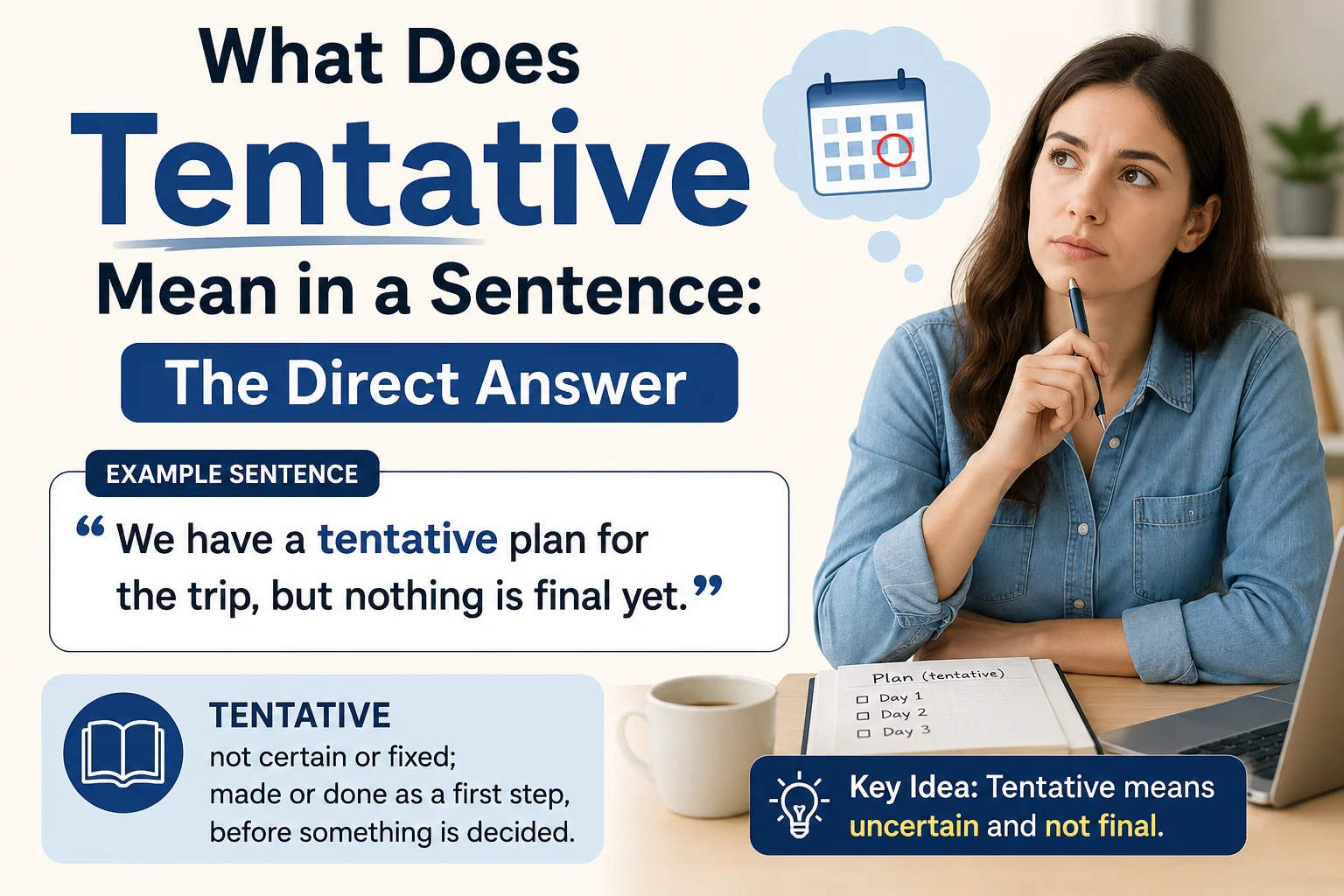
What Does Tentative Mean in a Sentence: The Direct Answer
At its simplest, the answer to what does tentative mean in a sentence is straightforward: it describes something uncertain or not yet confirmed. A “tentative date” is a date that might change. A “tentative agreement” is one that hasn’t been finalized. A “tentative smile” suggests hesitation rather than full confidence.
The word works as an adjective, describing nouns like plans, agreements, schedules, answers, or even emotions and expressions. It always carries a sense of “not quite settled yet,” whether that applies to a calendar event or someone’s tone of voice.
This flexibility is part of why the word shows up so often across such different types of writing. Whether the topic is a business deal, a research paper, or a nervous first date, the underlying answer to what does tentative mean in a sentence stays remarkably consistent.
Origin and Etymology of Tentative
Tentative comes from the Latin word “tentare” (also spelled “temptare”), meaning “to test” or “to try.” This root connects directly to the modern meaning: something tentative is essentially still being tested or tried out, not yet confirmed as final. The word entered English through French, carrying this same sense of trial or attempt.
Because exact historical timelines for word adoption into English are difficult to pin down precisely, the specific century or pathway “tentative” took into common English usage should be treated as a general pattern rather than a firmly documented history. Even without a precise timeline, the Latin root helps explain why what does tentative mean in a sentence today still centers on the idea of something being tried or tested rather than fully settled.
Tentative in a Sentence: Examples Across Contexts
Seeing what does tentative mean in a sentence across different situations helps clarify the word’s flexibility. In scheduling: “We have a tentative meeting time of 3 PM, but it might shift depending on everyone’s availability.” In relationships: “She gave a tentative nod, still unsure whether she agreed.” In business: “The two companies reached a tentative agreement pending final approval from both boards.”
Each of these examples uses “tentative” to signal the same underlying idea — something real and in progress, but not yet locked in. Removing “tentative” from any of these sentences would change the meaning significantly, turning an uncertain plan into a confirmed one. Seeing the word in several different sentence types side by side is often the fastest way to internalize what does tentative mean in a sentence without needing to memorize a formal definition.
Tentative vs. Tentatively vs. Tentativeness
Understanding what does tentative mean in a sentence also means recognizing its related word forms. “Tentative” is the adjective, describing a noun directly: a tentative plan, a tentative offer. “Tentatively” is the adverb form, describing how an action is done: she tentatively agreed, he tentatively reached for the door handle. “Tentativeness” is the less common noun form, referring to the quality or state of being tentative.
Choosing the right form depends on what part of the sentence needs description — a thing or plan, an action, or an abstract quality — but all three forms carry the same core sense of uncertainty or provisional status. Recognizing these related forms rounds out a complete answer to what does tentative mean in a sentence, since the adjective alone doesn’t cover every situation where the underlying idea applies.
Tentative in Business and Scheduling
One of the most common places people encounter this word is in professional scheduling and business communication. A “tentative” meeting, deadline, or agreement signals that something is planned but not yet fully locked in, giving both parties room to adjust if circumstances change. This kind of built-in flexibility is exactly what does tentative mean in a sentence about scheduling, and it’s precisely why the word shows up so often in calendar invites and project planning documents.
Example: “Please treat this invitation as tentative until we confirm the venue next week.” This kind of careful, provisional language is common in professional settings because it manages expectations honestly, without overpromising something that might still shift. It’s a practical, everyday illustration of what does tentative mean in a sentence used specifically to protect trust between colleagues or business partners.
Tentative in Legal and Academic Writing
In legal and academic contexts, “tentative” often appears in phrases like “tentative ruling,” “tentative conclusion,” or “tentative hypothesis.” A tentative ruling, for example, is a preliminary decision a judge shares before a final ruling, often allowing both sides to respond before anything becomes official. This staged process is a clear real-world example of what does tentative mean in a sentence within a formal legal proceeding, where careful, precise language carries real consequences.
In academic writing, researchers frequently describe early findings or conclusions as tentative, signaling that more evidence or testing is needed before treating the claim as settled. This careful, cautious use of the word reflects academic norms around avoiding overstated certainty.
Tentative in Medical and Scientific Contexts
Beyond general academic writing, “tentative” appears frequently in medical and scientific communication specifically. A “tentative diagnosis” is a doctor’s initial, working assessment based on available symptoms and test results, before further testing confirms or rules it out. This use of the word matters enormously in practice, since patients and medical teams need to understand that a tentative diagnosis is a starting point for further investigation, not a final answer. Clear communication about this distinction can meaningfully reduce patient anxiety, since understanding what does tentative mean in a sentence in a medical context helps set realistic expectations during an already stressful situation.
Similarly, in scientific research more broadly, a “tentative result” or “tentative hypothesis” signals that a finding is promising but not yet fully validated through repeated testing or peer review. Understanding what does tentative mean in a sentence in this context is especially important, since mistaking a tentative finding for a confirmed one can lead to real misunderstanding about how settled a piece of scientific knowledge actually is. Science journalism in particular has to navigate this carefully, since translating a tentative result into a confident-sounding headline can mislead readers about how settled the underlying research really is.
Tentative Agreements in Negotiation and Diplomacy
In negotiation, labor relations, and diplomacy, the phrase “tentative agreement” carries specific practical weight. It typically refers to terms both sides have agreed to in principle, pending formal ratification, approval, or a final signing step. Labor unions, for example, often reach a tentative agreement with an employer that still needs to be voted on by union members before becoming official.
This careful, staged process reflects exactly what does tentative mean in a sentence within high-stakes negotiations: real progress has been made, but the outcome isn’t legally binding or final until every required step is complete. Because negotiation and labor law processes vary by country, industry, and organization, specific procedural claims should be verified against current, jurisdiction-specific sources. Journalists covering these negotiations often use “tentative agreement” precisely for this reason, since it accurately communicates meaningful progress without overstating how final the outcome actually is.
What Does Tentative Mean in a Sentence About Emotion or Behavior?
Writers frequently reach for “tentative” when describing a character’s uncertain body language, tone, or decision-making, since the word captures hesitation without requiring lengthy explanation. A “tentative smile,” “tentative step forward,” or “tentative question” efficiently signals a character’s internal uncertainty through action rather than direct narration. This compact technique is a favorite among fiction writers precisely because it answers what does tentative mean in a sentence through action rather than exposition, keeping the prose tight and visual.
This usage highlights a slightly different side of what does tentative mean in a sentence compared to business or legal writing — here, the word describes emotional nuance rather than the formal status of an agreement or plan, giving writers a compact way to show hesitation without slowing down the pacing of a scene. Writing instructors sometimes point to this exact word as a useful example of “showing rather than telling,” since a single well-placed “tentative” can replace an entire sentence of explanation about a character’s inner uncertainty.
How to Communicate Tentative Plans Politely
Because tentative plans involve genuine uncertainty, choosing the right phrasing matters for managing expectations without sounding evasive or unreliable. Phrases like “I’d like to tentatively confirm,” “this is tentative pending final details,” or “let’s pencil this in as tentative for now” all communicate honesty about uncertainty while still showing genuine intent to follow through.
This kind of careful language is especially useful in professional settings, where overpromising a fully confirmed plan that later falls through can damage trust more than being upfront about something still being tentative from the start. Framing uncertainty this way is a practical, relationship-preserving answer to what does tentative mean in a sentence when the stakes involve someone else’s expectations and trust.
Regional and Contextual Differences in Usage
While the core meaning of “tentative” stays consistent across English-speaking regions, the frequency of its use can vary somewhat by context, industry, and even individual writing style. Legal, medical, and academic writing tend to use the word more often and more precisely, while everyday casual conversation might lean on simpler alternatives like “maybe” or “not sure yet” instead.
Because usage frequency and stylistic preference can shift over time and vary by publication, industry, or region, general claims about how commonly the word appears in a specific context should be treated as a broad pattern rather than a precise, measured statistic. Regardless of these stylistic differences, what does tentative mean in a sentence remains essentially unchanged from one professional field to the next — only the frequency of use shifts, not the underlying definition.
Tentative vs. Definite or Confirmed
Comparing “tentative” to its opposite helps sharpen understanding of what does tentative mean in a sentence. A “definite” or “confirmed” plan is locked in and unlikely to change without significant reason. A “tentative” plan, by contrast, is explicitly open to change, adjustment, or cancellation, which is really the heart of what does tentative mean in a sentence whenever it’s paired against its more settled opposite.
This contrast matters in practical communication: describing something as tentative sets different expectations than describing it as confirmed, which is exactly why the distinction matters so much in scheduling, legal writing, and everyday conversation alike. Keeping this contrast in mind is often the quickest way to settle what does tentative mean in a sentence versus its more definite counterpart.
Tentative vs. Similar Words
Several words overlap with “tentative,” but each carries a slightly different shade of meaning. “Uncertain” focuses more on the speaker’s confidence or knowledge, rather than the status of a plan itself. “Provisional” is very close to tentative and often used interchangeably, particularly for arrangements or agreements, making it one of the closest possible answers when someone asks what does tentative mean in a sentence and wants a single-word substitute. “Preliminary” emphasizes an early stage in a process rather than uncertainty specifically. “Hesitant” applies more to a person’s emotional state or manner, such as a hesitant response, rather than the status of a plan or fact.
Understanding these small distinctions helps clarify exactly what does tentative mean in a sentence compared to these closely related alternatives, even though they’re often used somewhat interchangeably in casual speech. Choosing the most precise word among this group can make writing noticeably clearer, especially in professional or academic contexts where precision matters.
Is Tentative a Formal or Casual Word?
Tentative leans slightly formal, showing up more often in professional emails, legal documents, and academic writing than in relaxed texting or slang. Recognizing this tendency is a useful part of a complete answer to what does tentative mean in a sentence, since tone and register matter just as much as dictionary definition when choosing the right word. That said, it’s common enough in everyday speech that most native English speakers use and understand it without any sense that it sounds overly stiff or academic.
It’s less likely to appear in casual social media posts or texting shorthand, simply because there are shorter, more casual alternatives like “maybe” or “not sure yet” that fit that context better. Even so, when it does appear casually, the meaning stays exactly the same as the more formal answer to what does tentative mean in a sentence covered throughout this guide.
Common Misunderstandings About Tentative
One common misunderstanding is assuming “tentative” means the same thing as “unlikely” or “probably not happening.” In reality, a tentative plan is genuinely expected to happen — it’s simply not fully finalized yet, which is a very different meaning from doubt about whether something will occur at all. Clearing up this confusion is often the exact reason someone searches what does tentative mean in a sentence in the first place.
Another misunderstanding treats “tentative” as interchangeable with “temporary.” A temporary arrangement is expected to end or be replaced after a set period, while a tentative arrangement is simply unconfirmed — it could easily become permanent once finalized, unlike something explicitly temporary by design. This is one of the more important distinctions to keep straight when explaining what does tentative mean in a sentence to someone still mixing up the two words.
A third misunderstanding assumes tentative always implies hesitation or nervousness on the part of a person. While “tentative” can describe hesitant behavior, like a tentative smile, it just as often describes the status of a plan or agreement with no emotional component involved at all. Keeping both uses in mind gives a fuller, more accurate picture of what does tentative mean in a sentence across the full range of situations where it naturally appears.
How to Use Tentative Correctly in a Sentence
Because the word can modify plans, agreements, emotions, and even hypotheses, it helps to see a variety of correct sentence structures. As a modifier for plans: “Our tentative itinerary includes three cities, though it may change.” As a modifier for behavior: “He offered a tentative handshake, unsure how the meeting would go.” As a modifier for ideas: “Researchers proposed a tentative explanation for the unusual results.”
In each case, “tentative” sits directly before the noun it describes, functioning like most standard English adjectives, which makes it relatively easy to place correctly once the underlying meaning is clear. Practicing with a few varied sentences like these is often the fastest way to move from simply knowing what does tentative mean in a sentence to actually using it confidently in your own writing.
Tentative in Everyday Conversation
Outside formal writing, people still use “tentative” in everyday speech, especially when discussing plans that depend on other factors. Saying “I have a tentative yes” or “that’s still tentative” communicates cautious optimism without fully committing, which is useful in situations where circumstances might still shift. These small, everyday phrases show just how naturally what does tentative mean in a sentence translates from formal writing into ordinary spoken conversation.
This everyday use doesn’t change the core meaning discussed throughout this guide — it simply shows that what does tentative mean in a sentence applies just as naturally to casual conversation as it does to formal business or legal writing.
Frequently Asked Questions
What does tentative mean in a sentence, simply put?
Tentative means not fully certain or confirmed — something provisional that could still change, whether it’s a plan, agreement, or statement.
Is tentative the same as maybe?
They’re related but not identical. “Maybe” expresses general uncertainty about an outcome, while “tentative” more specifically describes something already planned but not yet finalized.
Can tentative describe a person’s feelings?
Yes. “Tentative” can describe hesitant behavior or emotion, such as a tentative smile or a tentative response, alongside its more common use describing plans or agreements.
Is tentative a positive or negative word?
Neither inherently. It’s a neutral, descriptive word indicating uncertainty or provisional status, without carrying a built-in positive or negative judgment — a nuance worth remembering whenever someone asks what does tentative mean in a sentence and expects a simple good-or-bad answer.
What’s the difference between tentative and temporary?
Tentative means unconfirmed and possibly changeable, while temporary means intentionally short-term or expected to end, even if it’s fully confirmed and certain.
How do you use tentative in a formal email?
Common phrasing includes “This is a tentative confirmation” or “Please treat this schedule as tentative until finalized,” both of which clearly signal that details may still change.
Is tentative used the same way in speech and writing?
Yes, generally. What does tentative mean in a sentence stays consistent whether spoken aloud or written down, though it appears somewhat more often in formal writing than in casual speech.
Can tentative describe a scientific finding?
Yes. A “tentative result” or “tentative hypothesis” signals a promising but not yet fully confirmed finding, common in research and academic writing before further testing or peer review.
Conclusion
What does tentative mean in a sentence ultimately comes down to one clear idea: uncertainty that hasn’t yet been resolved into something fixed or final. Whether describing a meeting time, a hesitant smile, or an early research finding, the word consistently signals the same thing — something real and in motion, but not quite settled yet. Once that core idea clicks, using the word correctly in any sentence becomes far more intuitive than memorizing a formal dictionary definition.