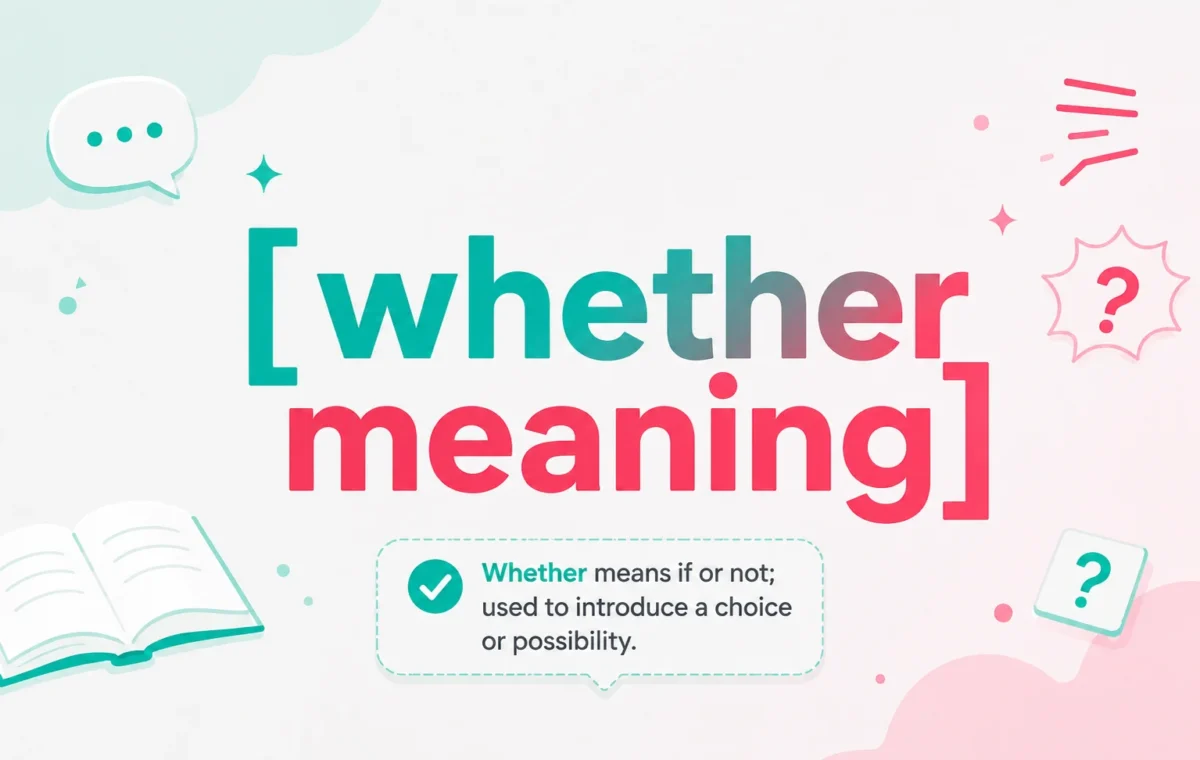
Whether meaning refers to a conjunction used to introduce a choice, doubt, or indirect question between two or more possibilities. It’s most commonly used in sentences like “I don’t know whether she’s coming” or “We debated whether to stay or leave.” Unlike “if,” which can sometimes work interchangeably, “whether” specifically signals a choice between alternatives. This guide covers the word’s grammar, common mix-ups, formal versus casual usage, and plenty of example sentences to make the definition stick. For more insights, read here:- spider lily meaning and skank meaning.
- The Direct Meaning of Whether
- Origin and Etymology of Whether
- Whether vs. If
- Whether in a Sentence: Examples
- Whether vs. Weather
- A Third Homophone: Wether
- Whether in Questions vs. Statements
- Whether Clauses and Formal Grammar
- Whether in British vs. American English
- Whether in Idioms and Fixed Expressions
- Teaching Whether to English Language Learners
- Whether in Poetry and Literary Writing
- How Dictionaries Define Whether
- Whether or Not: When You Need the Extra Words
- Whether in Formal and Academic Writing
- Whether in Legal and Business Writing
- Whether in Everyday Conversation and Texting
- Common Grammar Mistakes with Whether
- Whether vs. Similar Words
- Common Misunderstandings About Whether
- Whether in Programming and Technical Writing
- Why the Whether Meaning Matters for Clear Writing
- How to Use Whether Correctly
- Frequently Asked Questions
- What does whether mean in a sentence?
- Is whether the same as if?
- Why do people confuse whether and weather?
- Is "whether or not" grammatically necessary?
- Is whether a formal word?
- Can whether start a sentence?
- Conclusion
The Direct Meaning of Whether
At its core, the whether meaning centers on presenting options or expressing uncertainty between possibilities. It’s a conjunction, meaning it connects clauses within a sentence, and it typically introduces an indirect question — one embedded inside a larger sentence rather than asked directly.
For example, “Whether it rains or not, we’re going hiking” presents two possible outcomes side by side. This structure is central to understanding the whether meaning: it almost always implies at least two sides of a decision, question, or condition. Even in sentences where only one option is directly stated, an implied second possibility is usually lurking just beneath the surface.
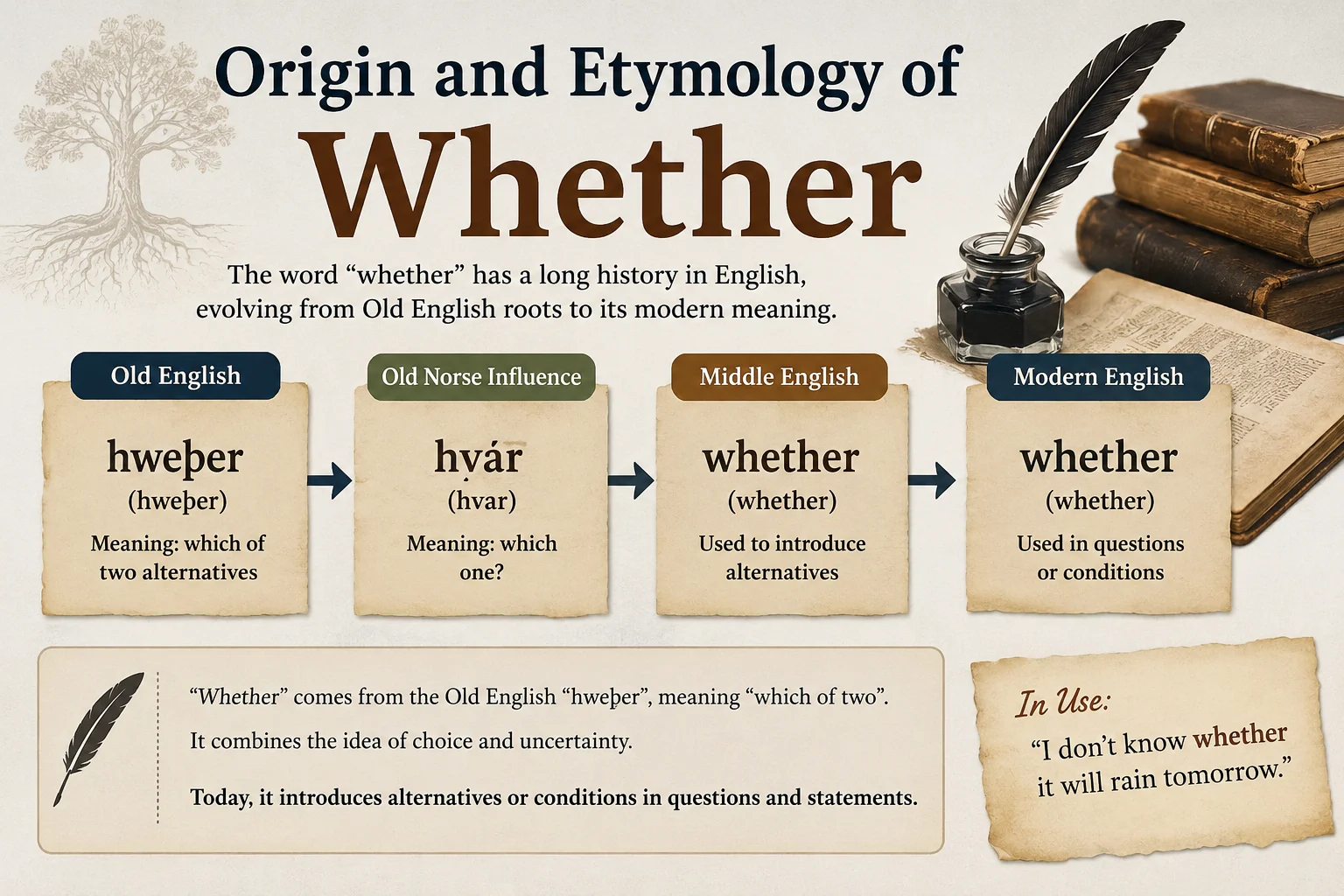
Origin and Etymology of Whether
Whether comes from Old English “hwæther,” itself related to older Germanic roots meaning “which of two.” This origin connects directly to the modern whether meaning, since the word has always centered on choosing or distinguishing between two possibilities, even as the language around it has changed dramatically over the centuries.
Because exact historical timelines for word evolution are difficult to document with total precision, the specific stages “whether” passed through on its way to modern English should be treated as a general linguistic pattern rather than a firmly settled historical record. Even without a precise timeline, the Germanic root helps explain why the whether meaning has stayed so consistently tied to the idea of choosing between two things across so many centuries of use.
Whether vs. If
One of the most common questions tied to the whether meaning involves how it differs from “if.” In many casual sentences, the two words seem interchangeable: “I don’t know if she’s coming” and “I don’t know whether she’s coming” both work naturally. However, “whether” is generally considered more precise when presenting a clear choice between alternatives, especially in formal writing.
“Whether” is required, rather than optional, in certain structures — for example, right before an infinitive: “She wasn’t sure whether to call or wait.” Using “if” in this exact structure (“she wasn’t sure if to call”) sounds noticeably less natural to most English speakers, which is one of the clearest grammatical distinctions tied to the whether meaning. This single rule is often the fastest way to settle a whether-versus-if debate when both options seem to sound acceptable at first glance.
Whether in a Sentence: Examples
Seeing the whether meaning applied across different sentence types helps make the definition concrete. In a question about choice: “He couldn’t decide whether to major in biology or chemistry.” In a statement of doubt: “I’m still not sure whether the plan will work.” In a conditional structure: “Whether you agree or not, the decision has already been made.”
Each of these examples relies on the same underlying idea — presenting two sides of a situation within a single sentence, rather than requiring two separate questions or statements. Practicing with these varied examples is often the fastest way to move from recognizing the whether meaning to actually using the word confidently in original writing.
Whether vs. Weather
A common point of confusion involves “whether” and “weather,” two words that sound identical but have completely unrelated meanings. “Weather” refers to atmospheric conditions like rain, sun, or temperature, while the whether meaning has nothing to do with climate or forecasts at all.
This mix-up is extremely common in casual writing and texting, since the words are pronounced exactly the same in most English dialects. Context almost always makes the intended meaning obvious, but the spelling mistake itself remains one of the most frequently flagged errors in casual and even professional writing.
A Third Homophone: Wether
Adding an extra layer of confusion, there’s actually a third, much rarer homophone: “wether,” referring to a castrated male sheep, a term still used occasionally in farming and agricultural contexts. Unlike the whether meaning or “weather,” this word is uncommon enough that most people never encounter it outside specific agricultural writing, but it technically completes a trio of identical-sounding words with three entirely unrelated meanings.
Because “wether” is rare in general use, confusing it with “whether” is far less common than the whether/weather mix-up, though spellcheckers still won’t catch the error if “wether” happens to be typed by mistake in an unrelated sentence.
Whether in Questions vs. Statements
The whether meaning shifts slightly depending on whether it appears in a direct question or an embedded statement. A direct question might be phrased as “Will she come?” while the same idea embedded within a larger sentence becomes “I wonder whether she will come.” This second form, called an indirect question, is one of the most common homes for “whether” in everyday English.
Recognizing this pattern helps explain why “whether” so often appears in the middle of a sentence rather than at the very beginning — it’s typically introducing a question that’s been folded into a larger, more complex sentence structure rather than standing on its own.
Whether Clauses and Formal Grammar
In more technical grammar terms, “whether” introduces what’s often called a “noun clause” — a clause that functions as the object of a verb, much like a noun would. In “I don’t know whether she’s coming,” the entire clause “whether she’s coming” acts as the object of “know,” similar to how a simple noun like “the answer” might function in a shorter sentence.
This grammatical role is part of why the whether meaning is so central to expressing uncertainty or presenting options within complex sentences, rather than functioning as a simple standalone word with an isolated definition.
Whether in British vs. American English
While the core whether meaning remains consistent across major English dialects, some subtle stylistic preferences differ between British and American writing conventions, particularly around when writers choose “whether” over “if” in formal contexts. Some style guides on both sides of the Atlantic recommend “whether” specifically for formal writing and “if” for more casual contexts, though individual preferences and house styles vary considerably.
Because specific regional usage patterns and style guide recommendations can vary and change over time, general claims about British versus American preferences should be treated as broad tendencies rather than strict, universal rules.
Whether in Idioms and Fixed Expressions
A few fixed expressions build directly on the whether meaning, most notably the somewhat archaic phrase “whether or no,” an older variant of “whether or not” that still occasionally appears in older literature or deliberately old-fashioned writing style. While rarely used in modern conversation, encountering this phrase in classic literature can confuse readers unfamiliar with this now-uncommon variation.
More common in modern usage is the phrase “come what may, whether we like it or not,” which leans on the word to emphasize inevitability regardless of preference or circumstance, extending the core whether meaning into a broader statement about accepting an outcome.
Teaching Whether to English Language Learners
For English language learners, the whether meaning can be genuinely tricky to master, particularly the specific situations where “whether” is required rather than optional, such as directly before an infinitive. Teachers often emphasize the “either/or” quality of the word, encouraging students to think of “whether” as always implying at least two sides of a situation, even when the second side isn’t explicitly stated.
Practice exercises that pair “whether” with clear either/or choices — like “whether to walk or drive” — tend to help learners internalize the pattern faster than memorizing abstract grammar rules alone, since the concrete examples reinforce exactly how the whether meaning functions inside a real sentence.
Whether in Poetry and Literary Writing
Beyond ordinary prose, “whether” appears frequently in poetry and literary writing, often used to weigh two possibilities against each other in a reflective or philosophical tone. Classic literary questions structured around choice — weighing one path against another — frequently lean on this exact word to hold both options in tension within a single line or sentence.
This literary use draws on the same core whether meaning found in everyday speech, but often with added weight and deliberation, since literary writing tends to slow down and dwell on a decision rather than resolving it quickly the way casual conversation typically does.
How Dictionaries Define Whether
Most standard dictionaries define “whether” as a conjunction used to introduce indirect questions or to express doubt between alternatives, closely matching the everyday whether meaning covered throughout this guide. Dictionary entries typically also note its use before infinitives and its function introducing noun clauses, reflecting the grammatical patterns discussed here.
Because dictionary definitions can vary slightly in wording and depth between publishers, specific dictionary language should be checked against a current, reputable source if an exact quoted definition is needed for academic or editorial purposes.
Whether or Not: When You Need the Extra Words
Many people wonder if “whether or not” is redundant compared to simply using “whether” alone. In most cases, “or not” can be dropped without changing the meaning: “I don’t know whether it will rain” already implies the alternative possibility. However, “whether or not” is sometimes used deliberately for emphasis, particularly in spoken English, to stress that a decision or outcome applies regardless of the alternative.
Understanding this nuance rounds out the whether meaning beyond a simple dictionary definition, since native speakers often make stylistic, rather than strictly grammatical, choices between the shorter and longer versions. Editors and writing teachers frequently encourage trimming “or not” simply for concision, unless the emphasis genuinely serves the sentence.
Whether in Formal and Academic Writing
In academic and formal writing, the whether meaning tends to appear specifically in structured, careful sentences discussing hypotheses, research questions, or policy considerations. Phrases like “the study examined whether X influences Y” or “the committee will determine whether the proposal meets requirements” reflect this more formal, structured use.
This formal usage tends to favor “whether” over “if” specifically because it reads as more precise and less conversational, which matters in academic and professional writing where clarity and formality are valued. Reviewers and editors in these fields often flag “if” as slightly too casual whenever the whether meaning is clearly what the writer intended.
Whether in Legal and Business Writing
Legal and business documents also rely heavily on the whether meaning, particularly when outlining conditions, contingencies, or decision points. Contracts frequently use structures like “regardless of whether the buyer completes the inspection” to explicitly cover multiple possible scenarios within a single clause.
This precise, conditional language helps prevent ambiguity in legally binding documents, where leaving out a clear “whether” clause could create confusion about which conditions actually apply in different circumstances. Legal writing guides frequently cite the whether meaning as a useful tool precisely because of this built-in precision.
Whether in Everyday Conversation and Texting
Outside formal writing, the whether meaning still shows up regularly in everyday conversation, even if “if” often replaces it in more casual contexts. In texting specifically, “whether” appears less often than “if,” simply because “if” is shorter and feels more casual for quick, informal messages.
That said, “whether” isn’t considered old-fashioned or overly formal in spoken English — it’s simply one of several natural options speakers reach for, often without consciously choosing between “if” and “whether” at all. Native speakers generally absorb the whether meaning intuitively through years of exposure, long before ever learning the formal grammar rules behind it.
Common Grammar Mistakes with Whether
One frequent mistake involves pairing “whether” with “or” incorrectly, such as writing “whether or if” instead of simply “whether… or.” Another common error is confusing “whether” with “weather” in writing, which spellcheckers don’t always catch since both are correctly spelled words, just with different meanings.
A third common mistake involves overusing “whether or not” in situations where the simpler “whether” alone communicates the same idea more efficiently. While not grammatically incorrect, editors often flag this as unnecessary wordiness in formal or professional writing, especially when a tighter grasp of the whether meaning would make the trim feel obvious.
Whether vs. Similar Words
Several words overlap conceptually with the whether meaning, though each carries a distinct function. “If” often works similarly in casual speech but is generally considered less precise for presenting a clear choice between alternatives. “Unless” introduces a specific exception or condition rather than a general choice between possibilities. “In case” focuses on precaution against a possible future event, rather than presenting parallel alternatives the way “whether” does.
Understanding these small distinctions helps writers choose the most precise word for their intended meaning, particularly in formal or technical writing where precision genuinely matters. Comparing the whether meaning directly against these near-synonyms is often the clearest way to see exactly what makes “whether” distinct.
Common Misunderstandings About Whether
One common misunderstanding is assuming “whether” and “if” are always fully interchangeable. While they overlap significantly in casual speech, certain formal and grammatical contexts specifically call for “whether,” particularly before an infinitive or when presenting a clear either/or choice. This is one of the most useful distinctions to internalize once the whether meaning starts to feel intuitive rather than something to look up each time.
Another misunderstanding involves assuming “whether or not” is always necessary for the sentence to make sense. In the vast majority of cases, plain “whether” alone communicates the same complete meaning, with “or not” simply adding emphasis rather than essential information.
A third misunderstanding treats the whether/weather mix-up as a sign of poor language skills generally, when in reality it’s simply a common homophone error that even experienced writers occasionally make, especially when typing quickly. Recognizing the whether meaning at a glance tends to get easier with exposure, even for writers who once mixed up the two words regularly.
Whether in Programming and Technical Writing
Interestingly, the whether meaning also shows up in technical and programming contexts, particularly in code comments, documentation, and technical specifications where developers describe conditional logic in plain English before writing the actual code. A comment like “check whether the user is logged in before loading the page” translates a programming condition into natural language, relying on the same core sense of choice between two states — logged in or not — that defines the word everywhere else.
This technical use doesn’t require any special grammatical treatment; it simply borrows the everyday whether meaning to describe binary conditions, which happen to map naturally onto how many programming decisions work under the hood. Developers writing documentation for non-technical audiences often lean on this word specifically because it reads clearly to people without a programming background, unlike more technical conditional language.
Why the Whether Meaning Matters for Clear Writing
Beyond grammar rules, understanding the whether meaning well genuinely improves everyday writing clarity. Choosing “whether” deliberately, rather than defaulting to “if” out of habit, can make sentences read more precisely, particularly when a genuine either/or choice is being described rather than a simple conditional statement.
This kind of small, careful word choice rarely gets noticed by readers when done well, but sloppy or inconsistent use tends to create just enough friction to slow a reader down, even if they can’t immediately articulate why a sentence feels slightly off. Mastering a word this common pays off across nearly every kind of writing, from casual emails to formal reports, and it’s a small investment of attention that compounds over years of everyday communication.
How to Use Whether Correctly
Because “whether” functions in several slightly different sentence structures, it helps to see a range of correct examples together. Before an infinitive: “She hasn’t decided whether to accept the offer.” Introducing an indirect question: “He asked whether the meeting had been rescheduled.” Presenting parallel alternatives: “Whether by car or by train, we’ll arrive around the same time.”
Practicing with a variety of sentence types like these tends to be far more effective for mastering the whether meaning than memorizing a single dictionary definition in isolation.
Frequently Asked Questions
What does whether mean in a sentence?
The whether meaning is a conjunction introducing a choice, doubt, or indirect question between two or more possibilities, similar in some contexts to “if.”
Is whether the same as if?
Not always. They overlap in casual speech, but “whether” is generally more precise for presenting clear alternatives and is required before an infinitive.
Why do people confuse whether and weather?
Because the two words are pronounced identically in most English dialects, despite having completely unrelated meanings — one relates to choice, the other to climate conditions.
Is “whether or not” grammatically necessary?
Usually not. In most sentences, plain “whether” alone communicates the same meaning, with “or not” mainly adding emphasis rather than essential grammatical information.
Is whether a formal word?
It’s slightly more formal than “if” in casual conversation, though it’s still completely natural and common in everyday spoken and written English.
Can whether start a sentence?
Yes. “Whether” commonly starts a sentence when presenting parallel alternatives, as in “Whether you agree or not, the decision stands.”
Conclusion
The whether meaning ultimately centers on one clear idea: choice between two or more possibilities, expressed within a single, connected sentence. Whether describing doubt, presenting alternatives, or setting up a formal condition, the word consistently signals that more than one outcome or option is genuinely on the table.