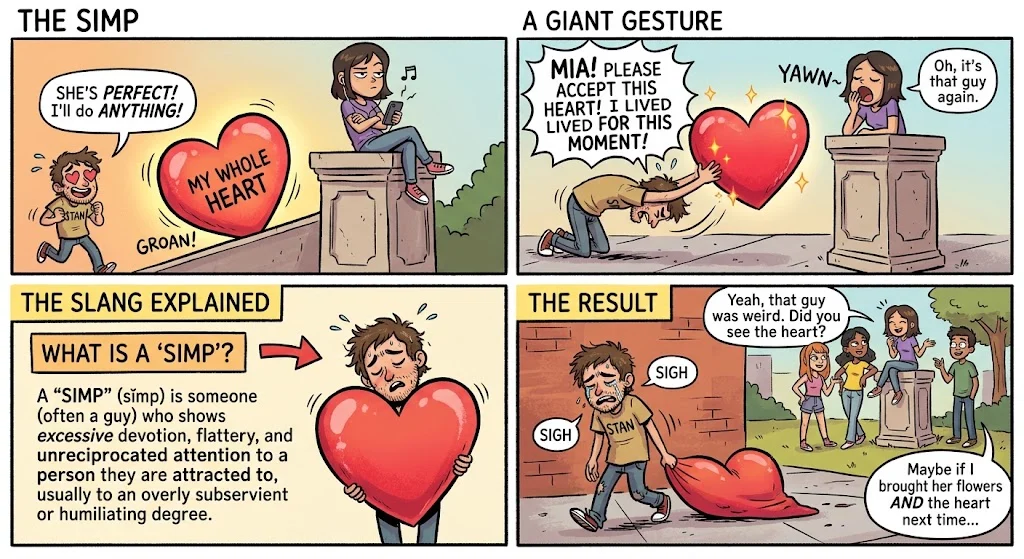
If you searched for simp meaning slang explained funny, the short answer is this: a simp is someone who is seen as giving excessive attention, effort, money, or praise to a person they’re attracted to, often without getting much in return. The word is usually teasing, but it can also be insulting or self-deprecating.
- Quick Answer
- What does simp mean in slang?
- Is a simp always a bad thing?
- Where did the word simp come from?
- Simp meaning slang explained funny with everyday examples
- Simping vs. genuine affection
- When is calling someone a simp funny?
- When should you avoid the word?
- Formal vs. informal: when to use which
- Common phrases with simp
- “Simp for someone”
- “Simping”
- “Simp behavior”
- “Simp era”
- Common mistakes to avoid
- Similar words and how they differ
- Simp meaning slang explained funny: a quick cheat-sheet
- Is simp an insult?
- Why does simp appear so often online?
- Frequently Asked Questions
- What does simp mean in slang?
- Is being a simp bad?
- Is simp a swear word?
- Can you use simp for a woman?
- What is simping on social media?
- What is the opposite of a simp?
- Can simp be used positively?
- Is simp appropriate in formal English?
- Why People Call Someone a Simp
- The exaggeration is part of the humor
- Simp vs. Nice Person: What's the Difference?
- What Does Simping Look Like Online?
- Simp, Simping, and Simped: The Grammar
- Simp as a noun
- Simp as a verb
- Simping as a present participle
- Simped as a past form
- Funny Examples You Might See in a Chat
- What Does “Simp for” Mean?
- Is Simp the Same as Desperate?
- Is Simp the Same as Simpatico?
- Can You Call Yourself a Simp?
- How Tone Changes the Meaning
- A Better Way to Understand the Slang
- Related Internet Slang
- Quick Memory Trick
- Common Misconceptions About Simp
- “Every romantic person is a simp.”
- “Simp always means loser.”
- “Only men can be simps.”
- “Simp is always romantic.”
- “You should never use the word.”
- Simp meaning slang explained funny in real conversations
- When the joke works
- When the word becomes unfair
- Simp vs. respectful romance
- How the expression works in memes
- Is simping always romantic?
- How Gen Z and younger internet users use it
- Tone matters more than the word itself
- Better alternatives in formal English
- Common mistakes learners make
- A simple test before you use it
- Quick comparison
- Can you use simp at work?
- Can parents and teachers use the word?
- A Final Meaning Check
- Final Thoughts
That matters because calling your friend a simp after he buys his crush coffee can be a harmless joke; using the label to shame someone for being genuinely kind is a different thing.more clicks:-hucow or abuela .
Quick Answer
| Term | Meaning | Example |
|---|---|---|
| Simp | Someone portrayed as overly devoted to a romantic interest | “Bro became a simp after one compliment.” |
| Simping | Acting in an excessively devoted or admiring way | “He’s simping hard in the comments.” |
| Simp for | To openly show strong admiration for someone | “She simps for that actor.” |
| Simp behavior | Actions that people jokingly describe as excessive devotion | “Buying five gifts on the first date is simp behavior.” |
What does simp mean in slang?
The simplest simp meaning slang explained funny version is: you’re trying way too hard for someone you like.
Imagine this scene: someone gets one “hey 😊” text from their crush and immediately writes a three-page love poem, orders their favorite dessert, changes their phone wallpaper, and says, “Honestly, I’d fight a bear for them.” A friend might laugh and say, “You’re such a simp.”
The humor comes from exaggeration. The label suggests that the person has lost a little common sense because attraction has taken over.
Still, the term doesn’t automatically mean someone is weak, foolish, or desperate. Context decides how harsh it sounds.
Is a simp always a bad thing?
No. The word can describe anything from playful admiration to unhealthy one-sided devotion.
Someone might jokingly call themselves a simp because they adore their partner. In another conversation, the same word could criticize someone for constantly giving money or attention to a person who takes advantage of them.
The stereotype usually involves excessive or unbalanced effort.
Where did the word simp come from?
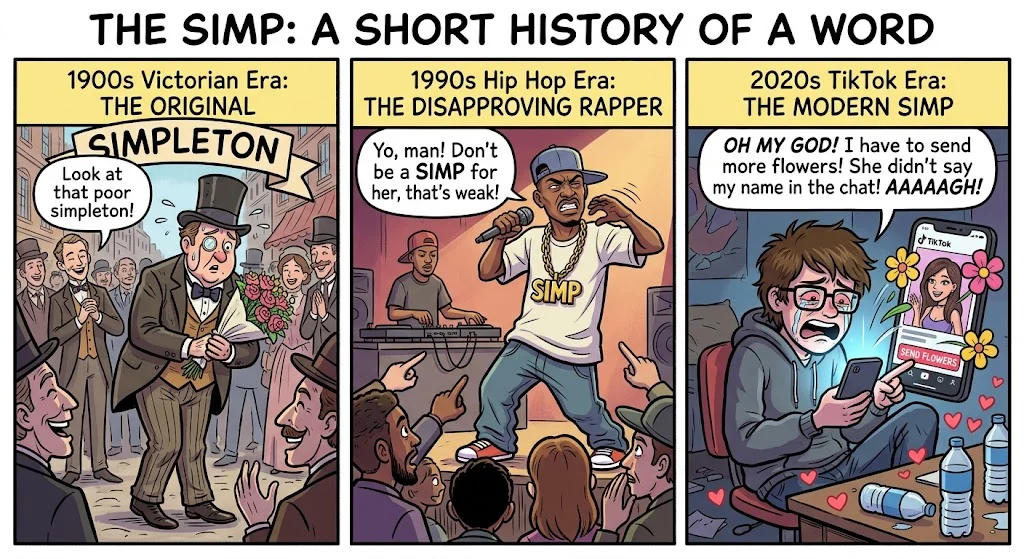
The modern slang term is commonly understood as a shortened form related to simpleton, a word for a foolish or naive person. Its history is older than social media, although its current internet meaning developed through later slang and online culture.
Today, the term is strongly associated with online discussions about dating, attraction, fandom, and exaggerated devotion.
Simp meaning slang explained funny with everyday examples
Here are some harmless examples that show the joke without treating normal kindness as embarrassing:
- “He remembered her coffee order after one date. The group chat called him a simp.”
- “She bought the last concert ticket for her boyfriend and joked, ‘My simp era continues.’”
- “He comments heart emojis under every post. His friends keep calling him a simp.”
- “I’m a simp for good food, not just celebrities.”
That last example shows an important twist: people often use simp for playfully with things they simply love.
For example, someone might say, “I simp for old movies,” meaning they have an unusually strong fondness for them. In that context, there’s no romantic target at all.
For readers, simp meaning slang explained funny needs context first.
A simp meaning slang explained funny guide highlights exaggeration.
Think of simp meaning slang explained funny as playful social shorthand.
The phrase simp meaning slang explained funny often signals teasing.
Searchers use simp meaning slang explained funny to understand online jokes.
A simp meaning slang explained funny explanation should mention tone.
In chats, simp meaning slang explained funny may sound affectionate.
Sometimes simp meaning slang explained funny can sound openly insulting.
A simp meaning slang explained funny example often involves excessive effort.
Another simp meaning slang explained funny example involves constant praise.
The phrase simp meaning slang explained funny can be self-deprecating.
For learners, simp meaning slang explained funny shows slang nuance.
The idea behind simp meaning slang explained funny is exaggerated devotion.
A simp meaning slang explained funny reading shouldn’t shame kindness.
Good simp meaning slang explained funny examples separate care from excess.
The best simp meaning slang explained funny explanation stays neutral.
Use simp meaning slang explained funny only in casual contexts.
Remember simp meaning slang explained funny is not formal vocabulary.
A simp meaning slang explained funny joke depends on shared context.
Ultimately, simp meaning slang explained funny is about comic exaggeration.
Simping vs. genuine affection
This is where the slang gets interesting. Affection means showing care, warmth, or love. Simping carries an extra suggestion of excessive, embarrassing, or one-sided devotion.
| Genuine affection | “Simping” stereotype |
| Balanced effort | One-sided effort |
| Respectful admiration | Excessive praise |
| Healthy boundaries | Ignoring boundaries |
| Both people contribute | One person keeps chasing |
| Care without self-erasure | Giving up too much for approval |
So, buying your partner flowers isn’t automatically simp behavior. Buying flowers every day because you’re terrified they’ll leave, while they never show any care back, fits the stereotype much better.
When is calling someone a simp funny?
The phrase works best when everyone understands that it’s a joke.
It can be funny among friends when the situation is obviously exaggerated: “You waited three hours just to say hi? Certified simp.”
Self-directed humor can also make it softer: “I’m absolutely simping over this fictional character.”
The word becomes less playful when it targets someone’s real vulnerability, relationship status, sexuality, appearance, or financial situation. A joke stops being funny when the person being labeled clearly doesn’t enjoy it.
When should you avoid the word?
Avoid it when:
- You’re talking to someone who may take the label personally.
- You’re criticizing a serious relationship problem.
- The person is being manipulated or exploited.
- You’re using it to shame ordinary kindness.
- The setting is professional or formal.
In a workplace email, “simp” is almost never the right choice. In a casual group chat, it may fit perfectly.
Formal vs. informal: when to use which
Simp is informal internet and conversational slang. It belongs naturally in texts, memes, social posts, gaming chats, and casual conversations.
For formal writing, use a more precise description:
- overly devoted
- excessively admiring
- desperate for approval
- one-sidedly attentive
- emotionally overinvested
For example, instead of writing, “He is a simp for his manager,” a professional report might say, “He appears unusually eager to gain his manager’s approval.”
That difference is important for English learners: knowing a word also means knowing where it belongs.
Common phrases with simp
The term appears in several common constructions.
“Simp for someone”
This means showing exaggerated admiration or devotion toward a particular person.
Example: “He totally simps for that singer.”
“Simping”
This refers to the behavior itself.
Example: “Stop simping in the comments.”
“Simp behavior”
This labels an action as stereotypically over-devoted.
Example: “You made a whole playlist for someone you met yesterday? That’s simp behavior.”
“Simp era”
This is usually playful and self-aware. Someone may say they’re entering their “simp era” after developing a big crush.
Common mistakes to avoid
One common mistake is assuming that simp simply means “someone who likes another person.” That’s too broad.
Another is treating every act of kindness as evidence of simping. Healthy generosity, loyalty, and affection don’t automatically fit the slang.
A third mistake is assuming the word always has exactly the same force. Tone can change it from affectionate teasing to a serious insult.
And don’t assume the word is appropriate everywhere. Slang is highly context-dependent.
Similar words and how they differ
There isn’t one perfect synonym because the term combines several ideas.
- Admirer — neutral; someone who likes or respects another person.
- Fanboy/fangirl — often describes enthusiastic fandom rather than romantic devotion.
- Devotee — stronger and more serious; not necessarily insulting.
- People-pleaser — someone who tries hard to satisfy others, not necessarily a romantic interest.
- Desperate — emphasizes urgency or insecurity, but lacks the specific slang sense.
- Lovesick — focuses on strong romantic emotion rather than excessive behavior.
- Obsessed — much stronger and potentially serious; don’t use it casually as a direct synonym.
So if you want a neutral description, admirer is usually safer. If you want the humorous internet flavor, the slang term carries more attitude.
Simp meaning slang explained funny: a quick cheat-sheet
Remember it this way:
Like someone → normal.
Really like someone → still normal.
Make them your entire personality → friends may start joking.
Ignore your own boundaries just to impress them → the stereotype gets stronger.
The funny part isn’t love itself. It’s the exaggerated imbalance.
Is simp an insult?
It can be. The word is often used as a mild insult, but its force depends heavily on tone and relationship.
Among close friends, “simp” may mean little more than “you have a huge crush.” Online, it can be used more aggressively to mock someone for perceived weakness or excessive devotion.
That’s why context matters more than the dictionary-style definition.
Why does simp appear so often online?
Internet slang spreads quickly because short, memorable words work well in comments, memes, livestream chats, and gaming communities. The term is especially useful because it packs a whole stereotype into four letters: someone is supposedly overinvesting in another person’s attention.
People also use it ironically. A person might call themselves a simp precisely because they know they’re being dramatic.
Frequently Asked Questions
What does simp mean in slang?
It usually refers to someone who is perceived as excessively devoted, attentive, or eager to please a person they’re attracted to. It can be teasing, humorous, or insulting depending on context.
Is being a simp bad?
Not necessarily. The slang often exaggerates normal admiration, and being caring or romantic isn’t inherently negative. The concern is usually excessive, one-sided, or self-disrespecting behavior.
Is simp a swear word?
No. It isn’t generally classified as a swear word, but it can still be insulting. The social effect depends on how and why it’s used.
Can you use simp for a woman?
Yes. The term isn’t restricted to men. People use it for anyone they think is showing exaggerated devotion or admiration.
What is simping on social media?
It usually means repeatedly praising, defending, complimenting, donating to, or otherwise seeking attention from someone in an exaggerated way. Sometimes it’s serious; often it’s simply meme language.
What is the opposite of a simp?
There isn’t one exact antonym. Depending on the intended contrast, phrases such as self-assured, independent, emotionally balanced, or unbothered may work.
Can simp be used positively?
Yes. Someone might proudly say, “I’m a simp for my partner,” meaning they adore that person and aren’t embarrassed about it. In that use, the term is affectionate and humorous rather than hostile.
Is simp appropriate in formal English?
Usually not. It’s casual slang, so formal writing should use clearer terms such as “overly devoted,” “excessively attentive,” or “eager for approval.”
Why People Call Someone a Simp
The slang term usually appears when someone’s behavior seems far more devoted than the situation requires. Imagine a person meeting someone attractive and immediately offering to carry every bag, agreeing with every opinion, replying within half a second, and writing dramatic comments under every photo. Their friends might laugh and say, “Bro, you’re simping.”
The joke is built around overreaction. The person isn’t simply interested; they’re portrayed as doing almost anything for attention or approval.
That’s why the term often appears in memes, gaming communities, TikTok comments, livestream chats, and casual group conversations.
The exaggeration is part of the humor
Online slang often works by making an ordinary situation sound dramatically serious.
For example:
“She said she liked my playlist, so I made her three more.”
A friend might respond:
“Certified simp behavior.”
The comment doesn’t necessarily mean the person has done anything wrong. It may simply tease them for being enthusiastic.
Simp vs. Nice Person: What’s the Difference?
This distinction is important because the slang can be misused.
Being kind, generous, romantic, or supportive doesn’t automatically make someone a simp. A person can treat their partner beautifully while still maintaining self-respect and healthy boundaries.
The stereotype becomes stronger when someone’s actions appear one-sided or excessive.
| Situation | Likely interpretation |
|---|---|
| Buying your partner a birthday gift | Normal affection |
| Complimenting someone you like | Normal flirting |
| Always agreeing because you’re afraid they’ll leave | Possible people-pleasing |
| Spending money you can’t afford to impress a crush | Could be called simping |
| Constantly chasing someone who shows no interest | More likely to receive the label |
| Supporting your partner during a difficult time | Healthy care |
So, don’t use the term as a shortcut for “nice person.” That’s not what it means.
What Does Simping Look Like Online?
Social media has given the expression plenty of opportunities to appear.
Someone might be called a simp for:
- Leaving extremely enthusiastic comments under someone’s posts.
- Defending a celebrity against every criticism.
- Sending excessive gifts or donations to an online creator.
- Constantly praising someone who barely responds.
- Turning every conversation back to their crush.
- Posting dramatic messages about how perfect someone is.
- Pretending not to notice obvious rejection.
Again, these examples describe the stereotype, not a rule about someone’s actual character.
A person can also use the label jokingly. Someone might comment, “I’m simping, I know,” simply because they think a celebrity looks great in a new movie.
Simp, Simping, and Simped: The Grammar
Although the expression began as slang, it behaves fairly normally in casual English.
Simp as a noun
A simp is the person being described.
Example:
“Everyone knows he’s a simp for his girlfriend.”
Simp as a verb
To simp means to behave in the exaggerated way associated with the slang.
Example:
“Why are you simping over a fictional character?”
Simping as a present participle
Simping describes the action or ongoing behavior.
Example:
“He’s been simping in her comments all morning.”
Simped as a past form
Simped can describe something that happened previously.
Example:
“I totally simped over that actor when I was younger.”
These forms are informal and should generally stay in casual speech and writing.
Funny Examples You Might See in a Chat
The humor becomes easier to understand when you see how naturally the term appears in conversation.
Friend 1: “She remembered my favorite snack.”
Friend 2: “It’s over. You’re a simp now.”
Or:
Friend 1: “I drove forty minutes to bring her coffee.”
Friend 2: “Forty minutes? That’s advanced-level simping.”
Another:
Friend 1: “I watched the whole series because my crush recommended it.”
Friend 2: “You didn’t watch a show. You entered your simp era.”
These jokes usually aren’t intended as serious judgments. They’re playful ways of pointing out that someone’s crush has become obvious.
What Does “Simp for” Mean?
Simp for is a common construction meaning to have an unusually strong admiration for someone or something.
For example:
- “I simp for that character.”
- “He really simps for his favorite singer.”
- “She simps for vintage cars.”
The expression can be romantic, but it doesn’t have to be. People frequently use it as exaggerated fandom language.
That makes simp for broader than the stereotype of someone desperately chasing a crush.
Is Simp the Same as Desperate?
Not exactly.
Desperate describes someone who urgently wants something and may be willing to behave irrationally to get it. Simp specifically carries the internet-slang idea of excessive admiration or devotion, often toward someone attractive.
Compare these:
- “He’s desperate to get the job.” → strong desire for employment.
- “He’s simping for his crush.” → exaggerated romantic admiration.
- “She’s desperate for attention.” → urgent desire to be noticed.
- “She’s simping for that celebrity.” → playful or critical admiration.
The words overlap sometimes, but they aren’t interchangeable.
Is Simp the Same as Simpatico?
No. They simply look somewhat similar.
Simp is internet slang associated with exaggerated devotion.
Simpatico is a completely different word meaning agreeable, compatible, or likable. Confusing the two would change the meaning entirely.
This is a useful reminder for English learners: similar-looking words aren’t necessarily related.
Can You Call Yourself a Simp?
Absolutely. In fact, self-labeling can make the expression sound less hostile.
Someone might say:
“I’m a huge simp for this band.”
They’re probably not making a serious confession. They’re exaggerating their enthusiasm for comic effect.
Self-deprecating use also communicates awareness: the speaker knows they’re being dramatic and is laughing at themselves.
How Tone Changes the Meaning
The same sentence can feel completely different depending on delivery.
Playful:
“Look at you simping again 😂”
Affectionate:
“I’ll admit it. I’m a simp for my wife.”
Critical:
“Stop simping for someone who clearly doesn’t respect you.”
Hostile:
“Only a simp would do that.”
The dictionary-style meaning stays broadly similar, but the social meaning changes. Emojis, punctuation, friendship, context, and tone all help listeners understand the intention.
A Better Way to Understand the Slang
Instead of memorizing one rigid definition, remember three ideas:
- Attraction — someone likes or admires another person.
- Excess — the attention seems unusually intense.
- Imbalance — the effort may appear one-sided or aimed at gaining approval.
When all three are present, the slang fits particularly well.
If only attraction is present, calling someone a simp may simply be unnecessary.
Related Internet Slang
If you’re learning modern online English, several terms often appear alongside this one.
- Crush — someone you’re romantically attracted to.
- Rizz — slang associated with romantic charm or the ability to attract someone.
- Thirsty — excessively eager for attention, attraction, or sexual interest.
- Stan — an extremely devoted fan, often of a celebrity or performer.
- Fanboy — someone who shows intense enthusiasm for a person, product, or fandom.
- Down bad — humorous slang for being strongly affected by attraction or desire.
These words overlap, but each has its own flavor. Stan, for example, is primarily about intense fandom, while simp usually focuses on excessive attention or devotion toward a particular person.
Quick Memory Trick
Here’s an easy way to remember it:
Simp = “I like you” turned up way too loud.
Normal:
“I really like her.”
Playful exaggeration:
“I’d cancel my plans, cross the ocean, and fight a dragon for her.”
Friend:
“Bro… you’re simping.”
That’s the basic joke.
Common Misconceptions About Simp
“Every romantic person is a simp.”
False. Romance and kindness aren’t inherently excessive.
“Simp always means loser.”
Not necessarily. It can be insulting, but many people use it jokingly or affectionately.
“Only men can be simps.”
No. The slang can describe anyone.
“Simp is always romantic.”
Not always. People often say they “simp for” fictional characters, celebrities, foods, games, music, or other things they love.
“You should never use the word.”
That’s too strict. It’s perfectly understandable in casual internet English, but formal situations call for more precise language.
How to Use Simp Naturally in Modern English
If you understand simp meaning slang explained funny, you can usually understand the joke when it appears in a text, meme, or comment. The tricky part is knowing when the label sounds playful and when it sounds rude. This section focuses on practical usage, tone, and examples so you can recognize the expression without accidentally using it in the wrong situation.
Simp meaning slang explained funny in real conversations
The phrase simp meaning slang explained funny points to a casual internet expression built around exaggerated admiration. A speaker may use it after noticing that someone is doing far more than usual to impress a crush, celebrity, partner, or favorite character.
For example, a friend might spend an entire evening helping someone prepare for an event. If the friend has a crush on that person, another friend may jokingly say, “Bro is simping again.”
The important word here is jokingly. The comment doesn’t automatically prove that the person is desperate or foolish. It may simply be friendly teasing.
When the joke works
A good use of simp meaning slang explained funny usually has an obvious exaggeration behind it. The audience can see why the behavior is being teased.
Consider these examples:
- “He learned her favorite song just because she mentioned it once. Bro is a simp.”
- “She bought matching phone cases after their second date. Her friends called it simp behavior.”
- “I watched twelve episodes because my crush said the show was good. I’m simping, apparently.”
- “He wrote a whole paragraph under her selfie. The group chat wasn’t going to let that slide.”
Each example has a comic element. The people involved aren’t necessarily doing anything harmful.
When the word becomes unfair
A major point in simp meaning slang explained funny is that kindness shouldn’t automatically be treated as weakness.
Buying flowers for your partner isn’t proof of simping. Remembering someone’s birthday isn’t proof either. Neither is helping a friend, paying for dinner, or giving someone a sincere compliment.
The label becomes more fitting when the situation appears excessive, one-sided, or driven by a need for approval.
For example:
“He keeps lending money to someone who never pays him back because he hopes she’ll like him.”
That situation has more of the imbalance associated with the slang.
Simp vs. respectful romance
Understanding simp meaning slang explained funny also means separating internet jokes from healthy relationships.
A respectful relationship can include:
- affection
- compliments
- gifts
- emotional support
- thoughtful surprises
- loyalty
- generosity
None of those automatically equals simping.
The slang stereotype usually adds another ingredient: loss of balance.
Someone might lovingly support their partner while still having their own interests, boundaries, friends, and opinions. That’s different from changing everything about yourself simply to earn another person’s approval.
How the expression works in memes
Online humor often makes the term more dramatic than it would be in ordinary conversation. A meme might show someone performing an absurdly elaborate favor and caption it “average simp.”
This is where simp meaning slang explained funny becomes especially useful for language learners. The literal picture may not be serious at all. The humor comes from exaggerating a recognizable social situation.
You’ll often see related phrases such as:
- “simp alert”
- “certified simp”
- “simp behavior”
- “simping hard”
- “entered my simp era”
- “down bad”
These expressions are casual and often intentionally dramatic.
Is simping always romantic?
No. A person can say they “simp for” a fictional character, singer, athlete, food, game, or even a particular brand.
For example:
“I simp for spicy noodles.”
Nobody is necessarily making a romantic statement about noodles. The speaker is exaggerating how much they love them.
This broader use makes simp meaning slang explained funny more flexible than a strict romantic definition might suggest.
How Gen Z and younger internet users use it
Online slang changes quickly, and not everyone uses a term in exactly the same way. Still, simp meaning slang explained funny commonly appears in social posts, comments, gaming chats, memes, and informal conversations.
You may see the word used sincerely, ironically, or as self-mockery.
A person might write:
“I know I’m simping, but that performance was incredible.”
Here, the speaker is openly acknowledging their exaggerated enthusiasm. The phrase can sound humorous because the person is in on the joke.
Tone matters more than the word itself
The same expression can be friendly in one situation and insulting in another.
Friendly: “You’re such a simp 😂.”
Playful: “Simping again, I see.”
Critical: “You’re doing way too much for someone who barely talks to you.”
Insulting: “Only a simp would do that.”
The first two may be harmless among close friends. The final example is much harsher.
That is why simp meaning slang explained funny shouldn’t be learned as a simple dictionary definition. You also need to understand the speaker’s intention.
Better alternatives in formal English
Because the term is slang, avoid it in academic papers, business reports, formal emails, and professional presentations.
Depending on what you actually mean, choose a more precise phrase:
| Casual slang | More neutral alternative |
|---|---|
| simp | overly devoted person |
| simping | excessive admiration |
| simp for someone | admire someone intensely |
| simp behavior | excessive devotion |
| desperate simp | someone seeking approval |
The neutral option is often better because it tells the reader exactly what behavior you’re describing.
Common mistakes learners make
One common mistake is assuming that every person with a crush is a simp. That’s too broad.
Another is thinking that the term is always negative. Many speakers use it as a joke, especially when describing themselves.
A third mistake is using the expression in serious situations where it could trivialize someone’s emotions.
Finally, don’t assume that every internet user understands the word in exactly the same way. Slang varies by age group, community, platform, and region.
A simple test before you use it
If you’re wondering whether the label fits, ask three questions:
- Is the setting casual?
- Is there obvious exaggeration or playful context?
- Would the person understand that you’re teasing rather than attacking them?
If the answer to all three is yes, the slang may work.
If not, choose a clearer phrase.
This practical rule captures much of simp meaning slang explained funny without requiring you to memorize complicated slang rules.
Quick comparison
| Expression | Main idea | Typical tone |
| Simp | Excessive devotion or admiration | Casual, teasing |
| Crush | Person you’re attracted to | Neutral |
| Fan | Person who strongly likes something or someone | Neutral |
| Stan | Extremely devoted fan | Informal |
| Thirsty | Excessively eager for attention or attraction | Informal |
| Lovesick | Strong romantic longing | Neutral/literary |
The comparison shows why these terms shouldn’t be treated as exact synonyms.
Can you use simp at work?
Usually, no. Even if your coworkers understand it, it can sound unprofessional or judgmental.
Instead of:
“He’s simping for the boss.”
say:
“He seems unusually eager to impress the manager.”
The second sentence communicates the observation without relying on slang.
Can parents and teachers use the word?
They can if they’re discussing slang itself, but using it to label a student or child may not be helpful. A teacher explaining online vocabulary could say, “In internet slang, simp can describe exaggerated admiration.”
That keeps the discussion descriptive rather than insulting.
A Final Meaning Check
For a quick simp meaning slang explained funny recap, remember that the label usually describes excess rather than ordinary affection.
A useful simp meaning slang explained funny example is a person who keeps chasing attention after receiving very little interest in return.
Another simp meaning slang explained funny clue is exaggerated praise that seems much bigger than the relationship itself.
If you’re searching for simp meaning slang explained funny, focus on the comic idea of doing “way too much” for someone you admire.
In everyday chats, simp meaning slang explained funny is usually understood through context, tone, and exaggeration rather than through a strict formal definition.
For English learners, simp meaning slang explained funny is best remembered as casual slang, not as a replacement for words such as admirer, partner, or devotee.
One last simp meaning slang explained funny reminder: affection is normal, but the slang usually points toward exaggerated or unbalanced behavior.
Final Thoughts
The easiest way to understand simp meaning slang explained funny is to remember that it usually describes exaggerated admiration or devotion, especially when someone seems to be doing far too much to impress a person they like. It can be playful among friends, self-deprecating online, or insulting depending on the tone and situation. If you’re learning modern English, use it mainly in casual conversations and choose a more neutral expression in formal writing.
For more vocabulary guides, explore SmartWording’s related articles on internet slang and modern language.