Elicit Meaning . Elicit means to draw out, obtain, or bring forth something such as a response, reaction, information, or emotion. It is usually used when someone intentionally causes or encourages something to come from another person.
- What Does Elicit Mean?
- Elicit Meaning in Simple Terms
- Elicit as a Verb
- Examples of Elicit in a Sentence
- Elicit in Different Contexts
- Elicit Information
- Elicit a Response
- Elicit an Emotion
- Elicit a Reaction
- Elicit vs. Illicit
- Elicit vs. Evoke
- Elicit Synonyms
- Is Elicit Formal or Informal?
- Common Mistake: Elicit vs. Illicit
- Frequently Asked Questions
- What does elicit mean in simple English?
- What is an example of elicit?
- Is elicit positive or negative?
- Is elicit the same as evoke?
- What is the opposite of elicit?
- Is elicit a verb?
- Elicit Meaning in Everyday English
- How Elicit Is Used in Sentences
- Elicit Meaning in Communication
- Elicit Meaning in Education
- Elicit Meaning in Psychology and Behavior
- Elicit Meaning vs. Evoke Meaning
- Elicit Meaning vs. Extract
- Elicit Meaning and Common Word Combinations
- Final Thoughts
For example: “The teacher asked a question to elicit a thoughtful response from the students.”The more insights information:-bumbaclot meaning or candid meaning.
What Does Elicit Mean?
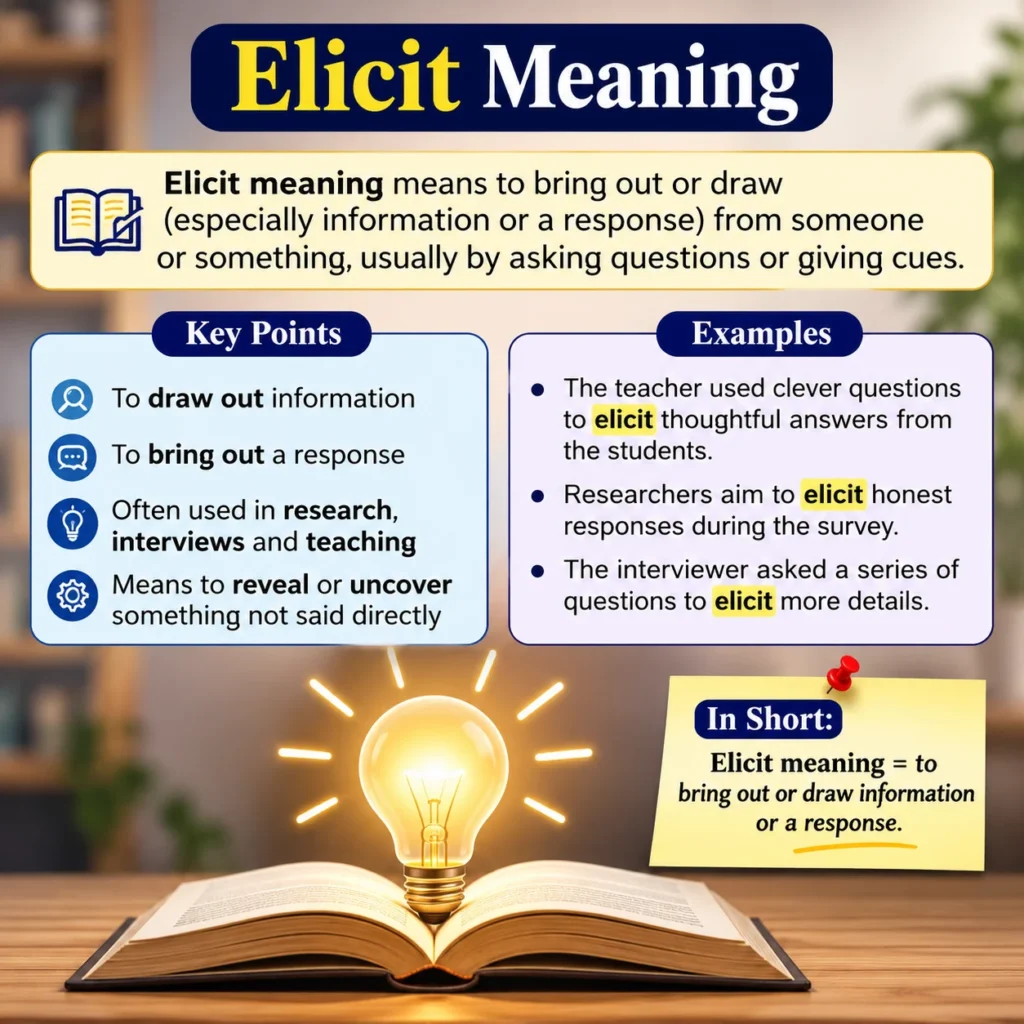
The word elicit is a verb. It describes the act of getting something from someone or causing a particular reaction.
In simple English, elicit can mean:
- To get a response
- To bring out information
- To cause a reaction
- To draw out an emotion or feeling
- To encourage someone to express something
The word often suggests that the response was brought out through a question, action, situation, or stimulus.
Elicit Meaning in Simple Terms
If you elicit something, you cause it to come out or become expressed.
For example:
- A good question can elicit an honest answer.
- A funny story may elicit laughter.
- The interviewer’s questions elicited useful information.
- The photograph elicited strong memories.
The important idea is that something is drawn out or brought forth rather than simply existing without being prompted.
Elicit as a Verb
Elicit is always used as a verb.
Common patterns include:
- elicit a response
- elicit an answer
- elicit information
- elicit a reaction
- elicit emotions
- elicit laughter
- elicit sympathy
- elicit criticism
Example:
“The question elicited an unexpected reaction from the audience.”
Here, elicited means that the question caused or brought about the reaction.
Examples of Elicit in a Sentence
Here are some natural examples:
- The teacher asked several questions to elicit opinions from the class.
- Her speech elicited loud applause from the audience.
- The detective’s questions elicited important information.
- The child’s joke elicited laughter from everyone.
- The photograph elicited memories of his childhood.
- The manager wanted to elicit honest feedback from employees.
- The announcement elicited mixed reactions.
- The interviewer used open-ended questions to elicit detailed answers.
Elicit in Different Contexts
Elicit Information
In interviews, research, investigations, and conversations, elicit often means to obtain information by asking questions or encouraging someone to speak.
Example:
“The researcher used carefully worded questions to elicit more detailed information.”
Elicit a Response
This is one of the most common uses of the word. Something elicits a response when it causes someone to answer or react.
Example:
“The question elicited a strong response from the audience.”
Elicit an Emotion
A person, event, image, story, or situation can elicit an emotional reaction.
Example:
“The reunion elicited feelings of happiness and nostalgia.”
Elicit a Reaction
Something can also elicit a physical, verbal, or emotional reaction.
Example:
“His unexpected comment elicited an angry reaction.”
Elicit vs. Illicit
Elicit and illicit are commonly confused because they sound similar, but their meanings are completely different.
Elicit is a verb meaning to draw out or obtain something.
Example:
“The question elicited an honest answer.”
Illicit is an adjective meaning illegal or not legally permitted.
Example:
“The police investigated an illicit business operation.”
A simple way to remember the difference is:
Elicit = draw out
Illicit = illegal
Elicit vs. Evoke
Elicit and evoke can sometimes be used in similar situations, especially when talking about reactions or emotions.
Elicit emphasizes bringing something out, often through a deliberate action or prompt.
Example:
“The interviewer elicited a detailed response.”
Evoke emphasizes causing a memory, feeling, image, or association to arise.
Example:
“The music evoked memories of childhood.”
They can overlap, but they are not always interchangeable.
Elicit Synonyms
Depending on the context, synonyms for elicit include:
- Obtain
- Draw out
- Extract
- Evoke
- Bring forth
- Produce
- Prompt
- Encourage
- Generate
- Call forth
The best synonym depends on what is being brought out. For example, obtain works well with information, while evoke is often more natural for emotions or memories.
Is Elicit Formal or Informal?
Elicit is a standard and relatively formal English word. It is common in academic writing, journalism, professional communication, research, psychology, education, and everyday educated speech.
For casual conversation, people may use simpler alternatives such as get, bring out, or cause.
For example:
Formal:
“The survey was designed to elicit detailed feedback.”
Casual:
“The survey was designed to get detailed feedback.”
Common Mistake: Elicit vs. Illicit
One of the most frequent mistakes is using illicit when elicit is intended.
Incorrect:
“The interviewer tried to illicit information.”
Correct:
“The interviewer tried to elicit information.”
Remember that elicit is an action, while illicit describes something unlawful or forbidden.
Frequently Asked Questions
What does elicit mean in simple English?
Elicit means to draw out, obtain, or cause something such as a response, reaction, emotion, or information.
What is an example of elicit?
“The teacher asked a question to elicit a response from the students.”
Is elicit positive or negative?
Elicit itself is neutral. The thing being elicited can be positive, negative, or neutral. A question can elicit laughter, anger, sympathy, criticism, or useful information.
Is elicit the same as evoke?
Not exactly. Elicit usually emphasizes drawing out a response or obtaining something, while evoke often refers to causing a feeling, memory, image, or association to arise.
What is the opposite of elicit?
Depending on the context, possible opposites include suppress, withhold, conceal, or discourage.
Is elicit a verb?
Yes. Elicit is a verb meaning to draw out, obtain, or bring forth a response, reaction, emotion, or information.
Elicit Meaning in Everyday English
The elicit meaning becomes easier to understand when you look at how the word works in real conversations. When someone elicits something, they bring it out from another person or situation. That “something” might be an answer, reaction, emotion, opinion, memory, or piece of information.
For example, a teacher may ask a question to elicit an answer from students. A journalist may ask carefully planned questions to elicit information from an interviewee. In both examples, the person is deliberately trying to bring something out.
The elicit meaning can therefore be summarized as “to draw something out.” The word does not necessarily mean forcing someone to respond. It can simply describe an action or situation that encourages a response to appear.
How Elicit Is Used in Sentences
Understanding the elicit meaning through sentence examples is one of the easiest ways to learn the word.
- The teacher asked a question to elicit a thoughtful answer.
- Her story elicited laughter from the audience.
- The interviewer’s questions elicited important information.
- The photograph elicited strong emotions.
- His comments elicited an unexpected reaction.
- The survey was created to elicit honest opinions.
- The announcement elicited mixed reactions from employees.
- The speaker’s comments elicited several questions from the audience.
In each example, elicit describes bringing out a response, feeling, reaction, or information.
Elicit Meaning in Communication
In communication, the elicit meaning often relates to getting another person to provide information or express an opinion. A skilled communicator may use questions, prompts, or observations to elicit a particular response.
For example:
“The interviewer used open-ended questions to elicit detailed answers.”
Here, elicit means that the interviewer encouraged the person to provide more information.
This use of elicit is especially common in interviews, surveys, research, education, counseling, and professional discussions.
Elicit Meaning in Education
Teachers frequently use questions to elicit answers, ideas, explanations, and opinions from students.
For example:
“The teacher asked several questions to elicit different viewpoints from the class.”
The elicit meaning in this context is essentially “to draw out ideas or responses.” Instead of simply giving students information, the teacher encourages them to think and express what they know.
Another example is:
“The instructor used a practical example to elicit a discussion.”
Here, the example caused students to respond and participate in the discussion.
Elicit Meaning in Psychology and Behavior
The word elicit can also describe something that produces a particular reaction or behavior.
For example:
“The loud noise elicited a sudden reaction.”
In this sentence, the noise caused the reaction. This is another important part of the elicit meaning: something can elicit a response without another person deliberately asking for it.
Similarly:
“The image elicited feelings of sadness.”
The image brought those feelings to the surface.
Elicit Meaning vs. Evoke Meaning
The elicit meaning is sometimes confused with the meaning of evoke because both words can describe bringing something out.
Elicit generally means to draw out or obtain a response, information, or reaction.
Evoke often means to bring a memory, feeling, image, or association into someone’s mind.
For example:
“The question elicited an honest answer.”
“The song evoked memories of childhood.”
The distinction is not always absolute, but elicit is particularly useful when something is being drawn out or obtained.
Elicit Meaning vs. Extract
Extract can also mean to obtain something, but it often suggests removing or taking something out, sometimes with greater effort.
For example:
“The journalist tried to elicit information from the witness.”
“The investigator managed to extract information from the witness.”
Both sentences suggest obtaining information, but elicit often sounds more neutral and focuses on encouraging or drawing out a response.
Elicit Meaning and Common Word Combinations
Learning common combinations can make the elicit meaning much easier to remember. Some frequently used phrases include:
- elicit a response
- elicit a reaction
- elicit an answer
- elicit information
- elicit emotions
- elicit sympathy
- elicit laughter
- elicit feedback
- elicit opinions
- elicit memories
- elicit criticism
- elicit a response from someone
For example:
“The manager’s question elicited useful feedback from the team.”
This means the manager’s question encouraged the team to provide useful feedback.
Final Thoughts
The elicit meaning is best understood as to draw out, obtain, or bring forth a response, reaction, emotion, opinion, or information. It is commonly used when a question, action, event, or situation causes something to be expressed or revealed. Understanding this useful verb can help you communicate more precisely in academic, professional, and everyday English.
For a broader understanding of how words function in English, explore Language on Wikipedia.