“Feining” is a phonetic spelling of “feenin'” or “fiending,” slang for having an intense craving for something specific. It’s most often used for a strong craving for food, attention, or a habit, and it can also carry the older, more serious sense of craving drugs. For more insights, read here:- entendre meaning and consort meaning.
- Quick Definition
- The Feining Meaning in Everyday Use
- Where the Spelling Comes From
- Is "Feining" the Same as "Feigning"?
- Texting and Social Media Use
- Is It Rude or Offensive?
- Dating and Relationship Context
- Gaming and Online Community Use
- Similar Slang Terms
- Frequently Asked Questions
- What does feining mean in texting?
- Is feining the correct spelling?
- Does feining always relate to drugs?
- Is feining the same word as feigning?
- Can feining be used in a romantic context?
- Where did the word feining first start showing up?
- Wrapping Up
Quick Definition
- Feining / feenin’ / fiending (informal): craving something intensely, often used casually about food, love, attention, or a habit.
- Example: “I’m feining for some pizza right now.”
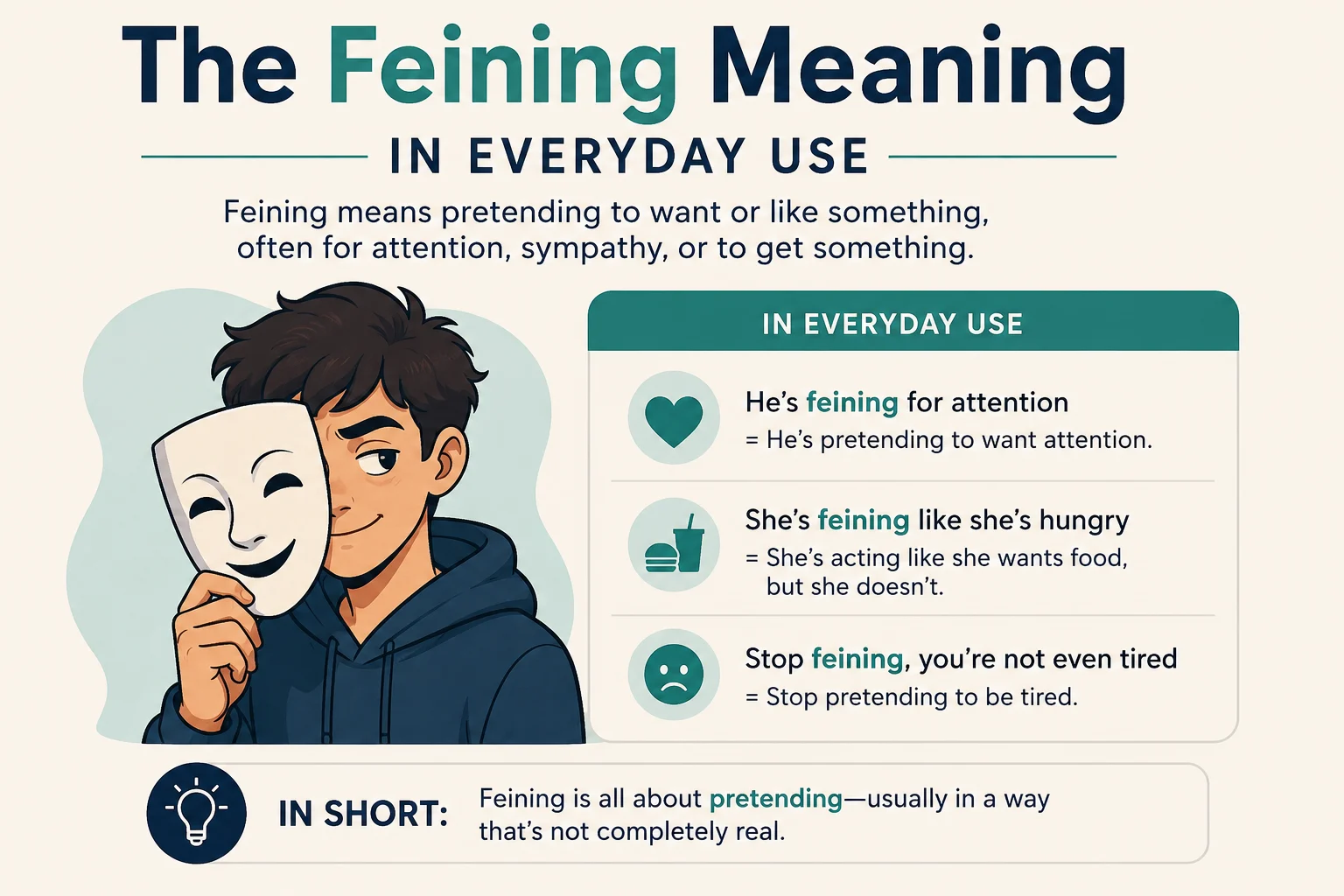
The Feining Meaning in Everyday Use
In casual speech and texting, the feining meaning usually points to a strong, almost desperate want for something specific, said lightheartedly or exaggerated rather than literally. People often use it to describe cravings that feel intense in the moment, even for something small.
It works a lot like other exaggerated craving language, such as “dying for” or “starving for,” where nobody actually believes the situation is as extreme as the words suggest. The feining meaning leans into that same kind of playful overstatement, which is part of why it feels natural in casual texts and captions rather than formal writing.
Example sentences:
- “I’m feining for coffee, I haven’t had any all day.”
- “She’s feining over that new song, she’s played it ten times already.”
- “Not gonna lie, I’m feining for a nap right now.”
- “We were all feining for the weekend by Wednesday.”
Where the Spelling Comes From
“Feining” is a phonetic, non-standard spelling of “fiending,” which comes from the noun “fiend.” Historically, “fiend” described someone in the grip of a compulsive craving, most seriously used for drug addiction, which is where “fiending” first developed its meaning of craving something intensely. Over time, especially in casual and internet slang, the word softened and broadened, and people began applying it to everyday cravings like food, sleep, or attention rather than only serious addiction.
That broadening is really the key to understanding the feining meaning as it’s used today. Very few people typing “I’m feining for pizza” are thinking about the word’s more serious roots at all; they’re simply reaching for a punchy, familiar way to say they want something badly.
Because slang spellings often follow how a word sounds rather than how it’s formally written, you’ll see this term written multiple ways, including “feenin,” “feening,” “fienin,” and “feining.” All of these point to the same underlying word.
Is “Feining” the Same as “Feigning”?
Not quite, though the two words look similar on the page. “Feigning” means pretending or faking something, as in “feigning interest” or “feigning surprise.” “Feining,” on the other hand, is a slang spelling connected to “fiending,” meaning craving something. If you meant to search for “feigning,” note that it describes pretense, not craving, and the two words aren’t related despite the similar spelling.
Mixing these two up is an easy mistake, since both words are unfamiliar-looking and share several of the same letters. When trying to figure out which one applies to a sentence, it helps to ask whether the sentence is about wanting something (the feining meaning) or about pretending something (the separate, unrelated word “feigning”).
Texting and Social Media Use
“Feining” shows up often in texting and casual online writing, usually to express an exaggerated craving in a relatable, half-joking way. It’s common to see it paired with food, a favorite show, or a person someone has a crush on.
- “I’m feining for that new season to drop already.”
- “He’s feining for a reply from her, checking his phone every five minutes.”
- “I’ve been feining for a vacation for weeks now.”
The feining meaning translates well to short, casual writing because it packs a lot of feeling into one word. It saves the writer from spelling out a longer explanation of just how badly they want something.
Is It Rude or Offensive?
On its own, casual use of “feining” for everyday cravings isn’t rude or offensive by itself. However, because the word’s roots trace back to describing drug addiction, using the feining meaning carelessly around serious substance-use struggles can come across as insensitive, even if that’s not how it’s meant.
Context and audience matter here, as they do with a lot of slang tied to sensitive topics. Around close friends joking about pizza, the feining meaning is completely harmless; brought up near someone dealing with addiction, either their own or a loved one’s, the same word can land very differently.
Dating and Relationship Context
In a dating or relationship context, “feining” is sometimes used to describe someone who seems overly eager or desperate for attention from a person they’re interested in. It can be used affectionately between partners or more critically to describe someone coming on too strong.
- “He’s been feining for her attention all week.”
- “Ever since the first date, she’s been feining for a text back.”
In this context, the feining meaning shifts slightly toward describing behavior rather than a physical craving, but the underlying idea of an intense, hard-to-ignore want stays exactly the same.
Gaming and Online Community Use
“Feining” also turns up in gaming chat and online communities, usually to describe an intense want for a new release, an item, or another round of a game. This use follows the exact same pattern as the food or attention examples above, just applied to a different object of desire.
- “I’m feining for the new update, I keep refreshing the patch notes constantly.”
- “Bro’s feining for one more match, we’ve been playing for six hours straight already.”
Even across such different settings, from food to gaming to relationships, the core feining meaning never really changes: it’s always about an intense, sometimes exaggerated, craving for something specific.
Similar Slang Terms
- Craving — the standard English word with a similar meaning, without the slang spelling or drug-related history.
- Thirsty — slang for being overly eager for attention, often in a dating context, similar to one use of “feining.”
- Itching for — an idiom describing eagerness for something, close in meaning but less intense-sounding than “feining.”
- Jonesing — another slang term originally tied to drug cravings that broadened into everyday use, closely paralleling how “feining” developed.
- Hankering — an older, more formal-sounding way to express a craving, without the slang tone that comes with the feining meaning.
None of these words are exact synonyms. Each carries its own tone, so swapping one in for “feining” can shift how casual or intense a sentence sounds, even when the general craving-based idea stays the same.
Frequently Asked Questions
What does feining mean in texting?
It usually means craving something strongly, often food, attention, or a show, expressed in a casual or exaggerated way rather than literally. Understanding the feining meaning in this context is mostly about tone, since it’s rarely meant word for word.
Is feining the correct spelling?
Not formally. “Feining” is a phonetic slang spelling of “fiending” or “feenin’.” Multiple spelling variants exist since the word developed mainly through spoken slang rather than formal writing, and no dictionary treats the feining meaning as a fixed spelling anyway, which is a big part of why it stays remarkably stable even as the spelling itself keeps shifting from person to person.
Does feining always relate to drugs?
No, not in casual modern use. While the word’s origin traces back to describing drug cravings, it’s now commonly used for everyday things like food, sleep, or attention, and the feining meaning in these situations rarely carries any reference to its more serious roots.
Is feining the same word as feigning?
No. “Feigning” means pretending, while “feining” is a slang spelling of “fiending,” meaning craving. They sound different and mean different things, despite looking somewhat alike, and confusing them can lead to a completely different reading of a sentence.
Can feining be used in a romantic context?
Yes. It’s sometimes used to describe someone who seems eager or desperate for attention from a person they like, either affectionately or as a lighthearted critique between friends. The feining meaning here still boils down to intense wanting, just applied to a person instead of food or an object.
Where did the word feining first start showing up?
The exact point at which this specific slang spelling became common online and in text is uncertain, since slang spellings usually spread informally through speech and casual writing rather than being tracked or documented anywhere official. What’s clearer is that the feining meaning descends from “fiending,” which has a longer, more traceable history tied to describing compulsive craving.
Wrapping Up
Understanding the feining meaning really comes down to recognizing it as a casual spelling of “fiending,” rooted in describing intense craving. Once you separate it from the unrelated word “feigning,” it becomes an easy, natural slang term to spot in texts and captions. For more on how words like this evolve through spoken slang, the Wikipedia entry on African-American Vernacular English is a useful starting reference, since many terms connected to the feining meaning trace some of their roots there.