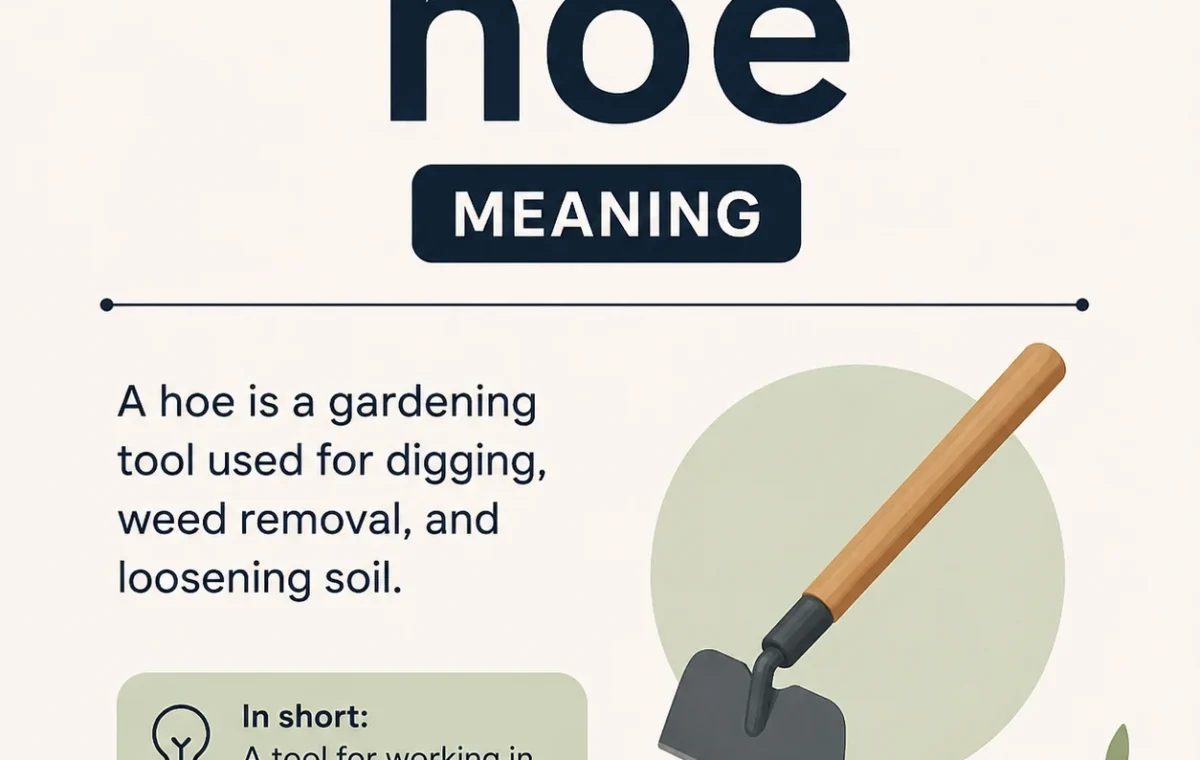
The hoe meaning depends on context. Most commonly, a hoe is a long-handled garden or agricultural tool with a blade used to remove weeds and break up or cultivate soil. It can also be used as a verb meaning “to work soil or remove weeds with a hoe.” In informal English, hoe is also used as a spelling variant of ho, an offensive slang term for a sexually promiscuous woman.
- Quick Answer: Hoe Meaning at a Glance
- What Does Hoe Mean in Standard English?
- Hoe Pronunciation
- Is Hoe Pronounced Like “Ho”?
- Hoe as a Noun
- Hoe as a Verb
- Examples of Hoe in Sentences
- Gardening examples
- Figurative phrase
- Hoe Meaning in Slang
- How Context Changes the Meaning
- Hoe vs. Ho: What's the Difference?
- Common Collocations and Phrases
- Common Mistakes to Avoid
- 1. Assuming every use refers to gardening
- 2. Treating the slang sense as neutral
- 3. Confusing pronunciation with spelling
- 4. Misspelling the verb forms
- 5. Misunderstanding “a hard row to hoe”
- Synonyms and Related Gardening Words
- Hoe Meaning and Word Origin
- A Simple Memory Tip
- Quick Cheat Sheet
- Frequently Asked Questions
- What is the basic hoe meaning?
- Is hoe a noun or a verb?
- How do you pronounce hoe?
- Is hoe an offensive word?
- What does “a hard row to hoe” mean?
- Is hoe the same as ho?
- What is the plural of hoe?
- What is the past tense of hoe?
- Related Word Guides
That last sense is important because the spelling looks identical to the gardening word, but the meanings are completely different. Context, pronunciation, and subject matter usually make the intended sense clear.gusto meaning or feining meaning .
Quick Answer: Hoe Meaning at a Glance
| Word | Meaning | Example |
|---|---|---|
| hoe (noun) | A gardening or farming tool used to loosen soil and remove weeds | “She used a hoe to clear the vegetable bed.” |
| hoe (verb) | To work or cultivate soil with the tool | “They hoed the rows before planting.” |
| hoe (slang noun) | An offensive spelling variant of ho | “The term is insulting and should be avoided in respectful speech.” |
| hoes | Plural noun or third-person singular verb | “Several hoes hung in the shed.” / “He hoes the garden.” |
What Does Hoe Mean in Standard English?
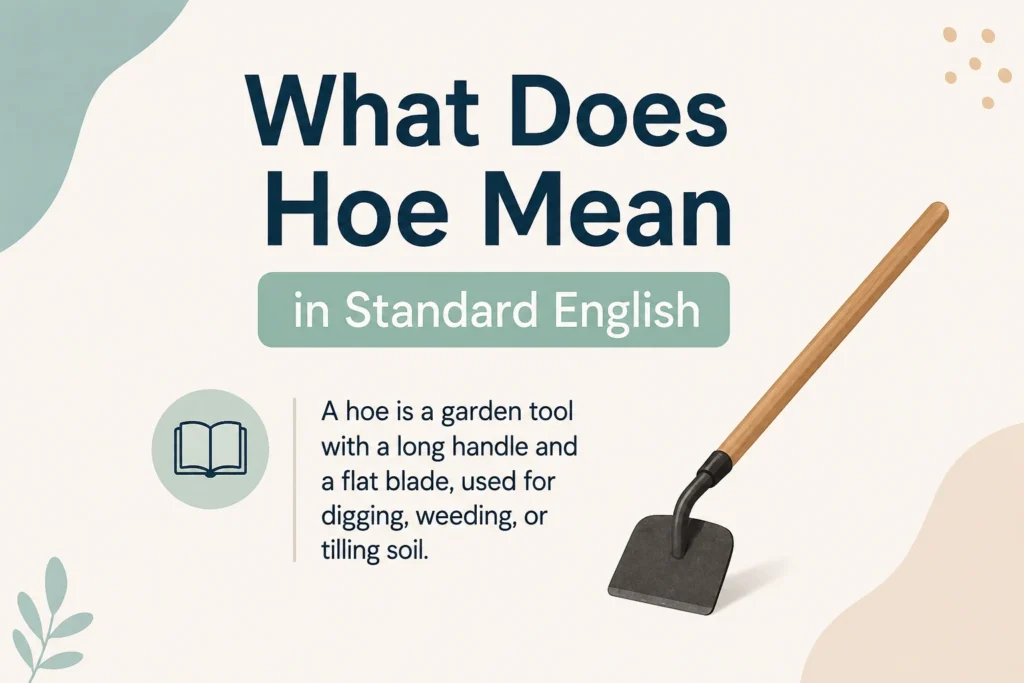
In standard English, the most familiar sense refers to a garden or agricultural implement. A traditional version has a long handle and a short metal blade positioned at the end. Gardeners use it to remove unwanted plants, loosen the surface of soil, and prepare planting areas. Cambridge gives essentially this definition and lists both the noun and verb forms.
The word can describe several related tool designs. Some hoes have broad blades for shallow cultivation, while others have narrower or heavier blades designed for cutting through tougher soil or weeds.
If you’re learning gardening vocabulary, this is the ordinary, neutral sense of the term. Cambridge Dictionary: hoe
Hoe Pronunciation
The hoe pronunciation is short and simple:
- US: /hoʊ/
- UK: /həʊ/
- Simple pronunciation: “hoh”
The gardening noun and verb have the same pronunciation in both major varieties of English. Oxford lists the British pronunciation as /həʊ/, while Cambridge gives /hoʊ/ for American English and /həʊ/ for British English.
Is Hoe Pronounced Like “Ho”?
Yes. The gardening word hoe and the spelling ho are pronounced alike. They are homophones, meaning they sound the same but can have different spellings and meanings.
That similarity explains why the slang spelling can sometimes cause confusion in online conversations.
Hoe as a Noun
As a noun, the term names the physical tool.
A typical garden hoe has:
- a relatively long handle;
- a metal blade or working head;
- a design suited to shallow digging, scraping, cultivating, or weeding;
- a practical role in gardens, fields, and planting beds.
For example:
“I left the hoe beside the vegetable patch.”
Here, there’s no ambiguity: the sentence is clearly talking about a physical gardening implement.
Another example is:
“The gardener used a hoe to loosen the soil around the plants.”
The tool is being used to disturb the surface of the ground without necessarily digging a deep hole.
Hoe as a Verb
The verb hoe means to use the tool to break up soil, remove weeds, or work cultivated ground. It can be transitive or intransitive. Oxford lists forms such as hoed, hoeing, and hoes.
Examples include:
- “We need to hoe the flower beds.”
- “She spent the morning hoeing between the rows.”
- “He hoed the soil before planting.”
- “The farmer hoes around the young plants.”
Notice the spelling of the -ing form: hoeing, not hoeing with an extra change to the base spelling. The final e is retained before -ing in this word.
Examples of Hoe in Sentences
Seeing the word in different contexts makes its use much easier to remember.
Gardening examples
- “I bought a new hoe for the vegetable garden.”
- “Use the hoe gently so you don’t damage the roots.”
- “She hoed the soil around the tomato plants.”
- “The workers spent the afternoon hoeing weeds.”
- “A sharp hoe can make shallow cultivation easier.”
- “He kept the hoe in the garden shed.”
Figurative phrase
You may also encounter the expression a hard row to hoe. It means a difficult task, situation, or period of work. The image comes from the physical effort required to cultivate a difficult row of soil. The phrase is especially common in American English.
For example:
“Starting a new business without much money can be a hard row to hoe.”
The phrase is figurative; nobody is necessarily talking about farming.
Hoe Meaning in Slang
The slang hoe meaning is very different from the gardening sense. In informal speech and online writing, hoe can be an alternative spelling of ho, an offensive and derogatory term for a woman who is stereotyped as having many sexual partners. Cambridge explicitly labels this use as offensive slang.
Because it is insulting, it should not be treated as an ordinary synonym for woman or person. Using it about someone can be disrespectful or sexually degrading.
You may encounter the slang form in:
- song lyrics;
- social-media posts;
- memes;
- casual online conversations;
- quoted dialogue.
Its appearance in a song, joke, or social-media post doesn’t make it neutral. Context can explain what someone meant, but it doesn’t remove the word’s derogatory character.
How Context Changes the Meaning
The easiest way to understand the hoe meaning is to look at the surrounding words.
| Context | Likely sense | Example |
| Garden | Tool | “Pass me the hoe.” |
| Farm | Agricultural implement | “The workers used hoes between the rows.” |
| Gardening action | Verb | “She hoed the soil.” |
| Farming phrase | Figurative expression | “It’s a hard row to hoe.” |
| Slang or insulting speech | Derogatory term | “He used a sexist insult.” |
If a sentence mentions soil, weeds, plants, gardens, crops, rows, or planting, the tool or verb sense is almost certainly intended.
If it appears in a conversation about people, relationships, or sexual behavior, it may have the slang sense.
Hoe vs. Ho: What’s the Difference?
The spellings hoe and ho can sound identical, but they aren’t interchangeable in ordinary writing.
Hoe is the standard spelling for the gardening tool and the verb related to using it.
Ho can refer to the offensive slang term, although hoe is also used as a spelling variant of that slang word. Cambridge treats ho as an offensive noun and notes hoe as an alternative spelling.
There is also an unrelated use of ho! as an exclamation in older or stylized English, such as “Ho there!” That use has nothing to do with either the gardening tool or the slang term.
Common Collocations and Phrases
Here are useful combinations you may see in real English:
- garden hoe — a hoe used for gardening.
- hoe the soil — cultivate or loosen soil with the tool.
- hoe the weeds — remove weeds using the implement.
- hoe a row — work a row of cultivated ground.
- a hard row to hoe — a difficult task or situation.
- hoe the garden — cultivate the garden using the tool.
- hand hoe — a small manually operated hoe.
These combinations make the intended sense especially clear.
Common Mistakes to Avoid
1. Assuming every use refers to gardening
The gardening sense is standard, but the word also appears in slang. Always consider context before interpreting a sentence.
2. Treating the slang sense as neutral
The slang use is offensive. Don’t casually substitute it for neutral words such as woman, person, or partner.
3. Confusing pronunciation with spelling
The gardening word sounds like “hoh.” Its pronunciation doesn’t reveal which spelling or meaning is intended.
4. Misspelling the verb forms
The main forms are:
- hoe
- hoes
- hoed
- hoeing
Oxford confirms these standard forms.
5. Misunderstanding “a hard row to hoe”
This expression doesn’t mean that someone literally has a difficult gardening job. It usually describes a challenging situation or difficult course of action.
Synonyms and Related Gardening Words
There isn’t one perfect synonym for the tool because different implements perform different jobs.
Depending on context, related terms include:
- cultivator — a tool or machine used to loosen and work soil.
- weeder — a tool specifically designed to remove weeds.
- rake — primarily used for gathering leaves, debris, or leveling loose material.
- spade — a digging tool with a broad blade and handle.
- mattock — a heavier tool for digging or breaking hard ground.
These aren’t exact replacements. A rake, for example, doesn’t perform exactly the same job as a hoe.
Hoe Meaning and Word Origin
The gardening word has a long history in English. Oxford traces it to Middle English, from Old French houe, with Germanic connections, and relates it to hew. Merriam-Webster similarly gives Middle English howe from Anglo-French houe and identifies a Germanic connection.
The connection with hew is especially interesting because both words are associated historically with cutting or striking. The verb developed from the noun, with the basic idea of working earth using the implement.
The slang sense has a separate history: it developed as a spelling variant of ho, itself an offensive slang term. That means the two modern uses shouldn’t be treated as if they came from one single meaning.
A Simple Memory Tip
Think of the gardening sense as:
HOE = handle + blade + earth.
Picture a gardener holding a long-handled tool and scraping weeds from the soil. If the surrounding words mention plants, crops, weeds, or a garden, you’re almost certainly dealing with the standard noun or verb.
For the slang sense, remember that it belongs to a completely different register and can be insulting. That distinction will help you avoid an embarrassing mistake.
Quick Cheat Sheet
| If you see… | Think… |
| a hoe | gardening tool |
| to hoe | work soil with the tool |
| hoed | past tense |
| hoeing | -ing form |
| a hard row to hoe | difficult task |
| hoe/ho in slang | offensive, derogatory usage |
The safest rule is simple: look at the context before deciding which sense is intended.
Frequently Asked Questions
What is the basic hoe meaning?
The basic meaning is a garden or agricultural tool with a handle and blade used to remove weeds and work the surface of soil. The same word also functions as a verb meaning to work soil with that tool.
Is hoe a noun or a verb?
It can be both. As a noun, it names the gardening implement; as a verb, it describes the action of using that implement to cultivate or weed soil.
How do you pronounce hoe?
In American English, it is /hoʊ/, while British English commonly uses /həʊ/. In simple terms, it sounds like “hoh.”
Is hoe an offensive word?
It depends on the sense. The gardening term is completely neutral, but the slang use is offensive and derogatory. Cambridge specifically identifies that slang sense as offensive.
What does “a hard row to hoe” mean?
It means facing a difficult task or challenging situation. The expression comes from the physical work of cultivating a difficult row of soil.
Is hoe the same as ho?
They can be pronounced the same, but their standard meanings differ. Hoe is the normal spelling for the gardening tool and its related verb, while ho can be an offensive slang term; hoe is also sometimes used as a spelling variant of that slang word.
What is the plural of hoe?
The plural noun is hoes. For example: “The shed contained several hoes.” The same spelling, hoes, can also be the third-person singular form of the verb: “She hoes the garden every spring.”
What is the past tense of hoe?
The past tense is hoed, and the past participle is also hoed. The -ing form is hoeing.
Related Word Guides
If you’re building your vocabulary, useful next reads could include:
- Garden vocabulary — learn the names of common gardening tools and actions.
- Slang vs. standard English — understand how context and register affect word choice.
- Homophones and confusing words — learn why words with the same pronunciation can have different meanings.
- More Useful Details About Hoe Meaning
Understanding hoe meaning becomes easier when you look at the word in real situations. The term is most often connected with gardening, farming, soil preparation, and weed removal. However, the same spelling can appear in slang, so context is essential.
Hoe Meaning in Everyday Gardening
A hoe is one of the basic tools used to maintain a garden. Its long handle allows a gardener to work while standing, while the blade is used to scrape, cut, loosen, or cultivate the upper layer of soil.
For example:
“She picked up the hoe and removed the weeds.”
“The gardener used a hoe around the rows of vegetables.”
“A hoe can help loosen compacted surface soil.”
“He stored the hoe beside the shovel.”
“We used a hoe to prepare the garden bed.”
In these examples, the intended meaning is completely neutral and relates to gardening.
How the Verb Is Used
The verb describes the action performed with the gardening implement. Someone can hoe a garden, a field, a row, or soil.
Common forms include:
Form
Example
hoe
“I need to hoe the garden.”
hoes
“She hoes between the plants.”
hoed
“They hoed the field yesterday.”
hoeing
“He is hoeing the vegetable bed.”
This distinction is useful for English learners because the noun identifies the object, while the verb identifies the action.
Hoe Meaning in the Expression “A Hard Row to Hoe”
One of the best-known expressions containing the word is “a hard row to hoe.” It describes a difficult job, challenge, or situation.
For example:
“Building a business from nothing is a hard row to hoe.”
The expression creates a picture of someone struggling to cultivate a difficult row of ground. In modern conversation, it is normally figurative rather than a literal reference to farming.
Is the Word Formal or Informal?
The gardening sense is a standard, neutral English word. You can use it in everyday conversation, school assignments, gardening instructions, newspaper writing, and professional agricultural contexts.
The slang sense is different. It is informal and offensive, so it should be avoided in respectful communication unless you’re discussing, quoting, or analyzing the language itself.
A useful rule is:
Garden, soil, weeds, crops → standard tool or verb.
People or sexual behavior → potentially offensive slang.
“Hard row to hoe” → figurative expression meaning a difficult challenge.
Related Gardening Terms
If you’re learning vocabulary connected with gardening, these words are useful:
spade — a tool designed mainly for digging.
shovel — a tool for lifting or moving soil and other loose materials.
rake — a tool commonly used to gather leaves and level loose material.
trowel — a small handheld tool for planting and digging.
cultivator — a tool used to loosen and prepare soil.
weeder — a tool designed primarily for removing unwanted plants.
These terms overlap in gardening, but they aren’t exact synonyms. Choosing the right word depends on the task and the tool being described.
Common Questions About Hoe Meaning
What does hoe mean in a garden?
In a garden, it refers to a tool with a handle and blade used to cultivate soil and remove weeds. As a verb, it means to work the soil with that implement.
What is another word for a garden hoe?
There isn’t one exact replacement that works in every context. Cultivator and weeder may describe related tools, but each has a somewhat different function.
What does hoe mean as a verb?
As a verb, it means to use a hoe to work, loosen, or cultivate soil, often while removing weeds. For example, “They hoed the garden before planting.”
Why can hoe be an offensive word?
In slang, the spelling can represent an offensive term used to insult or sexually demean a person, particularly a woman. This sense is separate from the ordinary gardening term.
What does “hard row to hoe” mean?
It means that something is difficult or requires considerable effort. The phrase comes from the physical work of cultivating a challenging row of soil.
Is hoe a common English word?
Yes. The gardening noun and verb are established English vocabulary, particularly in contexts involving gardening, agriculture, and cultivation. - Understanding the Word in Different Contexts
The hoe meaning changes according to how the word appears in a sentence. In gardening and agriculture, it is a completely ordinary word for a tool or an action involving soil. In informal slang, however, the same spelling can have a derogatory meaning.
This makes context especially important. If someone says, “The hoe is next to the shovel,” they are clearly talking about a gardening implement. If the surrounding conversation concerns a person rather than gardening, the intended sense may be entirely different.
Hoe Meaning in Gardening and Agriculture
The traditional garden hoe consists of a handle attached to a working blade. Gardeners use it for tasks such as removing weeds, loosening surface soil, and cultivating areas around plants.
A hoe can be particularly useful when weeds are growing between rows of vegetables. Instead of pulling every weed by hand, a gardener can use the blade to disturb the soil and cut unwanted growth.
For example:
“The farmer used a hoe between the rows of corn.”
“She keeps her garden hoe in the shed.”
“Use the hoe carefully around young plants.”
“The gardener hoed the soil before planting seeds.”
These sentences demonstrate the standard, neutral sense.
The Verb Form and Its Meaning
The word also works naturally as a verb. To hoe means to work or cultivate soil with the gardening tool.
The common forms are:
hoe — base form
hoes — third-person singular
hoed — past tense and past participle
hoeing — present participle
Examples:
“I hoe the vegetable beds every week.”
“She hoes around the plants to remove small weeds.”
“They hoed the garden yesterday.”
“He is hoeing the soil before planting.”
For English learners, this is a useful example of a word that can function as both a noun and a verb.
When Should You Use the Word?
The standard term is appropriate whenever you’re talking about gardening, farming, or soil cultivation. You might encounter it in gardening books, agricultural articles, instructions, classroom materials, or everyday conversation.
It works naturally in both American and British English, although particular gardening practices and tool designs may vary by region.
You don’t need a more complicated word if you’re describing the ordinary tool. Hoe is direct, precise, and widely understood.
When Should You Avoid the Slang Use?
The slang sense should generally be avoided in respectful conversation. It can be insulting and sexually degrading, particularly when directed toward a woman.
You may still encounter it in music, social media, movies, comedy, or quoted dialogue. Understanding the term can therefore help with reading comprehension, but understanding a word doesn’t mean you should use it.
If you’re writing professionally, academically, or respectfully, choose a neutral description instead.
Hoe vs. Other Garden Tools
It can be tempting to treat every gardening implement as interchangeable, but the differences matter.
Tool
Main purpose
Typical use
Hoe
Cultivating and weeding
Loosening surface soil and removing weeds
Spade
Digging
Turning or cutting into soil
Shovel
Moving material
Lifting and moving soil
Rake
Gathering and leveling
Collecting leaves or smoothing loose soil
Trowel
Small-scale digging
Planting flowers and seedlings
Cultivator
Soil preparation
Breaking up and loosening surface soil
So, while a hoe and cultivator may perform similar jobs, they aren’t necessarily the same implement.
Common Collocations
Learning common combinations can make the word easier to recognize.
Garden-related combinations
garden hoe
hand hoe
hoe the garden
hoe the soil
hoe the weeds
hoe between the rows
use a hoe
a sharp hoe
For example:
“The gardener used a sharp hoe to clear weeds between the vegetable rows.”
These combinations strongly signal the gardening sense.
“A Hard Row to Hoe” Explained
The phrase “a hard row to hoe” means a difficult task or challenging situation. It is usually figurative.
For example:
“Recovering the company after such a major loss will be a hard row to hoe.”
The expression is based on the physical effort involved in cultivating a difficult row of soil. You don’t need to be discussing agriculture for the phrase to work.
A similar idea could be expressed with:
a difficult task
an uphill battle
a tough challenge
a difficult road ahead
The farming expression has a more vivid, conversational flavor than these alternatives.
Common Mistakes With the Word
Mistake 1: Assuming only one meaning exists
The gardening sense is the standard one, but slang uses exist. Always examine the surrounding sentence.
Mistake 2: Using the slang sense casually
Because the slang term can be offensive, it shouldn’t be used casually to describe someone.
Mistake 3: Confusing a hoe with a shovel
A hoe is generally used for shallow cultivation, scraping, and weeding, while a shovel is designed primarily for lifting and moving loose material.
Mistake 4: Forgetting the verb forms
Remember:
hoe → hoes → hoed → hoeing
For example, “She is hoeing the garden” is grammatically correct.
A Simple Way to Remember the Main Sense
Picture a gardener standing in a vegetable patch with a long-handled tool.
Hoe = handle + blade + soil.
That mental picture makes the standard definition easy to recall. Then remember that the slang sense is separate and potentially offensive.
Why Context Matters So Much
English contains many words whose meanings depend on surrounding information. This term is a particularly clear example.
Consider these two sentences:
“The gardener sharpened the hoe.”
“He used a derogatory slang term for the woman.”
The first refers to an agricultural implement. The second describes the slang usage without repeating the insult.
When reading unfamiliar material, look at the words around the term. Words such as soil, garden, weeds, crops, plants, rows, and farming strongly indicate the standard meaning.