Via Meaning .The word “via” means “by way of,” “through,” or “using a particular route or method.” It is commonly used when describing the route someone takes, the place they pass through, or the method used to achieve something.
- What Does Via Mean?
- Via Meaning in Simple English
- Via as a Preposition
- Via Meaning When Talking About Travel
- Via Meaning in Communication
- Via Meaning in Technology and Online Communication
- Via Meaning in Social Media
- Via Meaning in Business and Workplace English
- Via Meaning in Latin
- Pronunciation of Via
- Via vs. Through
- Via vs. By
- Common Synonyms for Via
- Examples of Via in Sentences
- Common Misunderstanding About Via
- Is Via Formal or Casual?
- Frequently Asked Questions
- What does via mean?
- What does via mean in a sentence?
- Is via a preposition?
- Is via a formal word?
- How do you pronounce via?
- What is the difference between via and through?
- Via Meaning in Everyday English
- Via Meaning When Describing a Route
- Via Meaning When Describing a Method
- Via Meaning in Communication
- Via Meaning in Professional Writing
- Via Meaning in Technology
- Via Meaning on Social Media
- Via Meaning in News and Journalism
- Via Meaning in Transportation
- Via Meaning vs. Through
- Via Meaning vs. By
- Via Meaning vs. Using
- Is Via Formal or Informal?
- Common Mistakes With Via
- Examples of Via in Sentences
- Is Via Used in Everyday Conversation?
For example:
“We traveled to London via Paris.”
Here, “via Paris” means that Paris was the route or stopping point used to reach London.
“Via” can also describe a method of communication or delivery:
“Please send the documents via email.”
In this sentence, “via email” means “using email.” more information:-seinen meaning or skank meaning .
What Does Via Mean?
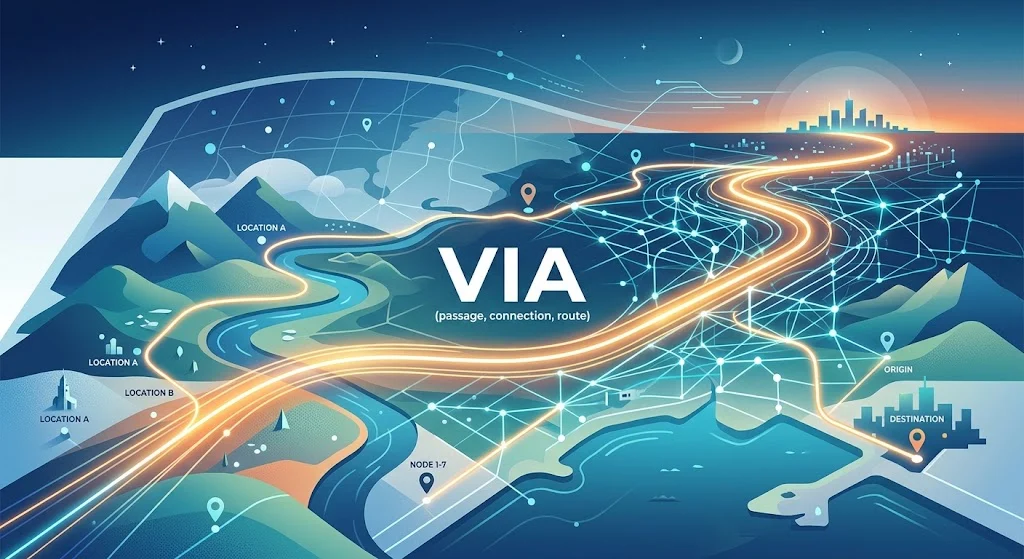
Via is a preposition used to indicate a route, means, or method.
The two main meanings are:
- Through or by way of a place
- By means of or using something
Examples:
- “The train goes to Rome via Milan.”
- “She contacted me via email.”
- “We received the information via a colleague.”
The exact interpretation depends on the context.
Via Meaning in Simple English
In simple English, “via” can usually be understood as:
- Through
- By way of
- Using
- By means of
For example:
“I flew to New York via Chicago.”
This means:
“I flew to New York by way of Chicago.”
Another example:
“He sent the file via WhatsApp.”
This means:
“He sent the file using WhatsApp.”
Via as a Preposition
“Via” is primarily used as a preposition.
A preposition connects a noun or noun phrase to another part of a sentence and can show relationships such as direction, location, or method.
Examples include:
- “We drove to Manchester via Leeds.”
- “The package was delivered via courier.”
- “She learned about the opportunity via a friend.”
- “The payment was made via bank transfer.”
In each example, “via” introduces the route or means involved.
Via Meaning When Talking About Travel
One of the most traditional uses of “via” is to describe a travel route.
For example:
“We traveled from Islamabad to Lahore via Faisalabad.”
Here, Faisalabad identifies the route taken between the starting point and destination.
You can also use “via” when describing flights:
“The flight goes to Istanbul via Doha.”
This means that Doha is part of the journey.
Other examples:
- “We drove to the coast via the mountain road.”
- “The bus reaches the city via the northern highway.”
- “She traveled to Rome via Frankfurt.”
In these sentences, “via” essentially means “by way of.”
Via Meaning in Communication
“Via” is also very common when discussing communication.
If someone says:
“I heard the news via a friend.”
They mean that a friend was the source or channel through which they received the information.
Similarly:
“The announcement was shared via email.”
This means email was the communication method.
Examples:
- “I received the invitation via text.”
- “They contacted customers via telephone.”
- “The information reached us via social media.”
- “She learned about the position via a former colleague.”
In these contexts, “via” is close in meaning to “through” or “using.”
Via Meaning in Technology and Online Communication
In modern communication, “via” frequently appears before the name of a digital platform, service, or communication channel.
Examples include:
- “Send the document via email.”
- “The meeting link was shared via Slack.”
- “I found the article via Google.”
- “The message was sent via an online form.”
This use is not necessarily slang. It is a standard way of indicating the channel or method through which something happened.
The word can appear in professional writing, casual conversation, news reporting, and technical communication.
Via Meaning in Social Media
On social media, “via” may identify where information, an image, quotation, or idea came from.
For example:
“Photo via @example”
This indicates that the photo was obtained from or associated with that source.
Someone might also write:
“News via Reuters.”
This identifies the source through which the information was obtained.
The meaning is essentially “through” or “from this source.”
Via Meaning in Business and Workplace English
“Via” is common in professional communication because it provides a concise way to describe a method or channel.
Examples:
“Please submit your application via the company website.”
“The invoice was sent via email.”
“We received the request via our customer service department.”
“Please contact the team via the support portal.”
In these sentences, “via” can make the sentence sound slightly more formal than simply saying “using” or “through.”
Via Meaning in Latin
“Via” is a Latin word meaning “way,” “road,” or “route.” English adopted the word and developed its modern uses from this sense.
The English word is closely connected with the idea of a route or means of reaching something.
The expression “via” therefore naturally works both for physical routes and figurative methods.
For example:
- Physical route: “We traveled via Paris.”
- Method: “We contacted them via email.”
The underlying idea is a path or channel through which something happens.
Pronunciation of Via
“Via” has more than one established pronunciation in English.
Common pronunciations include:
- VY-uh
- VEE-uh
The pronunciation can vary by region and speaker.
In American English, “VY-uh” is common, while “VEE-uh” is also widely recognized. British English speakers may use either pronunciation depending on the speaker and context.
Via vs. Through
“Via” and “through” can sometimes be used interchangeably, but they are not always identical in tone or structure.
Compare:
“We traveled via Paris.”
“We traveled through Paris.”
Both can describe a route involving Paris, although “via” emphasizes Paris as part of the route.
For methods:
“I sent the message via email.”
“I sent the message through email.”
The first is generally more natural in standard English.
“Via” is particularly useful when you want to identify a specific route, channel, or means.
Via vs. By
“Via” and “by” can both describe methods, but their usage differs.
For example:
“I traveled by train.”
“I traveled via Paris.”
The first describes the means of transportation. The second describes the route.
You can also say:
“I contacted her via email.”
“By email” is possible, but “via email” is often preferred when emphasizing the communication channel.
Common Synonyms for Via
Depending on context, possible alternatives include:
- Through
- By way of
- By means of
- Using
- Along
- Through the route of
- By
Not every synonym works naturally in every sentence.
For example, “via Paris” can often become “by way of Paris,” but “via email” is better replaced with “using email” than with “by way of email.”
Examples of Via in Sentences
Here are several natural examples:
- “We reached the village via a narrow mountain road.”
- “She sent the invitation via email.”
- “The train travels to Glasgow via Edinburgh.”
- “I heard about the opportunity via a friend.”
- “The company accepts applications via its website.”
- “The package was shipped via express delivery.”
- “They communicated with the team via video conference.”
- “We flew to Madrid via Lisbon.”
These examples show how “via” can refer to both physical routes and methods.
Common Misunderstanding About Via
A common misunderstanding is that “via” can only describe travel.
In reality, “via” is also widely used for communication, technology, business, transportation, information sources, and other methods.
Another misunderstanding is that “via” always means exactly “through.” Although “through” is often an appropriate replacement, the best synonym depends on the sentence.
For example:
“We traveled via Rome.”
Here, “by way of Rome” is particularly natural.
“We contacted him via email.”
Here, “using email” is a more natural equivalent.
Is Via Formal or Casual?
“Via” is generally neutral to somewhat formal in tone.
It is common in professional writing, transportation information, business communication, journalism, and everyday speech.
For casual conversation, people may sometimes prefer simpler alternatives such as “through” or “using.”
For example:
“I found it via a friend.”
This is perfectly natural, but:
“I found it through a friend.”
may sound more conversational to some speakers.
Neither version is inherently incorrect.
Frequently Asked Questions
What does via mean?
“Via” means “by way of,” “through,” or “using a particular route or method.”
What does via mean in a sentence?
Its meaning depends on context. “Via Paris” means “by way of Paris,” while “via email” means “using email.”
Is via a preposition?
Yes. “Via” is primarily used as a preposition in English.
Is via a formal word?
“Via” is generally neutral to somewhat formal. It is common in both professional and everyday English.
How do you pronounce via?
Common pronunciations include “VY-uh” and “VEE-uh.” Pronunciation can vary by region and speaker.
What is the difference between via and through?
Both can indicate a route or channel, but “via” often emphasizes a particular route, source, or method. “Through” is usually more general.
Via Meaning: More Examples, Uses, and Detailed Explanation
Understanding the “via meaning” becomes easier when you look at how the word works in different situations. Although “via” is a short word, it can describe a physical route, a communication channel, a source of information, or a method used to accomplish something.
The central idea behind the “via meaning” is simple: something happens by way of a particular route, person, place, or method.
Via Meaning in Everyday English
In everyday English, “via” commonly means “through,” “using,” or “by way of.”
For example:
“We went to the city via the old highway.”
Here, the “via meaning” is “by way of the old highway.”
Another example is:
“I received the information via a friend.”
In this sentence, the friend is the channel through which the information reached the speaker.
The word is useful because it lets speakers identify exactly how or through where something happened.
Via Meaning When Describing a Route
One of the clearest uses of “via” involves travel.
If someone says:
“We drove to Karachi via Lahore.”
The “via meaning” is that Lahore was part of the route between the starting point and Karachi.
More examples include:
- “The train travels to Paris via Brussels.”
- “We reached the village via a narrow road.”
- “The flight goes to Dubai via Doha.”
- “They traveled north via the coastal highway.”
In each sentence, “via” identifies a location or route that forms part of the journey.
This usage is especially common in travel schedules, directions, maps, transportation information, and everyday conversation.
Via Meaning When Describing a Method
The word can also describe how something is done.
For example:
“The payment was made via bank transfer.”
Here, the “via meaning” is “using bank transfer.”
Similarly:
“She contacted the company via email.”
This means that email was the method used to contact the company.
Other examples include:
- “The application was submitted via the website.”
- “The documents were delivered via courier.”
- “The customer paid via credit card.”
- “The meeting was conducted via video call.”
In these examples, “via” does not describe physical movement. Instead, it identifies the method or channel involved.
Via Meaning in Communication
The “via meaning” is particularly common when people discuss communication.
You can use “via” to identify the person, platform, device, or service through which information is communicated.
For example:
“I heard the announcement via my manager.”
The manager was the source through which the speaker received the information.
You could also say:
“The company contacted customers via text message.”
Here, text messaging was the communication channel.
Common examples include:
- “She sent the invitation via email.”
- “I received the message via text.”
- “They contacted us via telephone.”
- “The news reached me via a colleague.”
- “The information was shared via an online platform.”
The “via meaning” remains essentially the same in each example: through a particular communication route or method.
Via Meaning in Professional Writing
“Via” is frequently used in workplace and professional communication because it provides a concise way to describe a process.
Consider this sentence:
“Please submit your application via the company portal.”
The reader understands exactly how the application should be submitted.
Another example:
“Please send the completed form via email.”
This tells the recipient which communication method to use.
Professional examples include:
- “The report was submitted via the internal system.”
- “Please contact the department via the support portal.”
- “The invoice was sent via email.”
- “The documents were received via courier.”
- “The request was forwarded via the appropriate department.”
In professional writing, “via” is usually neutral and clear rather than slang or informal language.
Via Meaning in Technology
Modern technology provides many situations where “via” is useful.
People can communicate, transfer files, make payments, share information, and access services through digital systems. “Via” can identify the system or channel used.
For example:
“The files were transferred via a secure server.”
Here, the server is the means through which the files were transferred.
Other examples include:
- “The update was delivered via the application.”
- “The account was verified via text message.”
- “The document was shared via cloud storage.”
- “The payment was processed via an online system.”
The “via meaning” in these examples is close to “using” or “through.”
Via Meaning on Social Media
The word “via” can also appear when identifying an information source on social media or other online platforms.
For example:
“Photo via @username.”
This indicates that the image came from or is associated with that source.
Another example is:
“Report via BBC News.”
Here, “via” identifies the source through which the information was obtained.
This does not make “via” a social-media slang term. It remains a standard English preposition that happens to be useful in online communication.
Via Meaning in News and Journalism
News writing often uses “via” to identify a source or channel.
For example:
“The report was obtained via an official statement.”
In this sentence, the official statement is the means through which the report was obtained.
Another example:
“The information was released via the government website.”
The “via meaning” here is “through the government website.”
Because news writing often needs to identify sources and channels efficiently, “via” can be a convenient word.
Via Meaning in Transportation
Transportation is another area where the word is especially common.
A travel itinerary might say:
“London to Rome via Paris.”
This means that Paris is included in the route.
An airline itinerary could state:
“New York to Athens via Frankfurt.”
Again, the “via meaning” is “by way of.”
You might also see the word on road signs, railway information, travel websites, and maps.
For example:
“The bus reaches the airport via the city center.”
This tells passengers that the city center is part of the route.
Via Meaning vs. Through
“Via” and “through” can sometimes communicate similar ideas, but they are not always interchangeable in exactly the same way.
Compare:
“We traveled via Paris.”
“We traveled through Paris.”
Both sentences can describe a journey involving Paris. However, “via Paris” particularly emphasizes Paris as the selected route or stop.
Now consider communication:
“I sent the document via email.”
“I sent the document through email.”
The first sentence is generally more natural in standard English.
When discussing a method or channel, “via” often provides a concise way to identify exactly what was used.
Via Meaning vs. By
“Via” and “by” can also overlap, but they usually emphasize different aspects.
For example:
“I traveled by train.”
This describes the means of transportation.
“I traveled via Manchester.”
This describes the route.
You can therefore think of the distinction this way:
- “By” often answers how something was done.
- “Via” often identifies the route, channel, or means through which something happened.
However, context matters, and the two words can sometimes overlap.
Via Meaning vs. Using
When “via” describes a method, “using” is often a natural replacement.
For example:
“She contacted me via email.”
can become:
“She contacted me using email.”
Both communicate the basic idea, although “via email” is shorter and often sounds more polished.
Similarly:
“The payment was made via an online service.”
can become:
“The payment was made using an online service.”
The “via meaning” remains essentially unchanged.
Is Via Formal or Informal?
“Via” is generally considered a neutral word with a somewhat formal or polished feel in some contexts.
It is common in:
- Business writing
- Travel information
- Journalism
- Academic writing
- Technical communication
- Everyday speech
- Online communication
It is not considered offensive, vulgar, or slang.
In very casual conversation, speakers may sometimes prefer “through,” “using,” or “by.”
For example:
“I found out through a friend.”
may sound slightly more conversational than:
“I found out via a friend.”
Both are grammatically acceptable.
Common Mistakes With Via
One common mistake is assuming that “via” can only be used for physical travel.
It can also describe communication and methods.
Incorrect assumption:
“Via only means traveling through a place.”
Better understanding:
“Via can describe a route, source, channel, or method.”
Another mistake is using “via” when a simpler word would make the sentence clearer.
For example:
“I completed the task via using a computer.”
This sounds awkward because “via” and “using” are doing overlapping jobs.
A clearer sentence would be:
“I completed the task using a computer.”
Or:
“I completed the task via a computer.”
The best choice depends on the intended meaning.
Examples of Via in Sentences
Here are additional examples that demonstrate the “via meaning” in different contexts:
- “We traveled to the capital via the western highway.”
- “She sent the report via email.”
- “I learned about the event via a colleague.”
- “The package arrived via express delivery.”
- “The train reaches the destination via three major cities.”
- “The company accepts payments via its website.”
- “He contacted customer support via live chat.”
- “The announcement was delivered via text message.”
- “We flew to Rome via Istanbul.”
- “The information was obtained via an official source.”
These examples show that “via” can connect an action with a route, source, or method.
Is Via Used in Everyday Conversation?
Yes. Although “via” can sound slightly formal in some situations, it is not restricted to formal writing.
A person might naturally say:
“I heard about it via Sarah.”
They might also say:
“I found the restaurant via a friend.”
In casual conversation, some speakers prefer “through,” but “via” remains perfectly understandable and grammatically standard.
The “via meaning” does not change simply because the sentence appears in conversation rather than writing.
Final Thoughts
The “via meaning” is essentially “by way of,” “through,” or “using,” depending on the context. It can describe a travel route, communication channel, information source, or method.
Understanding the route involved can make the meaning of “via” much easier to recognize. Whether someone travels via another city or sends a message via email, the word points to the path or method through which something happens.