Skank meaning most commonly refers to a derogatory slang term used to insult a woman, implying she’s promiscuous or unkempt. It’s offensive in nearly every context, though the word also has a separate, non-offensive meaning tied to a dance style in ska and reggae music. This guide covers both senses, plus how the term shows up in everyday, social, and workplace situations.For more insights, read here:- purple heart emoji meaning and obliterated meaning.
- The Direct Skank Meaning
- Is the Skank Meaning Always Offensive?
- The Impact of Words Like This
- Origin of the Skank Meaning
- Skank in Music and Dance Culture
- Gendered Language and Why Words Like This Carry Extra Weight
- Why Insulting Slang Like This Persists
- The Skank Meaning in Texting and Social Media
- The Skank Meaning in Workplace and Legal Contexts
- Teaching Kids and Teens About Slang Like This
- How to Respond If Someone Calls You This
- Similar Slang Terms to the Skank Meaning
- The Skank Meaning in Pop Culture and Media
- Regional and Generational Differences in Use
- Common Misunderstandings About the Skank Meaning
- Frequently Asked Questions
- What does skank mean as slang?
- Is skank a rude word?
- Does skank have a non-offensive meaning?
- Is skank used differently online than in person?
- Should I use the word skank at all?
- Can using this word count as harassment?
- Why does this insult feel worse than other generic put-downs?
- How should parents explain this word to kids?
- Is there a male equivalent with the same weight?
- Does context ever make this word acceptable?
- Conclusion
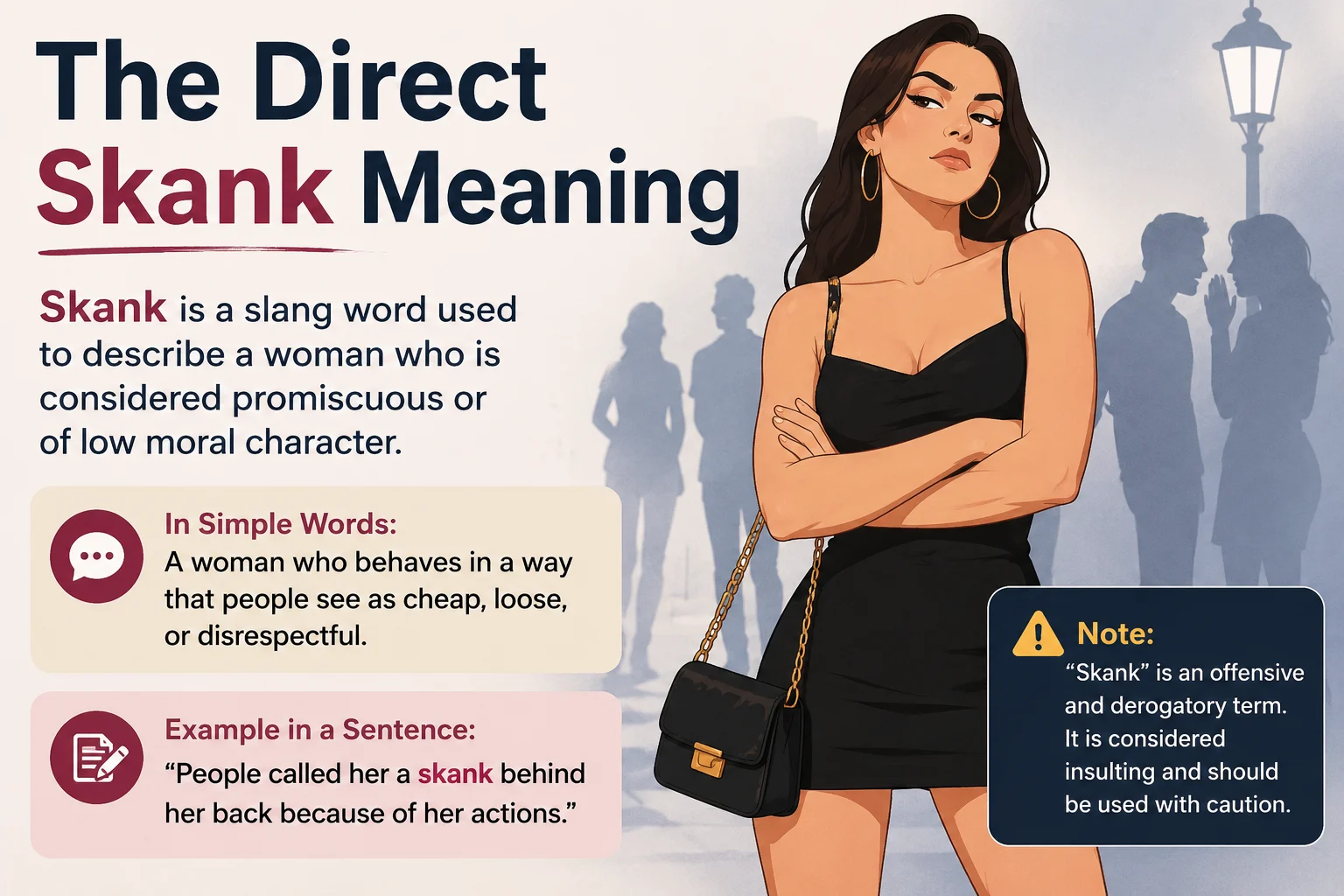
The Direct Skank Meaning
The primary skank meaning people search for is an insult. When used to describe a person, “skank” is a vulgar, demeaning term aimed almost exclusively at women, criticizing their appearance, hygiene, or perceived sexual behavior. It is not a neutral descriptive word — it functions as a put-down, and it can be genuinely hurtful.
This kind of word is sometimes described by linguists as a “slut-shaming” term — slang built specifically to police and criticize women’s real or assumed sexual choices. Unlike neutral slang that simply describes a trend or behavior, this category of word carries built-in judgment, which is part of what makes the skank meaning land so differently from a simple, casual nickname.
Because of this, the word is not appropriate for casual, friendly use, even jokingly, since it carries real weight as an insult rather than lighthearted teasing.
Unlike neutral descriptive words, the skank meaning doesn’t shift much based on tone of voice or intent. Even when someone claims they “didn’t mean it that way,” the word still lands as an insult to most listeners, because its primary function in the language is to demean rather than describe. This is different from words that can be reclaimed playfully among close friends — “skank” doesn’t have a widely accepted, affectionate alternate use.
Is the Skank Meaning Always Offensive?
Yes. In its common slang sense, the skank meaning is clearly offensive and disrespectful. It is often grouped with other misogynistic insults used to shame women, and it can contribute to harmful stereotypes about women’s bodies and choices. This isn’t a term with a “softer” casual reading — its main use is to demean.
Understanding this offensive context matters more than memorizing example sentences, since the skank meaning’s primary real-world use is as a targeted insult rather than harmless slang.
It’s also worth understanding why a word like this carries so much weight. Insults built around a woman’s perceived sexual behavior or hygiene tend to attach shame to something deeply personal, which is part of why the skank meaning can feel more cutting than a generic insult about someone’s intelligence or behavior. Recognizing this helps explain why the skank meaning shows up so often in discussions of bullying, harassment, and online abuse.
The Impact of Words Like This
Being on the receiving end of a demeaning term like this can affect more than just a single moment — repeated exposure to shaming language, whether from peers, partners, or strangers online, can wear on a person’s confidence and sense of safety over time. This is one reason schools, workplaces, and platforms increasingly treat gendered insults as a form of harassment rather than harmless teasing.
It helps to remember that the skank meaning reflects a judgment the speaker is choosing to make, not an accurate description of the person it’s aimed at. Reframing the insult this way — as a reflection of the speaker’s choice of words rather than a fact about the target — can make it easier to brush off in the moment, even if it still stings.
Origin of the Skank Meaning
The exact origin of “skank” as an insult is uncertain, and no single explanation should be treated as definitive. Some sources trace informal use of the word back several decades within English-language slang, but detailed historical documentation is limited.
Separately, “skank” or “skanking” has a clearer, well-documented history in music culture, referring to a loose, bouncy dance style that developed alongside ska music in the 1960s and later carried into reggae and punk scenes. This dance-related sense of the word is unrelated to the insult and is not considered offensive.
Linguists who study slang generally note that many insulting slang terms develop gradually through informal, spoken use long before they appear in print, which makes pinpointing an exact first use difficult. The skank meaning as an insult likely followed this same pattern — spreading through casual speech well before it became common in writing, song lyrics, or later, online text.
Skank in Music and Dance Culture
Outside the insult, “skanking” describes a specific style of dancing done to ska, reggae, or ska-punk music, involving loose arm and leg movements in time with the offbeat rhythm. Fans and musicians in these scenes use the word neutrally and without any negative connotation. This meaning is worth knowing because it explains why the same word can appear in very different, unrelated contexts online and in conversation.
Music writers and fans typically use “skanking” as a verb describing the dance itself — “the crowd was skanking along to the horn section” — rather than as a noun applied to a person. This grammatical pattern is one clue that helps separate the neutral dance meaning from the offensive personal insult, since the insulting sense almost always attaches directly to a person as a label rather than describing an action.
Gendered Language and Why Words Like This Carry Extra Weight
The skank meaning belongs to a broader category of English slang that linguists sometimes describe as gendered insults — words that criticize women specifically for perceived sexual behavior, with no widely used male equivalent that carries the same social weight. Words like “player” or “ladies’ man,” for example, are sometimes used to describe similar behavior in men but often carry a neutral or even admiring tone rather than a shaming one.
This asymmetry is a well-documented pattern in sociolinguistics, though the exact reasons behind it are debated among researchers and vary by culture and era. Understanding this pattern doesn’t change the skank meaning itself, but it does help explain why the word can feel especially loaded compared to more generic insults, and why many people consider it part of a larger pattern of language that polices women’s behavior more harshly than men’s.
Why Insulting Slang Like This Persists
Slang built around shaming tends to stick around in language for a mix of reasons: it’s short, easy to say, and it carries an immediate emotional punch, which makes it appealing to people looking for a quick way to put someone down. Because insults like this often get passed along through casual conversation, music, film, and now social media, they can persist for decades even as broader attitudes toward gender and respect shift.
At the same time, awareness campaigns, changing workplace norms, and more open conversations about harassment have pushed some communities to actively discourage the use of gendered insults like this one. The skank meaning hasn’t changed as a result, but its social acceptability in many settings has clearly declined compared to earlier decades.
The Skank Meaning in Texting and Social Media
When the word does appear in texting or on social media, it is almost always used in its insulting sense, aimed at criticizing or shaming someone. It is not considered acceptable slang for friendly banter, and using it toward someone — even as a joke — risks being genuinely hurtful or interpreted as harassment.
On social platforms, the word sometimes appears in comment sections or arguments as a quick way to attack someone rather than engage with what they actually said, which is a common pattern with gendered insults generally. Because platforms increasingly moderate harassment and targeted abuse, repeated use of a term like this toward a specific person can also violate community guidelines on many major platforms, separate from whether it’s simply considered impolite.
The Skank Meaning in Workplace and Legal Contexts
Because the skank meaning is so clearly tied to demeaning a person based on perceived sexual behavior or appearance, using the word toward a coworker can cross into workplace harassment, particularly if it’s repeated, targeted, or part of a broader pattern of hostile behavior. Many workplace conduct policies explicitly prohibit language that demeans someone based on sex or gender, and a term like this would typically fall within that category.
In more serious cases, repeated or public use of this kind of language toward a specific person could factor into harassment complaints or, in some jurisdictions, broader legal claims related to a hostile environment. Because employment law and harassment definitions vary significantly by location and specific circumstances, anyone facing this situation should consult their organization’s HR policies or a qualified professional rather than relying on a general definition.
Human resources professionals sometimes note that a single use of a word like this, in isolation, may be handled differently than a documented pattern of repeated language directed at the same person. Documentation — dates, context, and witnesses, where available — tends to matter significantly if a situation escalates to a formal complaint, which is a practical detail worth knowing separate from the word’s dictionary-level skank meaning.
Teaching Kids and Teens About Slang Like This
Parents, teachers, and other adults sometimes search for the skank meaning after hearing it used by a child or teenager, whether as something said to them, about them, or repeated from somewhere else, like a show, song, or classmate. In these conversations, it usually helps to explain plainly that the word is a gendered insult, why it can be hurtful, and that using it toward someone else isn’t acceptable, even as a joke.
For younger audiences specifically, framing the conversation around respect and kindness — rather than focusing heavily on the word’s more explicit implications — tends to be more effective than a detailed breakdown of its sexual connotations. The goal in most of these conversations isn’t to explain every nuance of the skank meaning, but to make clear that language designed to shame or demean someone isn’t something to repeat, regardless of where it was first heard.
How to Respond If Someone Calls You This
Being called a demeaning term like this can be genuinely upsetting, and it’s worth remembering that the insult reflects on the person using it, not on the person it’s aimed at. If it happens in person, it’s usually safest and most effective to calmly disengage rather than escalate, especially if the other person seems intent on provoking a reaction.
If it happens repeatedly online, most platforms allow reporting or blocking accounts that use targeted, demeaning language, and saving screenshots before reporting can help if the behavior continues. If it happens at school or work, telling a trusted adult, teacher, manager, or HR representative is a reasonable next step, particularly if the language is repeated or part of a larger pattern of unkind treatment.
It can also help to talk to a friend, family member, or counselor about how the experience made you feel, rather than carrying it alone. Insults like this are designed to isolate and shame, so reaching out rather than staying quiet often makes a real difference in how quickly the sting fades.
Similar Slang Terms to the Skank Meaning
Several other slang terms overlap with the offensive skank meaning, generally functioning as gendered insults aimed at criticizing a woman’s appearance or perceived behavior. These terms share the same core problem: they’re demeaning rather than descriptive, and none of them have a neutral, respectful equivalent. Recognizing this pattern across similar words reinforces the same skank meaning discussed throughout this article: language like this is built to demean, not describe.
The Skank Meaning in Pop Culture and Media
The word has occasionally surfaced in song titles, album names, and dialogue within punk, ska, and reggae-adjacent music scenes, sometimes playing on the overlap between the dance-related sense and the slang insult for comedic or provocative effect. Because specific claims about individual songs, films, or shows are easy to get wrong without direct verification, any particular pop-culture reference should be checked against a reliable source before being cited as fact.
More broadly, the skank meaning tends to surface in media the same way most gendered slang does — mostly in dialogue meant to signal a character’s rudeness or hostility, rather than as a term the media itself is endorsing. Viewers and listeners generally understand this kind of language as characterization rather than a recommendation, similar to how other insults function in scripted dialogue.
Regional and Generational Differences in Use
Slang intensity can shift somewhat by region, generation, and community, and “skank” is no exception. Some younger speakers may encounter the word primarily through older movies, music, or their parents’ generation rather than everyday peer conversation, which can make it feel slightly dated in some circles compared to newer insults. In other communities, particularly online spaces where older slang persists, it remains in more regular use.
Regardless of these variations, the core skank meaning as an insult stays consistent — only the frequency and cultural familiarity shift from group to group. Because usage patterns like this change over time and are difficult to measure precisely, specific claims about regional or generational popularity should be treated as general observations rather than firm statistics. Some newer slang terms have emerged that cover similar ground, and it isn’t unusual for a specific generation’s most common insult in this category to shift every decade or so as pop culture and social media introduce new terms.
Common Misunderstandings About the Skank Meaning
One common misunderstanding is assuming the skank meaning is mild or old-fashioned enough to be harmless. While it may feel less shocking than some other explicit insults, the underlying skank meaning is still a targeted, demeaning term, and treating it as harmless can minimize real harm it causes.
Another misunderstanding involves confusing the dance-related sense with the insult simply because they share a spelling. Context almost always makes the intended meaning clear — a sentence about a ska concert or dance move is describing something completely different from a sentence targeting a specific person.
A third misunderstanding is thinking that using the word about oneself, jokingly or otherwise, removes its offensive weight. While some people do use self-deprecating humor this way, the word’s broader cultural meaning as a demeaning insult doesn’t change based on who’s saying it, which is worth keeping in mind especially in mixed company or public settings.
A fourth misunderstanding assumes intent always determines impact — that if a person “meant it as a compliment” or “didn’t mean any harm,” the skank meaning somehow softens. In practice, the listener’s interpretation usually matters just as much as the speaker’s intent, and most listeners will still hear the word as an insult regardless of the reasoning behind it.
Frequently Asked Questions
What does skank mean as slang?
The skank meaning as slang is a derogatory, offensive insult typically directed at women, implying promiscuity or being unkempt.
Is skank a rude word?
Yes. It is considered rude and disrespectful in nearly all contexts and is not appropriate for casual or joking use.
Does skank have a non-offensive meaning?
Yes. “Skanking” also refers to a dance style associated with ska and reggae music, which is unrelated to the insult and carries no negative connotation.
Is skank used differently online than in person?
No. Whether used in texting, social media, or spoken conversation, the skank meaning carries the same offensive weight and risk of causing harm.
Should I use the word skank at all?
Generally, no — outside its specific, neutral use in ska and reggae dance culture, the word functions as an insult and is best avoided in everyday conversation.
Can using this word count as harassment?
Yes, potentially. Repeated or targeted use, especially at school, work, or online, can cross into harassment depending on the platform’s rules or the workplace’s conduct policy.
Why does this insult feel worse than other generic put-downs?
Because it targets a person’s perceived sexual behavior or hygiene, which are deeply personal topics, the skank meaning tends to carry more shame and sting than a generic, non-gendered insult.
How should parents explain this word to kids?
Most experts suggest keeping the explanation simple: it’s a hurtful, disrespectful word aimed at putting someone down, and it shouldn’t be repeated, without necessarily going into every detail of its sexual connotations.
Is there a male equivalent with the same weight?
Not really. While some slang terms criticize men’s behavior, few carry the same combination of shame and social judgment that the skank meaning carries when aimed at women, which reflects a broader pattern in gendered insults generally.
Does context ever make this word acceptable?
The only genuinely neutral context is the ska and reggae dance sense. Outside of that specific use, the skank meaning functions as an insult in essentially every setting, regardless of tone or relationship between speaker and listener.
Conclusion
The skank meaning that matters most is the one people are usually warned about: a disrespectful insult aimed at demeaning women, unrelated to its separate, neutral use describing a dance style in ska and reggae music. Knowing the difference helps explain why the same word shows up in such different settings, while understanding clearly that its common slang use is offensive and best avoided. If you’ve encountered this word aimed at you or someone else, remember that the insult says far more about the person using it than about the person it targets, and support from a trusted friend, family member, or professional is always a reasonable next step after an experience like that.