BFFR meaning stands for “be f***ing for real,” a more intense, emphatic version of “be for real.” It’s used to call out exaggeration, push back on something that sounds unbelievable, or ask someone to drop the act and speak genuinely. The added swear word functions purely as emphasis, not as an insult directed at anyone. This guide breaks down the term’s tone, origin, and how it compares to similar slang, along with when it fits a conversation and when it doesn’t. For more insights, read here:- ate and left no crumbs meaning and Ate meaning.
- BFFR Meaning: The Direct Definition
- Why Profanity Is Used for Emphasis in Slang Like BFFR
- Origin of BFFR as Slang
- BFFR Compared to Older Slang Expressions
- The Emotional Tone Behind BFFR
- How to Respond When Someone Says BFFR to You
- BFFR in Workplace and Formal Settings: Why It Doesn't Fit
- How People Use BFFR in Texting and Social Media
- BFFR in Everyday Conversation and Reactions
- Is the BFFR Meaning Offensive or Rude?
- BFFR vs. Similar Slang Terms
- BFFR in Dating and Social Contexts
- BFFR in Gaming and Online Communities
- Common Misunderstandings About the BFFR Meaning
- BFFR and Similar Abbreviations Across Generations
- Typing BFFR vs. Saying It Out Loud
- Writing BFFR in Different Styles
- When BFFR Might Be Misread
- Regional and Generational Differences in Use
- How to Use BFFR Correctly in a Sentence
- Frequently Asked Questions
- What does BFFR mean in texting?
- Is BFFR rude to say to someone?
- Is BFFR the same as no cap?
- Can BFFR be used seriously, not just jokingly?
- Is it okay to use BFFR at work?
- Does BFFR mean the same thing across every platform?
- Is BFFR considered offensive to specific groups?
- Will BFFR eventually go out of style?
- Conclusion
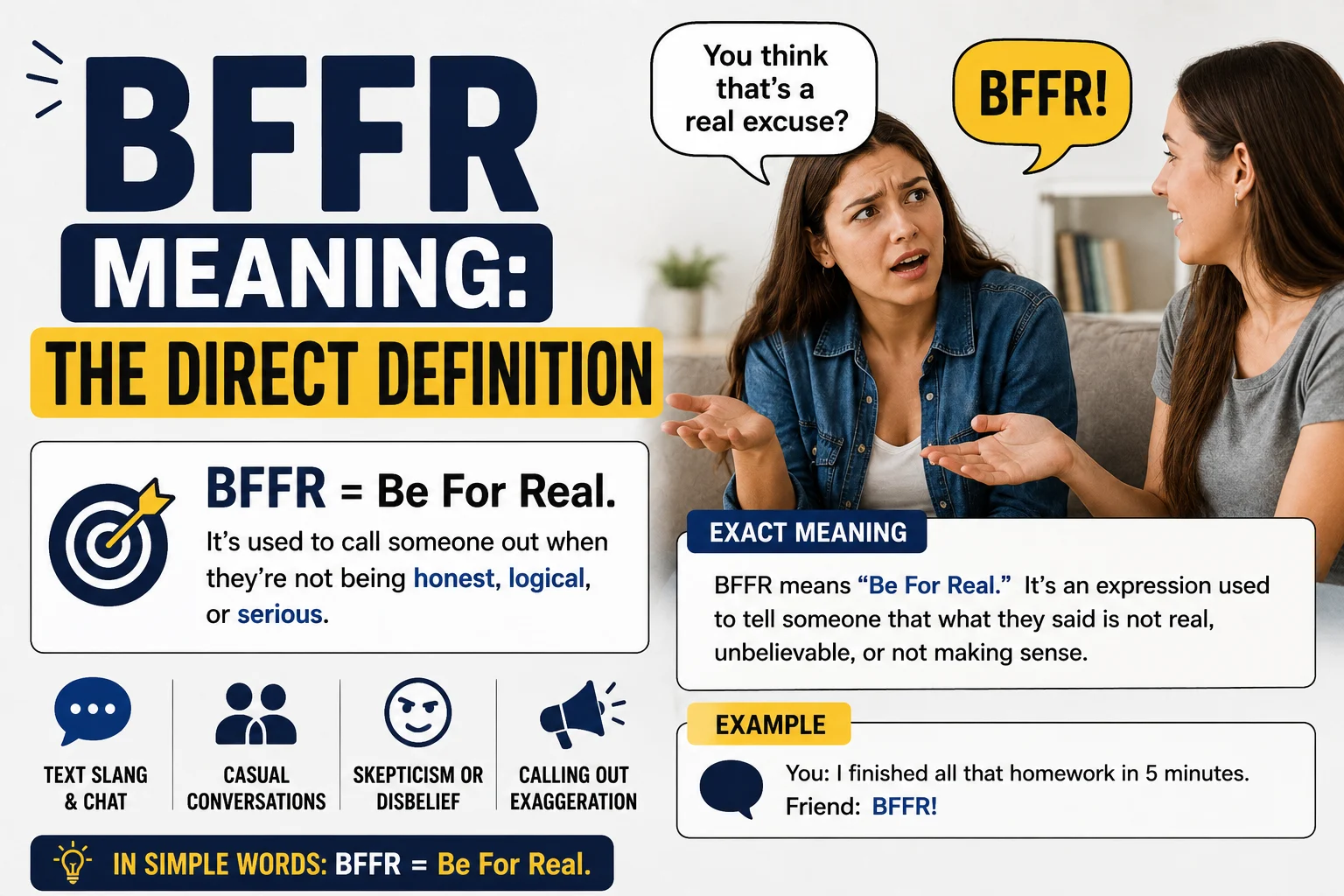
BFFR Meaning: The Direct Definition
At its core, bffr meaning centers on demanding honesty or genuine reaction from someone. It’s typically used as a reply when a statement seems exaggerated, unbelievable, or overly dramatic. Saying “bffr” pushes back on that exaggeration, essentially asking “are you serious right now?” or “stop being dramatic and tell me the truth.”
The abbreviation works as both a genuine challenge and a lighthearted reaction, depending entirely on tone and context. A friend describing an outrageous story might get a quick “bffr” simply out of disbelief and amusement, not because anyone actually doubts them in a serious way.
Why Profanity Is Used for Emphasis in Slang Like BFFR
A big part of understanding bffr meaning involves understanding why the swear word is there in the first place. Adding profanity to an existing phrase is a common way casual English intensifies emotion or emphasis without needing an entirely new word. “Be for real” already communicates sincerity, but adding profanity turns it into something sharper and more immediate, better suited for expressing genuine shock or disbelief in the moment.
This pattern shows up across plenty of casual English expressions, not just this one abbreviation. The profanity itself isn’t really “about” anything specific — it’s functioning grammatically almost like an intensifier, similar to how “really” or “seriously” might work in a milder version of the same sentence.
Origin of BFFR as Slang
Like many contemporary internet abbreviations, bffr meaning developed informally through texting and social media rather than any official coining process. It builds on the earlier, milder phrase “be for real,” adding a swear word purely for emphasis, a common pattern in casual internet slang where intensity gets added through profanity rather than new vocabulary.
Because exact origins of casual internet slang are rarely documented in real time, and because terms like this spread informally through community use before ever appearing in dictionaries, the specific point at which “bffr” became widely recognized shorthand should be treated as a general pattern rather than a firmly dated history.
BFFR Compared to Older Slang Expressions
Every generation develops its own version of a phrase meaning “seriously, stop exaggerating.” Bffr meaning fits into this long tradition, following expressions like “for real?” “no way,” and “you’re joking” that have existed in casual English for decades in one form or another. What’s different is the format — a lowercase, abbreviated, slightly profane version built for quick typing rather than spoken conversation.
This pattern of compressing an existing casual phrase into a shorter, punchier written abbreviation is common throughout internet slang more broadly, and bffr meaning represents a fairly typical example of how spoken disbelief phrases get reshaped for fast-paced texting and social media commentary.
The Emotional Tone Behind BFFR
Tone is central to understanding bffr meaning correctly. Read without context, the phrase might look harsh or confrontational, but in practice, it almost always carries a mix of surprise, amusement, and mild disbelief rather than genuine anger or hostility. The swear word intensifies the emotional reaction rather than escalating the situation into something serious or aggressive.
This is part of why the abbreviation works so well in fast-paced group chats and comment sections — it communicates a strong emotional reaction in just four letters, without requiring a longer, more detailed explanation of exactly why something feels hard to believe.
How to Respond When Someone Says BFFR to You
Understanding bffr meaning also means knowing how to respond naturally when it’s directed at you. Doubling down with more detail, sending proof if it’s readily available, or simply laughing along and confirming the claim are all common, natural responses. Since the comment is usually more about shared disbelief than a serious accusation, a relaxed, playful response usually fits the tone best.
Getting genuinely defensive over a casual “bffr” can sometimes feel like an overreaction, given how lighthearted the term usually is intended to be, though reading the specific relationship and conversation is still worth doing before assuming the comment is purely playful.
BFFR in Workplace and Formal Settings: Why It Doesn’t Fit
Because bffr meaning includes profanity, it’s essentially never appropriate in professional emails, workplace messaging, or formal writing of any kind. Even workplaces with fairly relaxed communication styles generally still expect written communication to avoid casual swearing, especially in messages that might be read by clients, supervisors, or people outside a close, informal friend group.
This doesn’t mean the underlying sentiment — genuine disbelief or a request for honesty — can’t be expressed at work. It simply means choosing a more formal phrasing, like “are you serious?” or “I find that hard to believe,” rather than the abbreviated, profanity-included version common in casual texting.
How People Use BFFR in Texting and Social Media
The abbreviation shows up constantly in texting and social media comments, typically as a short, standalone reaction to something surprising, exaggerated, or hard to believe. Someone might comment “BFFR” under a wild claim in a post, or text it directly in response to a friend’s exaggerated story.
This usage tends to carry a mix of disbelief and amusement rather than genuine anger, similar to saying “no way, seriously?” out loud. Understanding bffr meaning in this context mostly comes down to recognizing that playful, incredulous tone rather than reading it as a harsh accusation.
Scrolling through comment sections under surprising or exaggerated posts is often the easiest way to see this pattern of bffr meaning play out naturally in real conversation.
BFFR in Everyday Conversation and Reactions
One of the most common places to see bffr meaning play out is in casual back-and-forth conversation between friends. Someone claiming an unbelievable coincidence or a wildly exaggerated excuse might get an immediate “bffr” in response, calling out the exaggeration in a quick, familiar way.
Example: “He said he ran five miles before 6 AM and still made it to work early — bffr.” This kind of message uses the abbreviation to express genuine disbelief without needing a longer explanation of exactly why the claim seems questionable, which is really the whole practical value behind bffr meaning in everyday texting.
Is the BFFR Meaning Offensive or Rude?
Bffr meaning includes a swear word, so it’s not appropriate for every setting — professional emails, formal writing, or conversations with people who might be uncomfortable with casual profanity should generally avoid it. That said, among friends in casual texting or social media, it’s rarely considered genuinely offensive or aimed at hurting anyone.
The swear word functions as intensity rather than insult, similar to how many casual phrases use profanity for emphasis without directing it at a specific person. Context and relationship matter here — using it with close friends who text this way regularly reads very differently than using it in a professional or unfamiliar setting, which is really the practical boundary to keep in mind alongside the dictionary-style bffr meaning covered throughout this guide.
BFFR vs. Similar Slang Terms
Several other slang terms overlap with bffr meaning, though each carries a slightly different flavor. “No cap” emphasizes truthfulness without any implication of disbelief about a specific claim. “Deadass” emphasizes sincerity, often used when making a serious or surprising statement oneself rather than reacting to someone else’s claim. “FR FR” (for real, for real) doubles down on sincerity through repetition rather than profanity. “Be so fr” is a closely related, slightly softer variant that expresses similar disbelief without the added swear word.
Unlike some of these alternatives, bffr specifically implies pushing back on something that sounds exaggerated or hard to believe, rather than simply affirming one’s own honesty. This distinction is a useful way to remember bffr meaning specifically, compared to the broader family of honesty-focused slang it belongs to.
BFFR in Dating and Social Contexts
In dating conversations and casual social exchanges, bffr meaning often shows up when someone shares a surprising update, a questionable excuse, or an unexpected turn of events. A friend hearing about a partner’s implausible explanation might respond with “bffr” as a way of expressing skepticism in a lighthearted, familiar tone rather than a serious accusation.
This usage reflects the term’s broader function as social commentary — a quick, casual way of reacting to something that seems a little too convenient or unbelievable to simply accept at face value, which is exactly the everyday, conversational side of bffr meaning most people encounter first.
BFFR in Gaming and Online Communities
Gaming chats and online communities also use bffr meaning frequently, particularly in reaction to an impressive play, a suspicious claim, or an exaggerated boast. A player claiming an unlikely win streak might get hit with “bffr” from teammates questioning the claim, using the abbreviation as quick, informal pushback within fast-moving chat conversations.
Because platform-specific popularity is difficult to measure precisely and shifts constantly, any claim about exactly how common the term is on a specific platform or within a specific gaming community should be treated as a general impression rather than firmly measured data. Even so, this competitive, reactive use of bffr meaning fits naturally into the fast-paced back-and-forth typical of gaming chat culture.
Common Misunderstandings About the BFFR Meaning
One common misunderstanding is assuming “bffr” is always aggressive or genuinely angry. In most casual contexts, it’s closer to lighthearted disbelief than real hostility, more similar to laughing in disbelief than confronting someone seriously.
Another misunderstanding treats the swear word within the abbreviation as an insult directed at the other person. In reality, the profanity functions purely as emphasis on the phrase itself, not as language aimed at demeaning whoever it’s used toward.
A third misunderstanding assumes bffr meaning is appropriate in every casual setting simply because it’s common online. Workplace messaging, conversations with family members who dislike profanity, or any context involving people unfamiliar with the term are all situations where the abbreviation could easily land wrong, regardless of how normal it feels within certain friend groups or online spaces.
A fourth misunderstanding assumes the term always demands a genuine, detailed explanation in response. Often, a quick laugh, a playful confirmation, or simply moving on with the conversation is a perfectly natural reaction, since the comment is frequently more about shared amusement than an actual demand for proof.
BFFR and Similar Abbreviations Across Generations
Every few years, casual slang tends to cycle through new abbreviations expressing the same handful of core reactions: disbelief, sincerity, emphasis, and exasperation. Bffr meaning fits into this ongoing cycle, likely to eventually be replaced or supplemented by newer terms even as its core function — reacting to something that feels exaggerated — remains a permanent part of casual conversation.
This cyclical pattern is worth keeping in mind for anyone trying to track slang usage over time. The underlying communicative need rarely disappears; only the specific abbreviation or phrase representing it tends to shift as language keeps evolving in casual, informal spaces, which is a useful bit of perspective to hold alongside any single snapshot definition of bffr meaning.
Typing BFFR vs. Saying It Out Loud
While bffr meaning developed primarily as written texting shorthand, some people have started saying the abbreviation itself out loud, pronounced as separate letters, rather than expanding it into the full phrase. This spoken use tends to happen most often among people already deeply familiar with texting culture, where abbreviations sometimes cross over into spoken conversation as a kind of inside joke or shared shorthand — one more sign of just how flexible bffr meaning has become since its origins as a purely written abbreviation.
This crossover between written and spoken slang isn’t unique to this particular term, but it does highlight how thoroughly internet abbreviations have started blending into everyday spoken language for certain groups, particularly younger, heavily online communities.
Writing BFFR in Different Styles
Bffr meaning stays the same regardless of capitalization or punctuation, but style choices can shift the tone slightly. Lowercase “bffr” tends to feel more casual and low-key, common in quick texts between close friends. Fully capitalized “BFFR” often adds visual emphasis, similar to shouting the phrase, and shows up more often in comments or captions meant to grab attention. Adding extra punctuation, like “bffr??” or “BFFR!!,” pushes the emotional intensity even further, signaling heightened disbelief or excitement.
None of these stylistic variations change the underlying definition — they simply adjust how strongly the reaction comes across, giving texters a flexible way to fine-tune tone without needing an entirely different word or phrase to express the same core bffr meaning.
When BFFR Might Be Misread
Because bffr meaning depends so heavily on tone and shared context, there’s some risk of it being misread by someone unfamiliar with casual internet slang, or by someone reading a message without the benefit of vocal tone or facial expression. A text that reads as playful teasing to a close friend could potentially come across as harsher or more confrontational to someone less familiar with how the term is typically used.
This risk is one more reason context and relationship matter so much with this particular abbreviation. Sending “bffr” to someone who doesn’t already share a casual, joking rapport increases the chance the message lands differently than intended, regardless of how lighthearted it was meant to be — a practical caveat worth remembering alongside the more straightforward bffr meaning covered earlier in this guide.
Regional and Generational Differences in Use
Like most contemporary internet slang, bffr meaning tends to be most familiar among younger texters and social media users, particularly those active in spaces where quick, expressive reactions are part of the everyday conversational style. Older or less frequently online audiences may encounter the term less often or need brief context the first time they see it.
Because slang popularity shifts constantly and varies significantly across communities and platforms, general claims about which age groups or regions use the term most should be treated as broad tendencies rather than precise, measurable data.
How to Use BFFR Correctly in a Sentence
Because the abbreviation depends heavily on tone, it helps to see a few natural examples. As disbelief: “You finished that entire project in one night? Bffr.” As playful pushback: “Bffr, there’s no way that actually happened.” As emphasis paired with a question: “Wait, bffr, did that actually just happen?”
In each case, “bffr” works either as a standalone reaction or a short lead-in to a follow-up question, reflecting how flexible the abbreviation is within casual, conversational texting.
Frequently Asked Questions
What does BFFR mean in texting?
Bffr meaning stands for “be f***ing for real,” an emphatic way of calling out exaggeration or asking someone to be genuinely honest.
Is BFFR rude to say to someone?
Not typically, among friends in casual conversation. The profanity adds emphasis rather than functioning as a genuine insult, though it’s still not appropriate for formal or professional settings.
Is BFFR the same as no cap?
They’re related but slightly different. “No cap” affirms honesty directly, while bffr more often pushes back on something that sounds exaggerated or hard to believe.
Can BFFR be used seriously, not just jokingly?
Yes. While often lighthearted, it can also express genuine disbelief or frustration, depending on tone and context.
Is it okay to use BFFR at work?
Generally no. Because it includes profanity, it’s best kept to casual texting or social media rather than professional communication.
Does BFFR mean the same thing across every platform?
Its core meaning stays consistent, though exact popularity and frequency can vary somewhat by platform and community.
Is BFFR considered offensive to specific groups?
Not typically. It’s general-purpose casual slang rather than language targeting any particular group, though its profanity still makes it unsuitable for formal or unfamiliar settings.
Will BFFR eventually go out of style?
Likely, like most slang. New abbreviations tend to replace older ones over time, even though the underlying reaction of disbelief the term expresses will probably always have some casual shorthand attached to it.
Conclusion
Bffr meaning ultimately comes down to one clear idea: emphasis on genuine honesty, delivered with a playful, disbelieving punch. Whether reacting to an unbelievable story, a suspicious excuse, or an exaggerated claim, the abbreviation gives casual conversation a quick, familiar way to call out exaggeration without needing a longer explanation. Like most slang built around emphasis and reaction, it’s less about literal meaning and more about capturing a shared, immediate feeling between the people using it.