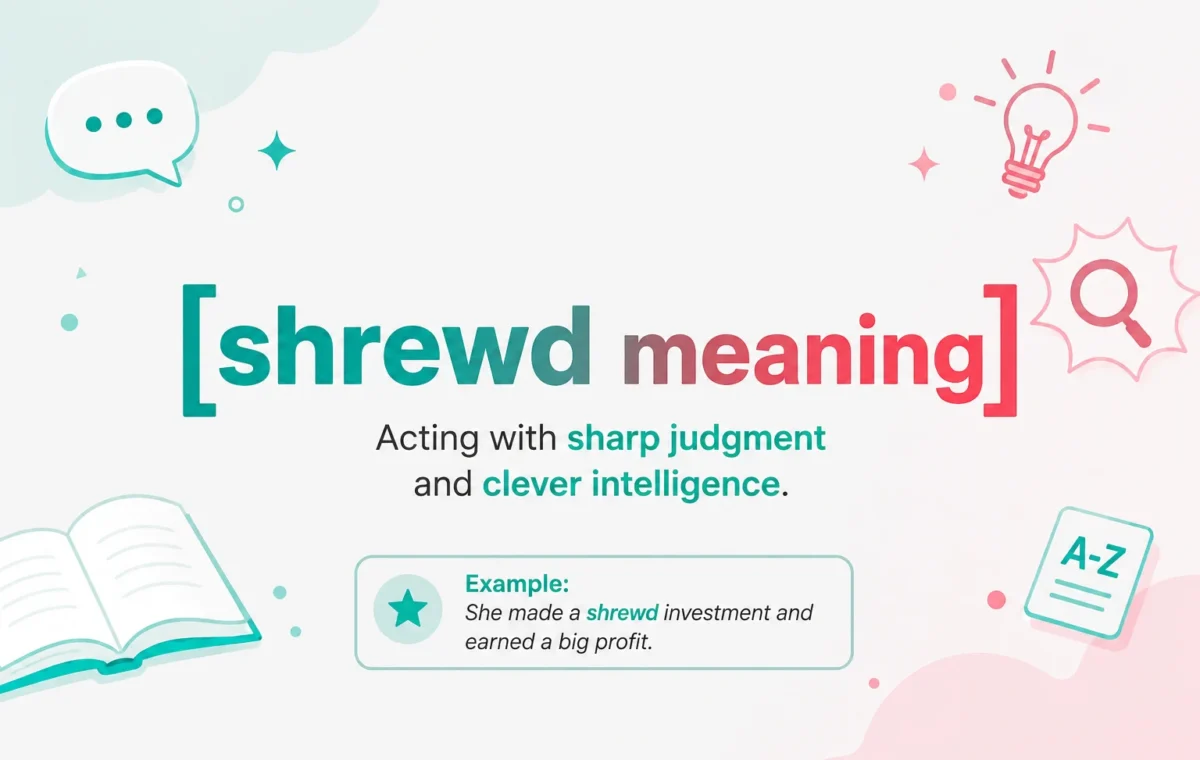
Shrewd means having sharp judgment and practical intelligence, especially in business, money, or strategic situations, often developed through years of real-world experience. A shrewd person notices details others miss and makes smart, calculated decisions rather than acting on impulse or emotion. For more insights, read here:- sagacious meaning and rescind meaning.
- Quick Definition
- The Shrewd Meaning in Everyday Use
- Is "Shrewd" a Compliment or an Insult?
- Where the Word Comes From
- Shrewd vs. Similar Words
- Is "Shrewd" Used as Slang?
- Common Misunderstanding
- Similar Expressions
- Workplace Context
- Dating and Relationship Context
- Gaming Context
- Frequently Asked Questions
- What is the simplest way to explain the shrewd meaning?
- Is shrewd a positive or negative word?
- What's the difference between shrewd and cunning?
- Can shrewd describe a decision, not just a person?
- Where does the word shrewd come from?
- Is shrewd used differently across English-speaking regions?
- Wrapping Up
Quick Definition
- Shrewd (adjective): showing sharp powers of judgment, especially in practical or financial matters.
- Example: “Her shrewd negotiating skills got the company a much better deal than expected, a clear demonstration of the shrewd meaning in action.”

The Shrewd Meaning in Everyday Use
In everyday conversation, the shrewd meaning usually points to someone who’s practically clever, good at reading situations, and skilled at making decisions that pay off in the long run. It’s less about book smarts and more about street-smart, strategic thinking honed through real experience.
People often reach for this word specifically because “smart” feels too generic and overused for what’s actually being described here. The shrewd meaning adds a distinct layer of practical, real-world savvy that a plainer compliment might miss entirely.
Example sentences:
- “He made a genuinely shrewd investment that doubled in value within a single year.”
- “Her shrewd observation about the client’s real underlying concerns changed the entire pitch.”
- “The coach’s shrewd substitution in the final minutes ultimately won them the game.”
- “It was a shrewd move to negotiate the terms carefully before signing anything at all.”
Is “Shrewd” a Compliment or an Insult?
Generally a compliment, though it can carry a slightly edgy undertone depending entirely on the surrounding context. Calling someone shrewd usually praises their sharp judgment and strategic thinking, but in some cases it can hint at calculating or self-interested behavior.
- Positive framing: “She’s a genuinely shrewd businesswoman who always spots a good opportunity before anyone else notices it.”
- Slightly negative framing: “His shrewd maneuvering throughout the negotiation ultimately left his rivals with absolutely nothing to work with.”
This dual potential is part of what makes the shrewd meaning interesting to track in conversation. The same core quality, sharp practical judgment, can read as admirable or slightly ruthless depending entirely on the surrounding words.
Where the Word Comes From
“Shrewd” originally comes from Middle English, related to the word “shrew,” which historically described a small, sharp-toothed mammal and, separately, was used to describe a scolding or ill-tempered person. Over time, “shrewd” shifted away from that negative sense and developed its modern meaning of sharp, practical intelligence, though the exact path of this shift isn’t fully documented and should be treated as a general historical pattern rather than a precise timeline.
This somewhat unexpected origin adds a genuinely interesting layer to the shrewd meaning today. A word once tied specifically to sharp teeth and bad temper eventually settled comfortably into describing sharp minds instead, a shift that reflects how word meanings can drift quite far from their original sense over many centuries of ordinary everyday use.
Shrewd vs. Similar Words
Shrewd is often confused with related words that don’t quite capture the same balance of intelligence and practicality.
- Shrewd — sharp, practical judgment, especially valuable in strategic or financial situations that require careful thought.
- Cunning — implies cleverness used deceptively, often carrying a distinctly negative connotation in most contexts.
- Wise — implies broader, deeper judgment, often including significant moral or life experience accumulated over time.
- Sly — implies sneaky or underhanded cleverness, generally read as more negative than shrewd.
- Perceptive — emphasizes noticing details clearly and accurately, without necessarily implying strategic follow-through or action.
Comparing these words side by side helps pin down the shrewd meaning more precisely and clearly. It sits closer to the positive end of the spectrum than “cunning” or “sly,” while still implying considerably more strategy than a purely observational word like “perceptive.”
Is “Shrewd” Used as Slang?
No, “shrewd” isn’t slang. It’s a standard English adjective used in formal and informal writing alike, and it doesn’t carry a hidden or alternate meaning online. Its use stays fairly consistent across contexts and doesn’t shift by platform or region.
Because it’s regarded as such a stable, dependable, and consistent word across the shrewd meaning’s long history, it rarely gets misused the way genuine slang can, where a word’s sense might shift dramatically depending on the audience, platform, or setting involved.
Common Misunderstanding
Some people assume “shrewd” always implies dishonesty or manipulation, but that’s not accurate. While it can carry a slightly calculating undertone in certain contexts, the word’s core meaning is simply sharp, practical judgment, not deception.
This misunderstanding often comes from a small handful of specific negative examples overshadowing the word’s much broader, mostly positive everyday use across countless ordinary situations. In the vast majority of ordinary sentences and everyday conversations, the shrewd meaning leans firmly toward genuine admiration rather than suspicion or distrust of any kind.
Similar Expressions
- Astute — very close in meaning, genuinely emphasizing sharp perception and consistently good judgment across situations.
- Savvy — a more casual, everyday synonym, often used for practical, real-world know-how and street smarts.
- Sharp-witted — emphasizes quick thinking and mental agility, especially in fast-moving conversations or negotiations.
- Canny — close in meaning, often used specifically in a similar business or strategic context involving money.
- Discerning — emphasizes careful judgment and the genuine ability to tell things apart clearly, somewhat overlapping with the shrewd meaning.
None of these words are exact synonyms. Each carries a slightly different emphasis, whether that’s speed of thought, casual practicality, or careful discernment, even though they all circle around the same general idea of sharp, effective judgment.
Workplace Context
“Shrewd” comes up often in professional and business settings, usually describing someone skilled at negotiation, strategy, or spotting opportunities others overlook.
- “Her genuinely shrewd handling of the delicate merger negotiations saved the company several million dollars in the end.”
- “He’s widely known as a shrewd operator who always seems to land the very best deals available.”
In a workplace setting specifically, the shrewd meaning is generally treated as a strong compliment, signaling someone whose judgment can consistently be trusted in high-stakes situations.
Dating and Relationship Context
Occasionally, “shrewd” shows up in dating or relationship conversations, usually describing someone who reads social situations well or makes thoughtful, deliberate choices about who they date and how.
- “She’s genuinely shrewd about relationships, never rushing into anything serious without really knowing someone well first.”
- “His shrewd, careful approach to dating meant he asked a lot of thoughtful questions early on in every relationship.”
Gaming Context
Occasionally, “shrewd” shows up in gaming commentary, usually describing a player who makes smart, calculated decisions rather than relying on luck or aggression alone.
- “That was a shrewd play, saving resources for exactly the right moment.”
- “The shrewd meaning fits her perfectly, she always outthinks opponents rather than outmuscling them.”
Frequently Asked Questions
What is the simplest way to explain the shrewd meaning?
It means having sharp, practical judgment, especially in business, money matters, or strategic decisions, allowing someone to notice small details others miss entirely. That single idea, sharp and practical rather than merely intelligent, covers most of how the word gets used.
Is shrewd a positive or negative word?
Generally positive overall, praising sharp judgment and strategic thinking, though it can carry a slightly calculating undertone depending on context. Most of the time, the shrewd meaning leans clearly toward admiration rather than criticism.
What’s the difference between shrewd and cunning?
Shrewd implies sharp, legitimate judgment developed through genuine experience, while cunning often implies cleverness used deceptively or manipulatively. This is really the clearest boundary separating the shrewd meaning from its more negatively toned cousin.
Can shrewd describe a decision, not just a person?
Yes. A decision, a strategy, a plan, or a business move can all be described as shrewd if it shows sharp, practical thinking. The shrewd meaning applies just as naturally to an action as it does to the person behind it.
Where does the word shrewd come from?
It comes from Middle English, related to “shrew,” which historically described both a small sharp-toothed animal and an ill-tempered person, before the word gradually shifted toward its current meaning. That older, now largely unrelated sense has almost entirely faded from how most people understand the shrewd meaning today.
Is shrewd used differently across English-speaking regions?
Not in any major way. Its use stays fairly consistent across British, American, and other varieties of English, generally describing sharp, practical judgment regardless of exactly where or by whom it’s used, whether that’s in a formal business context, a casual conversation, or written commentary.
Wrapping Up
The shrewd meaning ultimately comes down to sharp, practical intelligence: the ability to read a situation clearly and make smart, calculated decisions others might miss entirely. Understanding this balance between cleverness and practicality helps clarify when the word is meant as a genuine compliment versus a subtle criticism. For a broader look at related personality traits, the Wikipedia entry on practical wisdom is a useful starting reference.