Rescind meaning refers to the act of officially canceling, revoking, or withdrawing something that was previously agreed, offered, or put into effect. You can rescind an offer, rescind a contract, rescind a law, or rescind a decision. The word implies a formal, deliberate reversal rather than a casual change of mind. Because it shows up across legal, business, government, and even personal situations, this guide walks through each context in detail, along with tone, common mix-ups, and practical example sentences. For more insights, read here:- rendezvous meaning and rendition meaning.
- The Direct Meaning of Rescind
- Origin and Etymology of the Rescind Meaning
- How the Rescind Meaning Is Used in Everyday English
- The Rescind Meaning in Legal and Contract Contexts
- Rescind in Real Estate and Consumer Contracts
- Rescind in Academic and Institutional Contexts
- The Rescind Meaning in Business and Employment
- The Rescind Meaning in Government and Policy
- Rescind vs. Withdraw: Is There a Difference?
- Is the Rescind Meaning Formal or Casual?
- The Tone and Emotional Weight of Rescind
- Rescind vs. Similar Words
- Common Misunderstandings About the Rescind Meaning
- How to Use Rescind in a Sentence
- Why People Search for the Rescind Meaning
- Frequently Asked Questions
- What does rescind mean in simple terms?
- Is rescind the same as cancel?
- Can a job offer really be rescinded after it's accepted?
- What is the difference between rescind and revoke?
- Is rescind a formal or casual word?
- What does it mean when a law is rescinded?
- Is there a legal deadline for rescinding a contract?
- Conclusion
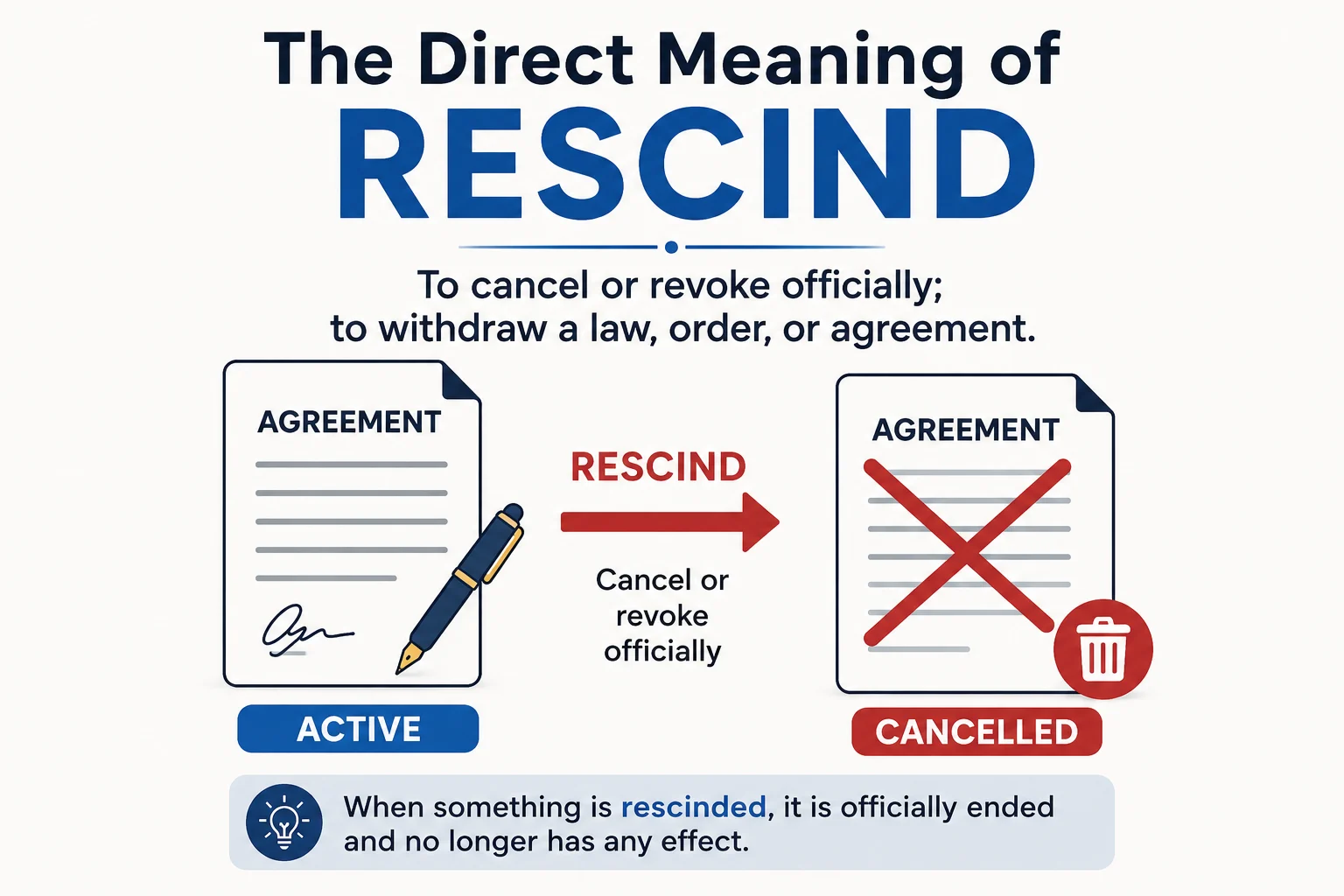
The Direct Meaning of Rescind
At its core, the rescind meaning describes taking back something that had legal, official, or formal standing. If a company rescinds a job offer, the offer no longer exists, as though it had never been made in the first place. This is different from simply changing plans informally — rescinding usually involves undoing something that had real consequences or commitments attached to it.
The word is almost always used in situations involving agreements, decisions, laws, or formal statements, rather than everyday casual plans. You wouldn’t typically say you “rescinded” dinner plans with a friend; you’d more likely say you canceled or called them off instead.
Origin and Etymology of the Rescind Meaning
Rescind comes from the Latin “rescindere,” formed from “re-” (back) and “scindere” (to cut or split). Together, the roots suggest the idea of “cutting back” or “cutting off,” which fits neatly with the modern rescind meaning of officially undoing something. English adopted the word through French and Latin legal and academic writing, where formal, precise vocabulary for canceling agreements was especially important.
Because exact historical adoption dates and pathways vary across sources, the precise timeline of when “rescind” entered common English legal use is uncertain. What is clear is that the core rescind meaning — a formal act of cutting something off or undoing it — has remained remarkably stable across centuries of use.
How the Rescind Meaning Is Used in Everyday English
In everyday speech, the rescind meaning usually appears in situations involving official decisions rather than casual conversation. News articles, workplace emails, legal notices, and government statements are the most common places you’ll encounter the word. It’s less common in relaxed texting or social media slang, since the tone of the word carries a formal weight that doesn’t fit loose, casual messages.
Example: “The university rescinded its acceptance letter after discovering the application contained false information.”
That said, the word does occasionally show up in more personal contexts when someone wants to emphasize how official or final a change feels — for instance, joking that you’re “rescinding” an invitation to a party after a friend behaved badly.
The Rescind Meaning in Legal and Contract Contexts
The rescind meaning is especially important in legal and contract law. Rescission, the legal term related to rescind, refers to the formal cancellation of a contract, effectively treating it as though it never existed. Courts may allow rescission in situations involving fraud, misrepresentation, mistake, or a serious breach of the agreement.
This differs from simply ending or “terminating” a contract, since termination usually stops future obligations while leaving past obligations intact, whereas rescission aims to restore both parties to the position they were in before the contract existed. Because contract law varies by jurisdiction, specific legal outcomes tied to rescission should always be verified against local statutes or a qualified legal professional rather than general definitions.
Example: “The buyer sought to rescind the purchase agreement after learning the seller had concealed serious structural damage.”
Rescission is generally treated as a significant legal remedy rather than a routine option, since courts weigh whether restoring both parties to their original position is genuinely fair and practical. In some cases, a party seeking rescission may also need to return any benefit they already received under the contract, such as a deposit or delivered goods, before the cancellation is considered complete. This reinforces the core rescind meaning of “undoing” rather than simply “stopping” an agreement partway through.
Rescind in Real Estate and Consumer Contracts
The rescind meaning also plays an important role in real estate and consumer protection law. Certain types of agreements, such as some home equity loans or contracts signed during in-home sales visits, may come with a legally defined “right to rescind” or “cooling-off period,” during which a buyer can cancel the agreement without penalty, no questions asked.
This right to rescind exists specifically to protect consumers from high-pressure sales situations or decisions made too quickly without enough time to reconsider. The exact length of these cooling-off periods, and which types of contracts they apply to, varies by country, region, and the specific type of agreement involved, so any specific claim about a rescission window should be verified against current consumer protection law rather than assumed to apply universally.
Example: “After signing the loan documents, she realized she had three business days to rescind the agreement if she changed her mind.”
Rescind in Academic and Institutional Contexts
Schools, colleges, and universities also use the rescind meaning in specific, sometimes high-stakes situations. A university might rescind an admission offer if a student’s final grades drop significantly after acceptance, or if the school later discovers false information on the original application. In rarer cases, an institution may even rescind a previously awarded degree if serious academic misconduct, such as plagiarism or fraud, is discovered after graduation.
These situations tend to receive significant attention precisely because they reverse something that felt settled and official, echoing the same core rescind meaning found in legal and business contexts: undoing something that had real, formal standing.
The Rescind Meaning in Business and Employment
One of the most common everyday encounters with the rescind meaning happens in employment and business settings. A company might rescind a job offer if a background check reveals a problem, if the position is eliminated before the employee starts, or if the candidate fails to meet a condition of employment, such as a required certification.
For job seekers, hearing that an offer has been rescinded can be understandably stressful, since it reverses what had felt like a settled outcome. In business more broadly, companies may also rescind proposals, bids, or partnership agreements if circumstances change significantly before the deal is finalized.
Example: “After the merger fell through, the company rescinded its earlier bid to acquire the smaller firm.”
The Rescind Meaning in Government and Policy
Governments and institutions frequently use the rescind meaning when discussing laws, regulations, executive orders, or official policies. A rescinded law is no longer in effect, as though it had been formally erased from the books, though records of its prior existence remain part of legislative history. A rescinded executive order similarly loses its legal force going forward.
This use of the word appears constantly in news coverage of policy changes, since governments and agencies regularly rescind, replace, or update regulations as circumstances shift. A rescinded policy can sometimes be reinstated later through a separate formal process, but until that happens, the original rescind meaning holds: the rule or order is treated as though it no longer exists. Because policy details, dates, and legal effects of specific rescinded laws or orders change over time and vary by country, any specific claims about particular laws should be verified against current official sources rather than assumed from general usage.
Rescind vs. Withdraw: Is There a Difference?
“Withdraw” is another word people often reach for alongside rescind, and the two overlap in many situations. You can “withdraw an offer” or “rescind an offer” and often mean essentially the same thing in casual usage.
The subtle difference is that “withdraw” can apply to almost anything being pulled back, including something informal, like withdrawing from a conversation or a race, while the rescind meaning specifically implies undoing something that had official, agreed-upon, or binding status. In formal writing, “rescind” tends to sound slightly more precise and legally weighted than the more general “withdraw.”
Is the Rescind Meaning Formal or Casual?
Rescind sits firmly on the formal end of English vocabulary. It’s a word you’ll find in legal documents, official letters, policy announcements, and professional communication far more often than in casual conversation. Choosing “rescind” over more casual alternatives like “cancel” or “take back” usually signals that the speaker wants to emphasize the formality, seriousness, or official nature of the reversal.
This is part of why the rescind meaning carries a slightly heavier tone than similar everyday words — it’s reserved for situations where something official is being undone, not just a casual plan falling through.
The Tone and Emotional Weight of Rescind
Beyond its technical definition, the rescind meaning carries a noticeable emotional weight in everyday use. Because the word usually appears in moments involving job offers, contracts, or official decisions, hearing that something has been “rescinded” often lands as disappointing or even alarming news, even before the specific details are known.
This emotional undertone is part of why writers and speakers choose “rescind” deliberately rather than reaching for a softer alternative. Saying an offer was “rescinded” signals finality and seriousness in a way that gentler phrases like “put on hold” or “reconsidered” simply don’t convey. Recognizing this tone helps readers understand not just the literal rescind meaning, but also why the word tends to show up in headlines and formal notices rather than casual chat.
Rescind vs. Similar Words
Several words overlap with the rescind meaning, but each carries slightly different shades of formality or context.
“Revoke” is extremely close to rescind and often used interchangeably, particularly with licenses, permissions, or privileges — a rescinded license and a revoked license mean essentially the same thing in most everyday usage.
“Repeal” is used almost exclusively for laws and legislation, whereas rescind applies more broadly to contracts, offers, and decisions as well as laws.
“Retract” often applies to statements, claims, or published content, such as retracting a public statement or a scientific paper, rather than formal agreements.
“Annul” typically implies making something void as though it never legally existed, which overlaps closely with the legal rescission sense of rescind, though “annul” is used especially often in the context of marriages.
“Cancel” is the most casual and general term of the group, usable for almost anything from plans to subscriptions, without necessarily implying any formal or legal process at all.
Understanding these distinctions helps clarify exactly what the rescind meaning adds that these other words don’t always capture: a sense of formal, deliberate, and often legally significant reversal. Choosing the right word from this group often comes down to context — a lawyer drafting a contract clause, a journalist reporting on a policy change, and a manager writing an internal memo might each reach for a slightly different term depending on how official or permanent the reversal is meant to sound.
Common Misunderstandings About the Rescind Meaning
One common mix-up is confusing “rescind” with “resend,” since the two words look and sound somewhat similar in quick reading or typing. They are completely unrelated — “resend” simply means to send something again, while “rescind” means to formally cancel or withdraw something.
Another misunderstanding involves assuming rescind can only apply to legal documents. While legal and contractual use is extremely common, the rescind meaning applies just as naturally to job offers, invitations, policies, statements, and everyday official decisions that don’t involve courts or contracts at all.
A third misunderstanding treats “rescind” and “cancel” as perfectly interchangeable in every situation. While they’re related, “rescind” specifically implies undoing something that had official or binding status, while “cancel” can apply to almost anything, including things that were never formal to begin with, such as a canceled coffee meetup.
How to Use Rescind in a Sentence
Because the word shows up across several distinct contexts, it helps to see the rescind meaning applied naturally in different situations. In an employment context: “The company rescinded the job offer after the candidate failed the required background check.” In a legal context: “The court allowed the buyer to rescind the contract due to the seller’s fraudulent misrepresentation.” In a government context: “Lawmakers voted to rescind the outdated regulation after years of public criticism.” In a personal context: “She jokingly said she was rescinding her dinner invitation after he showed up two hours late.”
Each of these examples relies on the same underlying idea — something official, agreed upon, or previously granted is being formally taken back — even though the settings range from courtrooms to casual dinner plans.
Why People Search for the Rescind Meaning
Most people look up the rescind meaning after encountering the word in a specific, often stressful situation: a rescinded job offer, a rescinded contract, or news coverage about a rescinded law or policy. Because the word rarely appears in relaxed, everyday conversation, many readers simply haven’t encountered it often enough to feel confident about its exact meaning, tone, and implications, which is exactly why a clear, direct explanation matters more than a long, roundabout definition.
This pattern is fairly common with formal vocabulary in general — words that live mostly in official documents, legal filings, and news reporting tend to feel unfamiliar even to fluent speakers simply because they don’t come up in daily conversation. Once a reader sees a handful of clear, concrete examples, though, the word usually stops feeling intimidating and starts feeling like a normal, useful addition to their vocabulary, ready to reach for the next time a truly formal cancellation needs describing.
Frequently Asked Questions
These quick answers cover the most common questions people ask about the rescind meaning.
What does rescind mean in simple terms?
The rescind meaning is to formally cancel, revoke, or withdraw something that was previously agreed, offered, or put into effect, such as an offer, contract, or law.
Is rescind the same as cancel?
Not exactly. Rescind implies undoing something with official or binding status, while cancel is a more general, casual term that can apply to almost anything.
Can a job offer really be rescinded after it’s accepted?
Yes. Employers can sometimes rescind an accepted job offer, particularly if a condition of employment isn’t met, though specific legal protections vary by jurisdiction and situation.
What is the difference between rescind and revoke?
The two words are very close in meaning and often used interchangeably, though “revoke” appears especially often with licenses and permissions, while “rescind” is common with offers, contracts, and laws.
Is rescind a formal or casual word?
It’s formal. Rescind appears far more often in legal, professional, and official writing than in casual conversation or texting.
What does it mean when a law is rescinded?
A rescinded law is no longer legally in effect going forward, though it remains part of legislative history and record.
Is there a legal deadline for rescinding a contract?
In some situations, such as certain consumer protection agreements, there is a specific legal window for rescission, often just a few business days, though exact rules vary by contract type and jurisdiction.
Conclusion
The rescind meaning ultimately comes down to one clear idea: a formal cancellation of something that previously had official standing, whether that’s a job offer, a contract, a law, or a public statement. Understanding this core idea makes it much easier to recognize the word’s tone and weight, whatever context it shows up in — from a courtroom filing to a stern email withdrawing an invitation. Whenever the word appears, it’s worth remembering that something formal and previously settled is being deliberately undone, not just casually set aside.