Skol meaning refers to a traditional toast, similar to saying “cheers,” used before drinking to mark a celebration, a shared moment, or good wishes among friends. It comes from Scandinavian drinking culture and has also become widely known in the United States through Minnesota Vikings football fans, who use it as an energetic rallying chant. This guide covers the word’s Scandinavian roots, its journey into American sports culture, its use as a beer brand name, and the small but important ways it differs from words that sound similar. For more insights, read here:- quirky meaning and ramadan mubarak meaning.
- The Direct Skol Meaning
- Origin and Etymology Behind the Skol Meaning
- Skol in Scandinavian Drinking Culture
- Skol Toasting Etiquette: A Few Common Customs
- Skol in American Football Culture
- How Skol Became Popular in the United States
- Skol as a Beer Brand
- Skol in Texting and Social Media
- How to Use Skol in a Sentence
- Is the Skol Meaning Offensive?
- Skol and Viking Symbolism
- Skol vs. Similar Toasts Around the World
- Why Words Like Skol Cross Cultural Borders So Easily
- Common Misunderstandings About the Skol Meaning
- Regional Variations in Spelling and Pronunciation
- Why Skol Feels Like Such a Positive Word
- Skol at Weddings, Toasts, and Special Occasions
- Frequently Asked Questions
- What does skol mean in English?
- Why do Minnesota Vikings fans say skol?
- Is skol the same as skål?
- Is skol offensive?
- Is skol related to the tobacco brand Skoal?
- Can skol be used outside of drinking?
- Is skol connected to Viking history?
- Do other Scandinavian countries use the word the same way?
- Conclusion
The Direct Skol Meaning
At its simplest, the skol meaning is a toast — a word said aloud, often while raising a glass, right before drinking together. It carries a warm, celebratory tone, similar to “cheers” in English or “prost” in German. People say it to mark an occasion, express good wishes, or simply bring a group together for a shared moment.
Because it’s meant to be shouted or said with energy, the skol meaning carries an upbeat, positive feeling rather than a formal or reserved one. It’s a word built for celebration, not quiet conversation.
Unlike toasts that require a specific ritual or lengthy phrase, the skol meaning works as a single, simple word — easy to say, easy to shout, and easy to pick up even for someone hearing it for the very first time. That simplicity is part of what has helped it travel so easily into completely different settings, from formal Scandinavian dinners to loud American football stadiums.
Origin and Etymology Behind the Skol Meaning
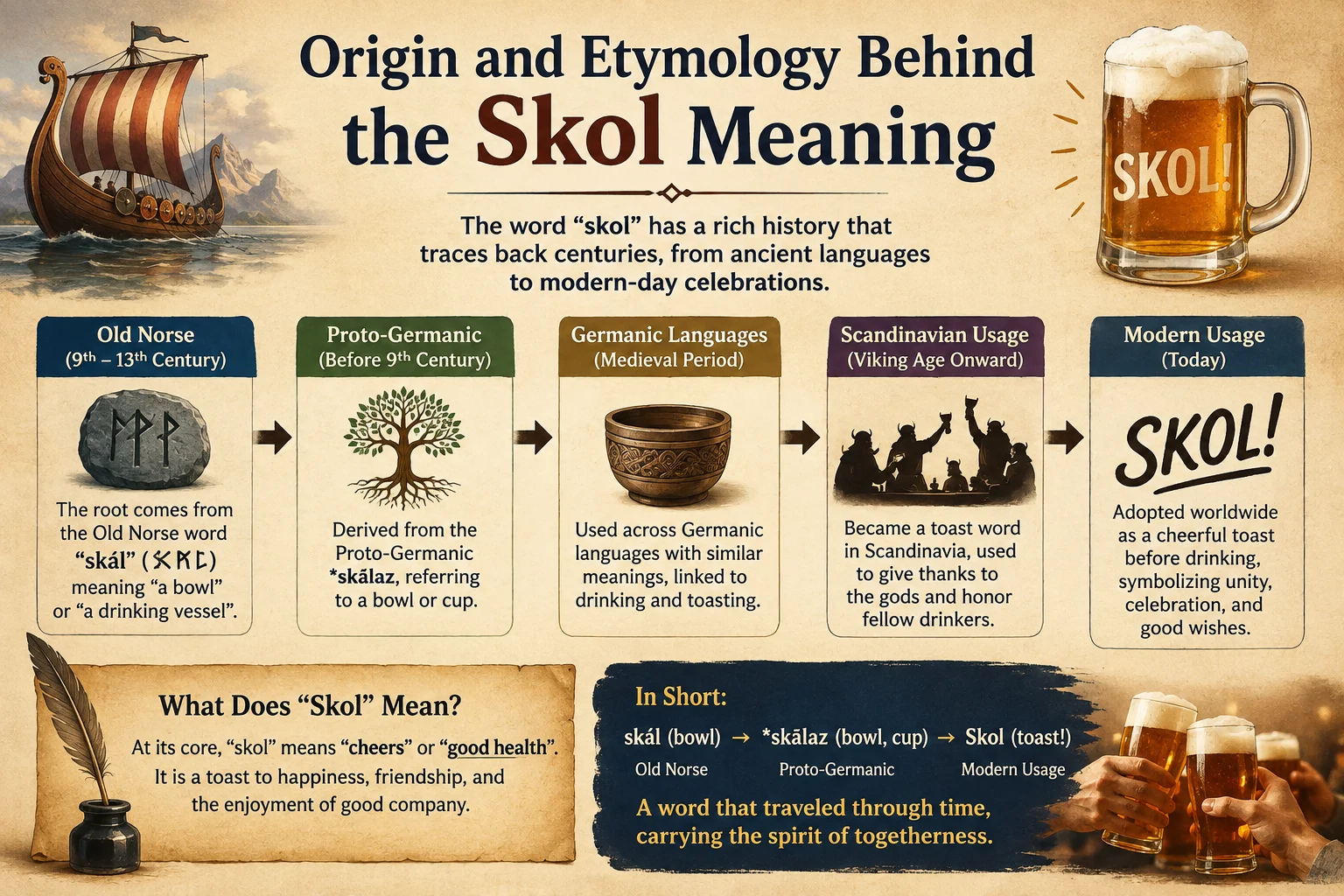
Skol comes from the Old Norse word “skál,” meaning “bowl” or “cup,” referring to the drinking vessel itself rather than the act of drinking. Over centuries, the word shifted from naming the cup to becoming the toast said before drinking from it, eventually spreading across Scandinavian languages as “skål” in Swedish and Norwegian, and “skål” or “skaal” in Danish, with slightly different spellings and pronunciations depending on the country.
Because exact historical timelines for slang and toast traditions are difficult to pin down precisely, the full path the word took from “drinking vessel” to “toast” over the centuries should be treated as a general pattern rather than a precisely documented history.
This kind of shift — where a word for an object becomes a word for the action or ritual surrounding it — is actually fairly common across languages. English speakers do something similar when they say “let’s grab a drink,” using the object to stand in for the broader social activity. Recognizing this pattern helps explain how a word for a simple wooden or metal cup eventually became shorthand for an entire cultural tradition of togetherness.
Skol in Scandinavian Drinking Culture
In Sweden, Norway, and Denmark, “skål” remains a common toast said before drinking, often accompanied by raising a glass and making direct eye contact with everyone at the table. This eye-contact custom is considered an important part of Scandinavian toasting etiquette in many social settings, and skipping it is sometimes seen as a small breach of politeness, though customs vary by family, region, and setting.
The skol meaning in this context isn’t limited to formal occasions — it’s used at everything from casual dinners to holiday celebrations, weddings, and business gatherings. Because it’s such a normal, everyday part of Scandinavian social life, many visitors to the region encounter the word within their first meal or gathering.
Skol Toasting Etiquette: A Few Common Customs
Beyond simply saying the word, Scandinavian toasting traditions often come with a handful of small, informal customs that shape how the skol meaning actually plays out at the table. Raising the glass to roughly eye level, making eye contact with each person before drinking, and waiting for a host or the most senior person present to initiate the first toast are all patterns commonly associated with the tradition, though exact expectations can vary by household, region, and generation.
Visitors unfamiliar with these customs generally aren’t expected to get every detail right, since the underlying spirit of the toast — warmth, connection, and shared celebration — matters far more than strict adherence to etiquette. Still, understanding these small customs adds useful context to the skol meaning beyond the word itself.
Skol in American Football Culture
Outside Scandinavia, many English speakers first encounter the skol meaning through American football, specifically the Minnesota Vikings. Fans of the team use “Skol!” as a rallying chant during games, often accompanied by a synchronized clap that builds in speed and volume, sometimes led by a large ceremonial drum at the stadium.
This use of “Skol” connects to the team’s Norse-inspired branding and mascot, drawing on Scandinavian and Viking cultural references rather than being an entirely new invention. For many fans, the chant carries the same celebratory, unifying energy as the original toast, just redirected from a dinner table to a football stadium. Because specific details about when the chant began and how it’s led during games can vary or change over time, exact historical details about the tradition should be verified against official team sources.
How Skol Became Popular in the United States
For many American sports fans, the skol meaning arrived not through Scandinavian heritage or travel, but simply through watching football. A chant repeated by tens of thousands of fans, broadcast on national television, and reinforced every home game has a way of teaching an entire fan base a new word without anyone needing to look up its dictionary definition.
Over time, the chant has extended beyond the stadium itself, appearing on merchandise, social media posts, and casual conversation among fans discussing the team, even outside of game day. This kind of adoption — a foreign-language word becoming shorthand for a specific fan community — isn’t unique to football, but the skol meaning is a particularly visible example of how quickly a word can spread once it’s tied to a shared, enthusiastic identity.
Skol as a Beer Brand
Adding another layer to the word’s modern usage, “Skol” is also the name of an internationally sold beer brand, available in various countries around the world. This commercial use of the name draws on the celebratory, toast-related feeling of the original word, since beer brands often choose names that evoke a positive drinking or social occasion. Because branding details, availability, and ownership of beer brands can change over time and vary by region, any specific claims about the brand should be verified against current, official sources.
Skol in Texting and Social Media
Outside stadiums and dinner tables, the skol meaning has also found a home in casual texting and social media, particularly among sports fans and people with Scandinavian heritage. It’s typically used as a short, enthusiastic exclamation — sometimes paired with celebratory emojis — to express excitement, support, or a toast-like sentiment, even when no one involved is actually holding a drink.
This casual online use tends to lean on the skol meaning’s energetic, positive tone rather than its formal cultural roots. A fan posting “SKOL!” after a big win, for example, isn’t necessarily thinking about Old Norse etymology — they’re borrowing the word’s built-in enthusiasm to express a similar feeling in a completely different context.
How to Use Skol in a Sentence
Because the skol meaning shows up in a few different contexts, it helps to see it used naturally. In a toast: “Skol! Here’s to another great year together.” At a football game: “The whole stadium shouted ‘Skol!’ as the drum began to beat.” In casual conversation about the word itself: “I always thought skol was just a football chant until I learned its Scandinavian roots.”
Each of these examples relies on the same underlying idea — a shared, celebratory expression — even though the settings range from a quiet dinner table to a roaring stadium crowd.
Is the Skol Meaning Offensive?
No. Unlike many slang terms, the skol meaning carries no offensive or negative connotation in either its traditional Scandinavian toast sense or its modern football chant sense. It’s a positive, celebratory word associated with togetherness, good wishes, and shared enthusiasm, making it one of the more universally welcome words covered on this site.
This doesn’t mean every use of the skol meaning is automatically appropriate in every setting — shouting it during a quiet business meeting would simply feel out of place — but the word itself carries no insulting or harmful meaning to be cautious about.
Because the skol meaning is so consistently positive, it’s one of the few toasting words that translates comfortably across generations, contexts, and even languages without needing a disclaimer about tone or appropriateness. Parents teaching children about toasting customs, coworkers celebrating a milestone, or strangers bonding over a shared football team can all use the word without worrying about it landing the wrong way.
Skol and Viking Symbolism
Because of its Old Norse roots and its adoption by a football team with Viking branding, the skol meaning is sometimes loosely associated with broader Norse and Viking symbolism — themes of strength, unity, and celebration. In some fan communities and marketing contexts, the word can symbolize a kind of shared warrior spirit or team unity, though this connection is cultural and modern rather than an ancient, documented meaning attached to the word itself.
It’s worth being careful here: while Viking imagery is often associated with strength and resilience in popular culture, these associations shouldn’t be treated as historically precise claims about how the word “skål” was originally used in Norse society. The modern symbolic connection is real in the sense that people genuinely feel it, but it reflects present-day branding and fan culture more than documented ancient tradition.
Skol vs. Similar Toasts Around the World
Many cultures have their own version of a toasting word, and comparing them helps highlight what makes the skol meaning distinct. “Cheers” is the most common English equivalent, generally more casual and less tied to a specific ritual. “Prost” is the German equivalent, often used in beer halls and casual gatherings. “Salud” is common across Spanish-speaking countries, sometimes extended into a longer phrase wishing health and happiness. “Kanpai” serves a similar role in Japanese celebrations, frequently accompanied by clinking glasses.
Each of these words reflects its own culture’s relationship with celebration and hospitality, and none of them map perfectly onto one another in tone or ritual, even though they all serve roughly the same social function: marking a moment worth pausing for.
What sets the skol meaning apart is its strong tie to a specific cultural tradition — Scandinavian toasting etiquette — combined with its unusual second life as an American sports chant, giving it a wider, more varied set of contexts than many other toasting words carry.
Why Words Like Skol Cross Cultural Borders So Easily
Toasting words tend to travel well between languages and cultures because they’re short, emotionally positive, and tied to universally understood moments — celebration, gratitude, and togetherness. The skol meaning benefits from all three of these traits, which likely helped it move from a specific regional tradition into a broader, internationally recognized expression.
This pattern isn’t unique to skol. Many short, celebratory words from one language eventually get borrowed into another, especially when there’s a specific cultural bridge — like immigration, sports branding, or media exposure — that introduces the word to a new audience in a memorable way. In skol’s case, that bridge includes both Scandinavian heritage communities in the United States and the highly visible platform of professional football.
Common Misunderstandings About the Skol Meaning
One common mix-up involves spelling and pronunciation. “Skol,” “skål,” and “skaal” all refer to the same underlying word and toast, with spelling differences mostly coming down to which Scandinavian language or English transliteration is being used. None of these spelling variations changes the core skol meaning.
Another common misunderstanding confuses “Skol” with “Skoal,” the name of an American smokeless tobacco brand. Despite the similar spelling and pronunciation, these are unrelated — one is a celebratory toast with Scandinavian roots, and the other is an unrelated product name. Context almost always makes clear which one is being referenced.
A third misunderstanding assumes the football chant and the traditional toast are two completely separate, unrelated words that simply happen to sound alike. In reality, the football chant directly draws on the original Scandinavian toast and its cultural associations, rather than being an unrelated coincidence.
A fourth misunderstanding treats the word as exclusively American or exclusively Scandinavian, when in reality both uses are genuinely active today, simply in different communities. Someone encountering the skol meaning for the first time through football has just as legitimate an entry point into the word as someone who first heard it at a family dinner in Norway or Sweden.
Regional Variations in Spelling and Pronunciation
Spelling and pronunciation shift somewhat across Sweden, Norway, and Denmark, along with how the word is written in English-language contexts. In Swedish and Norwegian, it’s typically written “skål,” with a distinct vowel sound. In Danish, spelling can vary slightly, sometimes appearing as “skål” or “skaal” in older or more informal writing. In English-language use, particularly in the United States, the simplified spelling “skol” (without the special character) is by far the most common, especially in football and pop-culture contexts.
Despite these small differences, the core skol meaning as a toast stays consistent across all of these spellings — the variation is about writing and pronunciation, not about what the skol meaning actually communicates.
Pronunciation also varies slightly by region and speaker. Some pronounce it closer to “skol” rhyming with “coal,” while others use a slightly rounder vowel sound closer to the original Scandinavian pronunciation. Neither pronunciation is considered “more correct” in casual English-language use, and most listeners will understand the intended toast regardless of which version is used.
Why Skol Feels Like Such a Positive Word
Part of what makes the skol meaning stand out compared to other slang or borrowed words is how consistently positive its associations are. It shows up at celebrations, toasts, sporting events, and gatherings meant to bring people together, rarely if ever appearing in a negative or dismissive context. Few words carry such a clean, uplifting reputation across such different settings — from a quiet Scandinavian dinner table to a deafening football stadium.
This positive energy is likely part of why the skol meaning has traveled so easily beyond its original cultural context. A toast built around celebration and togetherness translates naturally into new settings, whether that’s a sports chant, a beer brand, or simply a fun word people enjoy saying out loud.
It’s rare for a single word to carry such a consistently good reputation across such different audiences — Scandinavian families, American football fans, casual social media users, and beer drinkers around the world all associate the skol meaning with roughly the same thing: a reason to celebrate together.
Skol at Weddings, Toasts, and Special Occasions
Beyond football and casual conversation, the skol meaning still shows up in its original form at weddings, anniversaries, retirement parties, and other milestone celebrations, particularly in families with Scandinavian heritage. A best man or maid of honor with Nordic roots might close a wedding toast with “Skol!” instead of “cheers,” giving the moment a small but meaningful nod to family tradition.
Even outside families with a direct cultural connection, some hosts choose the word simply because it feels festive and a little more distinctive than the more common alternatives. Because the skol meaning carries no formal restrictions on who can use it, it works equally well as a nod to heritage or simply as a fun, memorable way to kick off a celebration.
Frequently Asked Questions
These quick answers cover the most common questions people ask about the skol meaning.
What does skol mean in English?
The skol meaning in English is essentially “cheers” — a toast said before drinking to mark a celebration or good wishes.
Why do Minnesota Vikings fans say skol?
Vikings fans use “Skol!” as a rallying chant tied to the team’s Norse-themed branding, drawing on the skol meaning’s Scandinavian toasting roots.
Is skol the same as skål?
Yes. “Skol” and “skål” refer to the same word and toast, with the spelling differing mainly by language and region.
Is skol offensive?
No. The skol meaning is entirely positive, associated with celebration, togetherness, and good wishes rather than any negative or offensive connotation.
Is skol related to the tobacco brand Skoal?
No. Despite the similar spelling and sound, “Skol” the toast and “Skoal” the smokeless tobacco brand are unrelated.
Can skol be used outside of drinking?
Yes, informally. Many people now use it simply as an enthusiastic exclamation of excitement or celebration, even without an actual drink in hand.
Is skol connected to Viking history?
Loosely. The word traces back to Old Norse, and modern branding sometimes links it to Viking symbolism, though these associations reflect present-day culture more than a precisely documented ancient tradition.
Do other Scandinavian countries use the word the same way?
Mostly, yes, though spelling and small toasting customs can differ slightly between Sweden, Norway, and Denmark, even as the core meaning stays the same.
Conclusion
The skol meaning ultimately centers on one simple idea: a shared toast meant to bring people together, whether that’s around a Scandinavian dinner table, at a football stadium roaring with fans, or anywhere else people want to mark a moment worth celebrating. Few words travel this far, this cheerfully, while keeping their original spirit so intact. Whether it’s shouted, toasted, or simply typed into a celebratory text message, the word still does exactly what it’s always done: bring people together for a shared moment of joy, one raised glass or one enthusiastic chant at a time.