Obliterated means completely destroyed or wiped out, leaving no trace behind whatsoever. In casual slang, it also means extremely drunk or intoxicated, well past the point of being just tipsy. For more insights, read here:- molested meaning and nimrod meaning.
- Quick Definition
- The Obliterated Meaning in Everyday Use
- The Slang Meaning: Extremely Drunk
- Where the Word Comes From
- Formal vs. Informal Use
- Texting and Social Media Use
- Is It Rude or Offensive?
- Common Misunderstanding
- Similar Expressions
- Gaming Context
- Workplace Context
- Dating Context
- Sports and Competition Context
- Frequently Asked Questions
- What is the simplest way to explain the obliterated meaning?
- Is obliterated the same as destroyed?
- Is calling someone obliterated rude?
- Can obliterated describe something other than physical destruction?
- Where does the word obliterated come from?
- Does obliterated always mean something bad happened?
- Wrapping Up
Quick Definition
- Obliterated (adjective/verb form): completely destroyed, erased, or wiped out entirely; slang: extremely drunk or high.
- Example: “The old building was obliterated by the storm.” / “He got completely obliterated at the party last night.”
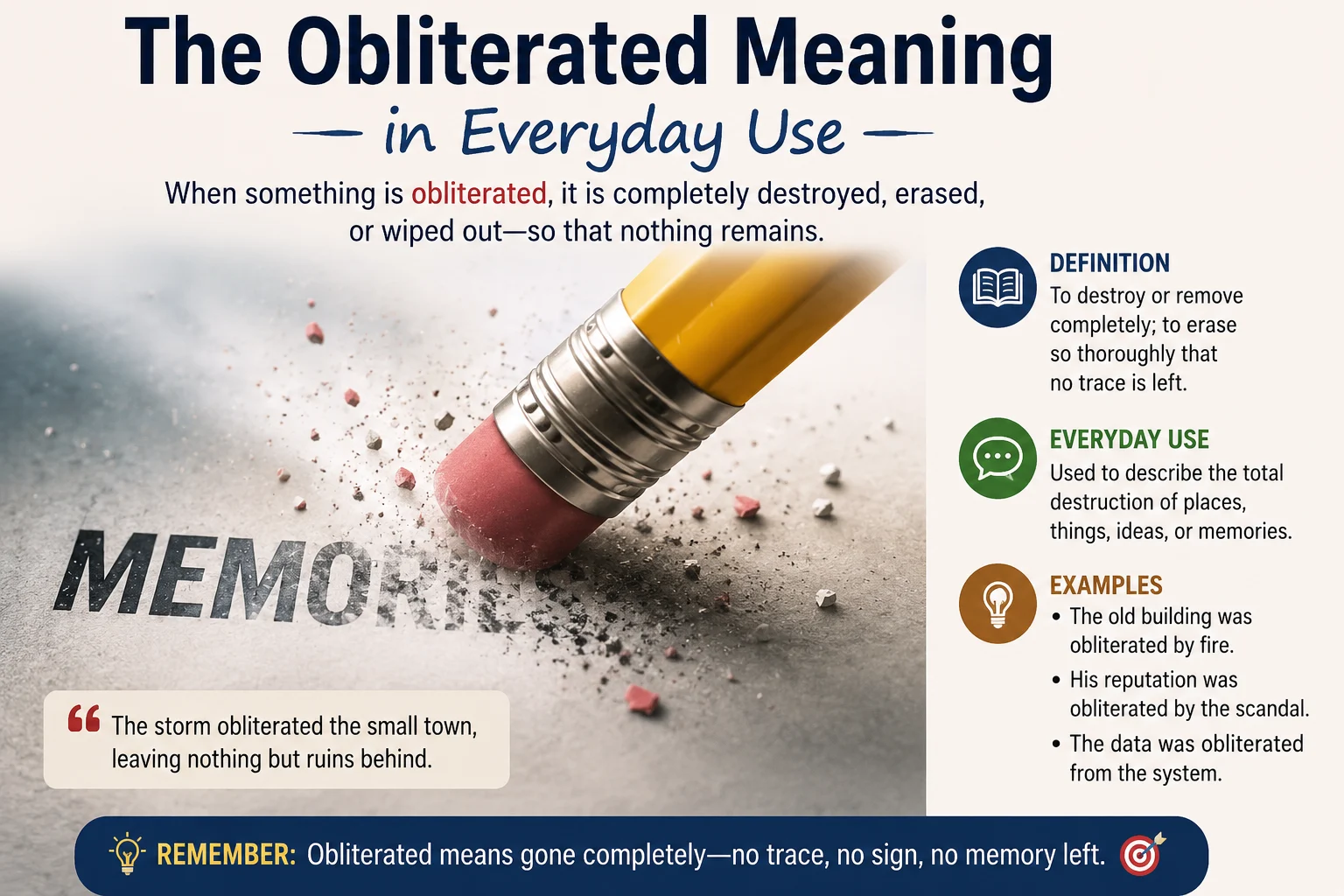
The Obliterated Meaning in Everyday Use
In its literal sense, the obliterated meaning centers on total destruction, something so thoroughly wrecked or erased that little or nothing remains. This sense applies to physical objects, records, evidence, or even abstract things like plans or reputations.
People often reach for this word specifically because “destroyed” can sound too mild for what they’re describing. The obliterated meaning carries an extra layer of finality, implying not just damage but complete erasure.
Example sentences:
- “The hurricane obliterated the entire coastline.”
- “Her old notes were completely obliterated when the file got corrupted beyond recovery.”
- “The champion completely obliterated the competition in the final round of the tournament.”
- “The old warehouse was completely and totally obliterated in the scheduled demolition.”
The Slang Meaning: Extremely Drunk
In casual, informal speech, “obliterated” is commonly used as slang for being extremely intoxicated, well beyond tipsy or buzzed. It’s a stronger, more dramatic word than “drunk,” implying someone is barely functional.
- “He got obliterated after three drinks.”
- “We were all obliterated by midnight.”
- “Don’t let him drive, he’s completely obliterated right now.”
- “She was so obliterated she couldn’t even remember getting home safely that night.”
This slang application of the obliterated meaning borrows the same sense of totality as the literal one, just applied to someone’s state of mind rather than a physical object.
Where the Word Comes From
“Obliterated” comes from the Latin word “obliterare,” meaning “to erase” or “to blot out,” originally related to smearing out writing on a surface. Its use in English for destruction has a long, well-documented history in formal and literary writing. The slang sense referring to extreme drunkenness developed more recently as an informal, exaggerated extension of the literal meaning, though the exact point this slang usage became common is uncertain.
This shared root is really what ties both senses of the obliterated meaning together. Whether describing a demolished building or someone who’s had far too much to drink, the underlying idea of complete erasure stays consistent.
Formal vs. Informal Use
The literal, destructive sense of “obliterated” works comfortably in formal writing, news reporting, and academic contexts. The slang sense meaning extremely drunk is strictly informal and wouldn’t fit professional or formal writing at all.
- Formal: “The village was obliterated by the earthquake.”
- Informal/slang: “She got absolutely obliterated at her cousin’s wedding.”
Recognizing which register applies matters a lot here, since the obliterated meaning can shift entirely based on the setting. A news article and a group chat can use the exact same word to describe two completely different situations.
Texting and Social Media Use
In texts and captions, “obliterated” usually leans on the slang meaning, describing a wild night out or extreme intoxication in an exaggerated, often humorous way.
- “Ngl I was obliterated last night, don’t remember half the party.”
- “Obliterated doesn’t even begin to cover how gone I was.”
- “We went out to celebrate and ended up completely obliterated by roughly 10pm.”
Used this way, the obliterated meaning is almost always exaggerated for comic effect rather than meant as a precise, literal description of someone’s blood alcohol level.
Is It Rude or Offensive?
Neither sense of “obliterated” is inherently rude or offensive. The literal meaning is neutral and descriptive. The slang meaning, describing extreme drunkenness, is casual and sometimes used humorously, though it can come across as concerning depending on context, especially if it’s describing a genuinely risky situation.
Because the slang sense of the obliterated meaning implies losing control, it’s worth being mindful of context. Said lightly among friends recapping a fun night, it’s harmless; said about someone in a dangerous or vulnerable situation, it can read very differently.
Common Misunderstanding
Some people assume “obliterated” always implies violence or disaster, but the word can describe any kind of complete erasure, including something neutral, like data, or even something intangible, like an argument or a losing streak.
This broader flexibility is part of why the obliterated meaning shows up in so many different contexts, from weather disasters to sports commentary to casual conversation about a night out.
Similar Expressions
- Destroyed — a more general word for the literal sense, without the same intensity.
- Annihilated — very close in meaning, often used interchangeably in the literal, destructive sense.
- Wasted — a common slang alternative to the drunk meaning of obliterated.
- Smashed — another slang term for being very drunk, similar in tone and intensity.
- Demolished — close to the literal obliterated meaning, especially for physical structures, though slightly less absolute in tone.
None of these words are exact substitutes in every context. Each carries a slightly different intensity or register, so choosing between them depends heavily on whether the setting calls for something formal, casual, or somewhere in between.
Gaming Context
“Obliterated” shows up frequently in gaming, usually describing a total defeat, a one-sided match, or a character being completely wiped out in a single move.
- “He got obliterated in the final round, no chance to recover.”
- “Our team obliterated the opposing base before they even had a strategy.”
In this context, the obliterated meaning leans heavily on totality and dominance, describing a defeat so complete there’s no meaningful comeback.
Workplace Context
Occasionally, “obliterated” shows up in workplace conversation, usually describing a competitor being decisively outperformed, a proposal being thoroughly rejected, or a deadline being completely blown past.
- “Our proposal got obliterated in the review, we’re starting from scratch.”
- “The new product completely obliterated its competition in sales within the first month.”
Dating Context
Occasionally, “obliterated” shows up in a dating or social context, usually describing someone who got extremely drunk during a date, a party, or a night out with a romantic interest.
- “First date and he showed up already halfway obliterated, definitely not a great sign.”
- “She joked about being obliterated at the wedding where they first met.”
In this setting, the word still centers on the same slang sense of extreme intoxication, though the context adds a layer of social judgment about timing and appropriateness on a first date specifically.
Sports and Competition Context
“Obliterated” is extremely common in sports commentary, describing a lopsided win, a dominant performance, or a record broken by a wide margin.
- “The home team obliterated their rivals, winning by nearly forty points.”
- “She obliterated the previous world record by almost two full seconds.”
Frequently Asked Questions
What is the simplest way to explain the obliterated meaning?
It means completely destroyed or erased in its literal sense, and extremely drunk in its casual, slang sense. If you remember nothing else about the obliterated meaning, remember that both senses point to total, complete erasure of some kind.
Is obliterated the same as destroyed?
They’re close, but “obliterated” implies a more total, thorough kind of destruction, often suggesting nothing recognizable remains. That extra intensity is really what separates the obliterated meaning from the more neutral word “destroyed.”
Is calling someone obliterated rude?
Not typically. It’s usually used casually or humorously to describe extreme drunkenness, though tone and context can shift how it lands, so the obliterated meaning here depends a lot on who’s saying it and why.
Can obliterated describe something other than physical destruction?
Yes. It can describe erased data, a crushed argument, a dominated opponent, or anything else completely wiped out or overwhelmed. This flexible use of the obliterated meaning is part of why it shows up so often in sports commentary and casual conversation alike.
Where does the word obliterated come from?
It comes from the Latin “obliterare,” meaning “to erase” or “blot out.” The slang meaning for drunkenness developed later as an informal extension of that idea, and the obliterated meaning has carried that same sense of total erasure ever since.
Does obliterated always mean something bad happened?
Not necessarily. While it often describes destruction or a heavy loss, “obliterated” can also apply to positive outcomes, like a business exceeding its sales targets or a runner setting a personal record by a wide margin.
Wrapping Up
The obliterated meaning ultimately comes down to totality: whether it’s a destroyed building, an erased file, or someone far too drunk to function, the word always signals that nothing recognizable is left standing. Understanding both the literal and slang senses makes it easier to read the tone correctly wherever the word shows up. For a broader look at how English words evolve between literal and slang meanings, the Wikipedia entry on slang is a useful starting reference.